
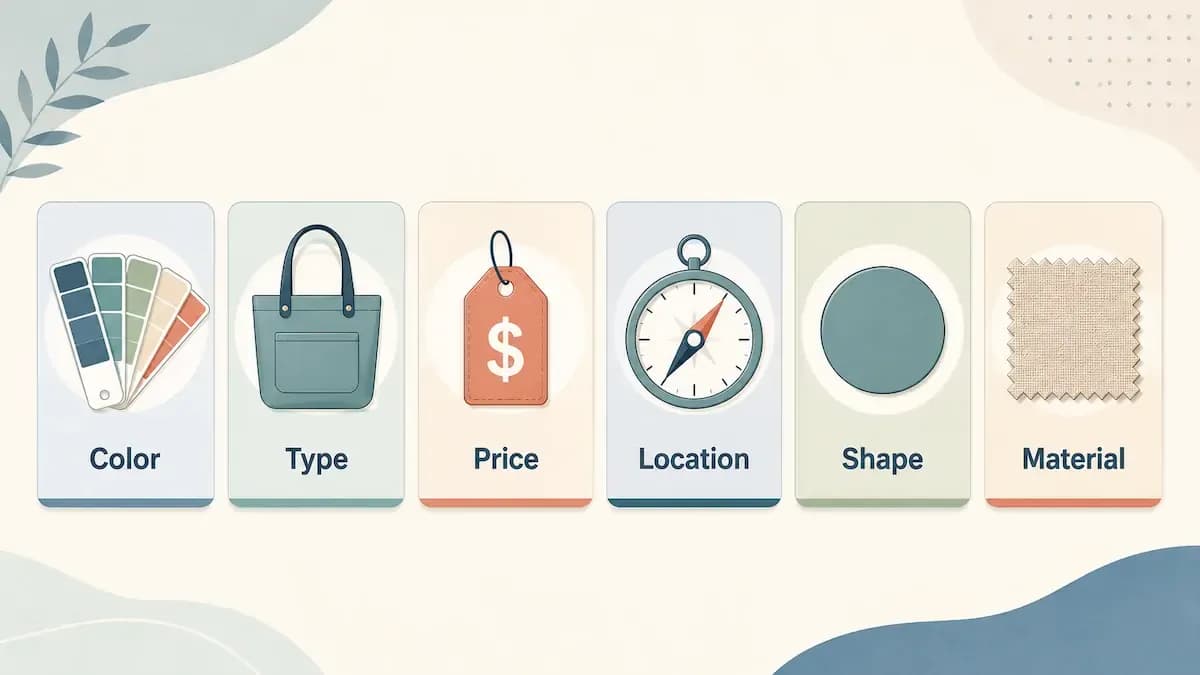
Profile Perfect levels keep reusing traits like Color, Type, Price, and Location because they are visual, sortable, and easy to compare. This breakdown treats them as a puzzle toolbox, showing what job each trait does and how they play out in levels 6, 20, 68, and 119.

Guide By Liam Stone
Published on July 7, 2026
Liam Stone has played Profile Perfect since the app first launched on the Apple App Store. He spotted its potential early, and that early bet turned into hundreds of hours spent solving levels, testing clue logic, and documenting answers for other players. Liam runs the YouTube channel Puzzle Game Answer where his puzzle walkthroughs have earned over 935,000 views and a growing community of more than 800 subscribers. He covers a wide range of mobile puzzle games beyond Profile Perfect, giving him firsthand experience with how these games design clues, structure levels, and trip up even experienced players. Every guide on this site reflects that hands on experience. Liam plays each level himself, verifies every answer against the in game grid, and rewrites confusing clues into plain language so you don't need to guess. If you want more of his walkthroughs, subscribe to his channel.
Loading calendar...
I have solved enough Profile Perfect levels now to notice a pattern before I even read the clues. Open a new grid, and there is a good chance you will see Color in the traits row. Or Type. Or Price. Or Location. These traits keep showing up, level after level, no matter what the subjects are: bags, buses, buildings, plants, criminals, dogs.
At first I thought this was laziness on the design side. Same traits, different skins. Then I started paying attention to what these traits actually do inside a clue, and I changed my mind. These traits are not filler. They are tools. Each one does a specific job in the logic, and the best puzzles reuse them the way a mechanic reuses a wrench, because it fits the job over and over.
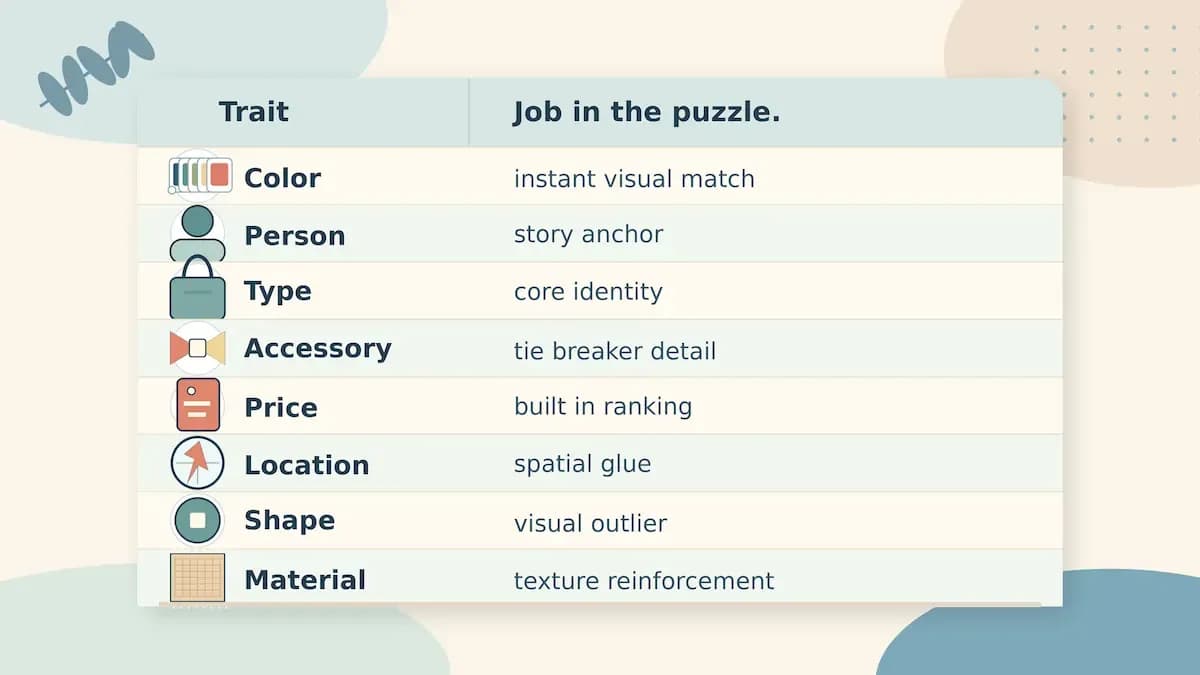
Across my games, eight traits keep reappearing more than any others: Color, Person, Type, Accessory, Price, Location, Shape, and Material. You will meet these in dog levels, dress levels, bus levels, building levels, and dozens of others that have nothing in common except the traits attached to them. Here is why that happens. Every one of these traits is either visual, sortable, or easy to compare at a glance. A trait that you can see, rank, or measure gives the puzzle designer something to build clues around. A trait that is vague or hard to picture just sits there being confusing.
Take Color. You do not need to think hard about what "red" or "green" means. Your eyes catch it in half a second. That is why clues like "the cheapest bag is colored Green" work so well. You are not decoding a riddle. You are matching a picture in your head to a picture on the grid. Price works the same way but through ranking instead of sight. "Bag C is cheaper than the German bag" only works because price has an order: low, medium, high, or a row of dollar signs. You cannot write a useful clue for a trait that has no order and no visual signature. Try writing a clue around "mood" or "vibe" and see how fast it falls apart. Profile Perfect avoids traits like that almost entirely.
This article is my breakdown of what job each of these traits performs, and how they show up in real levels I have played. Think of it as a toolbox tour rather than a stats report.
These two traits tend to resolve first in a puzzle. Color gives you something to look at, and Person gives you something to attach every other fact to.
Color gives you an instant answer. Clues either state a color directly or link it through elimination, such as "not red" or "the cheapest one is green." It rarely needs elaborate reasoning on its own, but it pairs well with almost every other trait because color is the fastest thing to check on a grid.
Person shows up constantly because puzzles need someone to attach the rest of the story to. Once you know "Sean has the Scar," you can hang three or four more clues off Sean without rereading his description. Names and people act like pins that hold the whole board together.
Once you know what a subject is and who owns it, the puzzle needs a way to tell similar subjects apart. That is where these two traits step in.
Type usually answers "what is this thing, specifically." A bag's Type might be Backpack or Handbag. A room's Type might be Bedroom or Kitchen. This trait often gets locked in early because everything else in the puzzle depends on knowing what you are dealing with before you can compare it to anything else.
When subjects look similar, Accessory breaks the tie. A dress level might have three dresses in different patterns, and the belt, bracelet, or handbag becomes the detail a clue can point to without repeating the pattern trait. It is a second identifier riding along with the first.
These traits carry the weight once a puzzle moves past simple identification. Both give you a scale to measure against, just in different directions.
Price is one of the easiest traits to write comparison clues for, because dollar signs or High, Medium, Low labels create an obvious order. "More expensive than," "the cheapest," and "twice the price of" all work instantly. You do not need extra explanation. The symbol does the work.
Location clues lean on direction and position, things like North, South, opposite, and next to. This trait often works together with row position on the grid itself, which means Location clues frequently double as positioning clues. It is one of the few traits that gives you two kinds of information in a single line.
These two show up less often than the traits above, but when they appear, they add a second layer of visual confirmation on top of whatever else the puzzle is already tracking.
Shape works like Color's cousin. It is instantly recognizable, whether it is a Pyramid, a Dome, or a Hexagon, and it plays well with negative clues like "buildings built in 2007 do not have a round shape." Because shapes are so distinct from each other, elimination clues built around Shape rarely feel ambiguous.
Material shows up less often than the others, but when it does, it usually reinforces another trait rather than carrying a puzzle on its own. A wooden weapon, a tiled floor, a striped pattern all give you something concrete to picture, which keeps the clue grounded instead of abstract.
Numbers only go so far. Here is what these traits actually look like once you drop them into real levels I have played.
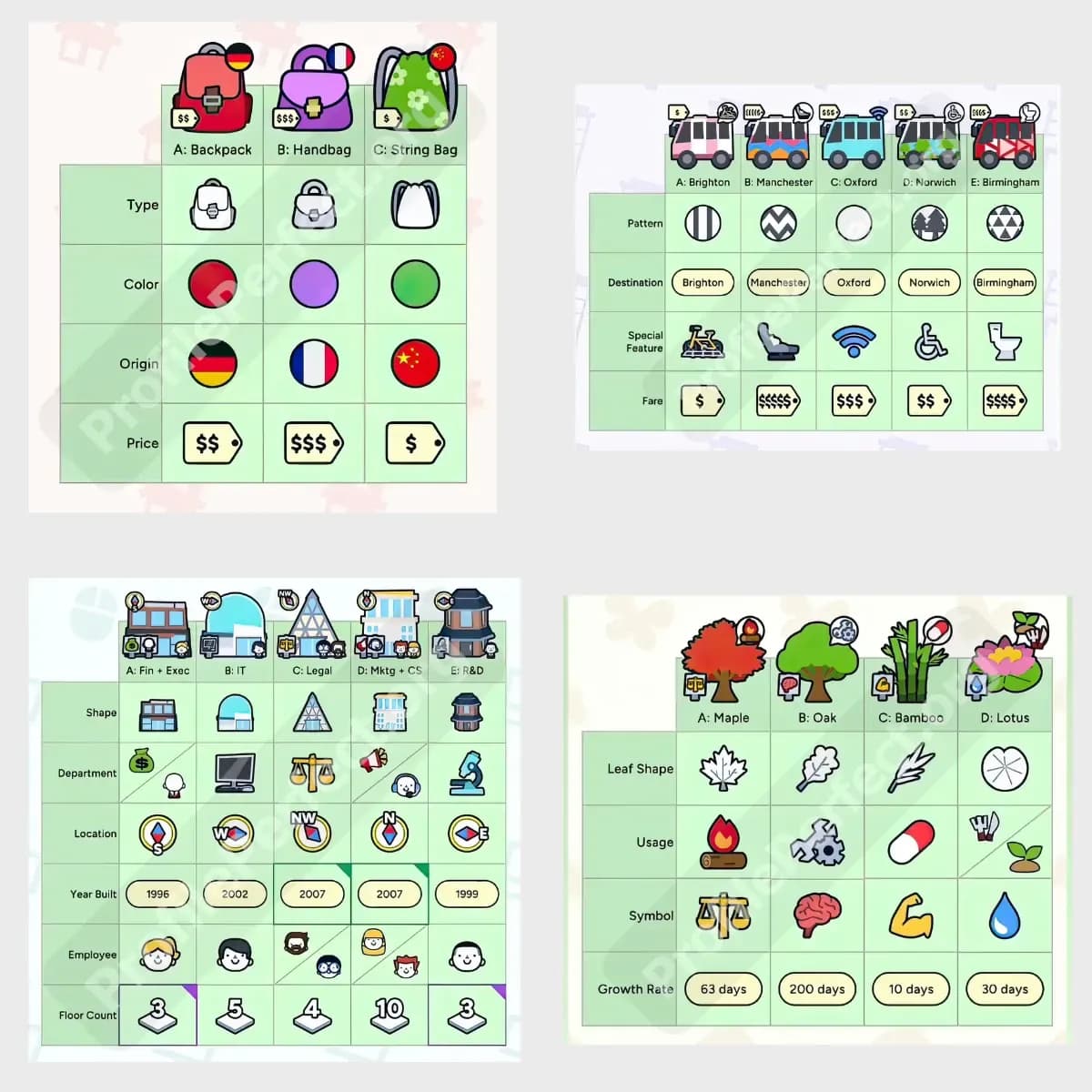
This bag level has four traits, Type, Color, Origin, and Price, spread across three bags. Watch how the clues never rely on just one of them. One clue says the String Bag is cheaper than the German bag, tying Type, Origin, and Price together in a single sentence. Another says the cheapest bag is colored Green, linking Price straight to Color. By the end you land on Bag A as a Red German Backpack at medium price, Bag B as a Purple French Handbag at high price, and Bag C as a Green Chinese String Bag at low price. Three traits, one small grid, and every clue earns its place.
This level bumps up to five buses and layers in Fare, which is a Price trait dressed in dollar signs, alongside Destination and Special Feature. One clue says the ticket to Manchester is the most expensive. Another says the Striped bus to Brighton is the cheapest. These are pure Price comparisons, and they only work because Price already carries a built in scale from $ to $$$$$. Destination pulls its weight too, placing the Sleeper Seat bus to the left of the bus heading to Oxford and mixing Location with Special Feature.
This level jumps to five buildings and six traits, including Shape, Location, and Employee, which functions as a Person trait here. One clue describes the "white Tall building" in the North, linking Shape directly to Location in a single sentence. Another places two buildings opposite each other by Location alone, and a third says the Legal team sits in the Northwest building, tying Location to Department. Location does double duty across this level. It tells you where a building sits geographically, and it tells you where the building sits on the grid relative to its neighbors.
This level swaps in Leaf Shape for visual identification and Growth Rate for ranking, which behaves exactly like Price even though it is measured in days instead of dollars. One clue says the plant with Needle leaves grows fastest, at ten days. Another pairs the fastest grower with the slowest grower as neighbors. A third says the farming plant grows three times slower than the plant with Needle leaves. Growth Rate is not on the official list of top eight traits, but it proves the larger point. Any trait that carries a number or an order can slot into the same clue patterns that Price uses. The label changes. The job stays the same.
Once you notice the toolbox, you can predict what a clue is likely to do before you finish reading it. If a clue mentions a color, expect an instant match with no math involved. If it mentions price, dollar signs, or a number, expect a ranking or comparison. If it mentions a direction or "next to," expect it to lean on Location and grid position at the same time.
You can also use this to guess which traits will resolve first. Type and Person tend to lock in early because everything else depends on them. Price and Location tend to resolve through comparison, so they often need two or three clues chained together before you can commit to an answer. Save those for when you have already filled in a few anchor points.
Profile Perfect keeps reaching for the same eight or so traits because they are the ones that actually work as puzzle material. Not every property of a subject can hold a clue's weight. Color, Type, Price, Location, Person, Accessory, Shape, and Material can, over and over, in bags, buses, buildings, and everything else the game throws at you.