
A look at how Profile Perfect scales difficulty from Level 1 to Level 234 by adding subjects, traits, hidden values, multivalue cells, and longer clue chains, without ever asking players to guess.

Guide By Liam Stone
Published on July 7, 2026
Liam Stone has played Profile Perfect since the app first launched on the Apple App Store. He spotted its potential early, and that early bet turned into hundreds of hours spent solving levels, testing clue logic, and documenting answers for other players. Liam runs the YouTube channel Puzzle Game Answer where his puzzle walkthroughs have earned over 935,000 views and a growing community of more than 800 subscribers. He covers a wide range of mobile puzzle games beyond Profile Perfect, giving him firsthand experience with how these games design clues, structure levels, and trip up even experienced players. Every guide on this site reflects that hands on experience. Liam plays each level himself, verifies every answer against the in game grid, and rewrites confusing clues into plain language so you don't need to guess. If you want more of his walkthroughs, subscribe to his channel.
Loading calendar...
Every logic puzzle designer runs into the same wall eventually. Level 1 has to be gentle enough that a brand new player trusts the game. Level 234 has to be tough enough that a player who has solved two hundred grids still feels a pull. Getting from one end of that range to the other without losing the player anywhere in between is the real job.
I went back through my own playthrough of Profile Perfect, level by level, to see how the game actually pulls this off. The early levels are tiny. The later ones are dense. But the jump never happens all at once, and it never happens through a single trick. It happens through five specific additions, layered in slowly, and each one carries its own risk of tipping a level from harder into unfair.
Here is what that ladder looks like when you line up real levels side by side.
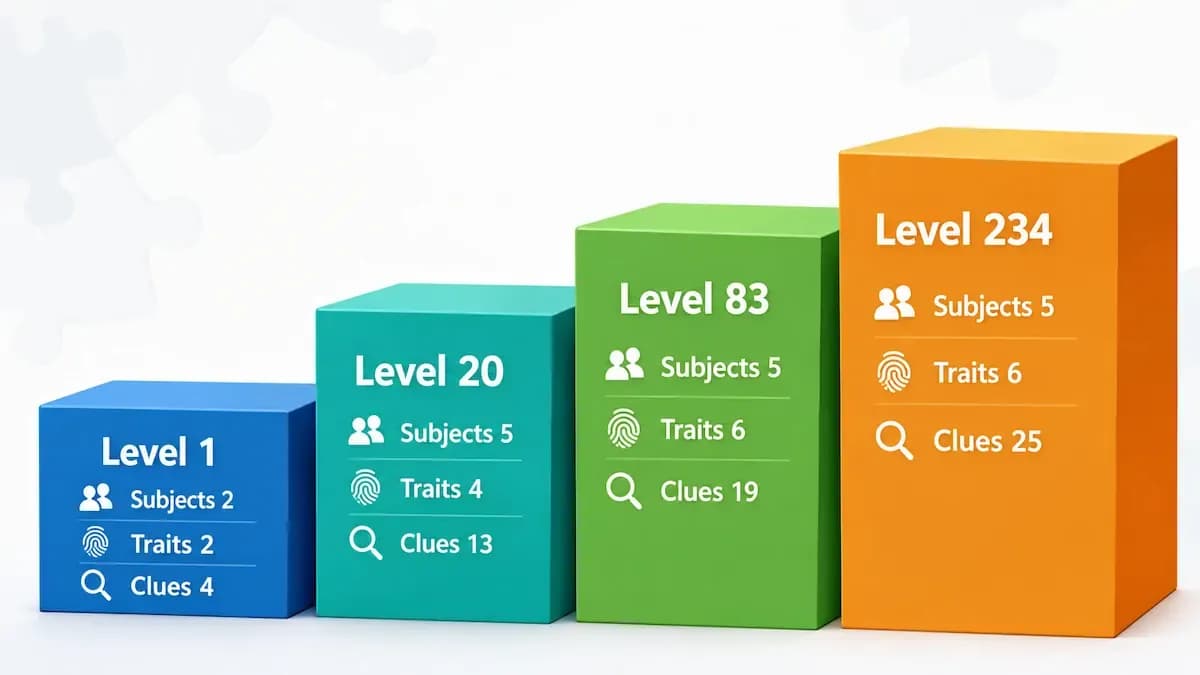
| Level | Subjects | Traits | Clues | Hidden values | Multivalue cells |
|---|---|---|---|---|---|
| 1 | 2 | 2 | 4 | 0 | 0 |
| 20 | 5 | 4 | 13 | 0 | 0 |
| 83 | 5 | 6 | 19 | 3 | 2 |
| 234 | 5 | 6 | 25 | 0 | 6 |
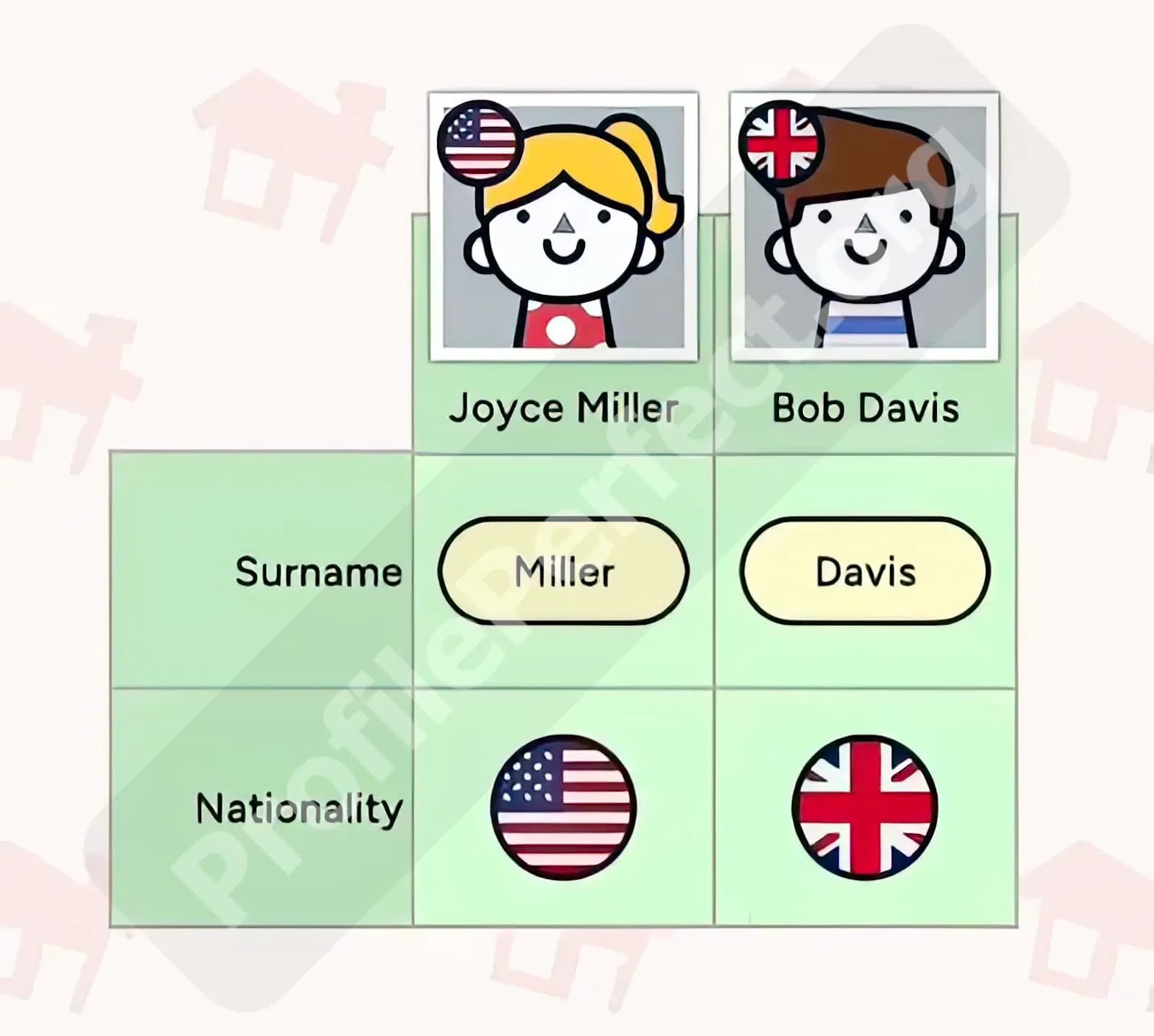
Level 1 matches two people, Joyce and Bob, to a surname and a nationality. Four clues, no hidden values, nothing split across two possible answers. It takes less than a minute to solve, and it should, because it is teaching you the shape of the game.
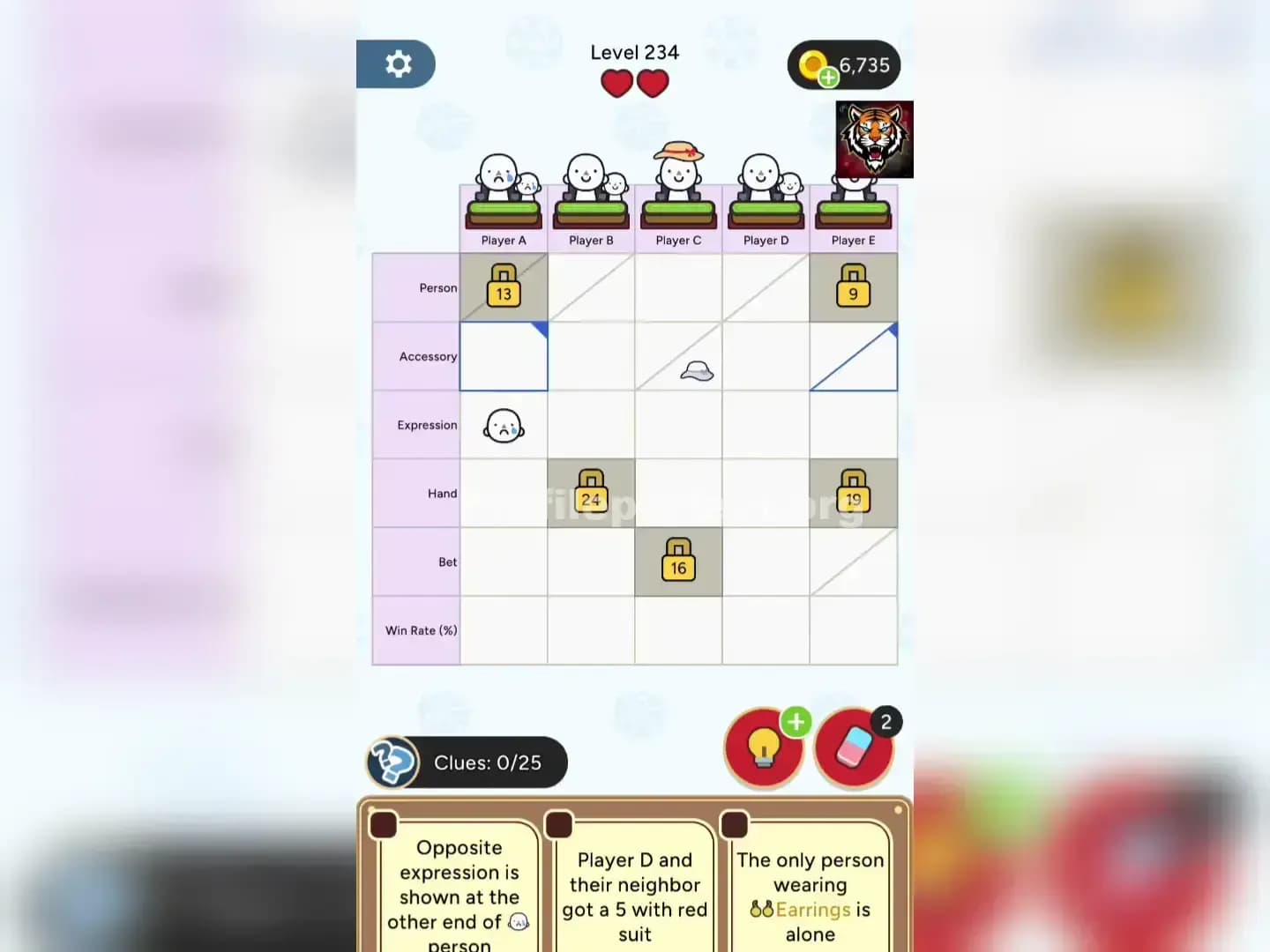
Level 234 matches five poker players to a person, an accessory, an expression, a hand, a bet, and a win rate, using twenty five clues where six of the ten cells for player identity and accessory hold two valid names or two valid items at once. That is not a small step up from Level 1. It is five separate steps stacked on top of each other. Below is what each step actually does to the puzzle, and where it can go wrong.
The simplest way to make a grid harder is to add more things to match. Two subjects only give you one relationship to sort out. Five subjects give you ten possible pairings and a full row of neighbors, which means clues about position finally mean something.
Level 20 shows this clearly. The level lines up five buses, each with a pattern, a destination, a special feature, and a fare. Once you have five buses in a row, a clue like "the bus in the middle has built in Wifi" becomes possible, because there finally is a middle. That same clue could not exist in a two subject puzzle. Adding subjects does not just add rows to fill in. It unlocks an entire category of relative clues that a small grid cannot support.

With two subjects, you hold the whole puzzle in your head without trying. With five, you have to actually use the grid as a memory aid, checking off what you know and what you still need. That shift alone raises the difficulty, even before a single trait or clue changes. It is also why five subjects shows up as the ceiling across nearly every harder level in the game, from the bus terminal to the poker table. Past five, a phone screen stops being able to display the grid clearly, so the difficulty has to come from somewhere else.
Traits work differently from subjects. Adding a subject adds a row. Adding a trait adds a column, and every existing subject now needs a new answer in it, which means every clue writer now has a new category to write clues about and connect back to the ones that already exist.
Level 1 has two traits, surname and nationality, and four clues cover it completely. Level 83 has six traits: student, expression, liquid color, flask, reaction type, and temperature, for the same five subject count as Level 20, and needs nineteen clues to resolve. That is not a coincidence. Six traits create far more possible pairings between categories than four traits do, and the puzzle has to spend a clue on each pairing that matters. When I solved Level 83, one clue told me the hottest and coldest chemicals sit next to each other, tying temperature to position. Another told me the coldest chemical sits next to the glowing one, tying temperature to reaction type. Neither clue would exist without both traits already on the board.
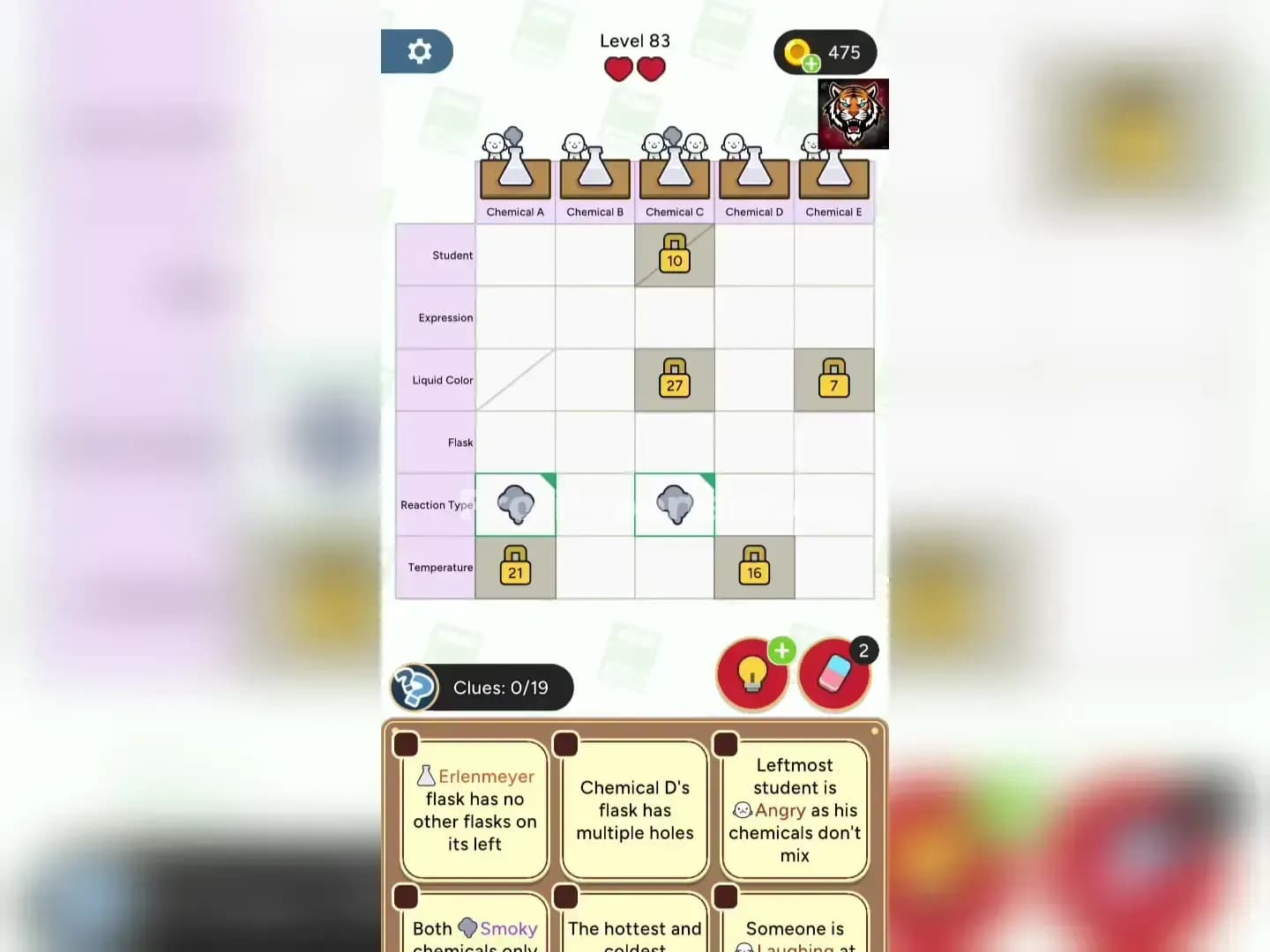
The risk here is obvious once you see it. If a puzzle adds a sixth trait but never writes a clue connecting it back to the other five, that trait becomes a dead weight the player has to solve almost by accident. Level 83 avoids that by making sure every trait touches at least one other trait directly in a clue. Reaction type connects to temperature, temperature connects to position, position connects to student name. Nothing sits alone in its own column waiting to be guessed.
Some trait values in Profile Perfect never appear as an icon you can read off the grid. They exist in the solved answer, but the game never shows them to you directly, so you can only reach them through the clues themselves.
Level 83 has three of these. The reaction type and flask for the chemical in the middle of the row are both hidden, along with the temperature of one other chemical. What is interesting is that one of these hidden values gets locked in immediately, through the very first clue in the level, which states plainly that the middle flask has multiple holes. That single line resolves a hidden value before you have touched anything else. Hidden values are not always saved for the end of a chain. Sometimes they anchor the whole chain from the start.
Level 199, the bandit level, uses the same trick with a mask type and a hideout that never appear as icons on the grid. Level 394, the explorer level, pushes it to three hidden values at once. In every case, the puzzle still gives you at least one direct clue that pins the hidden value down without requiring you to guess. That is the difference between a hidden value and a trap. A hidden value asks you to prove something the grid will not show you. A trap asks you to guess it anyway.
A multivalue cell holds two correct answers in a single spot. Chemical A in Level 83 shows both blue and orange as its liquid color at once. The same chemical's student is named both Billy and John, depending on which clue you happen to be reading. These are not two separate facts the puzzle wants you to pick between. They are one fact, described two ways.
This only stays fair if the puzzle eventually tells you the two labels point at the same subject. In Level 83, one clue places Billy between the cold and very hot chemicals, and a later clue says John is happy about his successful reaction. Read alone, those sound like two different people. Read together with the rest of the chain, they land on the same chemical, and the puzzle never leaves you stuck wondering if Billy and John are neighbors or the same person.
Level 234 leans on this harder than any other level I have looked at. Six different cells across the grid hold two valid names or two valid items, including three separate players whose identity itself splits into two names, such as one player who answers to both Jacob and Sonia. That is a heavier cognitive load than Level 83's two multivalue cells, and it explains part of why this level needed twenty five clues instead of the nineteen that got the job done in Level 83. More split cells mean more clues are required just to confirm which labels belong together, before the puzzle can even start using them to eliminate other answers.
Clue count is the number everyone notices first, and it is the easiest one to get wrong. A level with twenty five clues is not automatically harder in a good way. It depends on whether those clues let you work outward from something solid, or whether they ask you to hold a dozen loose threads in your head at once, hoping they connect later.
Level 234 sits at the top of the range with twenty five clues, but a cluster of levels, including 96, 191, 199, 360, 379, and 394, all land at twenty two clues using the same five subject, six trait structure. That plateau tells you something. Once a puzzle reaches five subjects and six traits, twenty two clues seems to be roughly what it takes to resolve that structure cleanly, whether the theme is lipsticks, credit cards, bandits, vampires, barbershop customers, or explorers. Level 234 needed three more clues specifically because it carries six multivalue cells instead of the two or three that the twenty two clue levels typically use.
Look at how the later clues in Level 234 behave. One clue states that the player with the highest hand wins less than the player with the lowest hand, which only makes sense once you already know who holds the highest and lowest hands from earlier clues. A few clues later, another one confirms that the two players furthest from the straight hand carry a zero percent and a fifty percent win rate, which restates a relationship you already built rather than introducing a brand new unknown. That is what a long chain should do. It keeps circling back to confirm what you have already earned, instead of piling on new unresolved variables that just sit there until the very last clue.
None of these five additions is dangerous on its own. Subjects, traits, hidden values, multivalue cells, and longer chains all raise difficulty the honest way, by giving you more to reason through. What tips a level into unfair territory is skipping the anchor. A new subject needs a clue that fixes its position before other clues start describing it in relative terms. A new trait needs at least one direct clue connecting it to a trait you already know. A hidden value needs a clue that proves it through elimination, not one that expects you to guess. A multivalue cell needs a clue that ties both labels to the same subject before the rest of the puzzle treats them as one. And a long chain needs to spend its later clues confirming earlier work, not scattering new loose ends right up to the final line.
Every level I looked at, from the four clue simplicity of Level 1 to the twenty five clue density of Level 234, follows that same rule. The puzzles get harder because they ask more of you, never because they ask you to guess. That is the whole difference between a level that earns its difficulty and one that just makes you feel cheated at the end.