
A step by step guide to solving five subject grids in Profile Perfect, using the Bus level and the Player level to show how shrinking the board, finding anchors, and solving edges first keep you from guessing.

Guide By Liam Stone
Published on July 7, 2026
Liam Stone has played Profile Perfect since the app first launched on the Apple App Store. He spotted its potential early, and that early bet turned into hundreds of hours spent solving levels, testing clue logic, and documenting answers for other players. Liam runs the YouTube channel Puzzle Game Answer where his puzzle walkthroughs have earned over 935,000 views and a growing community of more than 800 subscribers. He covers a wide range of mobile puzzle games beyond Profile Perfect, giving him firsthand experience with how these games design clues, structure levels, and trip up even experienced players. Every guide on this site reflects that hands on experience. Liam plays each level himself, verifies every answer against the in game grid, and rewrites confusing clues into plain language so you don't need to guess. If you want more of his walkthroughs, subscribe to his channel.
Loading calendar...
Five subjects is the point where Profile Perfect stops feeling like a warm up. You get a full row of subjects, a full row of neighbors, and clues that suddenly talk about position instead of just facts. Out of the levels I have gone through, 141 of them sit at exactly five subjects. That is not a rare shape. It is closer to the standard size once the game trusts you to handle a real grid.
The good news is that five subjects does not mean five times the panic. It means five steps you can run in the same order every time. Shrink the board. Find your anchors. Solve the edges. Use position clues. Finish the rows. I will walk through all five using Level 20, the Bus level, because it is a calm and friendly example of this size. Then I will contrast it with Level 234, the Player level, which uses the same five step process but stacks extra weight on almost every step.
A five subject grid looks bigger than it is. Before tapping anything, read through the subjects and traits once and picture the row as a short street with five addresses. Address one sits on the far left. Address five sits on the far right. Everyone in between has exactly two neighbors.
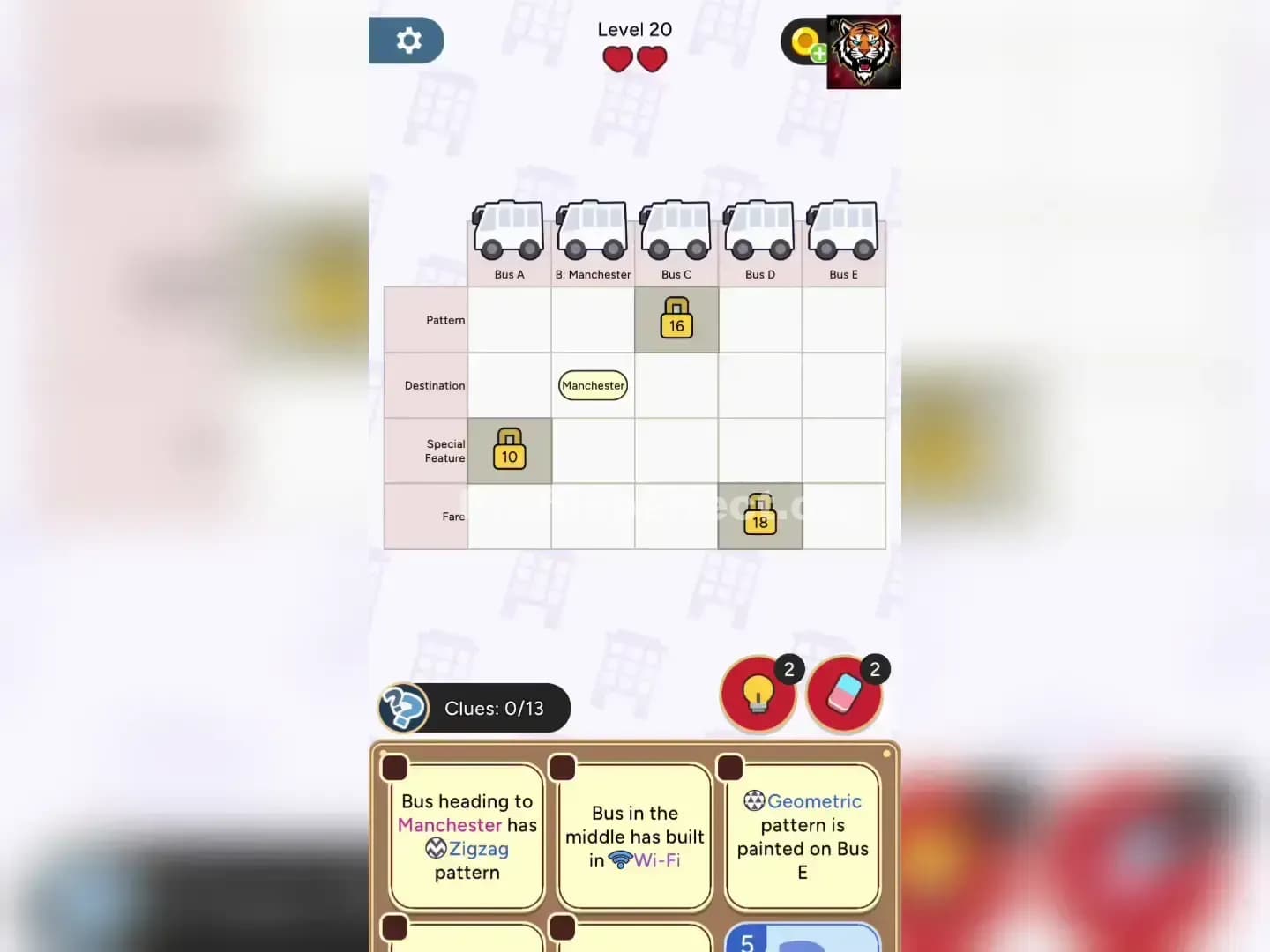
Level 20 lines up five buses this way. Each bus has a pattern, a destination, a special feature, and a fare. Four traits is a manageable amount to hold in your head once you have the five addresses fixed. I find it helps to say the row out loud in my head before reading a single clue, first bus, second bus, third bus, fourth bus, fifth bus, so that when a clue mentions "the bus in the middle" or "the leftmost bus," I already know which address that points to.
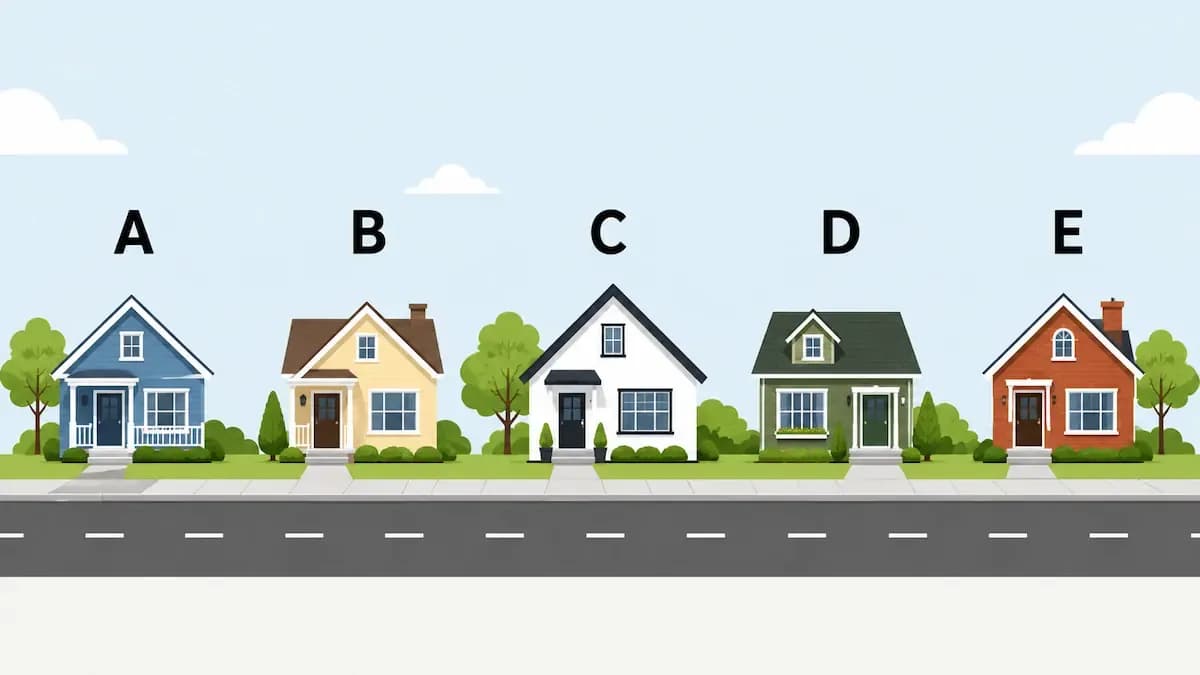
This is the mental trick that makes five subject grids stop feeling crowded. Picture columns A through E as five houses on one side of a street. House A is the first house you pass. House E is the last one before the street ends. House C sits exactly in the middle, with two houses on either side. Once that picture is set, a clue about the "leftmost" subject or the one "in the middle" stops being an abstract phrase and becomes a specific house you can point to.
Every five subject level gives you at least one answer for free before you touch a single clue. These are the initial answers, and they matter because they are the only cells you do not have to earn through deduction. Treat them as fixed points and build outward from there instead of jumping around the grid looking for whatever seems easiest.
Level 20 hands you one anchor right away. Bus B's destination is already filled in as Manchester. From that single fact, the very first clue tells you the bus heading to Manchester has a zigzag pattern, which locks Bus B's pattern too. Two cells solved before you have done any real reasoning, just by trusting the anchor and reading the clue that touches it.
Level 234 also opens with locked answers, Player C's accessory is already a sun hat, and Player A's expression is already crying. But this level shows why anchors do not always carry the same weight. Player A's identity is split across two names, Jacob and Sonia, so knowing the expression does not tell you who is sitting there yet. The anchor still matters, it just needs more clues layered on top before it pays off.
Once your anchors are placed, look for any clue that names an edge position directly. A clue describing the leftmost, rightmost, first, or last subject is worth solving before anything else, because it does not depend on figuring out any other cell first. It gives you a full answer in one read.
Level 20 has exactly this kind of clue. "The leftmost bus has a bike rack mounted" hands you Bus A's special feature immediately, with zero other information required. A separate clue tells you Bus E's pattern is geometric, which pins down the other end of the row just as cleanly. Solve both of those before you look at anything involving the middle of the grid. Edge clues are the safest taps in the entire level, because there is no other cell they could be confused with.
An edge subject only has one neighbor. A middle subject has two. That difference matters under a two life system, because a wrong tap in the middle of the row is guessing between more possibilities than a wrong tap at either end. Level 20's own middle clue, "the bus in the middle has built in Wifi," only becomes safe to tap once you already know that bus sits between two solved neighbors. Solve outward from the edges toward the center, not the other way around.
Level 234 uses the same idea, just dressed up differently. Its very first clue states that the opposite expression shows up at the other end of the row, tying crying at one end to smiling at the other. That is an edge clue in every way that matters, even though the puzzle never says the word leftmost. Edge logic still applies, you just have to recognize it when it is phrased as "the other end" instead of a direction.
Once both edges are locked, the middle cells fall through clues that describe distance and direction rather than direct facts. "The bus with the sleeper seat is on the left of the bus to Oxford" only works once you already know where Oxford's bus sits, then it hands you the neighbor for free. This is where the street map picture keeps paying off, because you are counting houses, not guessing blindly.
Level 234 pushes this further than Level 20 ever does. One clue tells you three people separate two named players before you reach a third. Another says there are three people to the left of one named player before you reach a different one. These clues only resolve because the letter order in the row always matches left to right position, so counting from a known player toward an unknown one works the same way it did with Level 20's buses, just with more players and more accessories to track along the way.
Once every subject has a fixed address, resist the urge to jump straight to whichever trait looks most interesting. Work one subject at a time and finish its entire row before moving to the next one. This keeps you from holding five half finished puzzles in your head at once, and it matches how the clues are usually written, since most clues connect several traits that belong to the same subject.
Level 20 wraps up cleanly this way. Once Bus C is known to sit in the middle with Wifi and a destination of Oxford, a later clue about solid patterns and fares closes out that row in one pass. Level 234 asks for more patience here, since a player's row will not close until you have confirmed both halves of a split name, matched the right accessory, and traced a bet back through two more clues. The order of operations stays the same. It just takes longer to walk the same five steps.
Level 20 and Level 234 are both built on five subjects, and both reward the exact same process, shrink the board, find your anchors, solve the edges, use position clues, finish the rows. Level 20 does it in thirteen clues with no hidden values and no split answers. Level 234 needs twenty five clues and six cells that each hold two valid answers at once, because nearly every player's identity is shared between two names.
That contrast is the real lesson behind the 141 levels that use this size of grid. Five subjects sets the shape of the puzzle, not the difficulty. The difficulty comes from how many times you have to run the same five steps before every row closes. Learn the process on a friendly level like the buses, and you already have everything you need for a harder one like the poker table. You are just running more laps around the same track.