A behind the scenes look at how Profile Perfect mixes anchor, position, exclusion, ranking, and common sense clues, with a full clue recipe card from Level 20's Bus puzzle and real dataset stats from across 400 levels.


Guide By Liam Stone
Published on July 7, 2026
Liam Stone has played Profile Perfect since the app first launched on the Apple App Store. He spotted its potential early, and that early bet turned into hundreds of hours spent solving levels, testing clue logic, and documenting answers for other players. Liam runs the YouTube channel Puzzle Game Answer where his puzzle walkthroughs have earned over 935,000 views and a growing community of more than 800 subscribers. He covers a wide range of mobile puzzle games beyond Profile Perfect, giving him firsthand experience with how these games design clues, structure levels, and trip up even experienced players. Every guide on this site reflects that hands on experience. Liam plays each level himself, verifies every answer against the in game grid, and rewrites confusing clues into plain language so you don't need to guess. If you want more of his walkthroughs, subscribe to his channel.
Loading calendar...
Every level in Profile Perfect gives you a stack of clues and asks you to fill in a grid without guessing. Read them closely, though, and you notice they are not the same kind of sentence repeated with new nouns. Some clues just hand you the answer. Others make you work sideways through position, elimination, or a ranking before the answer shows itself. When I sat down and pulled clue text across all 400 levels, that mix turned out to be the real engine behind the difficulty curve, more than subject count or trait count ever was.
This post breaks down the clue types Profile Perfect actually uses, shows what a well balanced level's clue list looks like when you sort it by type, and walks through what happens to a level when one type takes over. I built a recipe card for Level 20's Bus puzzle to make the balance concrete, since that level uses all five types across just thirteen clues.
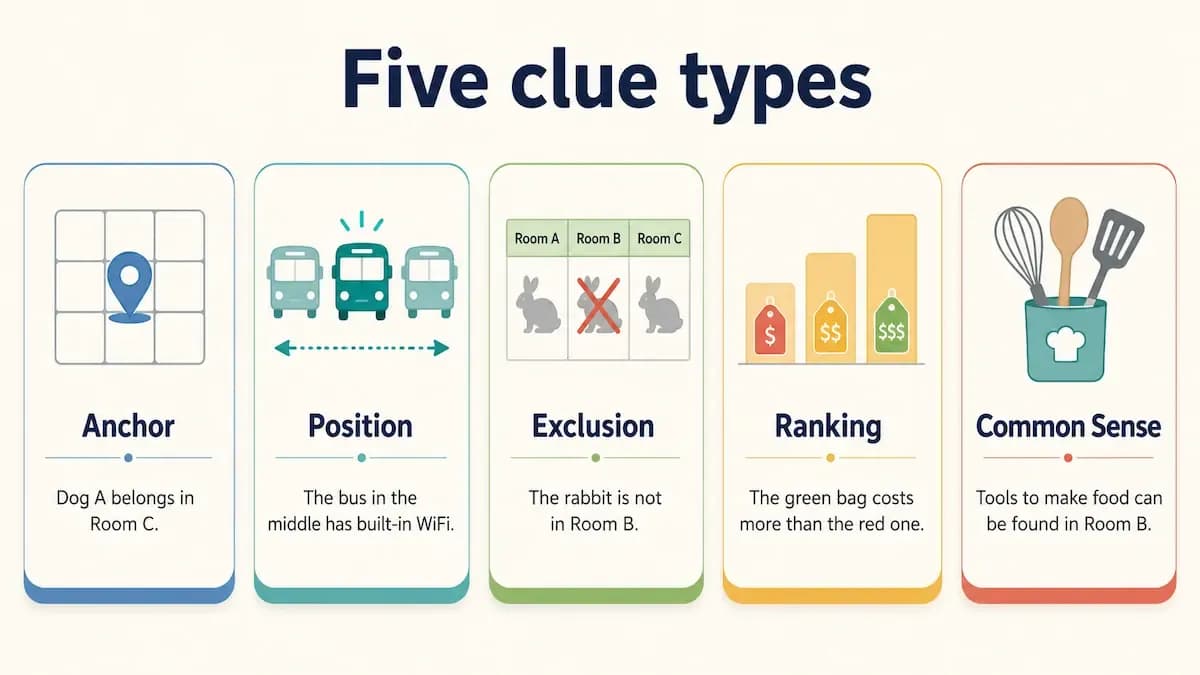
Every clue in the game falls into one of five buckets. Once you can name them, you start reading levels differently, because you can tell within a sentence or two which kind of work that clue is asking you to do.
An anchor clue states a fact outright and needs no other clue to confirm it. "Bicycle A has 2 sets of bike pedals" is an anchor. You read it, and Bicycle A's type is Tandem, full stop. Profile Perfect tags a lot of these with the label [initial] in its own clue data, which lines up with what players experience in game as the locked starting values already filled into the grid. Across the full 400 level set, anchor style clues make up roughly a quarter of all clue text, and every single level opens with at least one.
Anchors exist to give you a floor to stand on. Without at least one or two, a level has nothing solid to build from, and every other clue becomes a chain with no first link.
A position clue places a subject relative to another one instead of naming its trait directly. Words like leftmost, rightmost, next to, neighbor, beside, and between are the tell. "Bus with Sleeper Seat is on the left of bus to Oxford" from Level 20 is a position clue. It never says which bus has the Sleeper Seat. It only tells you where that bus sits compared to another one you may already know.
Position clues are the most common indirect type in the dataset, showing up in about 96 percent of levels. That is close to universal, and it makes sense once you notice how much of a logic grid's structure is spatial. Subjects sit in a row. Once a level tells you enough about who sits where, entire columns start locking into place just from the seating chart.
An exclusion clue, the "not" clue, removes one possibility instead of confirming one. "Wheelchair friendly bus is not going to Brighton" tells you nothing about where that bus actually goes. It only crosses Brighton off the list for that one bus. Exclusion wording shows up in 84 percent of levels, and it is where most wrong taps happen, because players read the elimination and then rush to fill in an answer the clue never actually gave them.
A ranking clue compares two or more subjects along a scale, using words like most, cheapest, twice as expensive, or oldest. "Ticket to Manchester is the most expensive" and "Nature pattern bus is cheaper than Solid one" are both ranking clues from Level 20. These clues ask you to hold two or three values in your head at once and put them in order, which makes them feel heavier than a simple fact, even when they only touch two subjects. Ranking wording appears in 59 percent of levels, the smallest share of the four structural types, since not every trait list has values that can be meaningfully ranked.
A common sense clue never uses the trait's actual name. It describes a scene and trusts you to translate it. "Tools to make food can be found in Room B" never says Kitchen. "Bus in the middle has built in WiFi" from Level 20 does name the trait directly this time, but plenty of common sense clues elsewhere in the game lean on outside knowledge instead, describing a shopping trip to point at a Supermarket or a bird that cannot fly to point at a grounded animal. These clues carry the most personality in the writing, since they are the ones that make a level feel like a described scene instead of a spreadsheet row.
Recipe cards work for cooking because they show you proportions, not just ingredients. A level's clue list works the same way. Here is Level 20, five buses matched to pattern, destination, special feature, and fare, broken down by type instead of by number.
| Clue # | Clue text | Type |
|---|---|---|
| 1 | Bus heading to Manchester has Zigzag pattern | Anchor |
| 2 | Bus in the middle has built in WiFi | Anchor |
| 3 | Geometric pattern is painted on Bus E | Anchor |
| 4 | Ticket to Manchester is the most expensive | Anchor plus ranking |
| 5 | Leftmost bus has a Bike Rack mounted | Anchor plus position |
| 6 | Bus with WiFi is heading to Oxford | Common sense link |
| 7 | Bus with Sleeper Seat is on the left of bus to Oxford | Position |
| 8 | Geometric bus going to Birmingham has a Restroom | Position plus common sense |
| 9 | Wheelchair friendly bus is not going to Brighton | Exclusion |
| 10 | Striped bus to Brighton is the cheapest | Ranking |
| 11 | Bus to Oxford is not using Nature patterned bus | Exclusion |
| 12 | Bus with Solid color has fare | Ranking |
| 13 | Nature pattern bus is cheaper than Solid one | Ranking |
The recipe card for this level reads as five anchors (two of them doing double duty with ranking or position), two straight position clues, two exclusion clues, three ranking clues, and one clue that leans on the common sense link between built in WiFi and a bus you would expect to see stop somewhere with connectivity, like a longer route into a city.
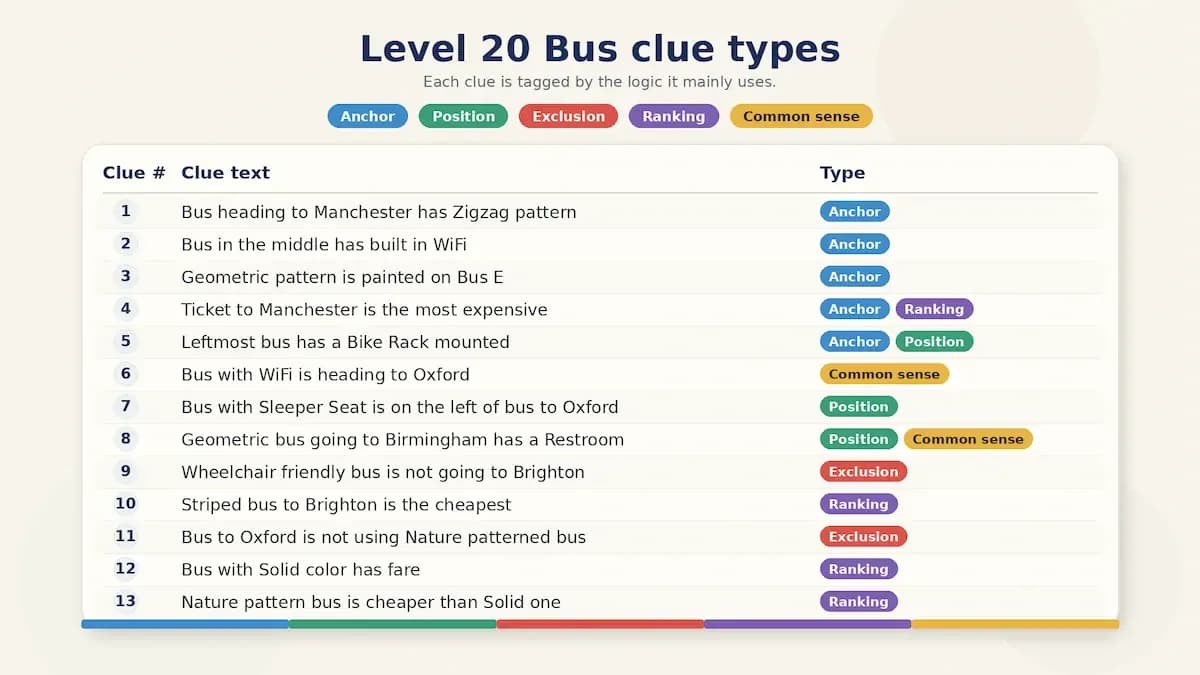
Notice the order the level puts these in. The three cleanest anchors come first, giving you Bus B's pattern, Bus C's special feature, and Bus E's pattern before anything harder shows up. Then the level layers in a ranking clue and a position clue while they are still attached to anchors, easing you into the harder clue types without cutting the floor out from under you. The exclusion clues arrive in the middle, once you already have enough locked cells that crossing off one option actually leaves just one choice standing. The last three clues are pure ranking, asking you to compare fares across buses whose other traits are already solved, so the only remaining work is ordering three dollar amounts.
That sequencing is the real recipe. It is not just what types show up. It is when.
Level 20 is not an outlier. Across all 400 levels, the average level runs about 11 clues, and most of them mix all five types in some proportion, even if the exact ratio shifts level to level. Anchor clues sit around a quarter of total clue text and appear in every level without exception. Position wording shows up in 96 percent of levels. Exclusion wording lands in 84 percent. Ranking wording, the type that asks the most of your working memory, shows up in 59 percent, which tracks with it also being the type that needs a trait list with values you can actually put in order, like price or age, rather than something like color that has no natural ranking.
A level does not need equal parts of everything to feel balanced. What it needs is enough anchors to get started, enough position and exclusion clues to do the bulk of the deduction, and just enough ranking or common sense clues to make the level feel less like a spreadsheet and more like a described scene. Level 20 hits that mix in thirteen clues. Plenty of longer levels with five subjects and six traits hit a similar ratio across twenty or more clues, just with more room to breathe between each type.
The clearest way to see why balance matters is to look at levels that lean hard into one type and feel the difference in how they play.
Level 1, the very first level in the game, is four clues and every single one is an anchor. That works there because the level exists to teach you the interface, not to test deduction. If a mid game level tried the same thing at a larger scale, stacking anchor after anchor with nothing indirect mixed in, it would stop feeling like a puzzle. You would just be transcribing facts from a clue list into a grid, one to one, with no moment where two pieces of information collide and produce a third. The deduction loop needs friction, and pure anchors remove all of it.
Level 139's Car puzzle leans hard on exclusion. Out of nine clues, six use "not" or "none of" wording, cars that are not paired with a certain color, muddy cars that are not a certain brand, one car that does not sit next to another. Each exclusion clue is fair on its own, but when they stack up back to back, the feeling shifts from deducing an answer to maintaining a running list of crossed out possibilities. You spend more time tracking what is not true than building toward what is. That is a heavier cognitive load than the same number of clues split more evenly across types, because exclusion by itself never hands you a positive fact to lock in. It only shrinks the field, and you need something else to finish the job.
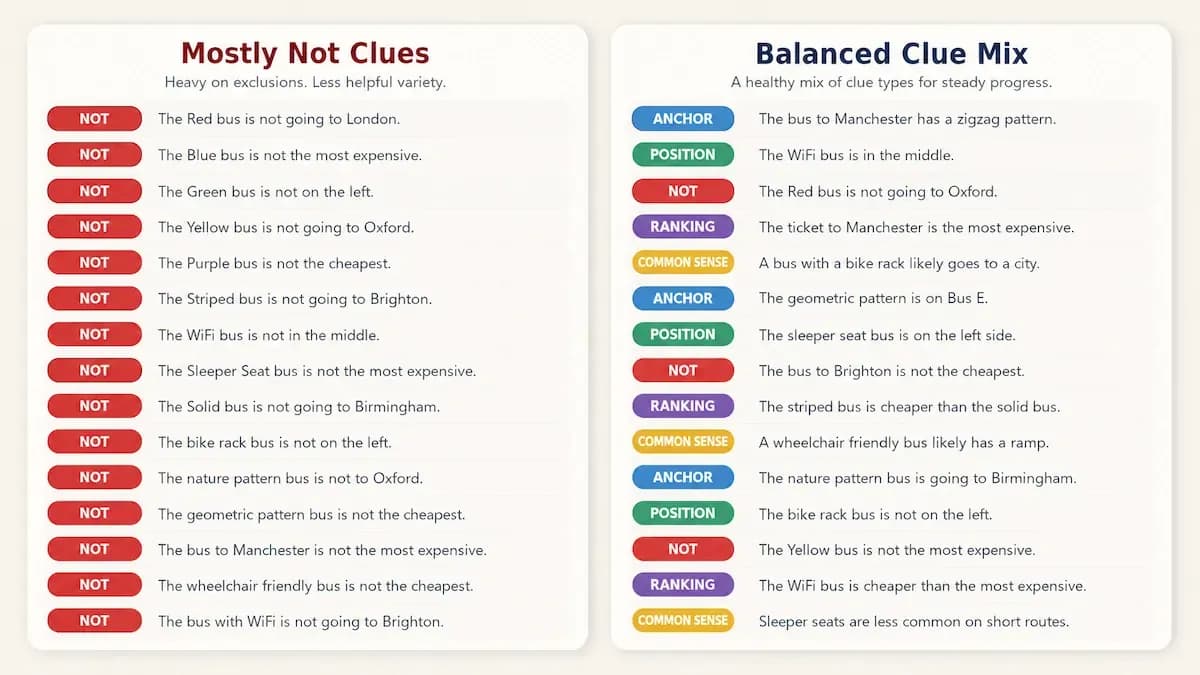
A level built mostly from ranking clues, several buses or meals or bells all compared by price or age in sequence, forces you to hold multiple relative values in your head before any of them resolve into an absolute fact. Level 20 avoids this by keeping its three ranking clues clustered at the end, once fare is the only unsolved trait left. If those same three clues had opened the level instead, before you knew anything about pattern or destination, you would be juggling relative comparisons with no anchor to check them against. Ranking clues work best late in a level's sequence, once other trait columns are already closed and the comparison has fewer variables to track.
Common sense clues carry risk in the other direction. When a clue leans on real world knowledge instead of stating the trait, it only stays fair if that knowledge is close to universal, cooking tools point to a kitchen, a shopping trip points to a supermarket. A level that stacked several less common scene descriptions back to back, ones that lean on specific trivia rather than everyday association, would stop testing your ability to deduce and start testing what you happen to already know. Profile Perfect mostly keeps this type as a light seasoning rather than the main structure, which is exactly why it still reads as fair when it shows up.
None of these five clue types is better or worse than the others. Anchors get you started. Position and exclusion clues carry most of a level's actual deduction weight, since together they cover the vast majority of clues across all 400 levels. Ranking clues add a layer of comparison once enough is already locked in to make that comparison meaningful. Common sense clues add flavor and make the grid feel like a described place rather than a data table.
The difficulty of a level, and how satisfying it feels to finish, comes down to the ratio and the order of these five types more than it comes down to how many subjects or traits sit in the grid. A five clue level with the right mix can feel more rewarding than a twenty clue level that leans too hard on one type. Next time you open a level, try sorting its clue list into these five buckets before you tap anything. You will start to see the recipe the designers were working from, and you will probably start solving faster too, since you will know exactly what kind of work each clue is actually asking you to do.