
Discover why Profile Perfect feels like mental reps: anchors, clue chains, safe taps, and calm logic-grid solving from Level 1 to Level 234.


Guide By Liam Stone
Published on July 5, 2026
Liam Stone has played Profile Perfect since the app first launched on the Apple App Store. He spotted its potential early, and that early bet turned into hundreds of hours spent solving levels, testing clue logic, and documenting answers for other players. Liam runs the YouTube channel Puzzle Game Answer where his puzzle walkthroughs have earned over 935,000 views and a growing community of more than 800 subscribers. He covers a wide range of mobile puzzle games beyond Profile Perfect, giving him firsthand experience with how these games design clues, structure levels, and trip up even experienced players. Every guide on this site reflects that hands on experience. Liam plays each level himself, verifies every answer against the in game grid, and rewrites confusing clues into plain language so you don't need to guess. If you want more of his walkthroughs, subscribe to his channel.
Loading calendar...
You know the feeling. You open Profile Perfect to knock out "just one level" on the couch, and forty minutes later you're four levels deep, eyes a little tired, grid empty, wearing that specific kind of satisfied exhaustion. It's the same feeling you get walking out of a gym session. Not sore in a bad way — just worked.
I started calling each little moment of certainty in this game a logic rep: the exact instant a clue lands, a possibility falls away, and you tap a cell knowing it's right. One logic rep doesn't feel like much. A whole level of them, stacked cleanly, is what makes the game addictive in a way that has nothing to do with a timer or a combo meter.
To figure out why, I actually sat down and went through the data behind the puzzles — all 400+ levels, every clue in the deck. That's 4,499 clues total, an average of 11.25 per level. And once you start reading them side by side, you notice the same four movements again and again: direct-anchor clues that just hand you a fact, positional clues that place things in relation to each other, negative clues that quietly cross an option off, and comparison clues that rank things against each other. Four exercises, repeated with different weights depending on the level.
So let's actually break the session down like a workout.
Level 1 is about as light as the game gets. Two people, Joyce and Bob. Two traits to fill in: surname and nationality. Four clues, and every single one of them just tells you something outright — Joyce's full name is Joyce Miller, Bob is the youngest son of the Davis family, the Davis family has lived in England for generations, the Millers have been in the US just as long. No elimination, no cross-referencing. You read, you match, you tap.
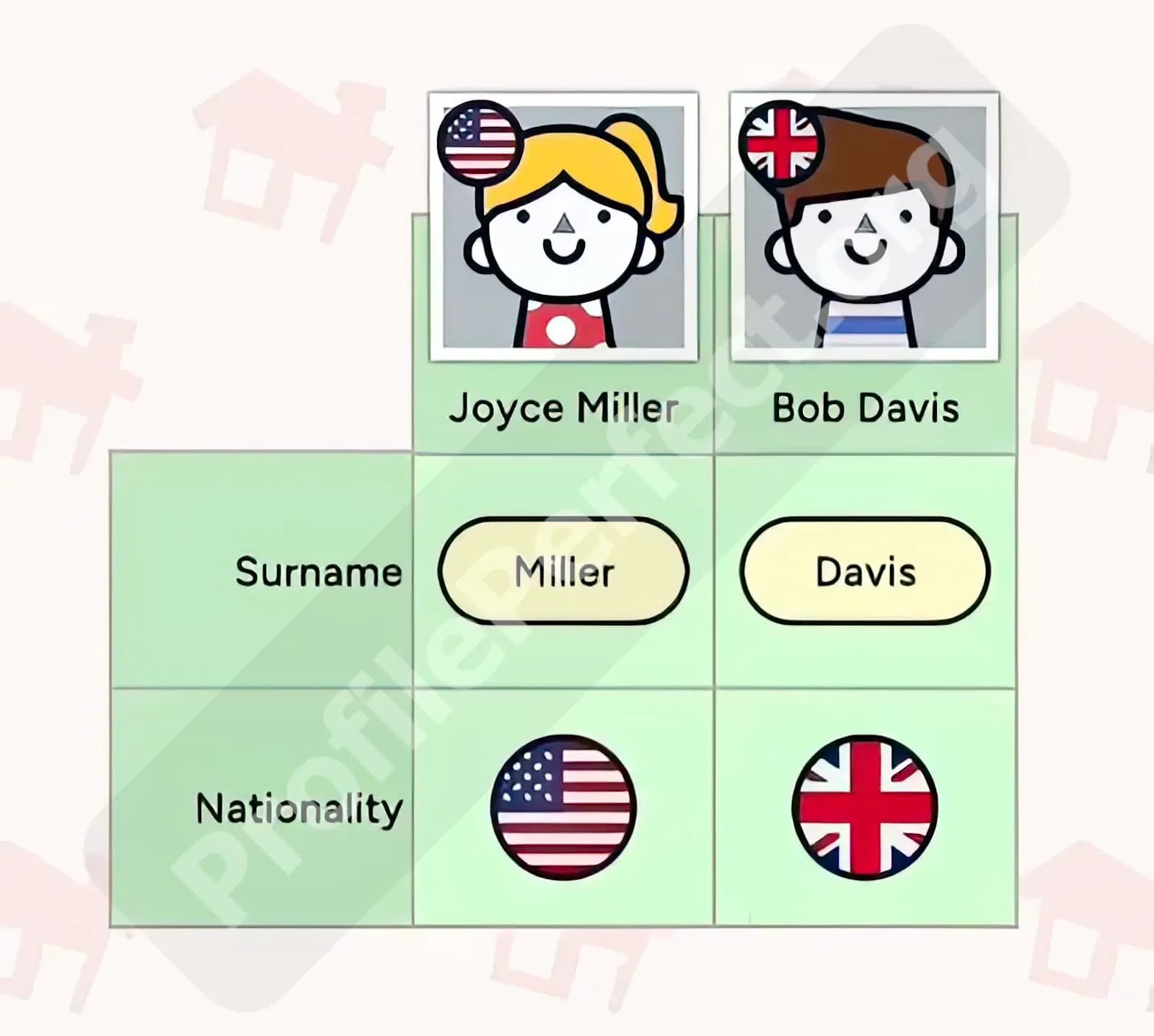
It's tempting to blow through a level like this without thinking. Don't. This is where you build deduction form — the habit of actually reading a clue fully before your thumb moves. Skip that habit here, with nothing on the line, and it'll cost you later when a level actually needs it.
Once anchors run out, the game starts asking you to combine two things to get a third. This is where the other three clue types show up, and where the real "sets" of the workout live.
A positional clue tells you where something sits relative to something else — next to, at the far end, three seats away. A negative clue doesn't tell you what's true, it tells you what isn't, quietly narrowing a cell down until only one option survives. A comparison clue stacks two values against each other — higher, lower, further, closer — and only makes sense once you've locked something else in first.

None of these clues do much alone. What makes a level click is chaining them: an anchor gives you a fixed point, a negative clue clears the noise around it, and a positional or comparison clue finishes the rep. That chaining, repeated across a level, is the actual "workout" — not any single clue, but the rhythm of doing that three-step move over and over without your form breaking down.
Then there's Level 234.
Where Level 1 hands you two people and two traits, Level 234 sits you down at a poker table with five players and six traits each — person, accessory, expression, poker hand, bet, and win rate. Thirty cells. Only two of them are filled in for free at the start. The other twenty-eight have to be earned across 25 clues, a full deck's worth of anchors, negatives, positions, and comparisons all stacked on top of each other.
A friend of mine hit this level on her lunch break, got about a third of the way through, and put her phone down mid-level out of sheer grid burn — that specific fog where you've read so many clues that they start blurring together. She came back that evening, re-read the board from scratch instead of trying to remember where she'd left off, and cleared it in ten minutes. Nothing had changed except that she gave her attention a clean restart. That's an endurance level in a nutshell: it doesn't need you to be smarter, it needs you to still have form left in the tank on rep twenty.
Here's one real chain from that level, annotated:
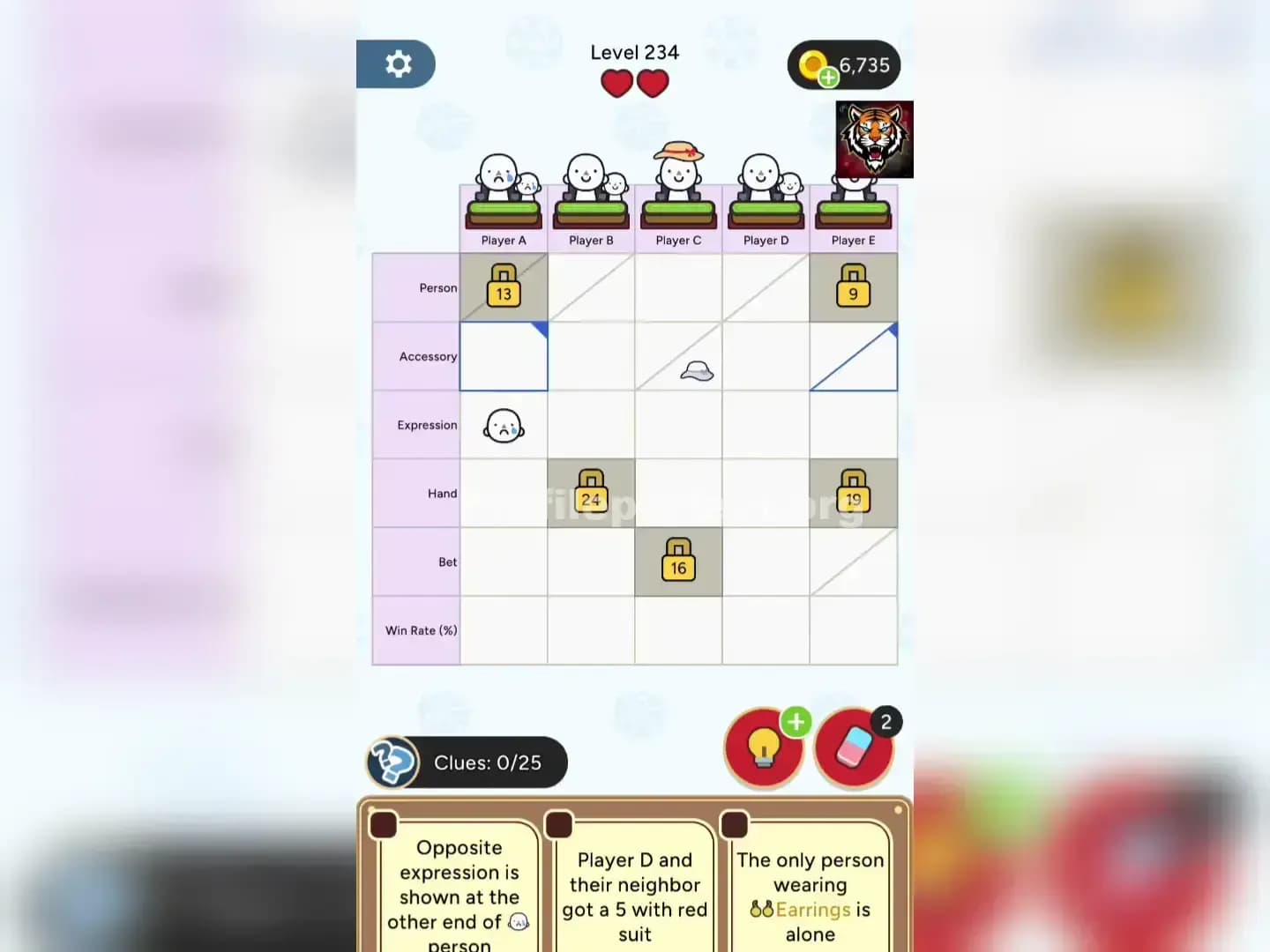
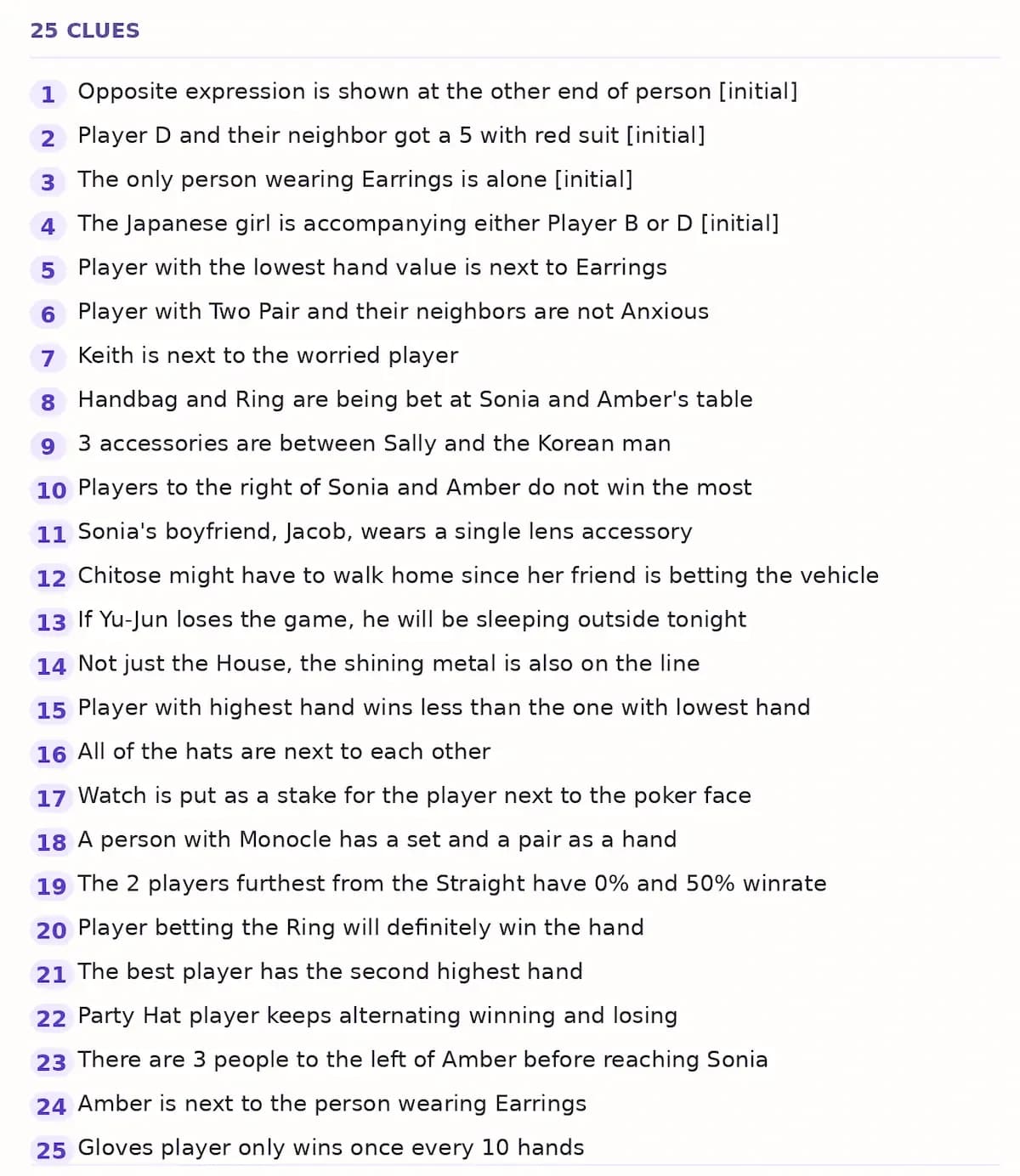
That's the shape of every endurance level: anchor, elimination, safe tap, repeat, for as many reps as the grid demands.
The last habit worth building is the one nobody talks about: before you tap the final few cells, scan the whole grid one more time. With only two lives standing between you and a restart, a rushed last tap after twenty good ones is how you lose a level you'd already basically solved.
Read the board top to bottom. Check that nothing you locked early contradicts something you figured out late. Then tap. It's the same reason you stretch after a heavy set instead of just walking off — the work is done, but the review is what keeps the whole session from being wasted on one careless finish.
Profile Perfect never asks you to be fast. It asks you to keep your form clean, rep after rep, whether the level is a two-person warm-up or a five-player endurance round. Some sessions are light. Some leave you with real grid burn. Either way, you close the app the same way you leave a good gym session — not because it changed how your brain works, but because you can feel exactly how many clean reps you just put in.
See you at the next set.
Liam