Price shows up 29 times as a trait in Profile Perfect, from bags and food stalls to lipstick, cruises, and pomade. Here is how those price clues quietly build rank, personality, world detail, and tension into every grid.

Guide By Liam Stone
Published on July 7, 2026
Liam Stone has played Profile Perfect since the app first launched on the Apple App Store. He spotted its potential early, and that early bet turned into hundreds of hours spent solving levels, testing clue logic, and documenting answers for other players. Liam runs the YouTube channel Puzzle Game Answer where his puzzle walkthroughs have earned over 935,000 views and a growing community of more than 800 subscribers. He covers a wide range of mobile puzzle games beyond Profile Perfect, giving him firsthand experience with how these games design clues, structure levels, and trip up even experienced players. Every guide on this site reflects that hands on experience. Liam plays each level himself, verifies every answer against the in game grid, and rewrites confusing clues into plain language so you don't need to guess. If you want more of his walkthroughs, subscribe to his channel.
Loading calendar...
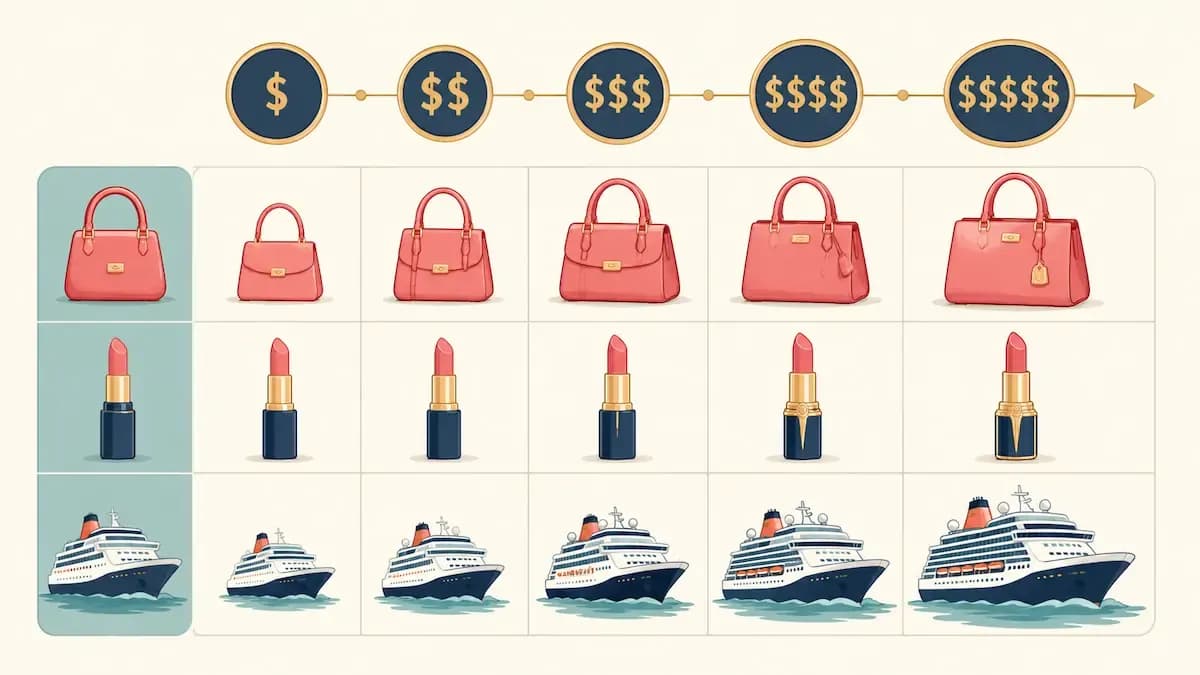
I noticed something the first time I sat down and counted trait types across my Profile Perfect games instead of just solving them one at a time. Price shows up 29 times. Not on every level, but often enough that I started expecting a dollar sign column before I even opened a new grid. Bags carry a price. Food stalls carry a price. Lipstick, cruises, pomade, even a set of balls and a row of bars all carry a price. That range surprised me. Price is not a trait the game saves for shopping levels. It shows up wherever the designers want you to rank something.
At first I treated price like any other column, something to fill in and move past. Then I noticed how much story leaks out of it once you pay attention. A price tag tells you who buys the item, what the scene is worth, and which subject the puzzle wants you to suspect. Price clues do the job of a ranking system on the surface, but underneath they carry rank, personality, world detail, and tension all at once.
Most traits need a whole clue just to explain how two answers relate. Color needs you to already know what red looks like. Price does not need that setup, because a dollar sign scale or a count of x1 through x5 already carries direction. Something is always cheaper, and something is always more expensive, before a single clue gets written.
That built in order is why price clues read faster than almost any other clue type in the game. "The cheapest bag is colored Green" works in one pass because you already know low sits at one end and high sits at the other. Compare that to a clue about, say, a personality trait, which has no natural order and needs a full sentence of context before it means anything.
Profile Perfect uses two versions of this ranking trait. Some levels spell it out in dollar signs, from a single $ up to $$$$$. Others use a plain count, like x1 through x4, attached to a label such as Price or Fee. I solved the pomade level using the count version and the cruise level using the dollar sign version, and the clues behaved exactly the same way in both. "The priciest pomade cannot create Wet Look" and "The most economical cruise is painted Navy" are doing identical work. The label changes. The order does not.
Once I stopped treating price as a number and started treating it as a detail about a person or a place, the clues read differently. A high price on a lipstick paired with a specific ambassador name told me which shade was the flagship product before I even looked at the scent or the barrel material. A low price on a stall told me which vendor was scraping by next to the popular one.
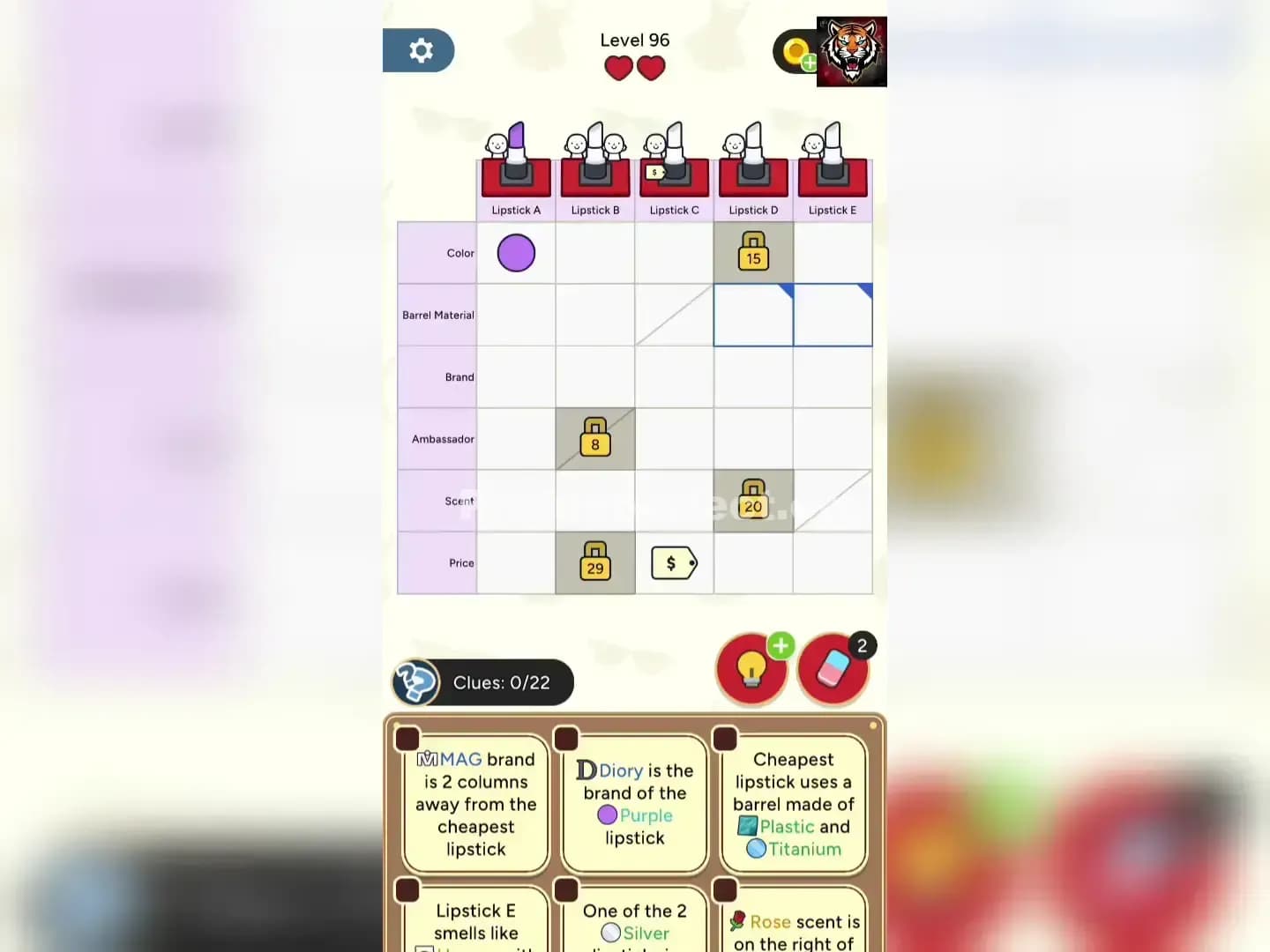
Take the lipstick level I solved. Lipstick E costs the most, comes in a Silver barrel, smells like coffee and honey, and carries the ambassador Megan. Lipstick C costs the least, comes wrapped in plastic and titanium, and belongs to a brand called Lorael with ambassador Emma. Nothing in the clues states outright that Lipstick E is the premium flagship and Lipstick C is the budget pick, but the price puts that story on the grid without anyone having to say it. You read the price first, and the rest of the row confirms what kind of product you are looking at.
Price also does quiet work as a setting detail. A food stall level does not need a paragraph describing a night market. It needs four stalls with a dish, a decoration, and a price, and the market builds itself. Ramen at the priciest stall, a burger at the cheapest one, and a taco stall stuck in the middle tell you exactly what kind of street food row you are walking through.
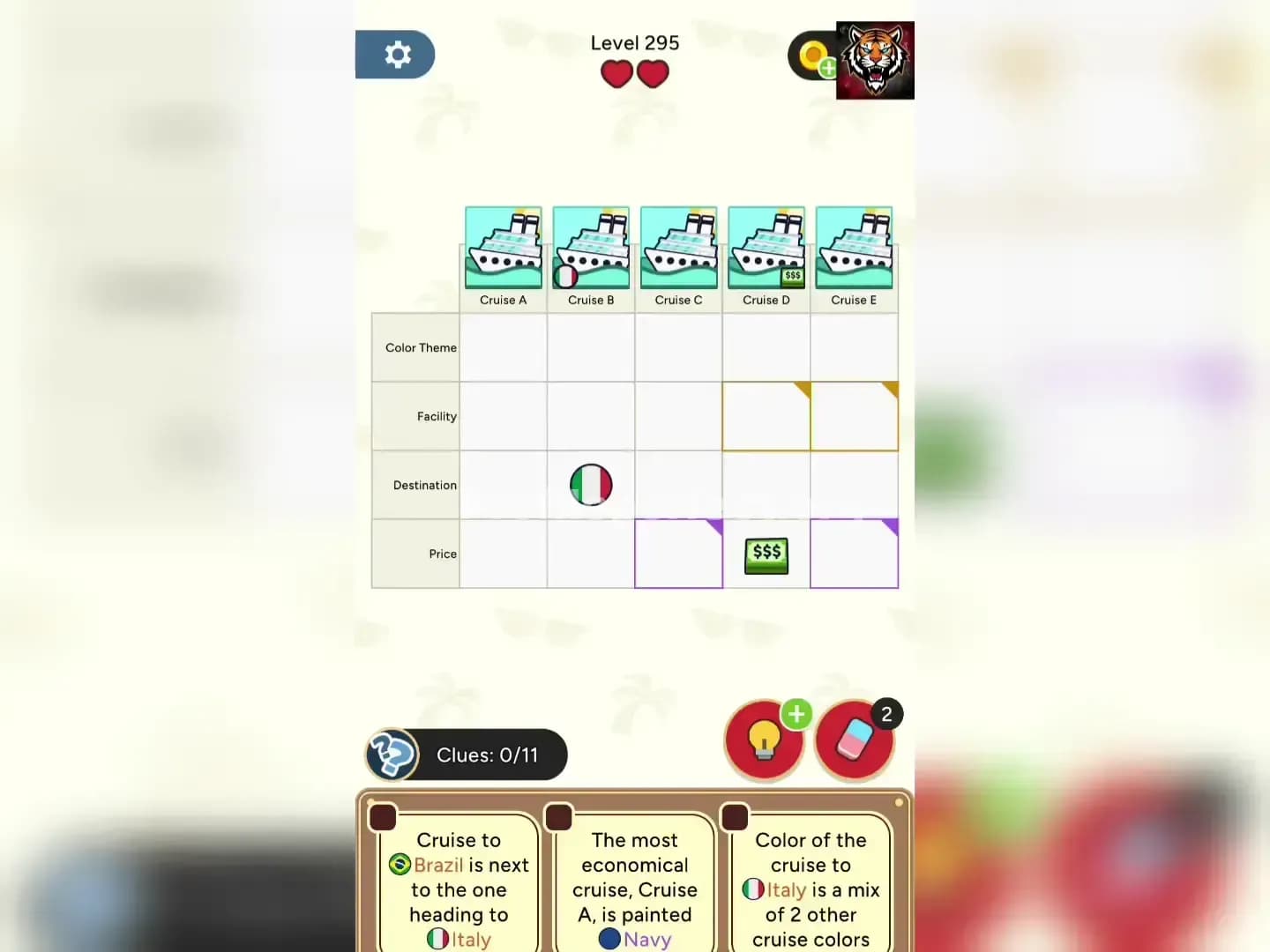
The cruise level does the same thing for a very different setting. Five cruise ships line up with a color theme, a facility, a destination, and a price that runs from a single dollar sign up to five. The cheapest cruise heads to Japan with a casino onboard. The priciest one heads to Italy with a theater. I did not need a clue describing a luxury liner versus a budget getaway. The price column already told me which ship carried backpackers and which one carried people who wanted a show with dinner.
The most interesting thing price does is create suspicion between neighbors. A clue like "the priciest pomade cannot create Wet Look" is not just handing you information. It is ruling out a possibility and making you double back to check who else might fit. A clue like "there is a lipstick that costs half as much as Lipstick B" forces you to hold two rows in your head at once and test them against each other.
I felt this most while solving the stall level, where one clue says Ramen costs the same as two Tacos. That single line ties three separate facts together, the dish, the neighbor's dish, and the exact price relationship between them, and none of it resolves until you already know at least one of the two prices. Price clues rarely stand alone. They lean on a comparison, and a comparison always creates a small pocket of doubt that the rest of the grid has to clear up.
Once I started collecting price rows across totally different level themes, the variety became the fun part. Here are five grids I solved, side by side, to show how far this one trait travels.
| Level | Scene | Price scale | What the price tells you |
|---|---|---|---|
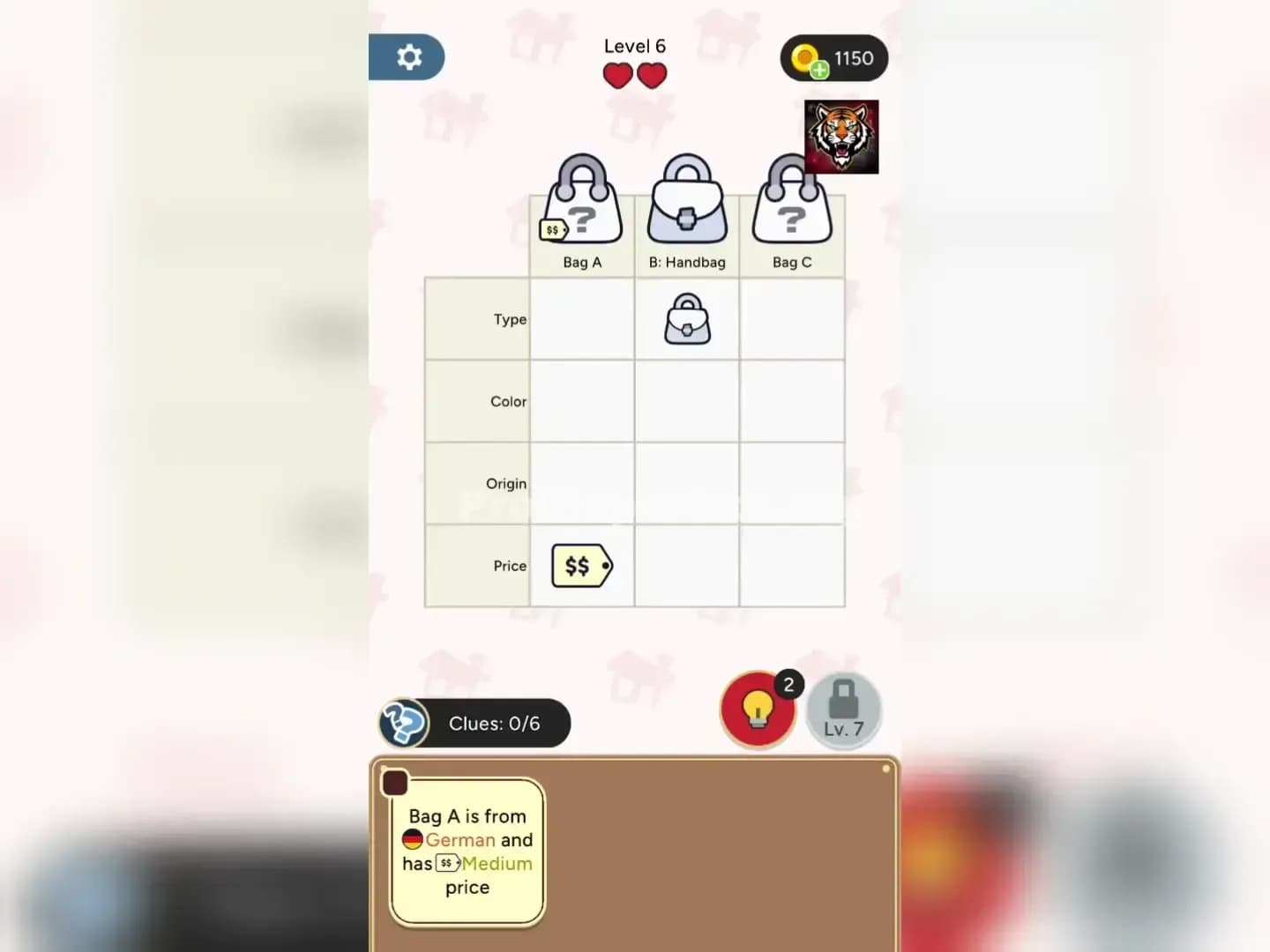
| Level 6 | Bag | Low, Medium, High | The cheapest bag is the plain String Bag. The priciest is a French Handbag |
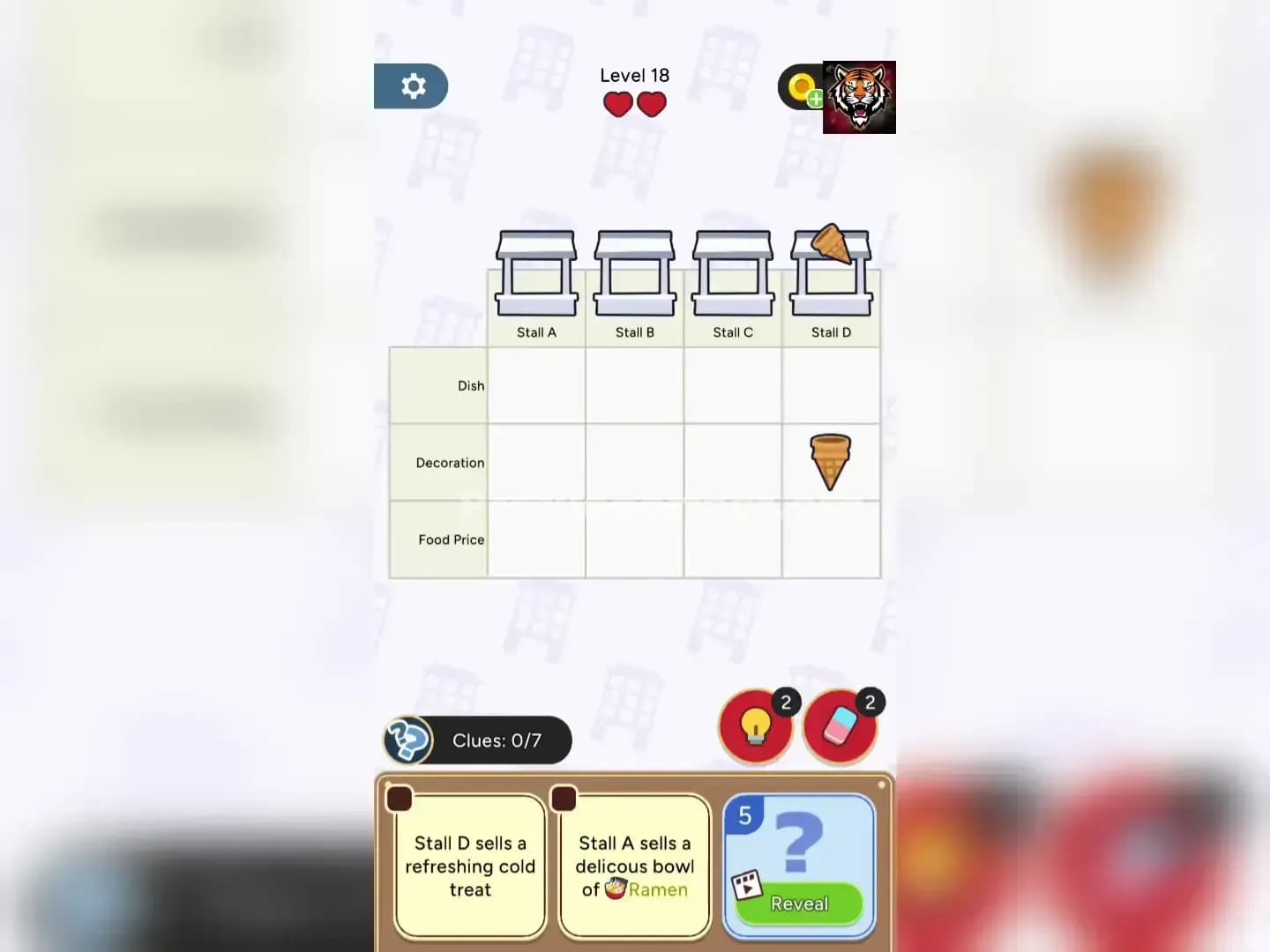
| Level 18 | Food stall | $ to $$$$ | Ramen tops the market. Burger sits at the bottom |
| Level 96 | Lipstick | $ to $$$$$ | The flagship shade costs five times the budget shade |
| Level 295 | Cruise | $ to $$$$$ | A casino cruise to Japan is the budget option next to a theater cruise to Italy |
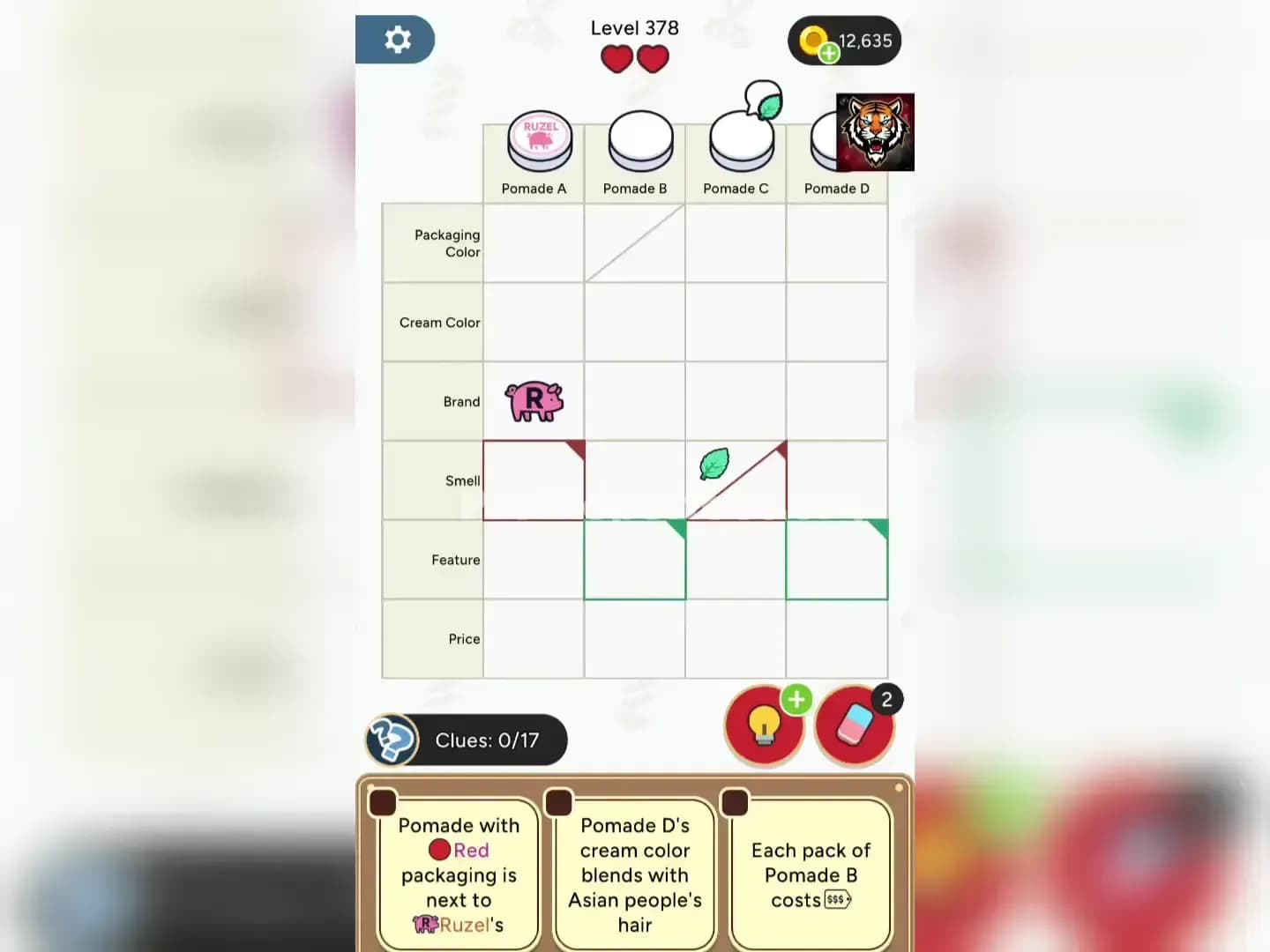
| Level 378 | Pomade | x1 to x4 | The cheapest pomade blends two scents. The priciest one skips the wet look feature entirely |
Level 6 keeps things small, just three bags sorted by type, color, origin, and price. The String Bag from China sits at the bottom of the price column, and the puzzle uses that low price as the anchor for a color clue too, since "the cheapest bag is colored Green" locks two traits together in one line. Level 378 does something similar with its pomade grid. The cheapest pomade in that level, Pomade C, is also the one with a mixed mint and citrus smell, and one clue spells that connection out directly, saying the pomade with the mixed smell is the cheapest product.
Level 18 and Level 295 sit at the other end. The stall level uses a tight four point dollar sign scale where Ramen holds the top spot, and one clue ties that directly to the price of two other stalls, saying Ramen costs the same as two Tacos combined. The cruise level stretches the scale out to five points, and the most expensive ship, a theater cruise to Italy, gets flagged in its own clue as sitting right next to the Red colored cruise. Both levels use their top price the same way, as a landmark other clues can point back to.
Price looks like the most boring trait on the sheet the first time you see it, a plain ranking system with none of the visual charm of color or the flavor of a nickname. Once you solve enough levels, though, price starts to read like a shortcut the designers built into the story. It tells you rank without a clue needing to explain rank. It tells you who the subject is before you reach the personality column. It tells you what kind of scene you are standing in, a night market or a cruise deck, before a single decoration gets mentioned. And it hands the clue chain its tension, because every price sits in relation to a neighbor, and every relation is something you still have to prove.
The next time a level opens with a row of dollar signs, slow down before you treat it like busywork. Price clues are quietly some of the best written clues in the game.