
A breakdown of Profile Perfect's slash marked multivalue cells, found in over half of all levels, and how they add texture to a puzzle without breaking its fairness.

Guide By Liam Stone
Published on July 7, 2026
Liam Stone has played Profile Perfect since the app first launched on the Apple App Store. He spotted its potential early, and that early bet turned into hundreds of hours spent solving levels, testing clue logic, and documenting answers for other players. Liam runs the YouTube channel Puzzle Game Answer where his puzzle walkthroughs have earned over 935,000 views and a growing community of more than 800 subscribers. He covers a wide range of mobile puzzle games beyond Profile Perfect, giving him firsthand experience with how these games design clues, structure levels, and trip up even experienced players. Every guide on this site reflects that hands on experience. Liam plays each level himself, verifies every answer against the in game grid, and rewrites confusing clues into plain language so you don't need to guess. If you want more of his walkthroughs, subscribe to his channel.
Loading calendar...
You are deep into a Profile Perfect grid, checking off the last few boxes, when you land on a cell that shows two answers instead of one. Blue and orange in the same liquid color box. Two names stacked under the same person. Your first reaction is probably confusion. Your second reaction, once you see how it resolves, is usually delight.
That second reaction is the whole point. I went through my own playthrough looking specifically for these split cells, the ones where the solved grid shows two values joined by a slash, like Black / Green or Billy / John. I found them everywhere. Out of four hundred levels, two hundred and fifteen contain at least one, and across the whole set there are four hundred ninety three of these cells total. That is roughly one split cell in every level you play, on average, once you count them all up.
This article walks through what these cells actually mean, why they make a grid feel less mechanical, how to read them without losing your place, and where the game draws the line before a split cell turns into a headache.
A slash inside a solved cell tells you one thing. Both values are correct at the same time, for the same subject. This is not the puzzle giving you two guesses and asking you to pick one. It is a single fact that happens to have two labels.
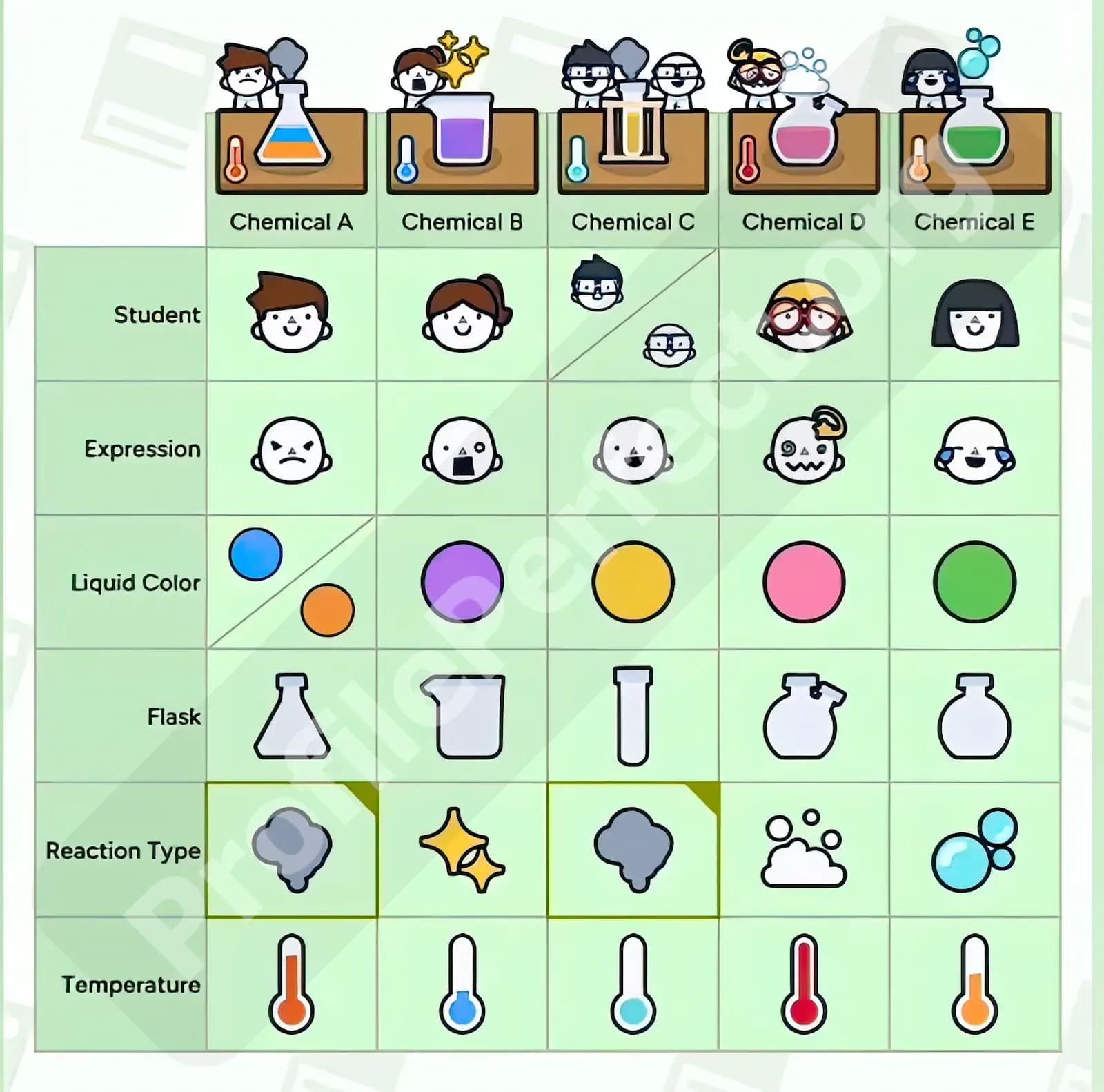
Take the chemistry themed level I solved, where five student chemists each work with a flask. Chemical A's liquid color reads Blue / Orange in the final grid. That is not two different chemicals fighting over one slot. It is one liquid that the clues describe from two different angles, once as blue and once as orange, and the puzzle expects you to realize both descriptions point at the same flask.
Once you accept that framing, the slash stops looking like a glitch and starts looking like a deliberate piece of design. The puzzle is telling you, in advance, that this subject will get described more than one way before you pin it down.
Here is the part that trips people up the first time. The two values in a split cell rarely show up in the same clue. One clue mentions blue. A different clue, several lines later, mentions orange. Nothing in either clue tells you they are the same thing until a third clue ties the position or the neighbor relationship together and forces both labels onto the same subject.
That gap between the two mentions is exactly where the tension lives. You read the blue clue and file it away. You read the orange clue and, if you are not paying attention, your brain treats it as a second chemical you have not identified yet. The moment you realize they collapse into one answer is the moment the level clicks.
A grid where every subject gets one clean value per trait can start to feel like a spreadsheet. Correct, but flat. Split cells break that flatness up. They give a plain matching puzzle something closer to a story, because a subject with two labels usually means someone or something in the fictional scene has two identities worth tracking.
The clearest version of this I ran into was a meal themed level, where five meals each get a main course, a side dish, and a dessert. One meal's side dish reads Garlic Bread / Corn Soup. Read on its own, that looks like a contradiction. A meal cannot have two side dishes. But the clues build it differently. One clue tells you the meal next to the taco gets bread on the side. A separate clue tells you chicken rice comes with a corn soup side dish. Once you work out that the taco meal and the chicken rice meal are actually the same seat in the row, both side dishes land in the same cell, and the meal in front of you suddenly feels like it has more on the table than a single item ever could.
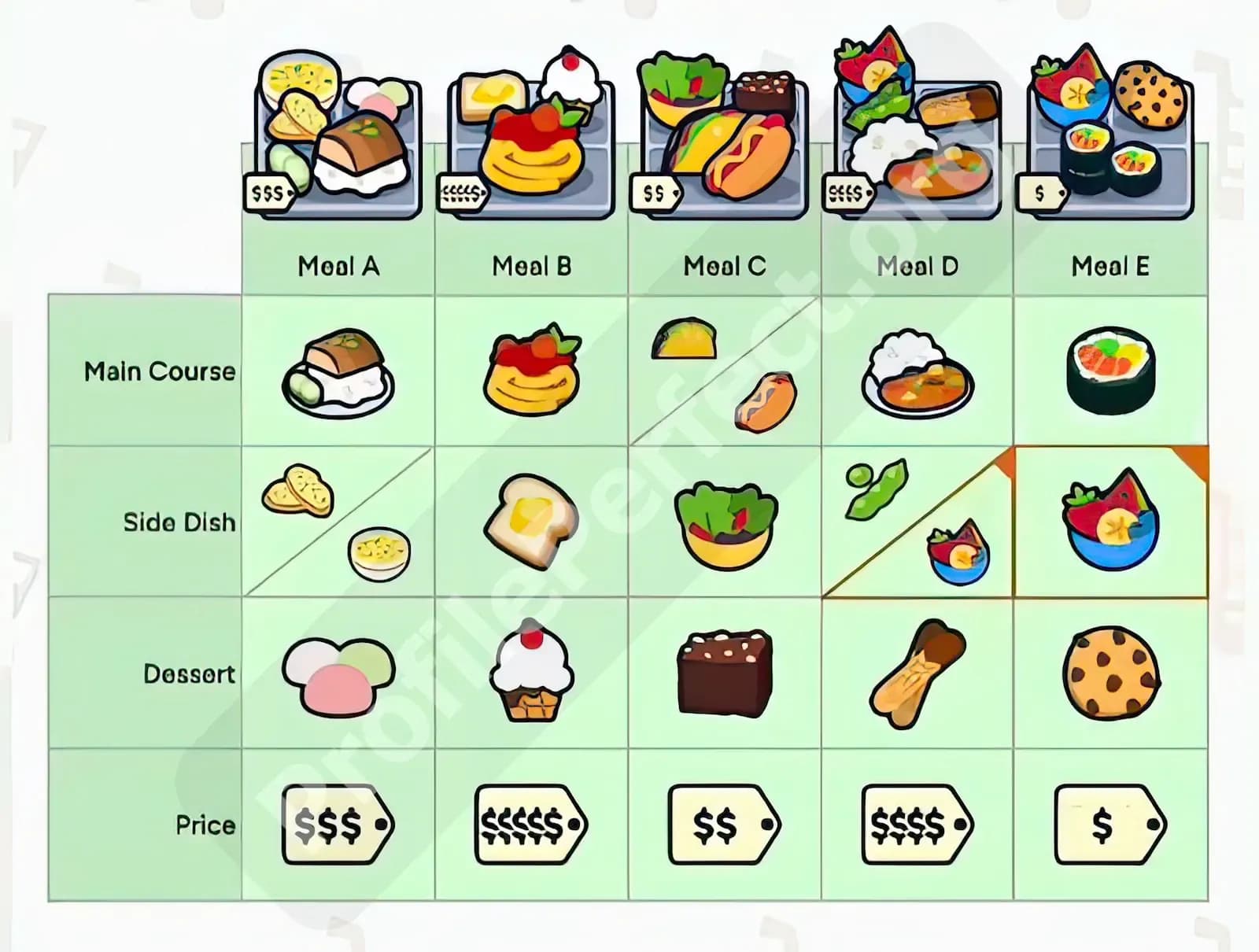
Two colors in one flask. Two side dishes on one plate. Two names for one player. None of these need to be dramatic to add texture. They just need to feel like something real got compressed into one slot, the way a person can have a nickname and a legal name, or a dish can have leftovers mixed with the main course.
The reason this works instead of feeling like padding is that each half of the split usually connects to a different clue thread. The blue label in the chemistry level connects to the clue about the coldest and hottest flasks sitting next to each other. The orange label connects to a completely separate clue about the second hottest liquid. Two threads, one cell. If a puzzle split a cell just to look busy, both halves would show up in the same clue and there would be no reason to hold them apart in your head. The good split cells always make you do a little bit of extra work to prove they belong together.
The safest habit is to treat every value in a split cell as its own fact until the clues force you to merge them. Do not assume two labels belong to the same subject just because they showed up in the same level. Wait for a clue that connects them directly, usually through position, through a shared neighbor, or through a shared trait value that only one subject can hold.
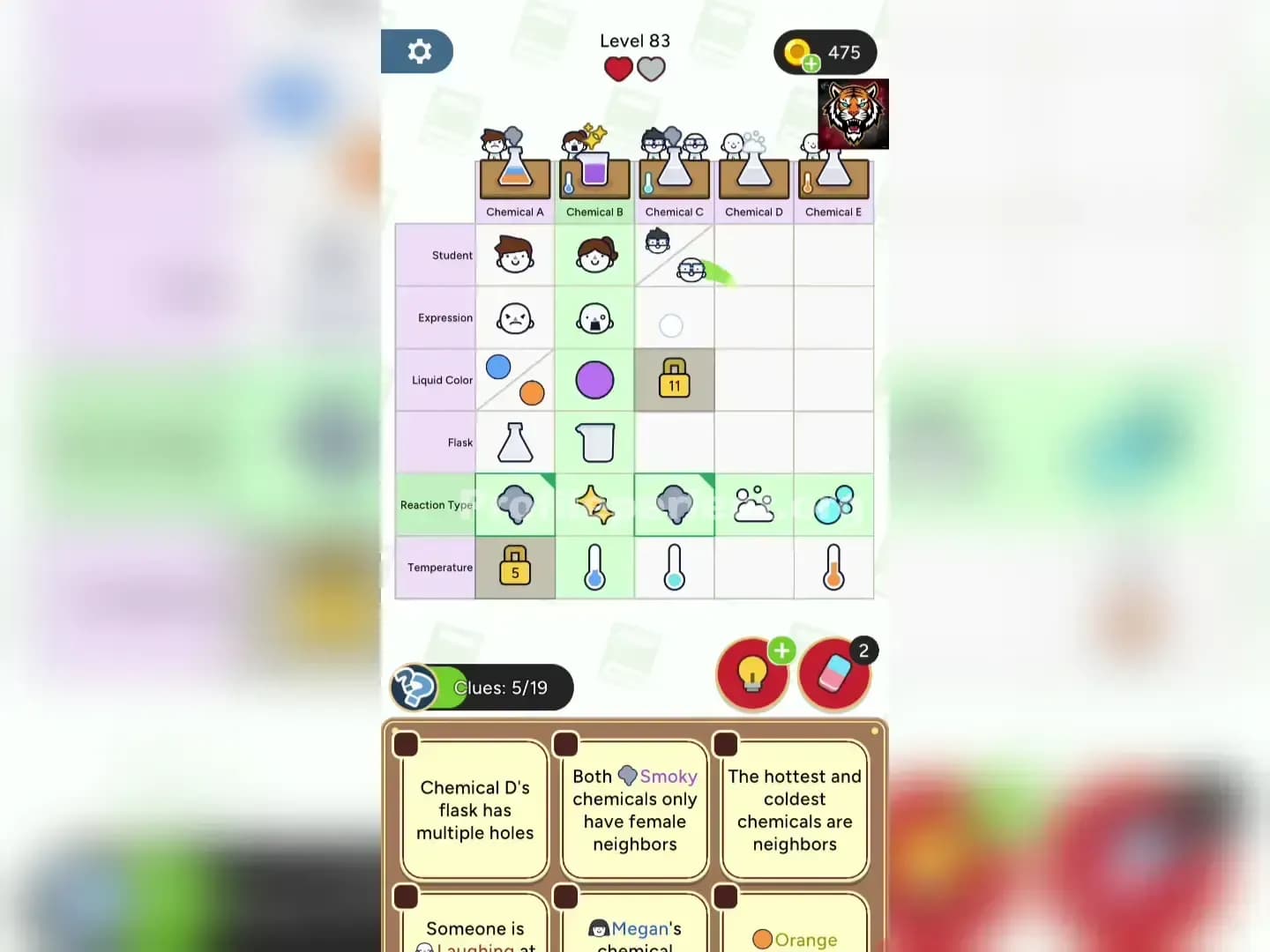
A people themed level made this clear for me. One chemist in the group gets called Billy in one clue and John in another. On a first read, Billy sounds like a different person from John. But one clue places Billy between the cold and the very hot flask. Another clue says John is happy about his successful reaction. Neither clue mentions the other name. It is only when I worked out which flask sits between the cold and hot ones, and matched that same flask to the happy expression, that Billy and John turned out to be one chemist with two names on record.
When you are partway through a level and a name or value seems to repeat under a slightly different label, resist the urge to assume they are already the same thing. Solve each clue on its own terms first. Let the position and neighbor logic do the work of merging them. If you jump ahead and guess that two labels are the same subject before a clue actually proves it, you risk locking in an answer that the puzzle never intended you to assume, and that guess can throw off everything downstream from it.
If you want a clean example of how one split cell can hide more than you expect, look at a picnic themed level with five baskets. One basket's contents read Taco / Sandwich. Another reads Donut / Taco. At a glance, that looks like a simple food list. But the basket content column in that level is doing double duty. It is not just telling you what people are eating. It is tied to a clue about who hates Mexican food and a separate clue about who is having a dessert, which means the same split cell carries two different story details at once, food preference and dietary taste, layered into a single answer.
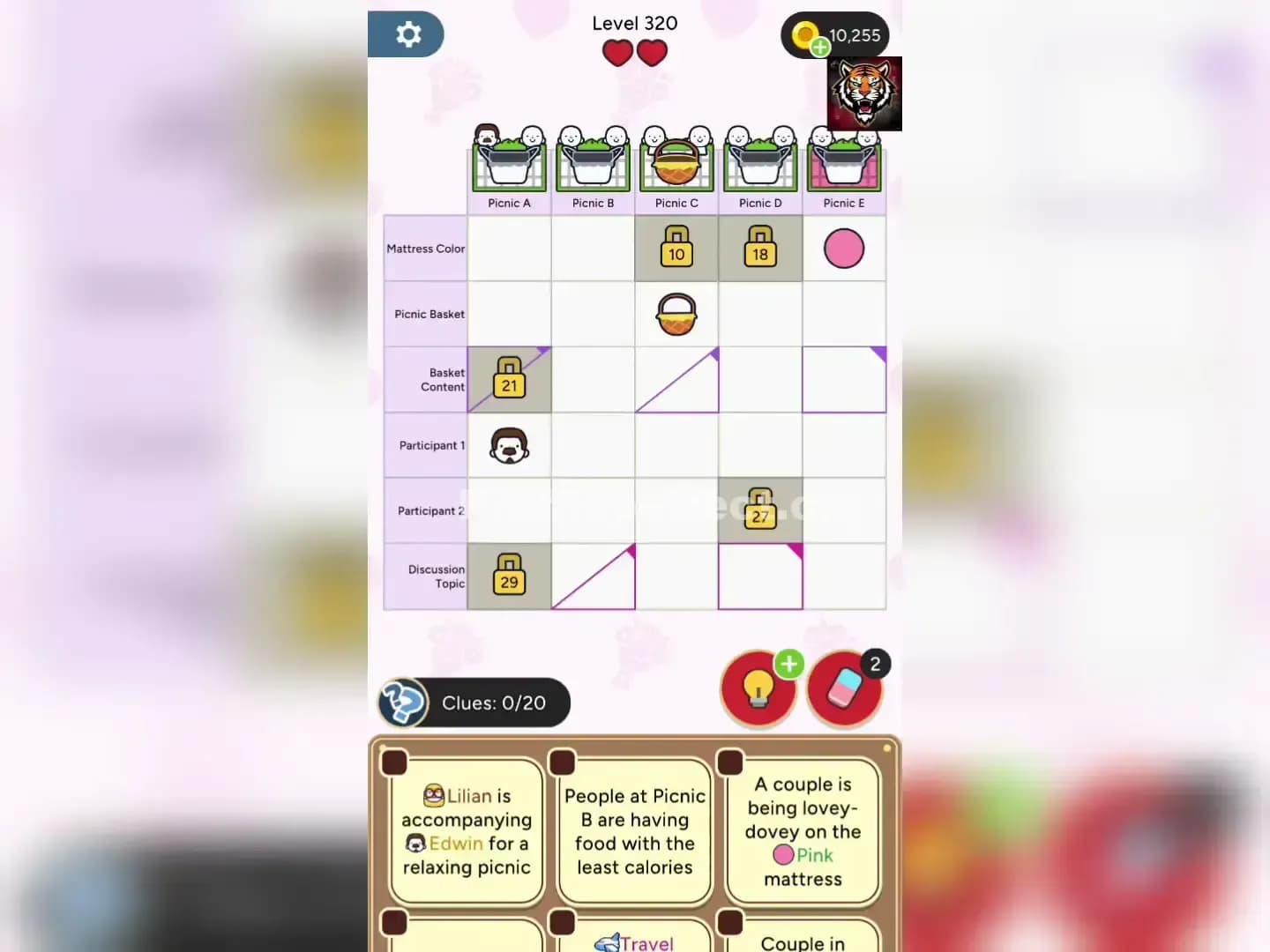
That is the warning worth keeping in mind any time you see a slash. A split cell is not always just two items sharing a slot. Sometimes one half of the split answers a completely different clue than the other half does, and if you only track one value, you will miss the clue that depends on its twin. Read both halves of a split cell as if they might each be doing separate work in the puzzle, because in a level like the picnic one, they usually are.
Two hundred fifteen levels out of four hundred use at least one split cell. That is a little over half the game. The total count of four hundred ninety three split cells across those levels works out to just over two per level that uses the mechanic at all, which tells you the game rarely stops at one. Once a level commits to giving a subject two labels, it tends to lean on the trick again somewhere else in the same grid, whether that shows up as two colors, two foods, or two names for the same person.
That frequency also explains why the mechanic never feels exhausting. It shows up often enough to stay familiar, but not so often that every single trait in every single level carries a slash. You get a plain, single value cell most of the time, and the split cells stand out precisely because they are the exception rather than the rule.
A split cell earns its place when both values connect to separate clues, when the puzzle eventually proves they belong to the same subject instead of asking you to assume it, and when reading both halves actually changes how you solve the rest of the grid. Blue and orange on one flask, garlic bread and corn soup on one plate, Billy and John on one chemist, all of these hold up because the clues do the work of tying the pieces together.
The moment a slash stops working is the moment it becomes decoration, a second label attached with no clue ever connecting the two. I did not find levels like that in my playthrough. Every split cell I traced back through its clues eventually resolved into one clean, provable answer. That is really what makes these cells feel richer instead of messier. They ask you to hold two facts apart for a little while, and then they reward you with the moment those two facts turn out to be the same thing all along.