
Match three rewards speed, but Profile Perfect rewards deduction. See how logic grid puzzles fill a different craving while keeping the pacing mobile players expect.


Guide By Liam Stone
Published on July 7, 2026
Liam Stone has played Profile Perfect since the app first launched on the Apple App Store. He spotted its potential early, and that early bet turned into hundreds of hours spent solving levels, testing clue logic, and documenting answers for other players. Liam runs the YouTube channel Puzzle Game Answer where his puzzle walkthroughs have earned over 935,000 views and a growing community of more than 800 subscribers. He covers a wide range of mobile puzzle games beyond Profile Perfect, giving him firsthand experience with how these games design clues, structure levels, and trip up even experienced players. Every guide on this site reflects that hands on experience. Liam plays each level himself, verifies every answer against the in game grid, and rewrites confusing clues into plain language so you don't need to guess. If you want more of his walkthroughs, subscribe to his channel.
Loading calendar...
Open any app store puzzle chart and you will see the same shapes over and over. Candy rows, gem swaps, fruit chains. Match three has earned its spot at the top. It is fast, it is colorful, and it rewards quick eyes and quicker taps. But a lot of players who have logged hundreds of hours in match three games are quietly craving something else. Not a replacement. A different kind of puzzle for a different kind of mood.
I want to walk through what match three does well, what logic grid games like Profile Perfect add to your rotation, and why Profile Perfect still respects the pace you expect from a phone game.
Match three games are not shallow just because they are fast. They built an entire genre around one clean idea: scan a grid, spot a pattern, clear it before the board fills up. That loop works because it is instant. You see three gems in a row, you swap, they pop, you get a small hit of progress every few seconds.
That speed is the whole appeal. Match three rewards fast pattern recognition and quick decisions under light pressure. It is the puzzle equivalent of a snack. You can play it standing in line, half watching a show, or killing two minutes before a meeting starts. Nobody needs to defend match three or apologize for loving it. It does its job well.
The tradeoff is built into the format. Once you spot the pattern, the thinking is mostly done. The rest is execution speed. That is not a flaw. It is the design goal. But it means match three asks very little of your reasoning brain. It asks a lot of your reflexes instead.

Logic grid games ask a completely different question. Instead of "how fast can you clear this board," they ask "can you figure out who did what, based on what you already know." That is a slower question, and it uses a different part of your brain.
Profile Perfect builds its entire game around that question. Every level hands you a set of subjects, a set of traits, and a list of clues. Your job is not to clear tiles. Your job is to read carefully, connect one clue to another, and rule out wrong answers before you commit to a right one.
Take Level 18, a level set at a food stall lineup. You get four stalls, each with a dish, a decoration, and a price. The clues do not just hand you the answers. One clue tells you that Ramen costs the same as two Tacos, which only makes sense once you already know the Ramen stall is priced at four dollar signs and the Taco stall at two. Another clue says the cheapest stall sits next to the Ice Cream stall. None of that is fast. You have to hold multiple facts in your head at once and test them against each other until the board clicks into place.

That is the craving match three cannot satisfy. It is not about speed. It is about the feeling of a case coming together, one clue confirming another until the picture is complete.
This is the real difference, and it is worth naming clearly because these two genres are not competing for the same craving. Pattern clearing is about visual speed. Your eyes scan, your hands react, and the reward comes from clearing the board quickly. Case solving is about logical patience. Your mind holds several clues at once, tests them against each other, and the reward comes from being right.
Neither one is better. They are different tools for different moods. Some days you want the quick dopamine hit of clearing a board in under a minute. Other days you want the slower satisfaction of working through a real deduction, the kind where you sit back after tapping the last cell and think through exactly how you got there.
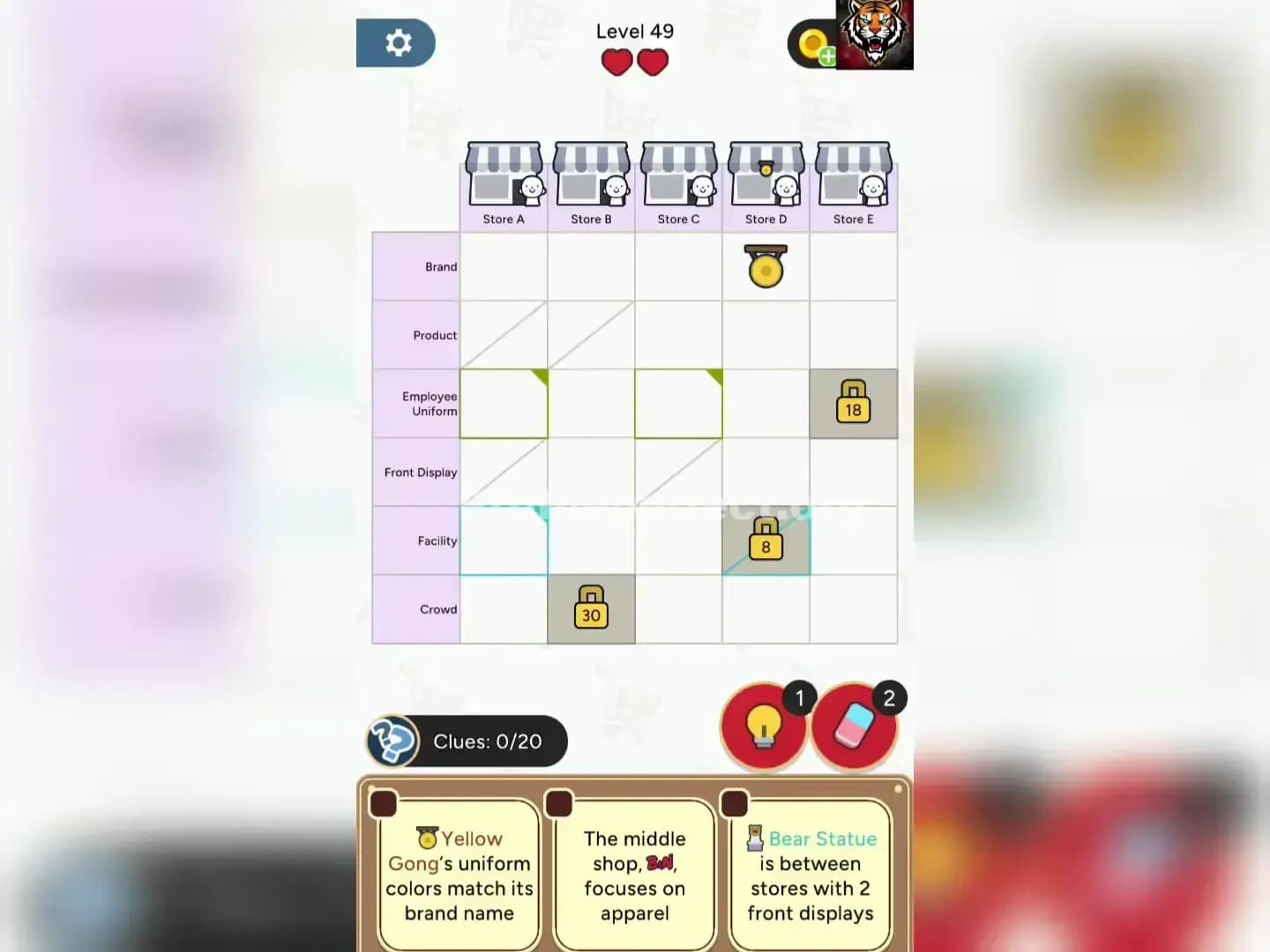
Profile Perfect leans fully into that second craving. Level 49, a level built around five competing stores in a mall, shows how deep that deduction can go. You are matching each store to its brand, its product, its employee uniform color, its front display, its facility, and how crowded it gets. Twenty clues stack on top of each other. One clue tells you the least crowded store sits next to the second most crowded. Another tells you a touch display facility sits to the left of a specific crowd number. You are not scanning for a pattern here. You are building a case, clue by clue, until every store's profile is confirmed.
Here is where a lot of logic puzzle games lose mobile players. They borrow the deduction of a paper logic grid but forget that people are playing on a phone, often in short bursts, often with one thumb. Profile Perfect avoids that trap in a few specific ways.
There is no timer anywhere in the game. That single choice changes everything about how the puzzle feels. You are not racing a clock while also trying to think clearly, which is a strange and stressful combination that plenty of "relaxing" puzzle games still force on players. Without a timer, you can sit with a tricky clue as long as you need.
The two life system keeps things from feeling too loose, though. A wrong tap costs a life, and losing both lives sends you back to try again. That small stake keeps you careful without punishing you the way a countdown does. You are not guessing against time. You are reasoning against your own certainty.
Session length matters just as much. A level like Stall A through D in Level 18 takes a few focused minutes, not a dedicated sitting. Even a heavier level like the five stores in Level 49, with its twenty clues, still resolves within a single short session once you get moving through the deduction chain. That is the mobile pacing that match three fans already expect. Profile Perfect just fills that pacing with clue reading instead of tile swapping.
Boosters exist too, and they work the way good mobile tools should. They can reveal a single cell or solve one clue, but they never clear the whole board for you. That keeps the deduction yours to finish, which matters more in a logic game than in almost any other genre, since the entire point is the thinking, not just the completion.
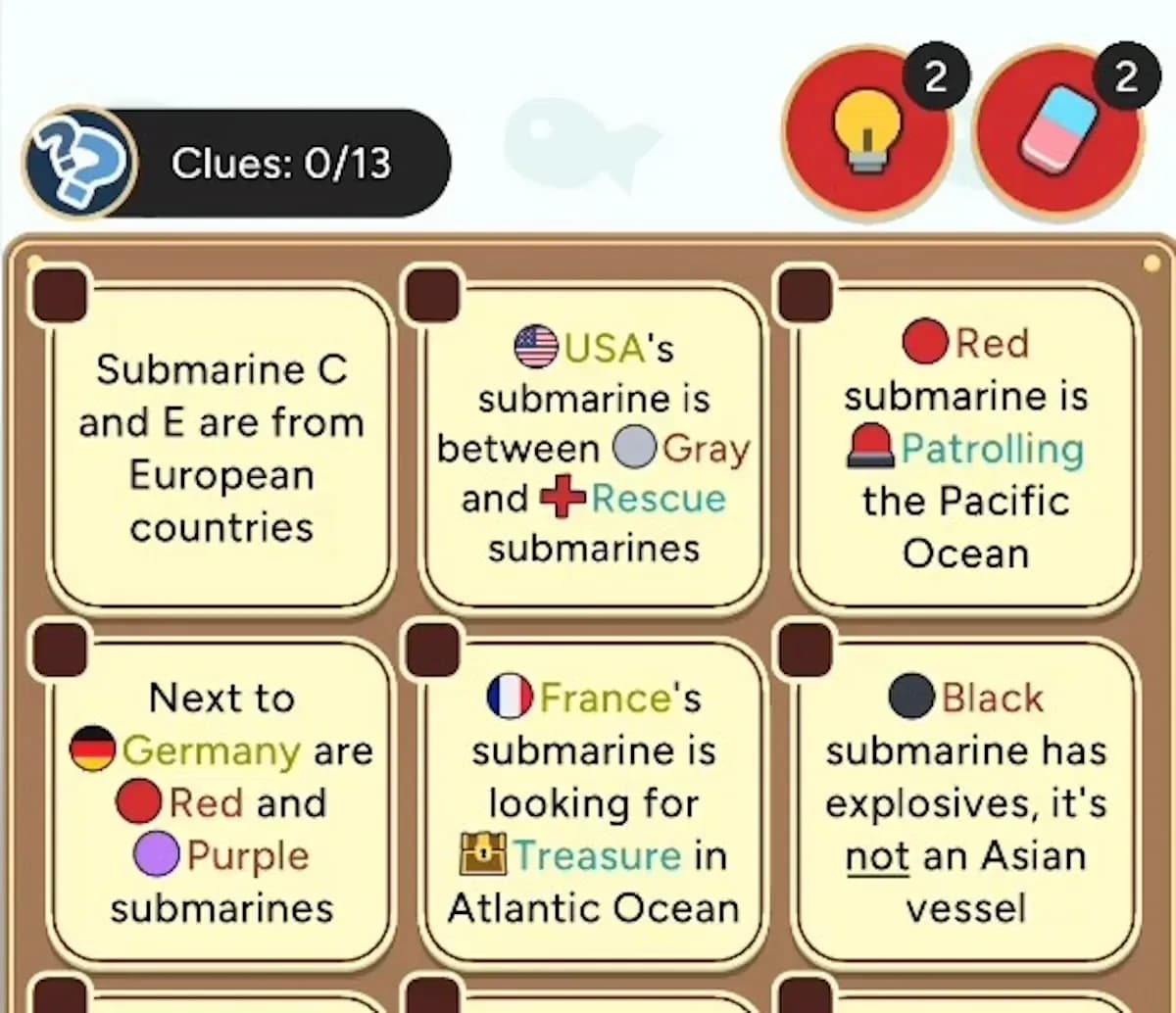
Match three is not going anywhere, and it should not. It is a great answer to a specific mood: quick, colorful, low effort, high reward. Logic grid games like Profile Perfect answer a different mood entirely, one built on observation, patient reasoning, clue interpretation, and the quiet confidence of ruling out a wrong answer before you tap.
You do not have to pick a side. Plenty of players keep both installed, reaching for one when they want speed and the other when they want a case to crack. If you have cleared thousands of match three boards and started wondering what else your phone could offer your brain, that is not boredom. That is a different craving showing up, and Profile Perfect was built to answer it.