
A behind the scenes look at how Profile Perfect builds clue chains that create an aha moment, using the Room level's Kitchen to Bedroom to Floral wall chain and the Bus level's Manchester to Zigzag to priciest fare chain as worked examples.

Guide By Liam Stone
Published on July 7, 2026
Liam Stone has played Profile Perfect since the app first launched on the Apple App Store. He spotted its potential early, and that early bet turned into hundreds of hours spent solving levels, testing clue logic, and documenting answers for other players. Liam runs the YouTube channel Puzzle Game Answer where his puzzle walkthroughs have earned over 935,000 views and a growing community of more than 800 subscribers. He covers a wide range of mobile puzzle games beyond Profile Perfect, giving him firsthand experience with how these games design clues, structure levels, and trip up even experienced players. Every guide on this site reflects that hands on experience. Liam plays each level himself, verifies every answer against the in game grid, and rewrites confusing clues into plain language so you don't need to guess. If you want more of his walkthroughs, subscribe to his channel.
Loading calendar...
Some clues in Profile Perfect solve alone. You read one line, tap one cell, move on. Those clues are fine, but they are not the ones you remember an hour later. The clues that stick are the ones that arrive in a chain, where one answer becomes the key that opens the next clue, and that answer becomes the key for a third. By the time you tap the final cell, you are not solving one clue anymore. You are closing a loop that started three steps back.
I want to break that loop open and show you exactly how it works, using two levels from my own runs, the Room level and the Bus level. Both hide a real chain inside a handful of clues, and once you see the shape of that chain, you start noticing it everywhere else in the game.
Every satisfying clue chain follows the same three part shape. Clue A gives you a fact you can lock in right away. That fact is not the answer you actually want, it is the doorway to it. Clue B reads that locked fact and uses it to hand you a second answer, one you could not have reached without clue A already sitting on the board. Clue C then takes that second answer and turns it into the piece you were missing from the start.
Clue A opens clue B. Clue B unlocks clue C. Then you tap the grid, and the cell that had been sitting blank for three clues suddenly has an answer in it. That tap is the aha moment. It feels bigger than a normal correct guess because it is not one deduction, it is three deductions collapsing into a single motion.
Profile Perfect hides this shape inside almost every level, but it shows up cleanest in the smaller grids, where you can watch the whole chain happen in the space of four or five lines.
Level 3 keeps things small on purpose, two rooms, three traits, a short clue list. That size makes the chain easy to trace with your own eyes.
The puzzle opens with tools to make food can be found in Room B. Only two room types exist in this level, Bedroom and Kitchen, and only one of them involves cooking tools. You tap Kitchen for Room B. That is clue A, and it gives you a locked fact you did not have thirty seconds earlier, Room B is the Kitchen.
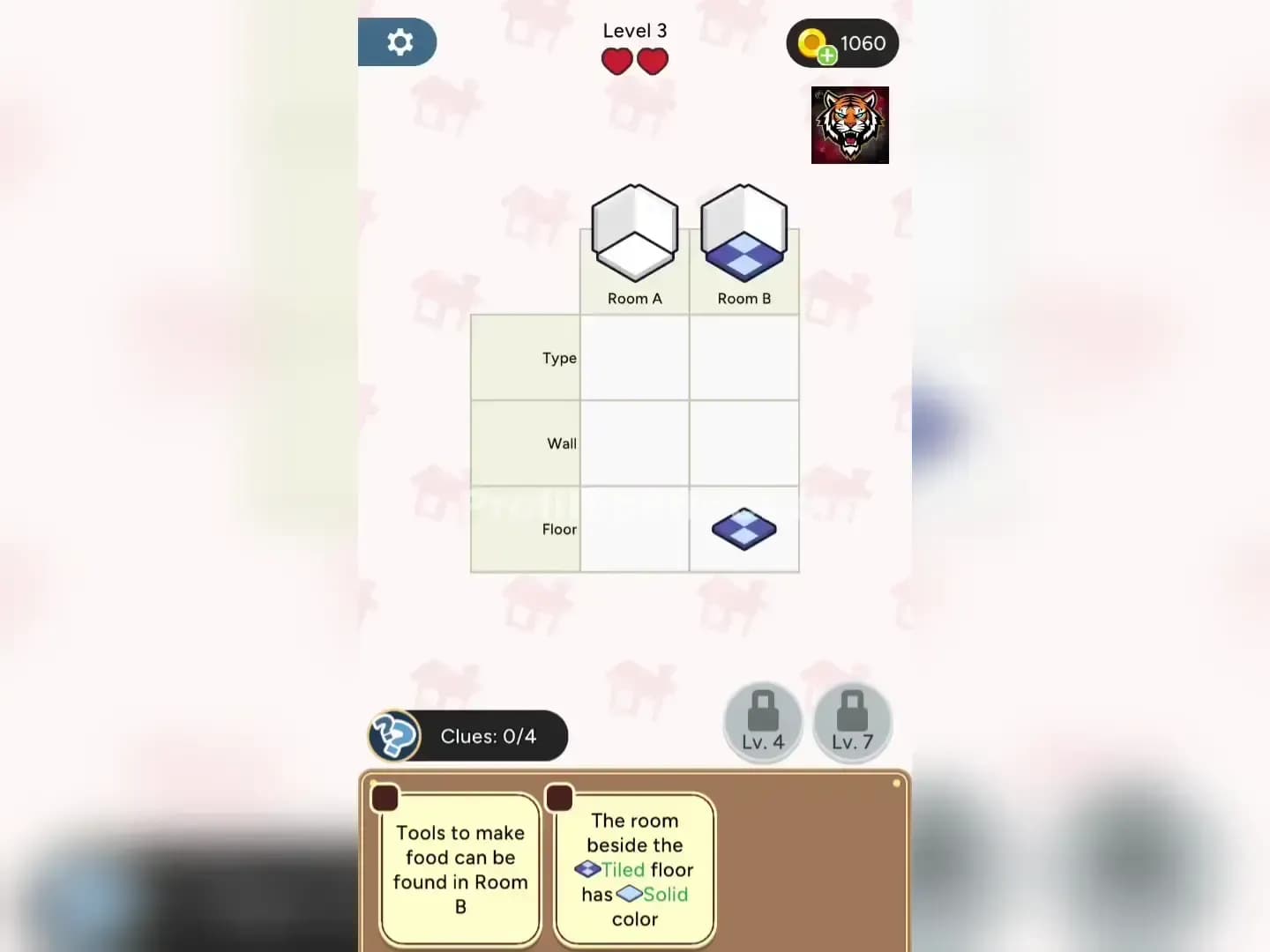
The next clue reads next to the Kitchen is the room where people sleep. Notice what that sentence needs from you before it means anything. It needs a Kitchen already placed on the board, because the whole clue is built around the word next. Without clue A, this sentence is just a vague description of some room somewhere. With clue A sitting in Room B, the phrase next to the Kitchen points straight at Room A, and room where people sleep gives you Bedroom. That is clue B, and it only worked because clue A opened the door for it.
The final clue in that short chain says the Bedroom has a Floral pattern on the wall. On its own, this sentence just connects a room type to a wall pattern, nothing special. But you only know which room is the Bedroom because of clue B, and clue B only existed because of clue A. So when you tap Floral for Room A's wall, you are really closing a three step loop, Kitchen led to Bedroom, Bedroom led to Floral. The tap lands, and the whole small grid clicks into a finished picture in under five lines of text.
That is the chain the assignment behind this article points at directly, Kitchen leads to Bedroom, Bedroom leads to Floral wall. It is the cleanest version of the three part shape you will find in the early levels, precisely because there is nowhere for the chain to hide.
Level 20 gives you five buses instead of two rooms, and it hands you Bus B's destination for free before you tap anything. The initial answer already tells you Bus B goes to Manchester. That locked fact works like a header on a file folder, everything else about Bus B gets filed underneath it as you go.
Two early clues read straight off that header. The bus heading to Manchester has a Zigzag pattern, and the ticket to Manchester is the most expensive. Both clues use the same anchor, Manchester, to hand you two more facts about the same bus without any extra work, Zigzag pattern and priciest fare. By the time you have read three clues, Bus B's file already has three of its four traits filled in, Manchester, Zigzag, and the top fare tier. That is the shape the level wants you to notice, Manchester opens Zigzag, and the same anchor opens the priciest fare right behind it.
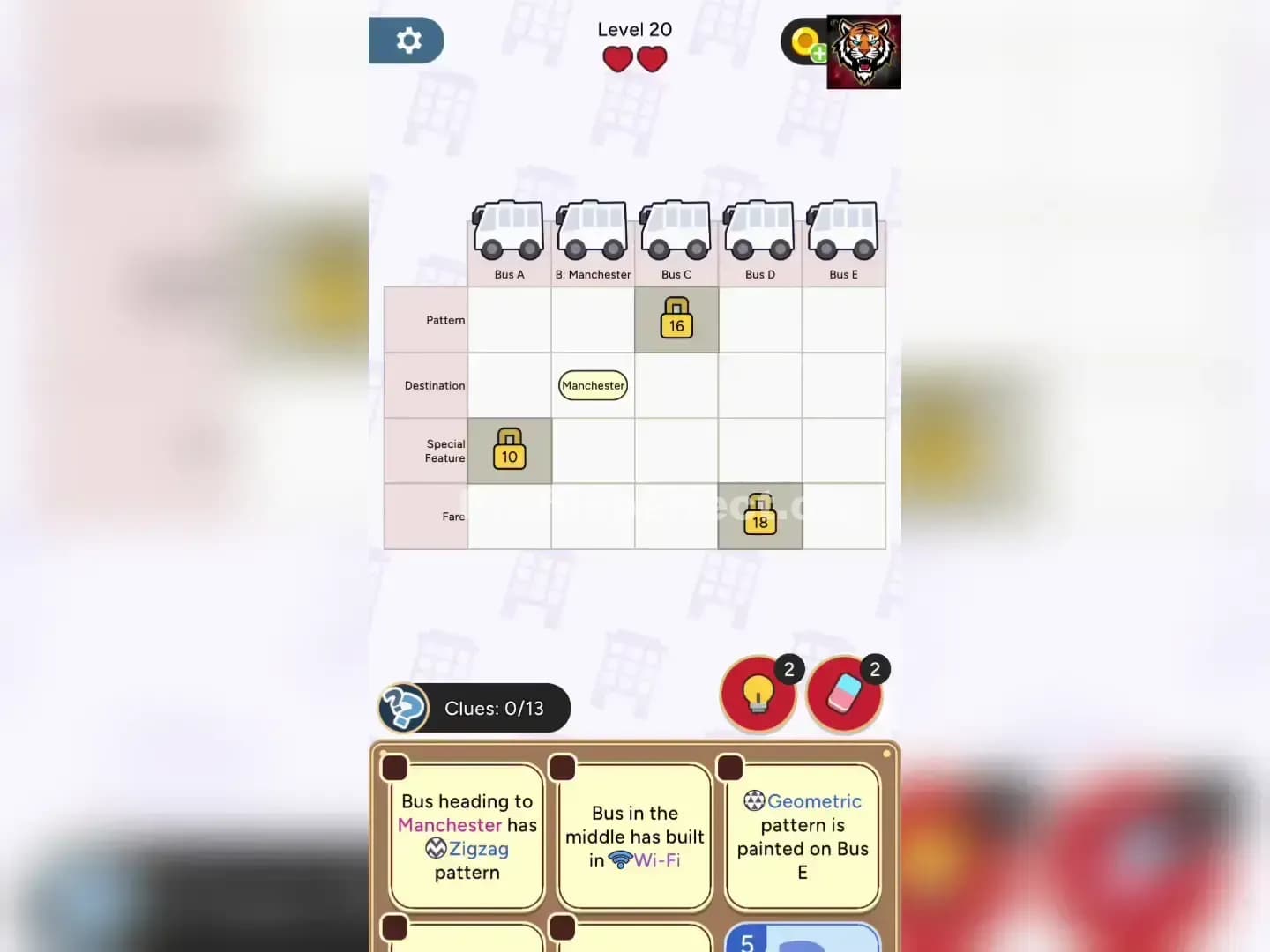
Bus B still has one blank cell left, its special feature, and this is where the real three link chain shows up. Clue two says the bus in the middle has built in wifi. That is clue A, and it hands you a locked fact about Bus C without naming Bus C directly, just its position in the row.
Clue six reads the bus with wifi is heading to Oxford. This clue is useless without clue A already on the board, because the whole sentence hinges on knowing which bus has wifi. Once you know that, the sentence hands you Bus C's destination, Oxford. That is clue B, opened directly by clue A.
Clue seven finishes the sequence, the bus with a sleeper seat is on the left of the bus to Oxford. You now know exactly which bus goes to Oxford, so left of that bus points at one specific seat, Bus B. The sleeper seat lands in the last blank cell of Bus B's row, and the file that started with a free Manchester header is now complete, destination, pattern, feature, and fare all filled in. Clue A opened clue B, clue B unlocked clue C, and the final tap on the special feature cell is the aha moment for that entire row.
Once you notice these chains, the easiest way to hold them in your head is to draw them the way a designer would, as plain arrows between clue numbers instead of paragraphs of text.
For Level 3, the chain looks like this:
Clue 1 (Kitchen) → Clue 3 (Bedroom) → Clue 4 (Floral wall)
For Level 20, the chain that closes Bus B's last cell looks like this:
Clue 2 (middle bus has wifi) → Clue 6 (wifi bus goes to Oxford) → Clue 7 (sleeper seat sits left of Oxford, landing on Bus B)
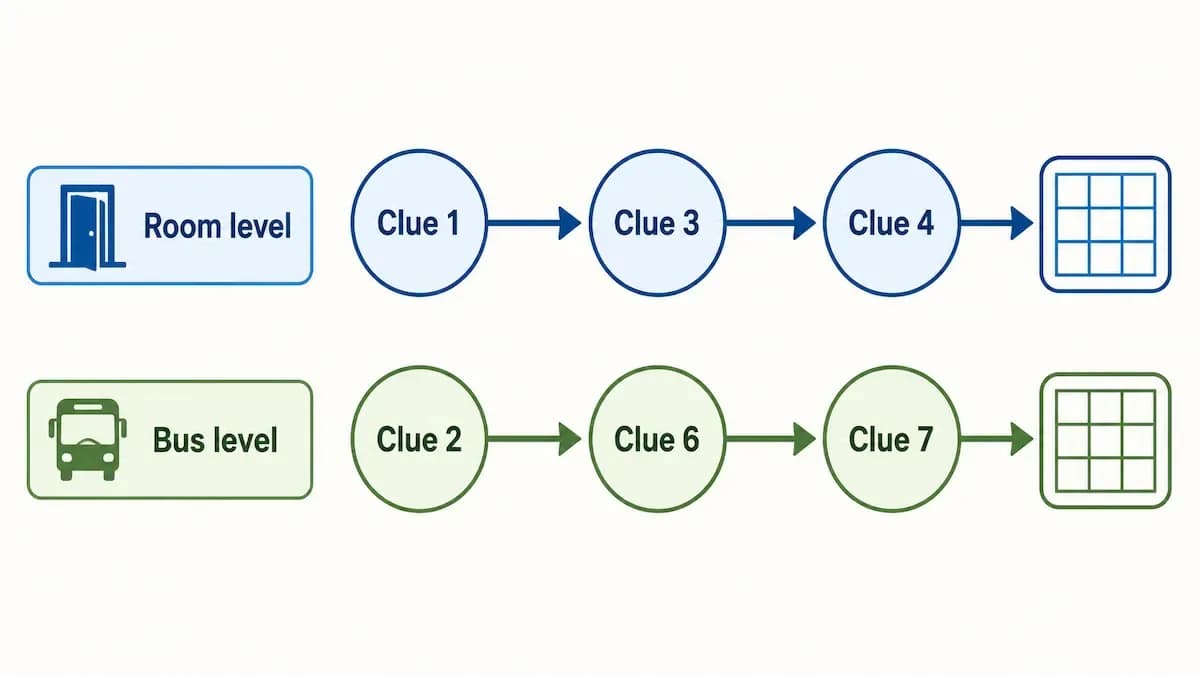
Drawing it this way strips away the sentence structure and leaves only the dependency. You can see at a glance that clue 3 needs clue 1 to mean anything, and clue 7 needs clue 6, which needs clue 2. That dependency is the entire trick behind why these moments feel bigger than a single correct tap.
None of the individual clues in these two chains are hard to read on their own. Tools to make food, bus in the middle has wifi, none of that is complicated language. The difficulty, and the payoff, comes from the order. Each clue is a small, easy fact by itself. Stacked in sequence, they turn into a locked loop that only opens if you read them in the right order and remember what the last one told you.
That is the real design goal behind a clue chain. It is not about writing a harder sentence. It is about placing three easy sentences in a row so that reading them in order feels like discovery, and reading them out of order feels like nothing at all. The next time a Profile Perfect level hands you a clue that seems to lean on an earlier one, follow the thread all the way back. You will usually find a locked fact sitting two or three clues upstream, quietly doing all the work.