
Learn the row reduction technique for Profile Perfect. Eliminate candidates one clue at a time on a single row until one answer remains, using Level 6's Bag puzzle and Level 79's Locker puzzle as worked examples.

Guide By Liam Stone
Published on July 7, 2026
Liam Stone has played Profile Perfect since the app first launched on the Apple App Store. He spotted its potential early, and that early bet turned into hundreds of hours spent solving levels, testing clue logic, and documenting answers for other players. Liam runs the YouTube channel Puzzle Game Answer where his puzzle walkthroughs have earned over 935,000 views and a growing community of more than 800 subscribers. He covers a wide range of mobile puzzle games beyond Profile Perfect, giving him firsthand experience with how these games design clues, structure levels, and trip up even experienced players. Every guide on this site reflects that hands on experience. Liam plays each level himself, verifies every answer against the in game grid, and rewrites confusing clues into plain language so you don't need to guess. If you want more of his walkthroughs, subscribe to his channel.
Loading calendar...
You lose lives in Profile Perfect by tapping a cell before you actually know the answer. Most wrong taps come from the same habit. You feel like a value is probably right, so you tap it, and it turns out another subject already owns that value.
Row reduction fixes this. You pick one subject, treat every trait in that subject's row as a set of candidates, and cross candidates out one clue at a time until exactly one option survives. When you get there, you tap with real certainty instead of a hunch. This lesson walks through that process using a single row from Level 6's Bag puzzle, then shows the same move solving a hidden value in Level 79's Locker puzzle.
Every subject in a Profile Perfect grid has one row. That row has a cell for each trait, and each cell starts out open to every value the puzzle offers for that trait. You don't know yet which value belongs in which cell. Row reduction is the process of narrowing each cell's candidates down to one, using the clues attached to that subject.
The puzzle almost always resolves this way. A clue rarely hands you a finished answer. Instead it removes a possibility, or it locks a value onto a different subject, which means your subject can no longer hold that value. Do that enough times to one row and you end up with a single surviving candidate in each cell. That candidate is your answer.
Clues come in two flavors, and you need both to make row reduction work. A direct clue tells you a value belongs to a subject, such as "Bag A is from Germany." A negative clue tells you a value does not belong somewhere, such as "the bag from France is not colored red." Direct clues fill a cell in. Negative clues cross a candidate off a list. You'll use both in the walkthrough below, and neither one works as well without the other. A direct clue on one subject often becomes the negative clue that finishes a different subject's row, because a value that's already taken can't show up twice.
Level 6 has three subjects, Bag A, Bag B, and Bag C, and four traits covering type, color, origin, and price. The finished grid puts Bag A at backpack, red, German, and medium price. You don't know any of that yet. You know the type of information the puzzle asks for, and that's the row you're going to fill.

Before you touch a single clue, Bag A's color cell could hold any of the three colors in play, red, purple, or green. That's the starting point for row reduction. Write those three candidates down, mentally or on paper, because you're going to remove two of them one clue at a time.
The puzzle hands you an initial answer that Bag A's price is medium. That's a freebie, no reduction needed. The color cell is where the real work happens.
Start with the clue that says Bag C is cheaper than the German bag. Bag A is the German bag, and its price is medium, so Bag C's price has to sit below medium, which means Bag C is the low priced bag. Now bring in the clue that says the cheapest bag is colored green. Bag C is the cheapest, so Bag C is green. That's one color placed, and it's not on Bag A's row, but it still matters, because green just left Bag A's candidate list. Bag A's color options drop from three to two, red or purple.
Next, the clue about neighbors tells you the French bag sits next to the German bag. With only three bags in this puzzle, that neighbor has to be Bag B, so Bag B is the French bag. Then the clue that the French bag isn't colored red removes red from Bag B's candidates, leaving Bag B with purple. Purple is now taken. Look back at Bag A's row. It started with three color candidates. Green went to Bag C. Purple went to Bag B. One color is left standing for Bag A, and it's red.
That's the whole move. You never guessed. You crossed out options because the puzzle told you, directly or through a neighbor, that those options belonged somewhere else.
Here's the mistake that costs lives. Once you know Bag B is purple, it's tempting to jump straight to Bag B's row and start filling in its other traits, since you're already thinking about that subject. Resist that. Finish Bag A's row first. The type and origin cells for Bag A resolve the same way, through elimination as Bag B and Bag C's types get pinned down, and if you jump around between rows before any single row is fully locked, you'll lose track of which candidates you've actually confirmed versus which ones you're assuming. Stay on one row until every cell in it shows exactly one candidate, then move to the next subject.
Bag A's color cell now holds one candidate, red. Every other option got removed for a reason you can point to, not a hunch. That's what makes the tap safe.
Profile Perfect grids work on a simple rule. Every value shows up exactly once per trait across the whole puzzle. If you've correctly assigned green to one subject and purple to another, and there are only three colors available, the third subject cannot be anything but the third color. There's no scenario where the grid contradicts that outcome, because the puzzle can't reuse a value it already placed. Once a cell has exactly one remaining candidate, and you got there through clues rather than guesses, that candidate is the answer. Tap it.
Level 79 stretches this technique further. It has five lockers, A through E, with traits for lock type, upper shelf, lower shelf, and number. Two of the answers are hidden values you have to earn through deduction rather than read off the board, and one of them is Locker D's lock type. Row reduction gets you there the same way it got you to Bag A's color.
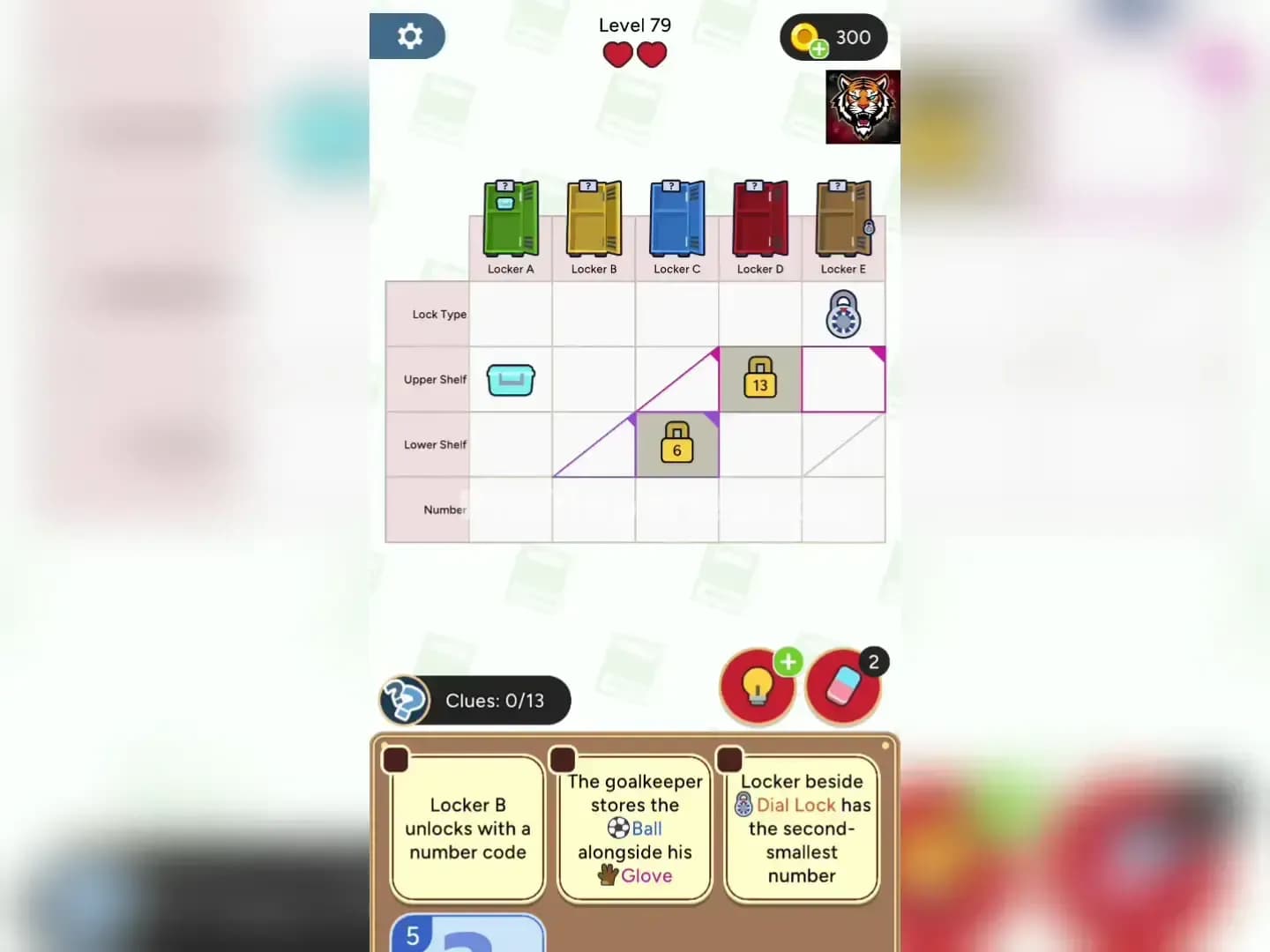
Before any clues narrow things down, Locker D's lock type could be any of the five options in the puzzle, fingerprint, number lock, cable lock, padlock, or dial lock. Watch how fast that list shrinks.
An early clue assigns the number lock directly to Locker B, so cross number lock off Locker D's list. The puzzle's own setup places the dial lock on Locker E, so cross that off too. Another clue puts the cable lock on Locker C, which leaves Locker D with only two candidates, fingerprint or padlock.
Now bring in the negative clue. It says the locker holding the glove has no sensor. A separate direct clue already told you Locker D holds the glove, on its upper shelf, right next to the soccer ball on the lower shelf. A fingerprint lock works through a sensor, so if Locker D has no sensor, it can't be the fingerprint lock. Cross that off. One candidate remains, and it's padlock. That's the hidden value, and you reached it the exact same way you reached Bag A's red, one elimination at a time, on one row, without skipping ahead.
The rest of Locker D's row falls into place the same way. Its number resolves to 35 through a clue about the second smallest number in the puzzle, once you've ruled out the numbers already claimed by other lockers. None of it requires a lucky guess. It requires staying on Locker D's row until every cell shows one candidate.
Both examples follow the same shape. Pick a subject, list what its cells could still be, then remove candidates as clues and other subjects' confirmed answers rule them out. The grid resolves cleanly because it has to. Only one value can occupy each trait slot, so once you've placed every other candidate somewhere else, the last one left has nowhere else to go.
Run through this before you tap any cell.
If you can answer all four without hesitating, tap the cell. If you can't, go back to the row and keep eliminating. That's the whole method, and it works the same whether you're deducing a bag's color or digging out a locker's hidden lock type.