
A reflective look at why Profile Perfect rewards slow, careful clue reading over quick taps, with a step by step solve of the Level 15 Hiker puzzle showing how patience fills the grid.


Guide By Liam Stone
Published on July 7, 2026
Liam Stone has played Profile Perfect since the app first launched on the Apple App Store. He spotted its potential early, and that early bet turned into hundreds of hours spent solving levels, testing clue logic, and documenting answers for other players. Liam runs the YouTube channel Puzzle Game Answer where his puzzle walkthroughs have earned over 935,000 views and a growing community of more than 800 subscribers. He covers a wide range of mobile puzzle games beyond Profile Perfect, giving him firsthand experience with how these games design clues, structure levels, and trip up even experienced players. Every guide on this site reflects that hands on experience. Liam plays each level himself, verifies every answer against the in game grid, and rewrites confusing clues into plain language so you don't need to guess. If you want more of his walkthroughs, subscribe to his channel.
Loading calendar...
I used to skim everything. Text messages, recipe steps, the fine print on a parking sign. My eyes would jump to the end before my brain finished the beginning. Then I opened Profile Perfect one slow evening, and the game asked me to do something I had almost forgotten how to do. It asked me to read.
Not read fast. Not read for the gist. Read a single sentence, sit with it, and let it tell me exactly what it meant before I touched anything on the screen.
Profile Perfect looks simple on the surface. You get a set of subjects across the top of a grid, a set of traits down the side, and a pile of clues that connect them. You read the clues, compare the profiles, fill in the grid, and try not to make a wrong selection. That is the whole loop. No timer counts down in the corner. No swarm of falling blocks demands a quick decision.
Because nothing rushes you, the game quietly shifts the pressure from your fingers to your eyes. The tapping part is easy. Anyone can tap a cell. The reading part is where the actual puzzle lives, and it only works if you slow down enough to notice what each sentence is actually claiming.
Skim a clue in Profile Perfect and you will grab the wrong meaning almost every time. A sentence like "the hiker at the waterfall is very excited" looks like a throwaway detail on a fast read. Read it properly and it locks two answers into place at once. The game rewards the reader who treats every sentence as a small contract, not the reader who scans for keywords and moves on.
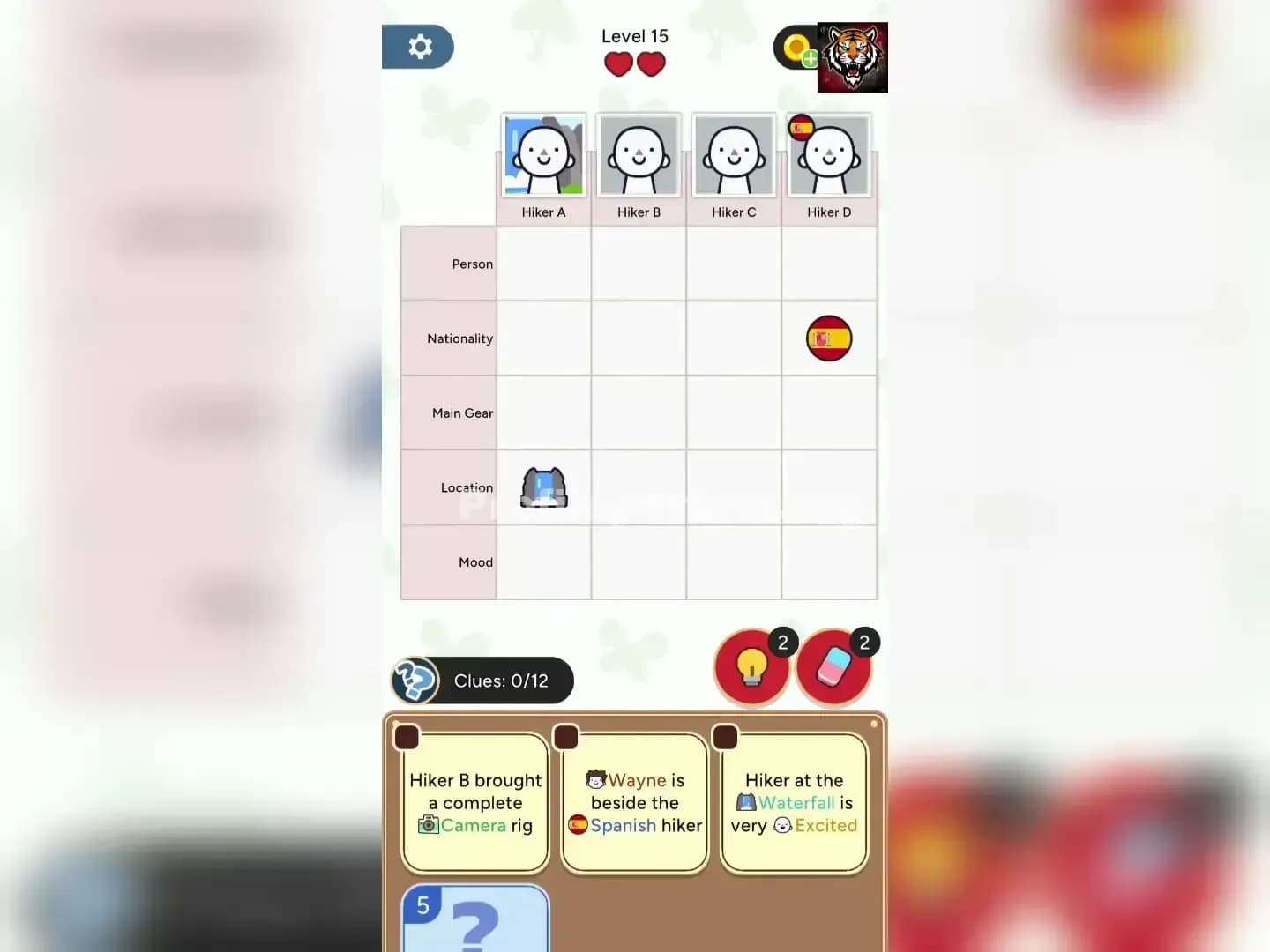
Open the clue panel and you will notice the writing has a certain shape to it. Clues rarely announce an answer outright. They describe a scene, a relationship, a small fact about a person, and leave you to translate that fact into a grid category. "Wayne is beside the Spanish hiker" is not a nationality lesson. It is a pointer. It tells you which hiker Wayne is, and it does that by borrowing a fact you already locked in earlier.
That translation step, from plain sentence to grid answer, is the actual game. Everything else is just bookkeeping.
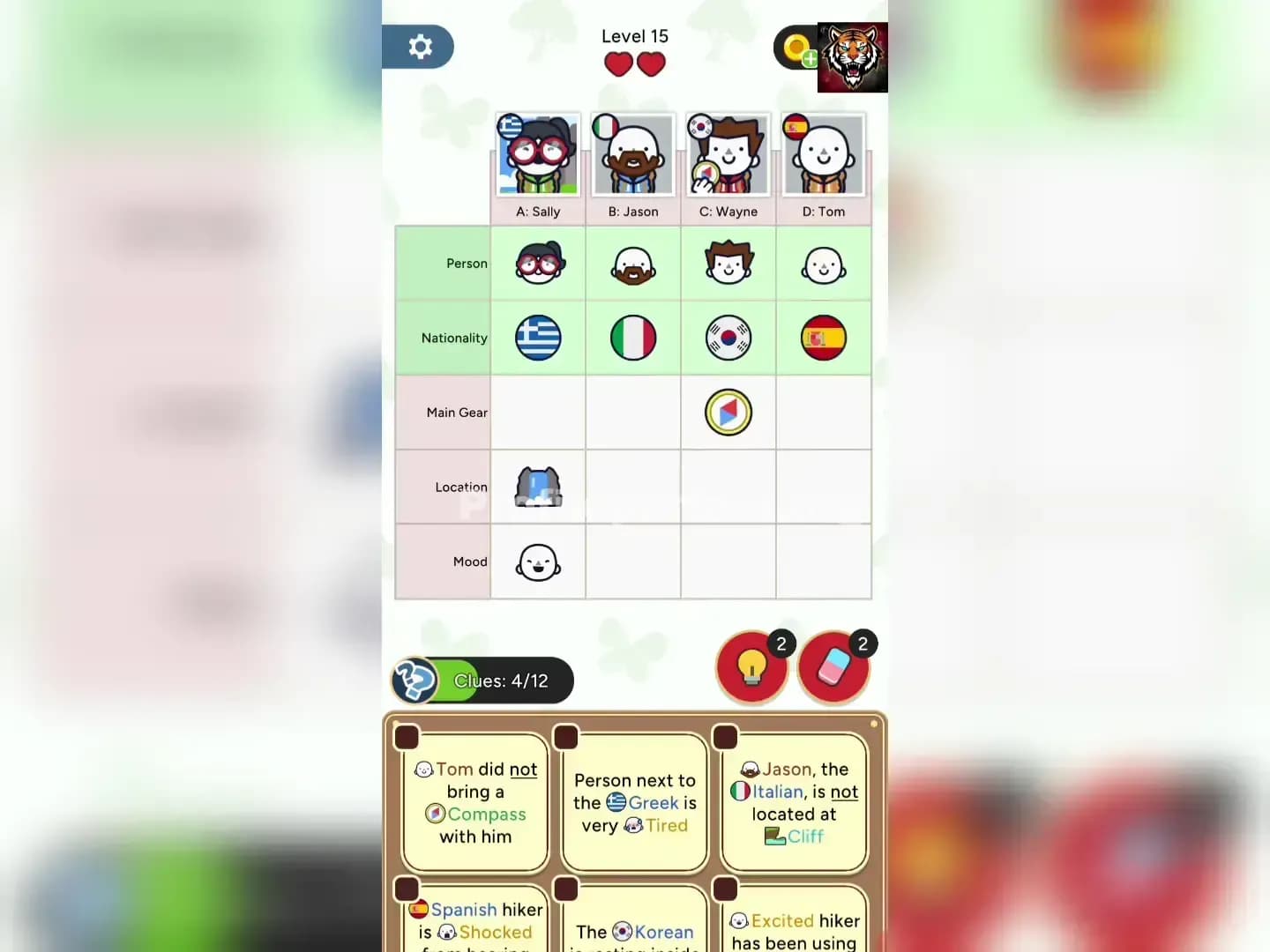
Take a clue from Level 15, the Hiker level. It reads, "The Korean is resting inside a cave."
What it says. One hiker's nationality is Korean, and that same hiker's location is a cave.
What it implies. Once you already know which hiker still needs a nationality, this clue hands you two answers for the price of one. If three of the four hikers already have a confirmed nationality, "Korean" can only belong to the hiker still sitting empty, and that hiker's location falls into place at the same moment.
What to tap. Korean under nationality, cave under location, both landing in the same hiker's row.
Say the same fact three different ways and it stops feeling like trivia. It starts feeling like a small chain you can follow with your finger.
Profile Perfect uses a two life system instead of a clock. Get a wrong answer and you lose a life. Lose both and you restart the level. That single design choice changes how a person's eyes move across the screen. You stop scanning for the fastest plausible answer and start checking your own logic before you commit to it.
There is a small, specific pleasure in that pause. You read the clue again. You trace it back to what the grid already shows you. You confirm the link is solid before you tap, rather than tapping and hoping. Nothing about that feels urgent, and that is exactly the point.
Rush through Profile Perfect and the two life system punishes you fast. A clue like "person with a camera is not in the cave right now" sounds like it eliminates one option, but it only works once you already know who is carrying the camera. Tap before you have that piece, and you are guessing. The game does not care how confident the guess feels. Wrong is wrong, and a life disappears either way.
Slow down instead, and the same clue becomes a checkpoint rather than a gamble. You read it, you check what you already know, and only then does your hand move.
Here is how a real solve unfolds on Level 15, moving at the pace the game actually wants.
The grid opens with two answers already locked. Hiker D's nationality is Spanish, and Hiker A's location is the waterfall. Nothing to solve there yet, just a starting point to read against.
Clue two says Wayne sits beside the Spanish hiker. That places Wayne as Hiker C, since Hiker D already holds the Spanish nationality. One name locked, purely from reading, no guessing involved.
Clue five says the hiker named Sally is not Korean and not Italian. Combined with what the grid already shows about Hiker A, that leaves Sally as Greek. A second name, and a nationality, both from careful cross checking rather than a lucky tap.
Now the nationality clue does its quiet work. Spanish belongs to Hiker D, Greek belongs to Hiker A, and clue eight confirms Jason as the Italian hiker in Hiker B's row. Three nationalities are gone. Only one hiker and one nationality remain unmatched, so Korean has to belong to Wayne, in Hiker C's row, with no clue spelling that out directly. This is the elimination moment the whole level has been building toward, and it only clicks if you have been reading in order rather than jumping around the grid.
Clue eleven confirms it from the other direction. The Korean hiker rests inside a cave. Wayne's row now holds a name, a nationality, and a location, three cells filled from patience rather than force.
Clue six ties off the mood. It describes the Spanish hiker's shock at hearing about Wayne's condition, and inside that same sentence sits the answer for Wayne himself. Sick. A clue about someone else's reaction ends up finishing a different hiker's row.
The gear is the last piece, and it needs no clue of its own. The walking stick belongs to Hiker A, the camera belongs to Hiker B, the map belongs to Hiker D. Only the compass is left, and it settles into Wayne's row simply because there is nowhere else for it to go.
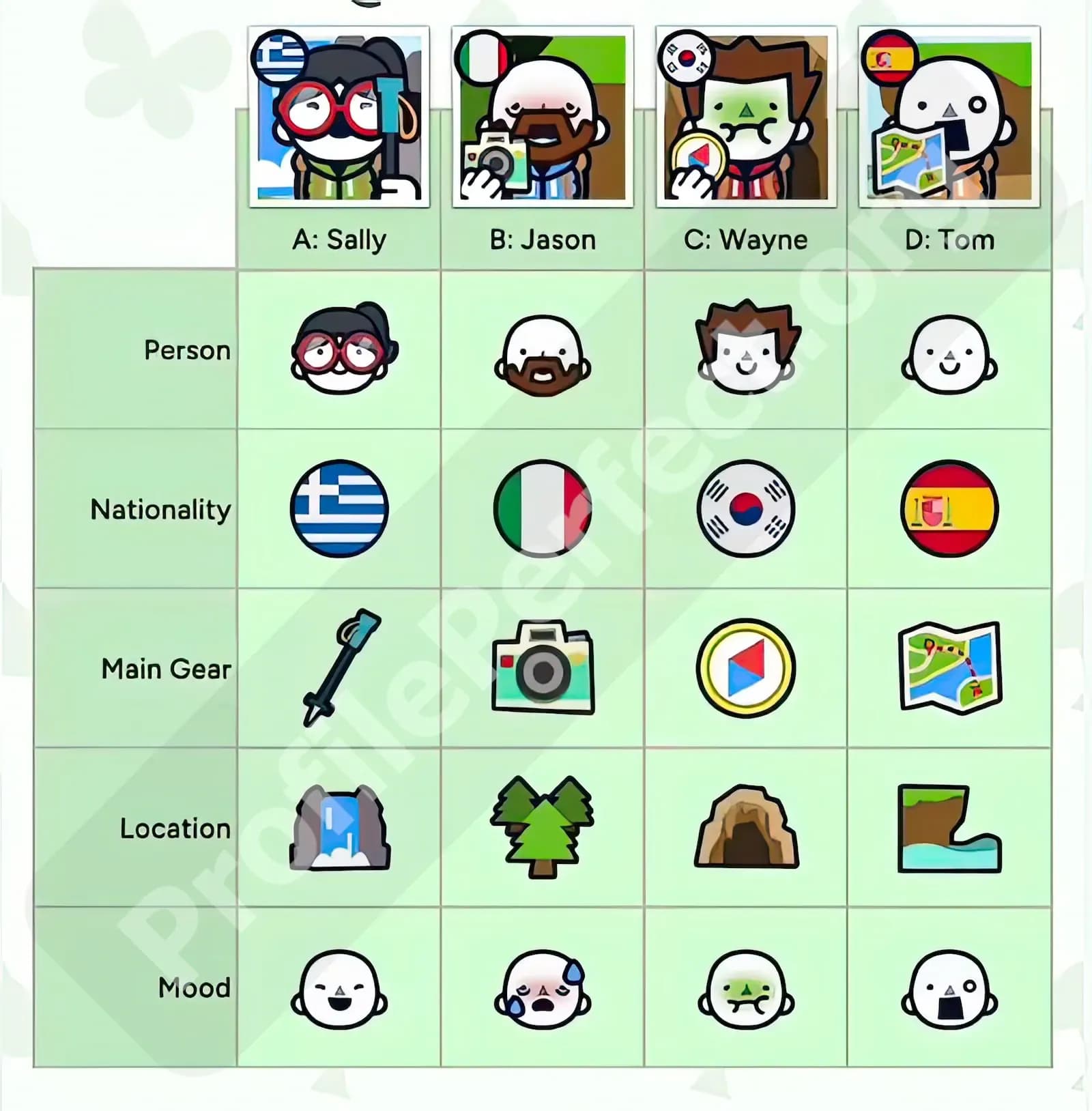
Five cells, five different paths to get there. Some from a direct sentence, some from a name already ruled out elsewhere, one from pure elimination with no supporting clue at all. None of it happens quickly, and none of it needs to.
I still skim plenty of things. Emails, headlines, group chats. But Profile Perfect has become the one part of my day where I let a sentence finish before I react to it. There is no trick to the game beyond that. Read the clue, compare it to what you already know, tap only when the two line up. The satisfaction is not in speed. It is in the small, steady feeling of a grid filling in because you paid attention, one clue at a time.