A behind the scenes look at retroactive obviousness, the design trick that makes Profile Perfect clues feel confusing at first and obvious after, with examples from the Room, Building, and Cave levels.

Guide By Liam Stone
Published on July 7, 2026
Liam Stone has played Profile Perfect since the app first launched on the Apple App Store. He spotted its potential early, and that early bet turned into hundreds of hours spent solving levels, testing clue logic, and documenting answers for other players. Liam runs the YouTube channel Puzzle Game Answer where his puzzle walkthroughs have earned over 935,000 views and a growing community of more than 800 subscribers. He covers a wide range of mobile puzzle games beyond Profile Perfect, giving him firsthand experience with how these games design clues, structure levels, and trip up even experienced players. Every guide on this site reflects that hands on experience. Liam plays each level himself, verifies every answer against the in game grid, and rewrites confusing clues into plain language so you don't need to guess. If you want more of his walkthroughs, subscribe to his channel.
Loading calendar...
You tap the wrong cell in Profile Perfect, lose a life, and mutter that the clue made no sense. Thirty seconds later you solve the same clue a different way, look back at the wording, and it reads like the answer was sitting right there the whole time. Nothing about the clue changed. You changed.
That flip is not an accident. It is a design trick, and once you notice it, you start seeing it in almost every level. Game designers have a name for the feeling, even if players never hear it, retroactive obviousness. The clue looks vague before you solve it and looks inevitable after. I want to walk through how that trick works using three levels from my own runs through the game, a two room level, a three building level, and a cave level, and show you the exact moment each one flips from confusing to obvious.
Before you dismiss a confusing clue as bad writing, it helps to know that the confusion is doing a job. A clue that names the answer outright gives you nothing to figure out. A clue that describes the answer without naming it forces you to sit with an unfinished thought for a second, and that second of not knowing is where the puzzle earns your attention.
The trick only works if the confusion resolves cleanly. If a clue stays foggy even after you fill in the grid, that is bad design, plain and simple. But when the fog lifts the instant you place the right answer, and the wording suddenly reads as plain fact, you get the specific pleasure Profile Perfect is built around. Confusion first, then a clean snap into place.
Here is how that snap plays out across three real levels.
Level 3 gives you two rooms, Room A and Room B, and asks you to match each one to a room type, a wall pattern, and a floor. Small grid, short clue list, nothing to hide behind.
The first clue reads, tools to make food can be found in Room B. Read it cold and it stalls you for a beat. Tools to make food. What kind of tools. What room has tools. The sentence does not hand you a category, it hands you a scene.
Translation happens the moment you notice the room type list only has two options, Bedroom and Kitchen. A picture of a stove or a cutting board cannot belong to a Bedroom, so it can only belong to one place. You tap Kitchen for Room B, and the game confirms it.
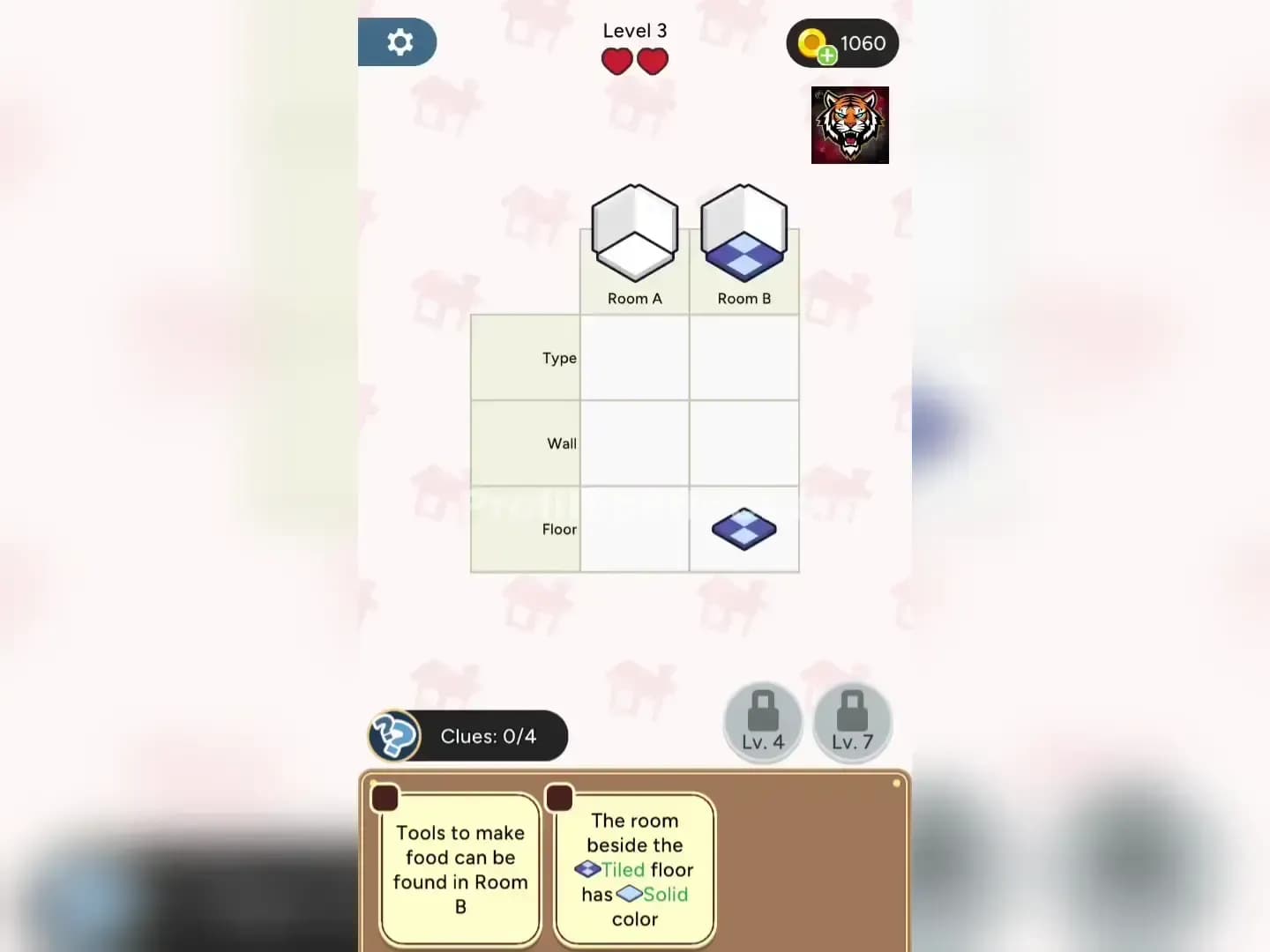
Now go back and reread the clue. Tools to make food can be found in Room B. It no longer feels like a riddle. It reads like a plain statement of fact, almost too simple to have been a clue at all. That is retroactive obviousness working exactly as intended. The sentence did not get easier. Your knowledge of the grid got bigger, and the sentence rode along with it.
The level backs up that snap with a second clue almost right away, next to the Kitchen is the room where people sleep. By this point Room B is locked as Kitchen, so this clue only has to point at Room A, and the phrase room where people sleep reads as Bedroom before you even finish the sentence. The first clue trains you on the trick. The second clue proves you learned it.
Level 16 raises the subject count to three buildings, a Hospital, a Supermarket, and an Office, each holding one person and one warning sign. The opening clue says building B is a great place to buy groceries.
On a first read, buy groceries is broad. Grocery stores, corner shops, farmers markets, the phrase alone does not commit to one building type. The confusion here is mild but real, because the sentence describes an activity, not a place.
The translation step arrives fast because the building type list only offers three choices, Hospital, Supermarket, and Office, and only one of those has anything to do with groceries. You place Supermarket on Building B.
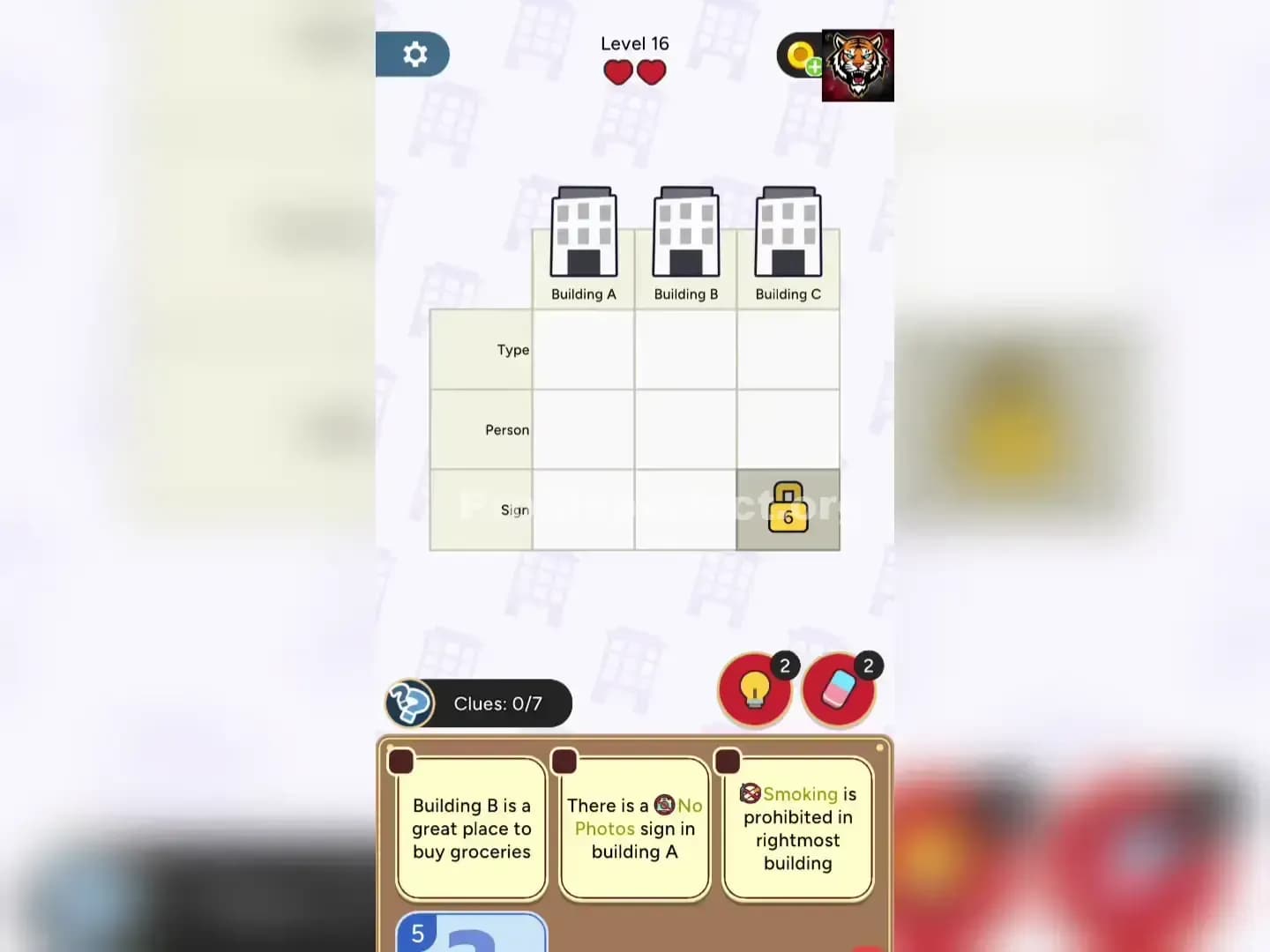
Reread the sentence now. Building B is a great place to buy groceries. It sounds less like a clue and more like a sign hanging outside the building. That shift from vague activity to obvious label is the whole design trick compressed into one line.
Later in the level, a clue says Mom is visiting her bedridden friend. This one is easy to skim past, because it reads like a small detail about a character rather than a fact about the grid. But bedridden friend describes exactly one kind of place, and once you already know Building A holds the No Photos sign, the visit locks Mom into that building and locks the Hospital label into place at the same time.
Go back and read it a third time, after solving. Mom is visiting her bedridden friend. Of course that is the Hospital. It was always the Hospital. The clue never changed its mind, you just needed the rest of the grid to catch up to the sentence.
Cave levels push the same trick further because the scenes get less domestic and more observational. Level 118 sets up three caves, a Sea Cave, an Ice Cave, and a Lava Tube, each holding a discovery and an animal resident.
The clue that carries the most hindsight weight reads, the cute animal who lives in the Ice Cave cannot fly. Before you solve anything, this sentence sounds almost playful, cute animal, no real information yet. The confusion is light but it is there, because cannot fly rules something out instead of pointing something in.
The translation clicks once you see the inhabitant options for that cave are only Pika and Swallow. Swallows fly. Pikas do not. One fact about birds erases half the choices, and Pika is what remains.

Read the clue again with Pika sitting in the grid. The cute animal who lives in the Ice Cave cannot fly. It reads like a nature documentary caption now, plain and settled. That is the same snap from Level 3 and Level 16, just wearing a different costume.
Not every clue in this level earns its obviousness the same way. The next clue reads, Olivine is a mineral found in cave made from dried up lava. After solving, this reads as clean fact, dried up lava becomes a Lava Tube, and Olivine belongs there. But that clarity depends on a piece of geology trivia that not every player already carries around. Retroactive obviousness works best when the fact behind it is close to universal, birds fly, groceries mean a store, cooking tools mean a kitchen. When the fact is closer to a trivia question, the hindsight snap still happens, but it happens with a small asterisk attached. Profile Perfect covers for that gap here by letting you confirm the same cave through elimination once the other two cave types are already taken, so the answer never depends on the mineral fact alone.
None of these three clues change their wording after you solve them. What changes is the amount of grid you can see at the moment you read the sentence. Before you place an answer, a clue like tools to make food or cannot fly sits alone, open to more than one reading. After you place answers around it, the same sentence has exactly one place left to land, and your brain reads that as obviousness instead of narrowing.
That is the actual trick behind a puzzle that feels obvious after you solve it. The designer never needed to make the clue easy. They needed to make the surrounding grid narrow enough that the clue only has one honest reading left by the time you get back to it. Confusion opens the door, translation walks you through it, the correct tap proves you read it right, and hindsight is just what happens when you look back through a door you already know the shape of.
Next time a clue in Profile Perfect stops you cold, try reading it twice, once before you solve it and once right after. The gap between those two reads is retroactive obviousness in action, and it is the reason a well built puzzle feels less like it tricked you and more like it was waiting for you to catch up.