
A tour of Profile Perfect's social media levels, covering a viral meme case, a five post feed, a four app home screen, a six trait influencer profile, and two company levels, showing how phone habits you already have turn straight into logic puzzle clues.


Guide By Liam Stone
Published on July 7, 2026
Liam Stone has played Profile Perfect since the app first launched on the Apple App Store. He spotted its potential early, and that early bet turned into hundreds of hours spent solving levels, testing clue logic, and documenting answers for other players. Liam runs the YouTube channel Puzzle Game Answer where his puzzle walkthroughs have earned over 935,000 views and a growing community of more than 800 subscribers. He covers a wide range of mobile puzzle games beyond Profile Perfect, giving him firsthand experience with how these games design clues, structure levels, and trip up even experienced players. Every guide on this site reflects that hands on experience. Liam plays each level himself, verifies every answer against the in game grid, and rewrites confusing clues into plain language so you don't need to guess. If you want more of his walkthroughs, subscribe to his channel.
Loading calendar...
Profile Perfect started as a digital investigation game, and nowhere does that identity show up clearer than in the levels built around your phone. You are not sorting dogs or dresses in these puzzles. You are opening a feed, checking a follower count, reading a notification badge, and treating every screen detail as evidence. Based on my gameplay across the levels built around memes, posts, apps, influencers, and the companies behind them, this is where the game feels the most like scrolling with a detective's eye instead of a casual one.
A dress has a pattern and an accessory. A phone screen has a lot more going on at once. It has an icon, a badge count, a position on the grid, a widget sitting nearby, and a color running through the whole case. That density is exactly what a good profile puzzle wants. Every screen element becomes its own trait column, and the game barely has to dress anything up because a phone already looks like a grid before the first clue even loads.
Open your own phone right now and count what you see without trying. App icons sit in a fixed position. Each one carries a notification number. A widget sits near a cluster of icons. The wallpaper or case color ties the whole layout together. Profile Perfect just borrows that existing structure and turns it into Icon, Notification Count, Position, Nearby Widget, and Phone Color, the exact trait list you will see in the app level below. Nothing about the puzzle has to feel invented, because the grid was already sitting in your pocket.
Likes, comments, followers, and revenue all share one thing that makes them puzzle friendly. They are numbers you already compare in real life without thinking about it. You already know a post with more comments than likes feels different from one that racks up both. Profile Perfect just asks you to prove that comparison with a grid instead of a gut feeling.
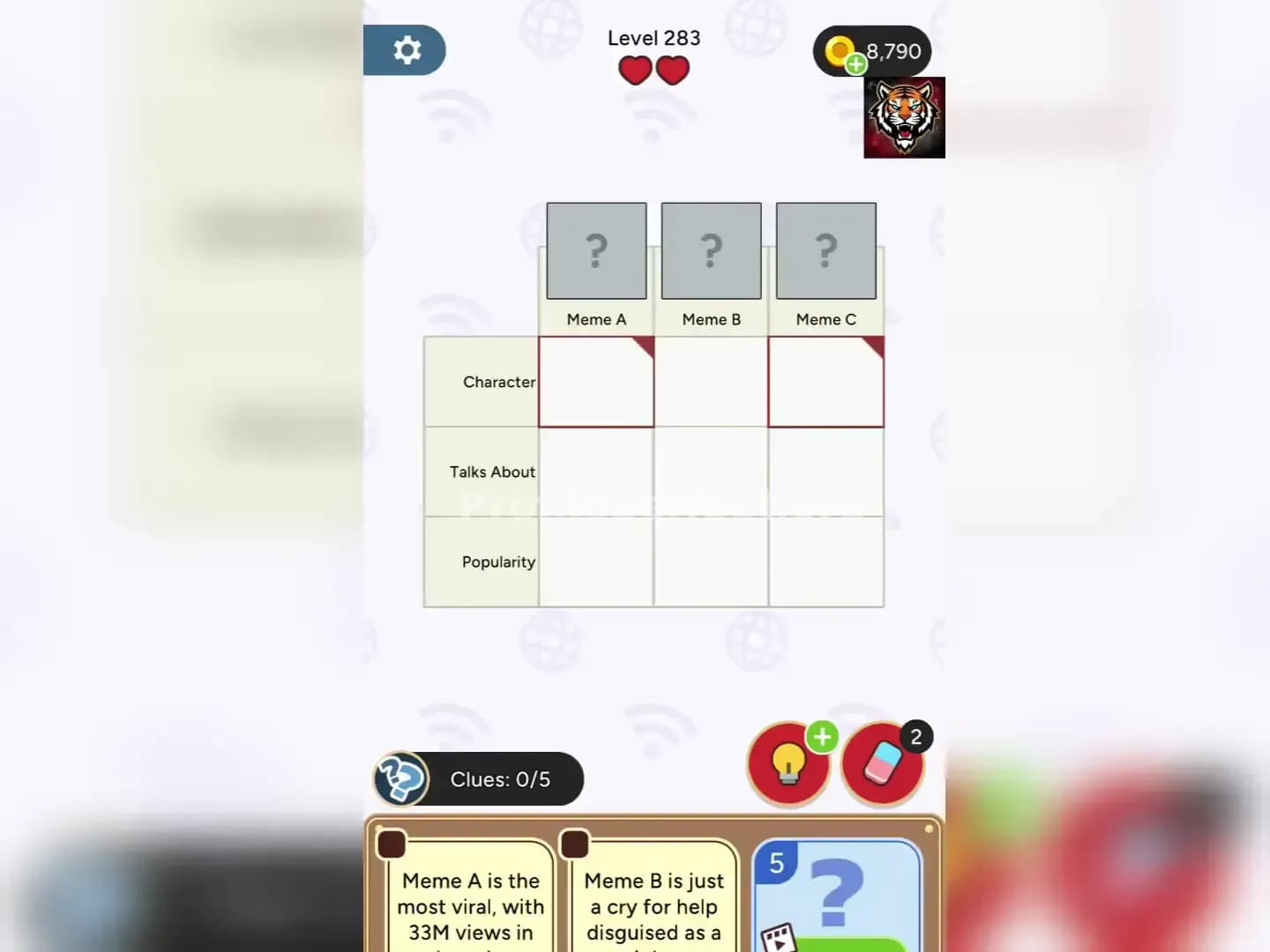
Level 283 hands you three memes and asks you to sort them by character, subject, and popularity, measured on a simple x1 to x3 scale that stands in for how viral each one went. It is a small case, only five clues, but it plays with the exact kind of reasoning you would use scrolling your own feed, comparing which post blew up and which one got quietly ignored.
The puzzle opens by telling you Meme A pulled in 33 million views in an hour, which locks its popularity at the top of the scale. From there the clues read like captions sitting under each post.
Meme A is the most viral, with 33M views in only an hour. Meme B is just a cry for help disguised as a joke. Meme C copied the viral one, yet it only got popularity.
Those three lines tell you Meme A is the Dog meme about exercise sitting at the top with x3 popularity, Meme B is the Cat meme about stress sitting in the middle at x2, and Meme C copied Meme A's format but talks about food instead, landing at the bottom with x1. The plagiarism angle is the nice touch here. The puzzle does not just ask you to match a meme to a subject. It asks you to notice that copying a viral format does not guarantee viral results, which is about as true to real feed behavior as a five clue puzzle gets.
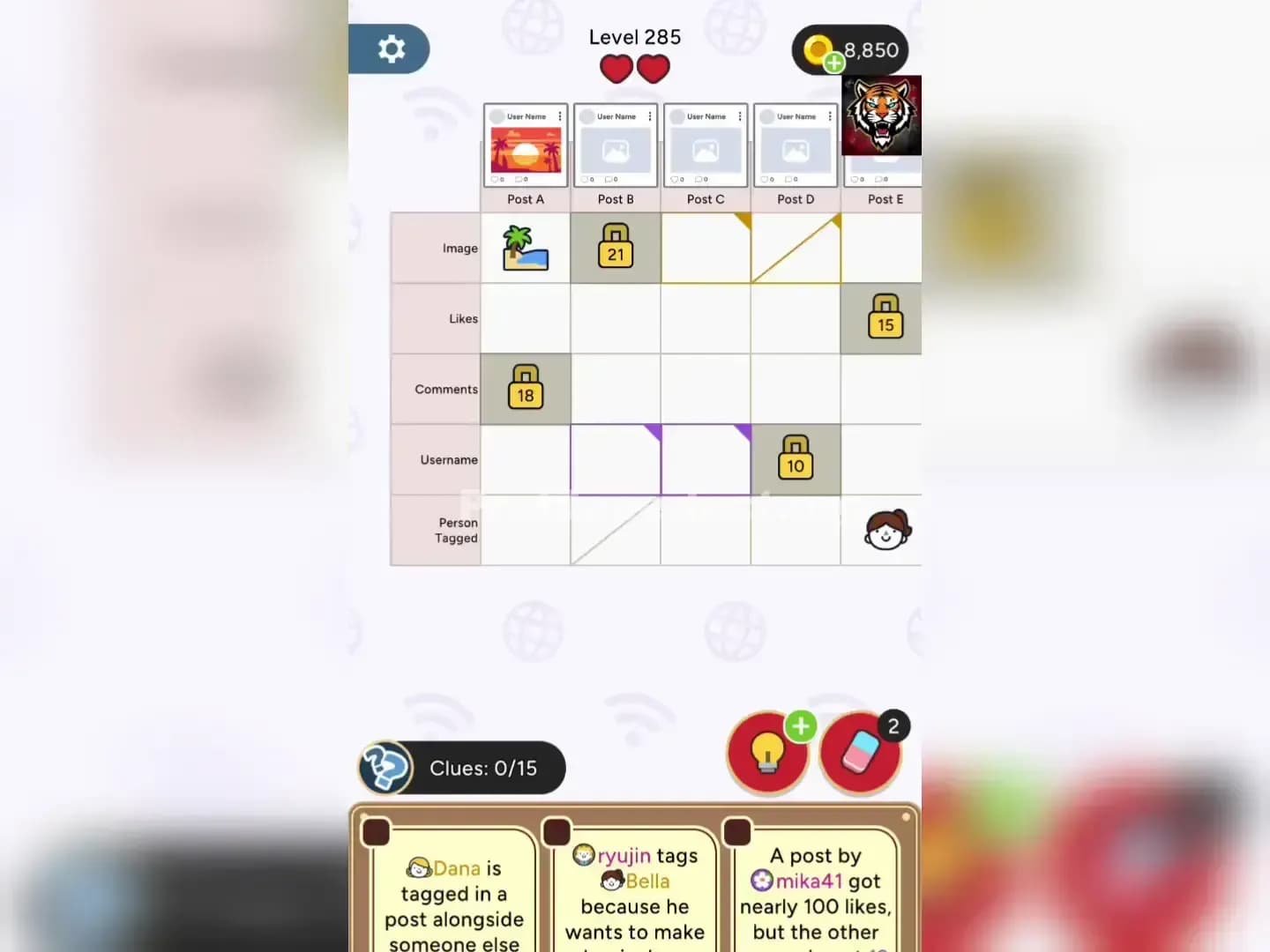
Level 285 is the closest thing in this set to opening an actual social app and studying one post at a time. Five posts sit on the grid, each carrying an image, a like count, a comment count, a username, and a person tagged, five traits total, which makes this one of the busier cases in the whole social media set.
Two answers start locked in on this level, Post A's sunset beach image and Post E's tag on Bella, so you already have two footholds before the first clue. From there the puzzle plays out like you are actually reading captions and doing the math a real feed would ask of you.
A post by mika41 got nearly 100 likes, but the other one only got 12. nova_blaze's post has around 5x as many likes as its neighbor. Both Cat posts have the most comments despite being AI generated.
The username mika41 posts twice in this level, once with a latte art photo that pulls 98 likes and 60 comments, and once with a cat photo that only pulls 12 likes but somehow racks up 120 comments, the most of any post on the grid. That gap between likes and comments is small but accurate feed logic. A post does not need a huge like count to spark the longest comment thread, and the puzzle uses that exact tension to help you tell the two mika41 posts apart. By the end, nova_blaze's sunset beach post tags Chris, zen1th's gym selfie tags Alex, and ryujin's mountain shot tags Bella, closing out a grid that reads less like a logic puzzle and more like an actual scroll through someone's feed.
Level 287 leans hardest into the idea that your phone is already a grid. Four apps sit on a home screen, each carrying an icon, a notification count, a position, a nearby widget, and a phone color. Two answers start locked in, Application A's icon as Gomini and Application C's spot in the top right, so the puzzle opens by handing you a partial home screen and asking you to fill in the rest.
What makes this level feel like real home screen deduction is how the clues treat position and color as facts you can cross reference, the same way you would notice your messaging app always sits bottom right or that your red phone case only shows up in certain photos.
Red phone has an odd number of notifications. The Search Bar is placed near Application B. Blue ish phone is on Black's left.
That first clue locks Application A to five notifications and a red case in one move. From there the puzzle threads Application B's search bar widget, Application C's black phone and top right slot, and Application D's music player widget together until the whole screen resolves: Gomini in the top left next to a clock and news widget, weMessage in the bottom right on a navy phone, TockTick in the top right on black, and Gatedash in the bottom right on orange, camped next to the music player. It is a home screen you could believe belongs to a real person, which is exactly the point.

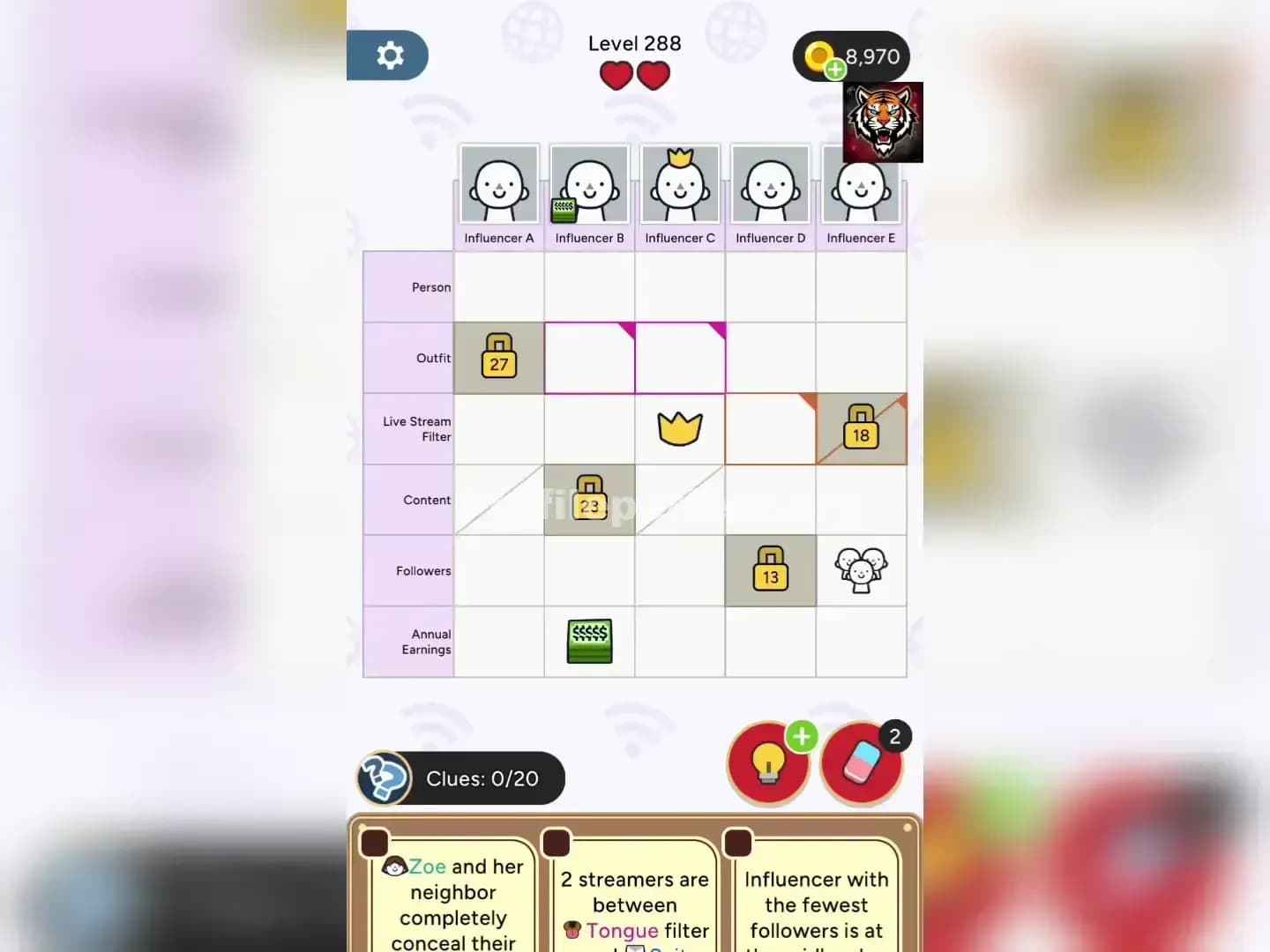
Level 288 is the biggest case in this set, five influencers carrying person, outfit, live stream filter, content type, follower count, and annual earnings, six traits across twenty clues. If the meme level is a quick scroll, this one is a deep dive into a creator's entire profile, the kind of research an actual detective would do before believing anything a stream tells you.
Three answers start locked in here, Influencer C's crown filter, Influencer E's x3 follower count, and Influencer B's top tier earnings, giving you real footholds on a level this dense. The clues then spend a lot of time proving that fame and income do not move together in a straight line.
Influencer with the fewest followers is at the grid's edge. Influencer with an even level of income is using Vampire filter. Despite many posts, Influencer C's follower count stays small.
That last clue is the sharpest piece of writing in the level. Mika, running the crown filter, posts constantly across gaming and movie content, yet her follower count sits second from the bottom at x2. Meanwhile Leo, who only posts songs, ends up with the most followers of the group at x5 despite the lowest earnings tier. The grid ends with Alice at x1 followers but solid $$$ earnings from health and photography content, Jaxon leading everyone in earnings at $$$$$ despite only x4 followers, and Zoe landing in the middle on both counts with a vampire filter and dog content. It is a small case study in how a creator's numbers can point in different directions at once, and the puzzle makes you track all six traits at the same time to see it clearly.
Levels 284 and 286 step back from individual posts and creators to look at the platforms and stocks behind them, proving the social media theme covers the boardroom just as easily as the home screen.
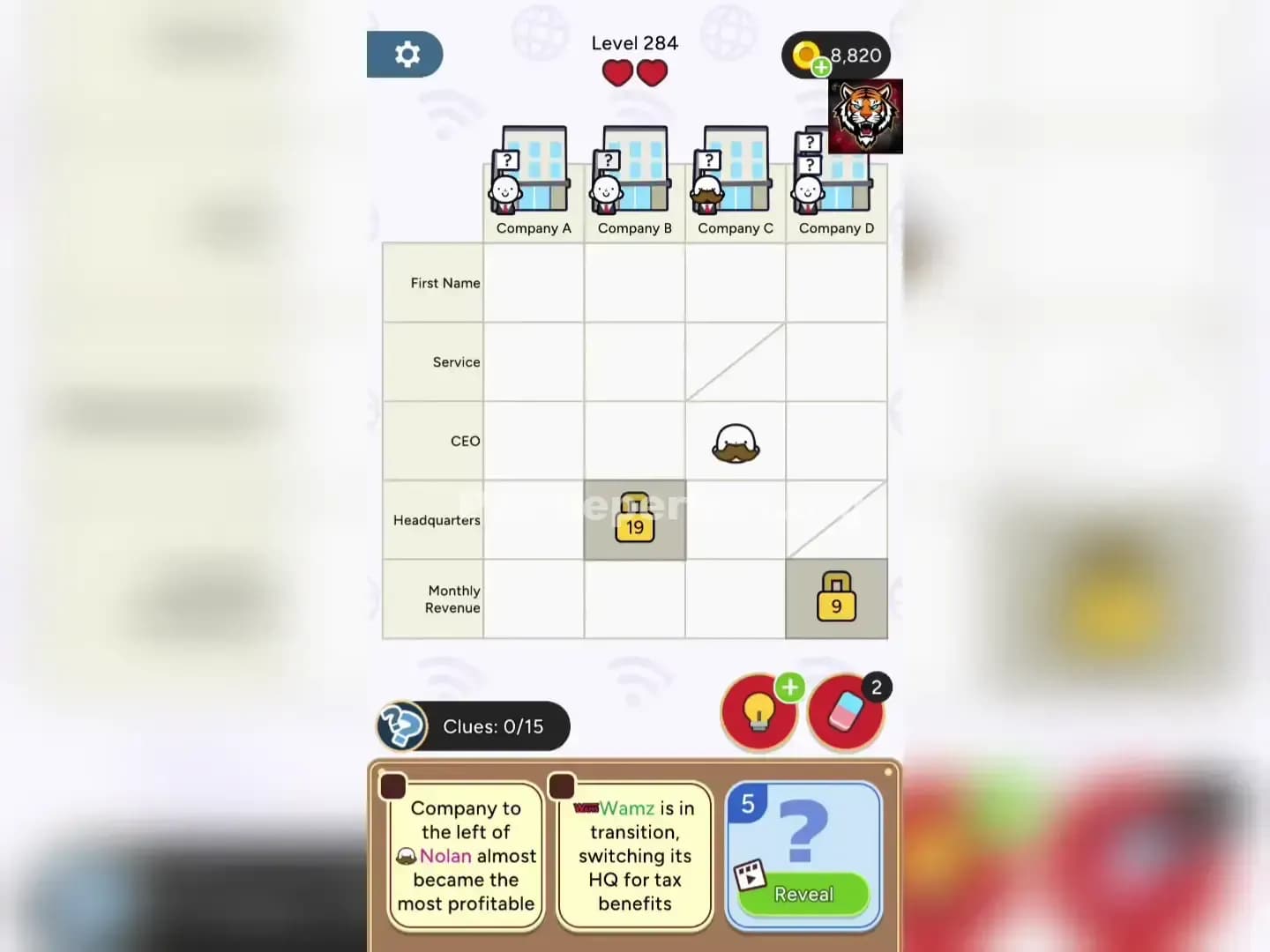
Level 284 gives you four companies, Superlab, Auroar, Kewpie, and Wamz, each with a service, a CEO, a headquarters, and a monthly revenue tier. One CEO name, Nolan Pryce at Kewpie, starts locked in, and the clues work like a business profile you would read before investing.
Wamz is in transition, switching its HQ for tax benefits. Two most profitable companies are not neighbors. Wamz beats Superlab's quarterly revenue in just 1 month.
That last clue is doing real work. Wamz's social media platform out earns Superlab's AI service so badly that one month of Wamz revenue beats an entire quarter from Superlab, which locks in Wamz at the top $$$$ tier and Superlab at the bottom $ tier before you have touched most of the grid. By the end, Auroar's marketplace sits in South Korea earning $$$, Kewpie's streaming and cloud storage business runs out of China at $$, and Wamz splits its headquarters between Singapore and Turkey while leading the whole group in earnings.
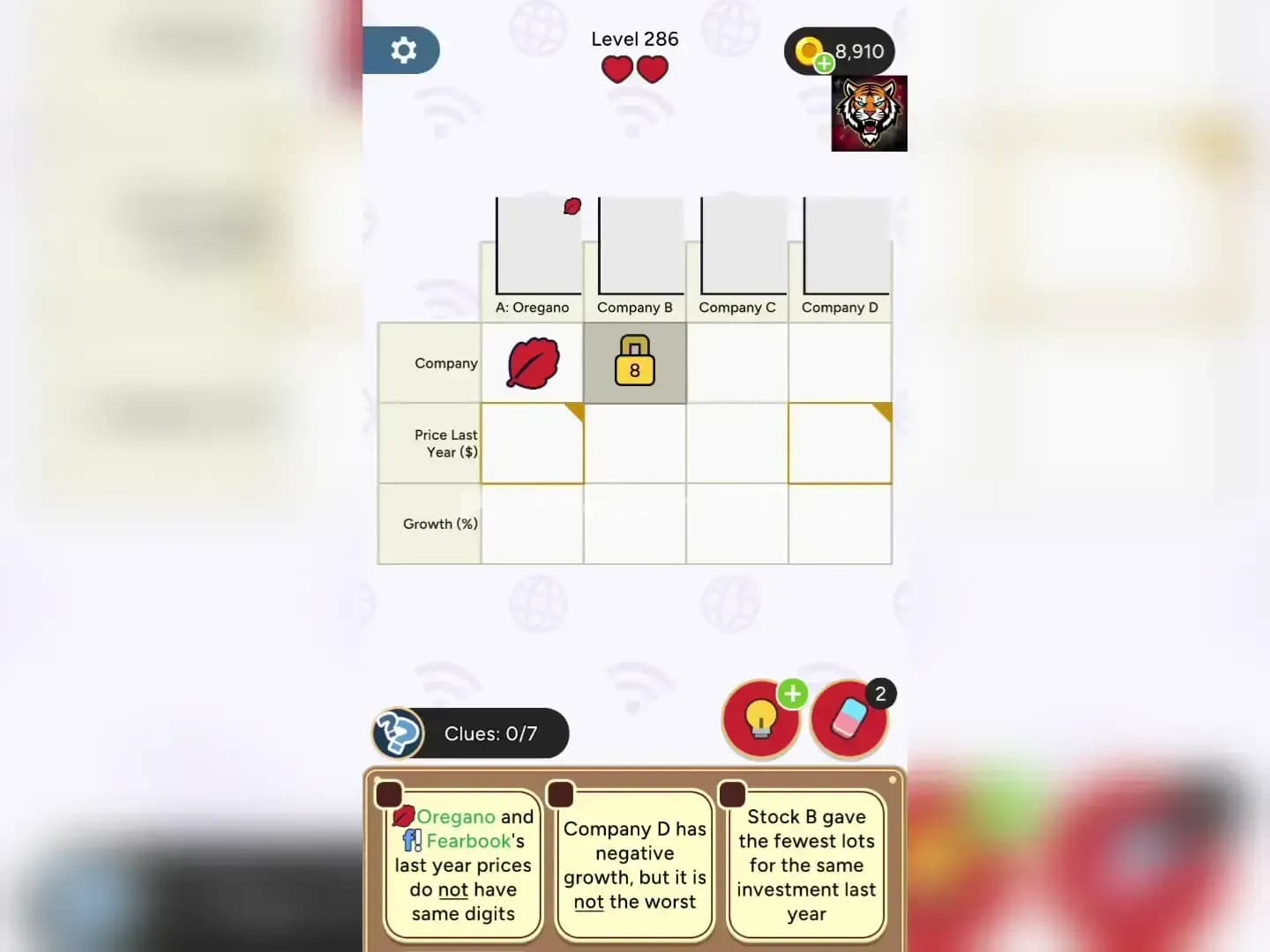
Level 286 shrinks the company idea down to a pure numbers case, four stocks, Oregano, Virno, Fearbook, and Hairro, each with a price from last year and a growth percentage. One company name, Oregano, starts locked in, and from there the clues read like a trading floor conversation.
Stock B gave the fewest lots for the same investment last year. Highest and lowest growth stocks are next to the Stock B. Company D has negative growth, but it is not the worst.
Fearbook posts the biggest swing on the board, jumping 72 percent despite trading at the lowest price of the group, $78, while Oregano drops the hardest at negative 35 percent even though it started higher at $124. Hairro's negative 5 percent growth reads almost calm next to those two extremes, exactly what the second clue is pointing at when it calls out Company D's dip as real but not the worst on the board. Seven clues is a short case file, but the puzzle packs a lot of financial logic into it, the kind of price versus growth comparison that shows up in a real stock ticker every day.
Every level in this set borrows a habit you already have from your own phone. You already compare like counts to comment counts without thinking. You already notice which app sits where on your home screen, and you already have an opinion about whether an influencer's follower count matches how often they post. Profile Perfect just hands you the same information as a clue instead of a passive scroll, and asks you to prove your read on it before the grid lets you move on.
That is the real reason these social media levels feel sharper than most other themes in the game. A dress or a dog asks you to learn a new set of details. A meme, a post, an app screen, or an influencer profile asks you to apply details you already read every day, just with the stakes turned up and a two life system watching your next tap. If you want to test that instinct, start with Level 283 for a quick five clue case, then work up to Level 288 once you are ready to track six traits across a full creator profile at once.