
A tour through Profile Perfect's room puzzles, from a two room starter level to a five room party with hidden values and slash answers, showing how walls, floors, furniture, and people turn a house into a logic grid.

Guide By Liam Stone
Published on July 7, 2026
Liam Stone has played Profile Perfect since the app first launched on the Apple App Store. He spotted its potential early, and that early bet turned into hundreds of hours spent solving levels, testing clue logic, and documenting answers for other players. Liam runs the YouTube channel Puzzle Game Answer where his puzzle walkthroughs have earned over 935,000 views and a growing community of more than 800 subscribers. He covers a wide range of mobile puzzle games beyond Profile Perfect, giving him firsthand experience with how these games design clues, structure levels, and trip up even experienced players. Every guide on this site reflects that hands on experience. Liam plays each level himself, verifies every answer against the in game grid, and rewrites confusing clues into plain language so you don't need to guess. If you want more of his walkthroughs, subscribe to his channel.
Loading calendar...
Walk into a house you have never seen before and you start reading it without even trying. The wall color tells you something. The floor tells you something else. A stool by the mirror, a stack of gloves by the sink, a portrait on the wall. None of it is random, and your brain sorts it automatically.
Profile Perfect's room levels ask you to do that same reading, just with the stakes turned up. Every room hides its answers in plain sight, spread across walls, floors, furniture, and the people standing inside them. Based on my gameplay across a wide stretch of these levels, from a tiny two room bedroom puzzle all the way up to a five room party with sixteen clues, the theme keeps returning because a house has an almost unlimited number of details you can turn into traits. This piece walks through an early room puzzle, a much harder one, the traits that show up again and again, and a screenshot tour through four different rooms so you can see the pattern for yourself.
Room appears as a subject constantly across the level set. I pulled examples from Level 3, Level 28, Level 108, Level 168, Level 183, Level 232, Level 377, and Level 386, and no two of them build the same house. One is a bedroom and kitchen. Another is a casino floor. Another is five actresses getting ready backstage. What stays constant is the format. Each room gets a letter, each trait gets a column, and the clues describe what sits inside each space and how the rooms relate to their neighbors.
That neighbor relationship matters more here than in most other themes. A bus level or a chemistry level can describe subjects that have nothing to do with physical position. A room level almost never does that. Rooms sit in a row, so left, right, middle, and between carry real weight, the same way they would if you were actually walking down a hallway.
Level 3 is about as small as a room puzzle gets. Two rooms, three traits, four clues. Room B starts with its floor already locked in as Tiled, which gives you a foothold before you read a single clue.
From there the puzzle plays out fast. One clue tells you tools for making food sit in Room B, which makes it the Kitchen. Another tells you the room beside the Tiled floor has a Solid colored floor, which puts Solid on Room A. A third clue connects the Kitchen to the room next door where people sleep, turning Room A into the Bedroom. The last clue ties the Bedroom to a Floral wall pattern. By the time you finish reading four short sentences, Room A is a Bedroom with a Floral wall and Solid floor, and Room B is a Kitchen with a Striped wall and Tiled floor.

What makes Level 3 worth studying is not the difficulty. It is how directly each clue maps to something you could actually picture. A kitchen has cooking tools. A bedroom is where people sleep. You are not decoding jargon, you are just matching what you already know about houses to the grid in front of you.
Level 168 shows what the same room format looks like once the game stretches it as far as it goes. Five rooms, six traits, sixteen clues, four hidden values, and three rooms carrying double answers in a single cell. This is a full party house, and every room is mid celebration.
Room A has a Gold floor, a Gray wall, a Dance Floor as its centerpiece, and both Flowers and Lanterns as its decoration, since that cell carries two valid answers at once. Room B is Pink floored with a Stage and Streamers, hosting six guests at Dawn. Room C shares the same Cream color on both its floor and wall, the only room in the entire puzzle where that happens, and centers on a Christmas tree at Night with Ribbons and Garland decorating the space. Room D has a floor listed as Black and White together, a Balloon filled birthday room built around a Cake, with the largest crowd of the five at eight people during Evening. Room E rounds it out with a Gray floor, a Fountain centerpiece, and Garland, hosting a Noon gathering of four.
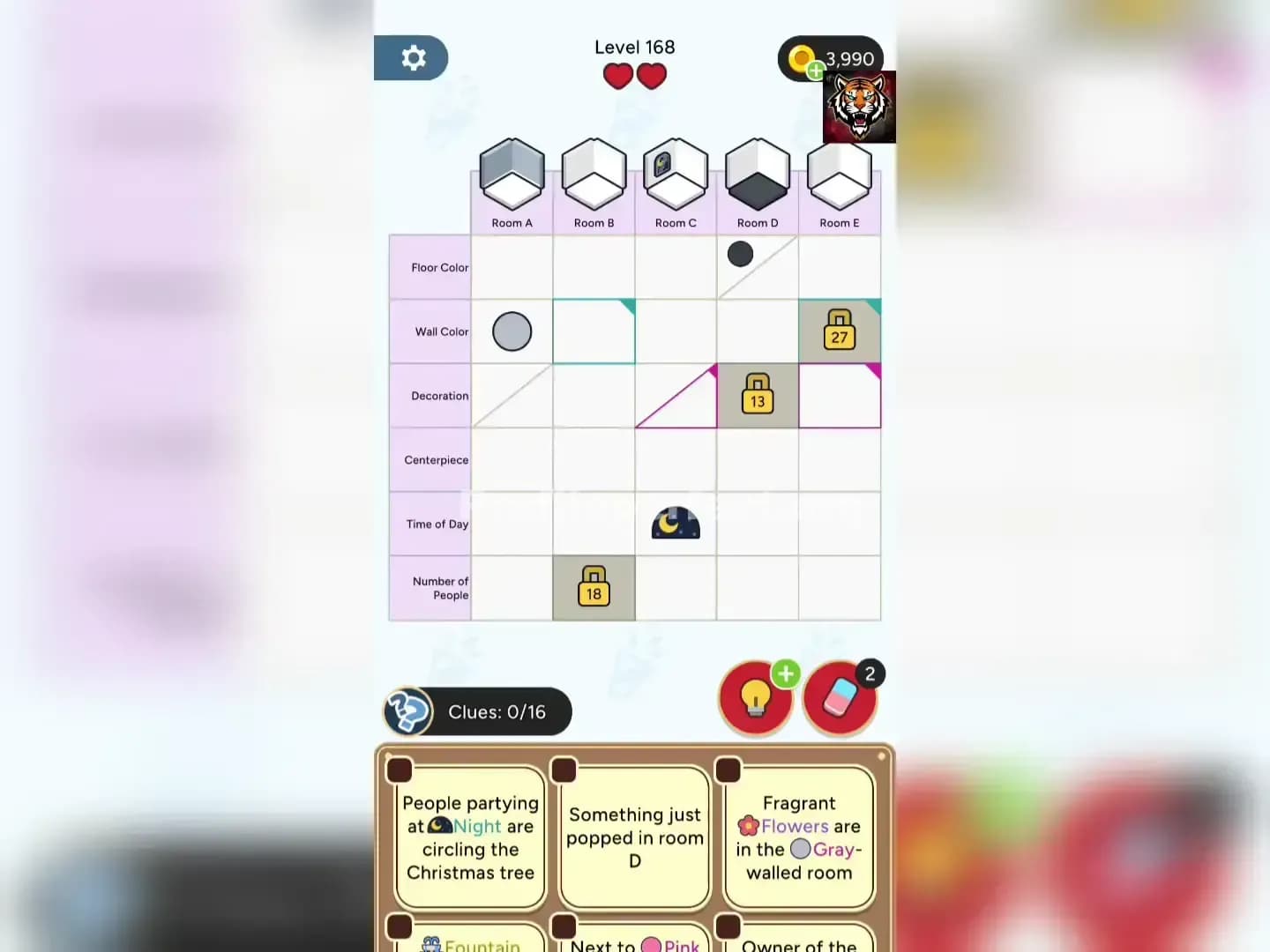
Four of this level's answers count as hidden values rather than clues you solve directly. Room B's wall color, Room E's wall color, Room C's centerpiece, and Room A's time of day never get spelled out in a single obvious statement. Instead they fall out once you have locked in enough of the surrounding grid. That is the real jump in difficulty between Level 3 and Level 168. Early rooms hand you the answer once you read the right clue. Advanced rooms make you build toward an answer that only becomes visible once several other cells are already filled.
The three multi value cells in this level, Room A's decoration, Room C's decoration, and Room D's floor color, work the same way slash answers work anywhere else in the game. Both listed values are correct for that cell, and the clues support both rather than pointing you toward a single winner. If you try to pick just one and move on, you will find yourself stuck later when a different clue references the other half of the pair.
Pull enough room levels together and a short list of traits keeps resurfacing no matter what kind of house you are inside. Walls, floors, and carpets cover the structure. Furniture, decorations, and the people who occupy each room cover everything else.
Wall and floor traits show up in almost every room puzzle in this set, and they are usually where the puzzle starts. Level 3 opens with wall and floor. Level 28 adds a Carpet trait on top of Wall, describing a fantasy castle where the Prince's room has an Emerald carpet under a Marble wall, while the Queen's room combines a Blue Royal wall with a Floral Carpet. Level 108 swaps carpet for a mix of Wood, Solid, Tiled, Floral, and Brick walls across a five room family home, one wall type per room, no repeats. These structural traits give you the shape of the house before you know anything about who lives in it.
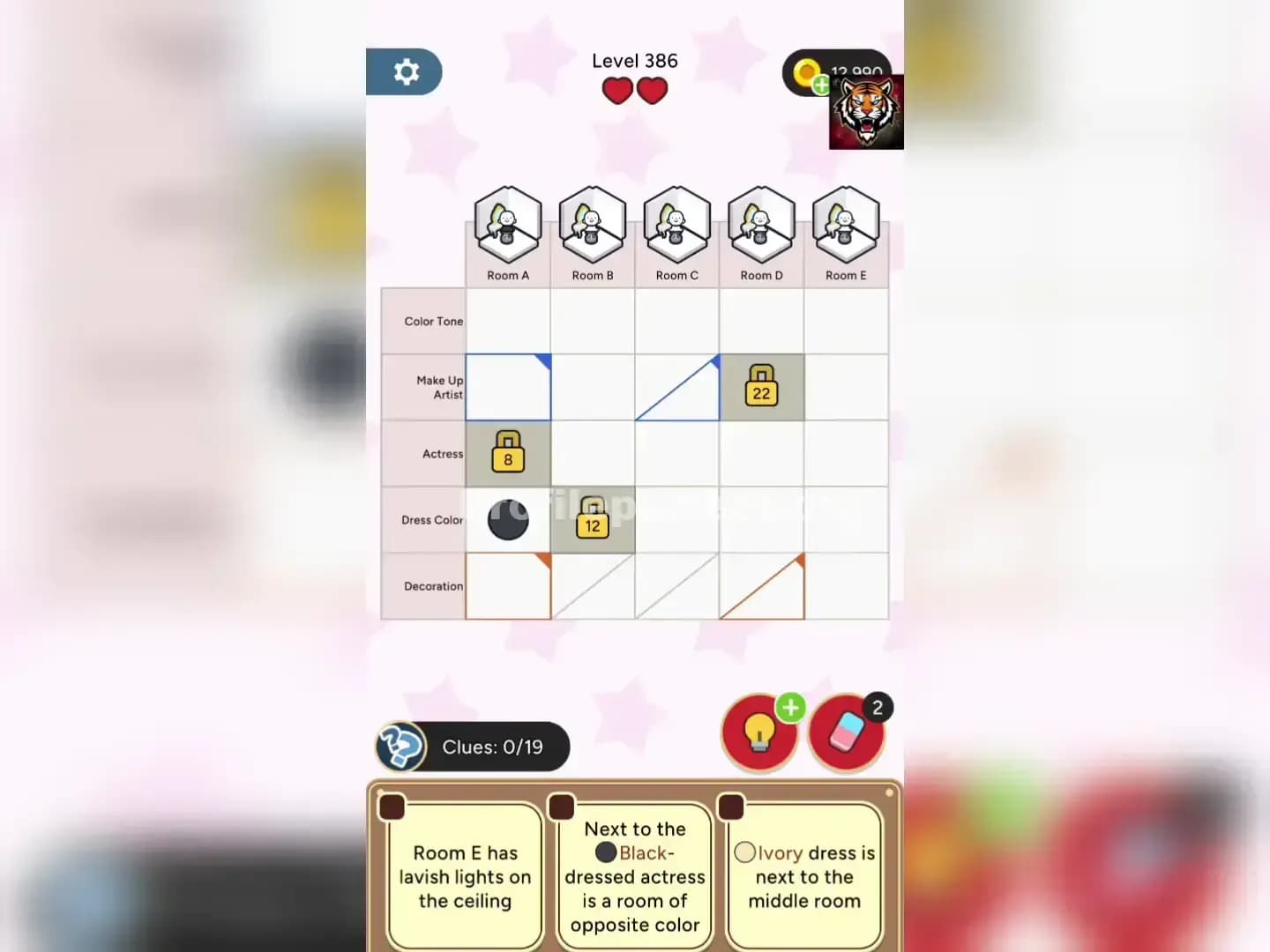
Once the structure is set, furniture and decoration traits fill in the personality of each room. Level 183 hands you a Seat Type trait that ranges from a Stool to a Sofa to a Pillow, paired with a Feature like a Locker, an Arcade, or a Food Stall. Level 377 leans on Chair and Mirror shape instead, pairing a Bucket Stool with a Round mirror and a Swivel Stool with a Rectangle mirror across four uniquely colored rooms. Level 232 strips the trait count down to a lean casino floor, tracking Game Type, Staff, Aroma, Floor Number, and Crowd size across just three rooms, proof that a room puzzle does not need five subjects to work. Level 386 pushes people into the spotlight directly, giving each of five backstage rooms an Actress, a Make Up Artist, and a Dress Color alongside the usual Color Tone and Decoration traits. The room stops being just a container and becomes a stage for the person inside it.
Lining up Level 3, Level 108, Level 168, and Level 386 side by side shows the full range the room theme covers, from a two room starter to a five room ensemble cast.
Level 3's Bedroom and Kitchen give you the baseline. Two rooms, three traits, four clues, and every answer traceable back to something you already know about how a house works.
Level 108 raises the stakes with a five room family house. Room A is the Garage where Mom keeps a Vase and Hammer together in one cell. Room B is the Living Room, shared by Grandpa and Baby, with a Tumbler nearby. Room C is the Kitchen, home to Son and Grandma, marked by Gloves. Room D is the Bedroom where the Daughter keeps a Book and Phone side by side. Room E is the Basement where Dad sweeps with a Broom, and this level treats the Kitchen's room type and the Broom's location as hidden values rather than direct answers.

Level 168's party room shows how far the format stretches once decoration, centerpiece, time of day, and crowd size all stack on top of the usual wall and floor traits. Five rooms, six traits, and a Christmas tree glowing in the one room where the floor and wall share an identical Cream color.
Level 386 closes the tour backstage, where five actresses get ready under five different color tones. Scarlett sits under Pink light in a Black dress. Eilish gets styled in White under a Red dress. Emma works through Nina and Isla's shared attention in a Red toned room with a Green dress. Megan waits in Gold under Ivory. Tessa finishes in Lavender wearing Navy, right next to the room that just won a Trophy.
Four rooms, four completely different houses, and the same underlying skill running through all of them. You are not memorizing trivia about chemistry or card games. You are reading a space the way you already read every room you walk into, just with the answer waiting a few clues away instead of a glance.