
Learn how to read "not" and exclusion clues in Profile Perfect without wasting lives, using real examples from Level 4's Dress puzzle, Level 82's Pen puzzle, and Level 191's Card puzzle to show what these clues prove, what they cannot prove, and how to pair them with positive clues before you tap.


Guide By Liam Stone
Published on July 7, 2026
Liam Stone has played Profile Perfect since the app first launched on the Apple App Store. He spotted its potential early, and that early bet turned into hundreds of hours spent solving levels, testing clue logic, and documenting answers for other players. Liam runs the YouTube channel Puzzle Game Answer where his puzzle walkthroughs have earned over 935,000 views and a growing community of more than 800 subscribers. He covers a wide range of mobile puzzle games beyond Profile Perfect, giving him firsthand experience with how these games design clues, structure levels, and trip up even experienced players. Every guide on this site reflects that hands on experience. Liam plays each level himself, verifies every answer against the in game grid, and rewrites confusing clues into plain language so you don't need to guess. If you want more of his walkthroughs, subscribe to his channel.
Loading calendar...
Profile Perfect throws two kinds of clues at you. Positive clues hand you an answer straight up. Negative clues, the "not" ones, tell you what an answer cannot be. Both matter, but players lose lives on the second type far more often, because a "not" clue feels like progress when it has actually only closed one door out of several.
I pulled this pattern from my own runs through the game. Exclusion wording, phrases like "not," "does not," "isn't," or "none of," shows up in 359 levels across the puzzle set. That is a huge share of the game, and it means you cannot treat "not" clues as background noise. You need a method for reading them correctly the first time.
This tutorial walks through what a "not" clue can prove, what it can never prove by itself, and how you pair it with a positive clue to land a safe tap. I will use three levels I solved to show the pattern in action, Level 4's Dress puzzle, Level 82's Pen puzzle, and Level 191's Card puzzle.
A "not" clue removes exactly one possibility from one cell. That is the whole job. When the puzzle shows "Floral dress is not paired with a Belt," it is not telling you what the Floral dress is paired with. It is telling you Belt is off the table for that one dress.
That sounds small, but small is the point. Logic grids solve through subtraction as much as addition. Every option you cross off shrinks the remaining choices, and once a row or column has only one option left, you have your answer without ever guessing.
Treat every "not" clue as a single cross out action, nothing more. If you catch yourself thinking "so it must be this instead," stop and check whether the grid actually supports that jump yet, or whether you just assumed it.
A "not" clue cannot name the correct answer. It cannot tell you which of the two remaining traits applies. It cannot confirm a match between two subjects. All of that requires a second clue, usually a positive one, or enough eliminated options that only one choice remains.
This is where wrong taps happen. A player reads "the Bronze chip card does not end in 9," feels confident, and taps the first card that seems to fit, without checking whether another card also avoids ending in 9. The clue ruled out one digit for one card. It did not hand over the full answer.
Speed is the real problem, not comprehension. You read the "not" clue correctly, then rush the tap before checking if the elimination actually leaves one option. Slow down at the moment right after you cross something off. That is the moment to recount what is left, not the moment to tap.
Level 4 has three dresses to solve, matching each one's pattern and accessory. The finished grid looks like this.
| Dress | Pattern | Accessory |
|---|---|---|
| Dress A | Polkadot | Belt |
| Dress B | Floral | Bracelet |
| Dress C | Solid | Handbag |
Early clues hand you most of the pattern column outright. Dress C gets a Handbag from the start, and Dress A's Polkadot pattern is locked in early too. That leaves Dress B needing both its pattern and its accessory.
A positive clue tells you the Floral dress sits next to the Polkadot one, which gives Dress B its pattern. Then the "not" clue arrives.
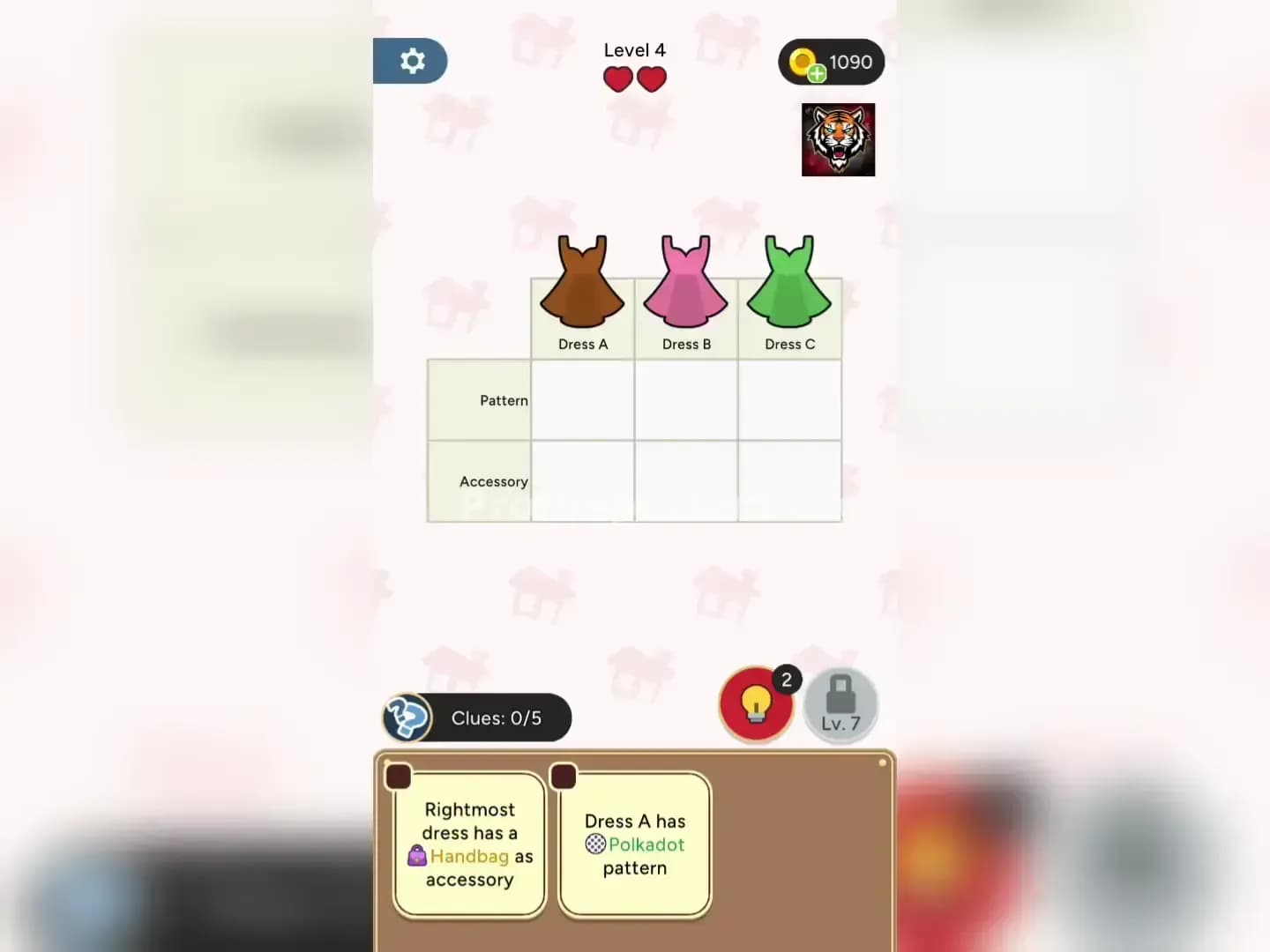
"Floral dress is not paired with a Belt" only removes Belt from Dress B. It does not say Dress B has a Bracelet. But by this point, Handbag already belongs to Dress C, and Belt already belongs to Dress A from an earlier clue. Dress B has nothing left but Bracelet. The "not" clue did not solve the cell. The board did, once you removed the one option the clue told you to remove.
Here is the accessory column for Dress B before and after that single "not" clue, shown as a simple cross out so you can see the shift.
Before the clue, Dress B's accessory column looks like this.
Belt, Bracelet, Handbag (all three still open for Dress B)
After the clue and the two earlier lock ins, Dress B's accessory column looks like this.
Belt, Bracelet, Handbag (Bracelet is the only one left standing)
That is the whole trick in one picture. The "not" clue crossed out Belt. Everything else crossing out came from other clues you already solved. Stack the crosses, and the answer appears on its own.
Not every "not" clue works on a single cell. Some hit a whole group at once, which is where they get powerful and where they get misread.
Level 82 asks you to match five pens on type, ink color, brand, ink level, and how many people use each one. One of the earliest clues reads "Ballpoint and its neighbors do not use Red ink." Since the Ballpoint pen sits in one fixed position, this single clue removes Red as an option from three pens at once, the Ballpoint pen itself and the pens sitting on either side of it.
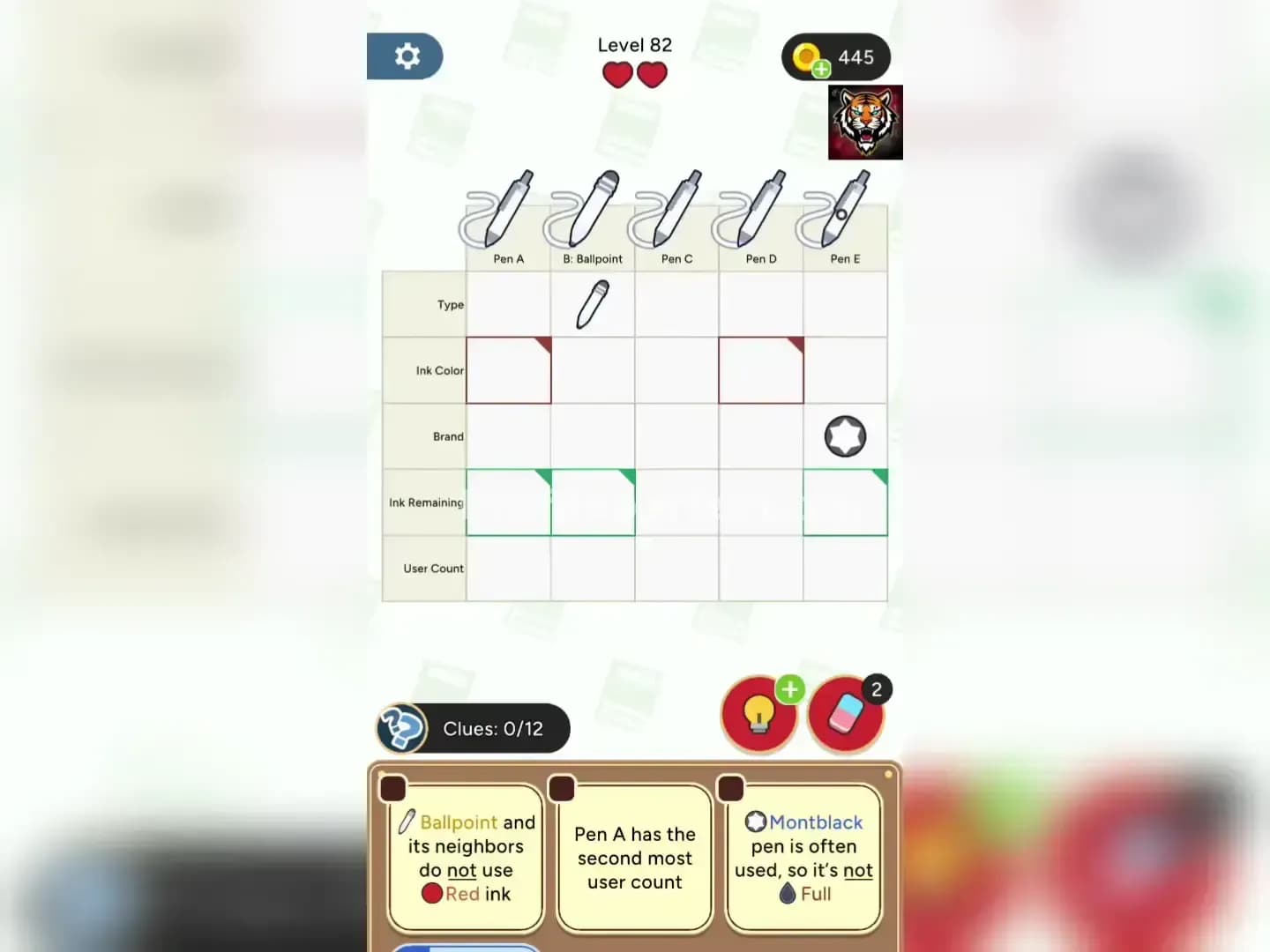
That is real progress, but notice what it still has not told you. It has not said which pen actually has Red ink. Red still has to land somewhere among the two pens that are not neighbors of the Ballpoint pen. You need another clue, one that places the Red ink pen by position or by a trait like brand or user count, before you can safely tap.
Group style "not" clues almost always route through position, words like neighbor, next to, or between. When you see one, do not just cross out the named subject. Map its neighbors on the actual row of pens in front of you, then cross out the trait for each of them. Skipping the neighbor check is how players miss two eliminations for the price of reading one clue.
Level 191 is the richest example here, five credit cards with six traits each, including a trait called Network, which lists Amex, Mastercard, Visa, JCB, and UnionPay. Two separate "not" clues work on that Network column, and only by combining them do you get a safe tap.
The first clue says "Amex's neighbor is not Visa or UnionPay." Amex sits at one end of the row, so this removes Visa and UnionPay as options for the card sitting right next to it. The second clue says "Visa card does not have any Red color." Since one card's color is already locked in as Red from an earlier clue, this removes Visa as an option for that specific card too.
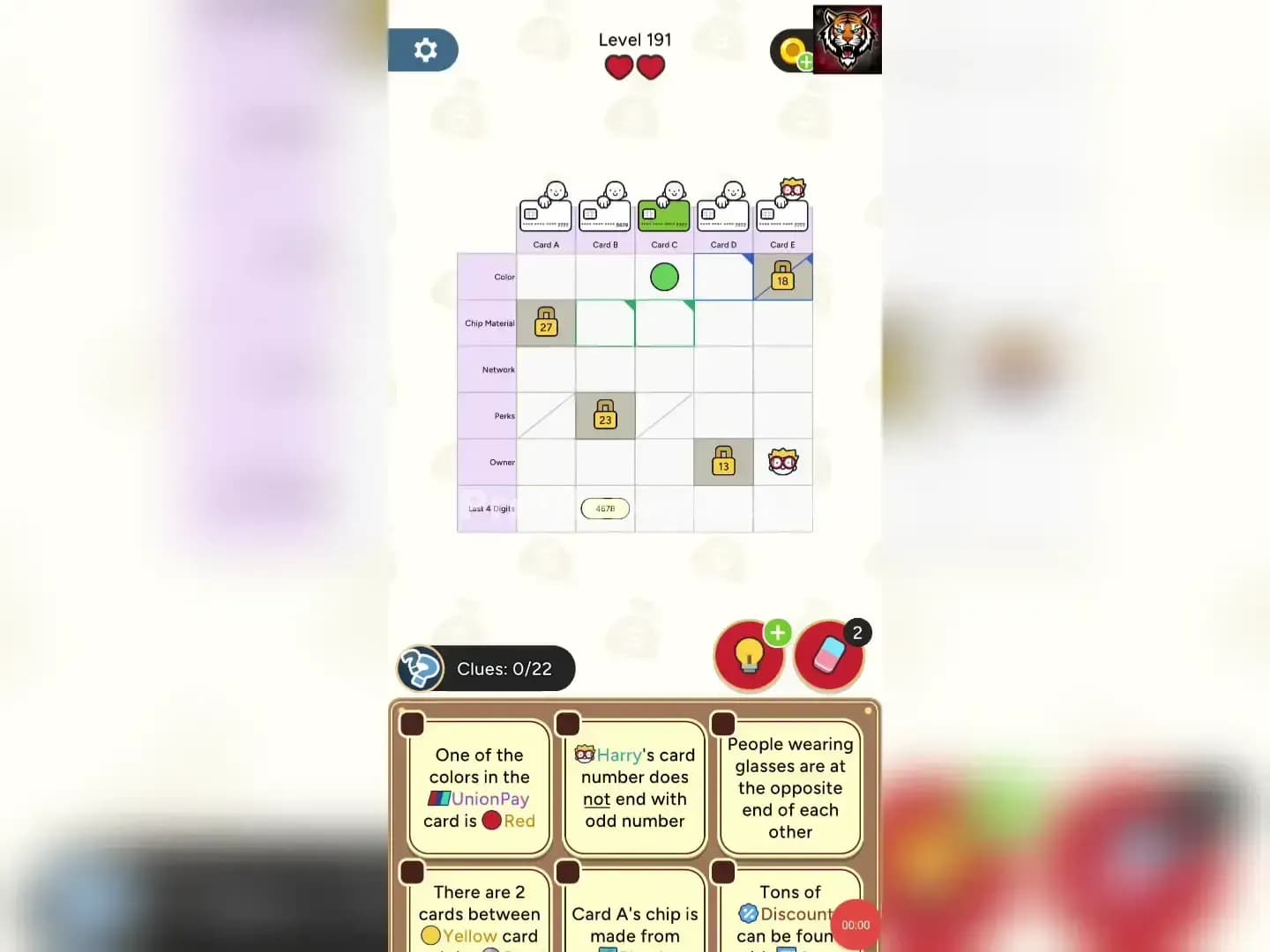
Neither clue by itself names the Visa card. The first clears Visa off one neighbor. The second clears Visa off the Red colored card. Line those two exclusions up against the five cards, and Visa only still fits one card left, the green one that was locked in from the start. That is the finished grid's Network match for that card, reached entirely through subtraction.
The lesson from Level 191 carries the whole tutorial. When a puzzle throws several "not" clues at the same trait column, do not solve them in isolation. Hold all of them in view at once, cross off what each one removes, and check after every cross out whether a row or column has finally narrowed to one name.
Every example above followed the same shape. A positive clue or a locked initial answer supplied most of the column. A "not" clue removed the one remaining wrong option. The tap only became safe once both pieces were in place.
Before you commit an answer, ask yourself two questions. What did the positive clues already lock into this row or column. What did the "not" clue remove. If you cannot answer both, you are guessing, even if it feels like logic.
A "not" clue removes an option. It does not name the answer. Never tap the moment you read a "not" clue. Tap only after you check whether removing that one option leaves exactly one choice standing.
Keep that line in mind on every level, not just the three above. It is the single biggest reason careful players still lose lives on levels that otherwise looked easy.
Use this same routine whenever you hit a "not" clue and you are not sure if it is safe to tap yet.
Run that routine on every "not" clue you meet, and you will stop losing lives to clues that were actually true the whole time, just misread as bigger answers than they really gave you.