A behind the scenes look at how Profile Perfect turns real life phrases like tools to make food and groceries into grid answers, with a translation table and examples from the Room, Building, and Cave levels.


Guide By Liam Stone
Published on July 7, 2026
Liam Stone has played Profile Perfect since the app first launched on the Apple App Store. He spotted its potential early, and that early bet turned into hundreds of hours spent solving levels, testing clue logic, and documenting answers for other players. Liam runs the YouTube channel Puzzle Game Answer where his puzzle walkthroughs have earned over 935,000 views and a growing community of more than 800 subscribers. He covers a wide range of mobile puzzle games beyond Profile Perfect, giving him firsthand experience with how these games design clues, structure levels, and trip up even experienced players. Every guide on this site reflects that hands on experience. Liam plays each level himself, verifies every answer against the in game grid, and rewrites confusing clues into plain language so you don't need to guess. If you want more of his walkthroughs, subscribe to his channel.
Loading calendar...
Most logic grid clues are honest about what they are. They name a subject, name a trait, and connect the two. Profile Perfect has plenty of those. But the clues that stick with you after you close the app are the other kind, the ones that never say the answer out loud. They describe a scene from real life and trust you to land on the right grid value yourself.
I want to walk through how that translation works, where it can go wrong, and which levels in Profile Perfect pull it off best. I pulled the examples from my own runs through the puzzle set, three levels in particular, a two room level, a three building level, and a cave level that pushes the idea further than the other two.
A direct clue tells you the fact. "Room B has a Kitchen" is a direct clue. There is nothing to translate. You read it, you tap it, you move on.
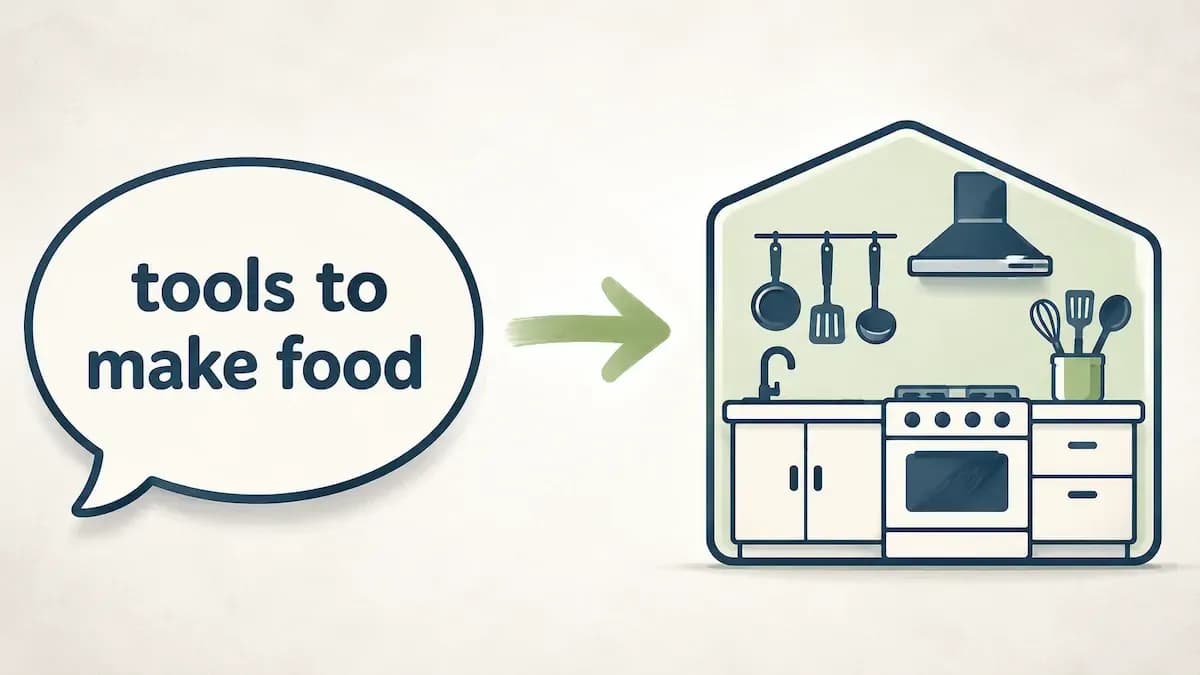
A common sense clue describes the fact instead of naming it. "Tools to make food can be found in Room B" never says the word Kitchen. It gives you a scene, tools for cooking, and expects you to connect that scene to the one room type that fits. The puzzle is not testing your reading comprehension at that point. It is testing whether you can turn a real world description into the exact label sitting in the grid's trait list.
That gap between the phrase and the label is where the puzzle earns its personality. Direct clues feel like a spreadsheet. Common sense clues feel like a person describing a room to you over the phone.
Every common sense clue asks you to make one small jump. You take the phrase, strip away the specific words, and land on the category the puzzle is actually asking about. "Tools to make food" strips down to cooking, and cooking points at one room type in the list you already have in front of you, Kitchen. The jump only works because the puzzle limits your options ahead of time. You are not guessing from every room type in the world. You are matching a description against a short list the grid already gave you.
Level 3 keeps things small on purpose, just two rooms, Room A and Room B, matched against room type, wall pattern, and floor. That size makes it a clean place to see the translation happen without much noise around it.
The very first clue in the level reads "Tools to make food can be found in Room B." Nothing in that sentence says Kitchen. It gives you cooking equipment, and cooking equipment only belongs in one kind of room. Since the level only offers Bedroom and Kitchen as room types, the moment you picture a stove or a knife block, the answer locks itself in. Room B is the Kitchen.
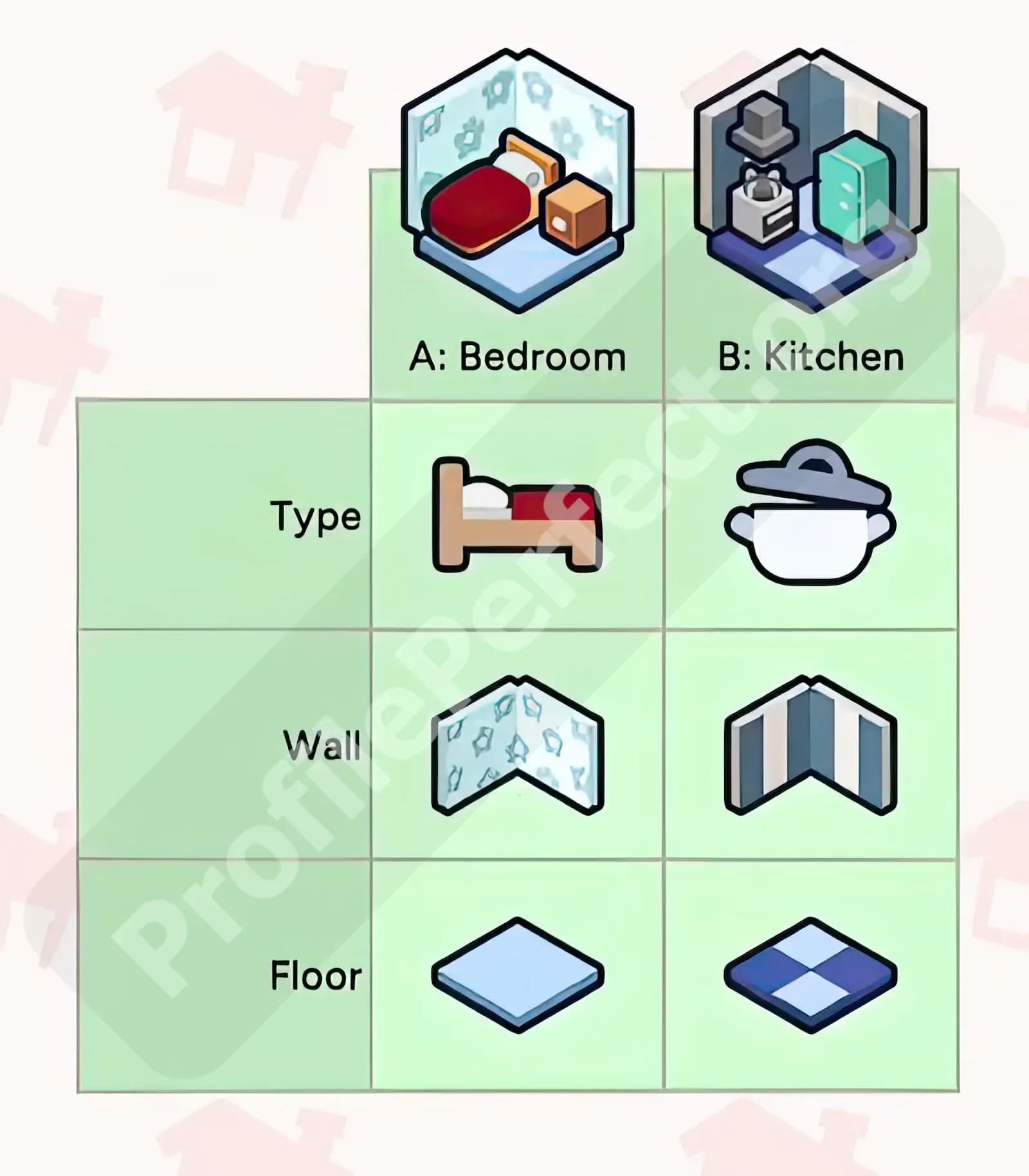
The rest of the level plays out from that one anchor. "Next to the Kitchen is the room where people sleep" repeats the same trick from the other direction, describing sleep instead of naming Bedroom, and once Room B is confirmed as the Kitchen, Room A has nowhere else to go. The Bedroom's Floral wall pattern arrives the same way a page later, described through the room's identity rather than stated outright. Three clues, one small translation each, and the whole grid falls into place.
Level 16 moves the same idea into a row of three buildings, a Hospital, a Supermarket, and an Office, each tied to a person and a warning sign. The opening clue says "Building B is a great place to buy groceries." Again, the puzzle never types the word Supermarket. It hands you a shopping trip and lets you land on the building type that matches.
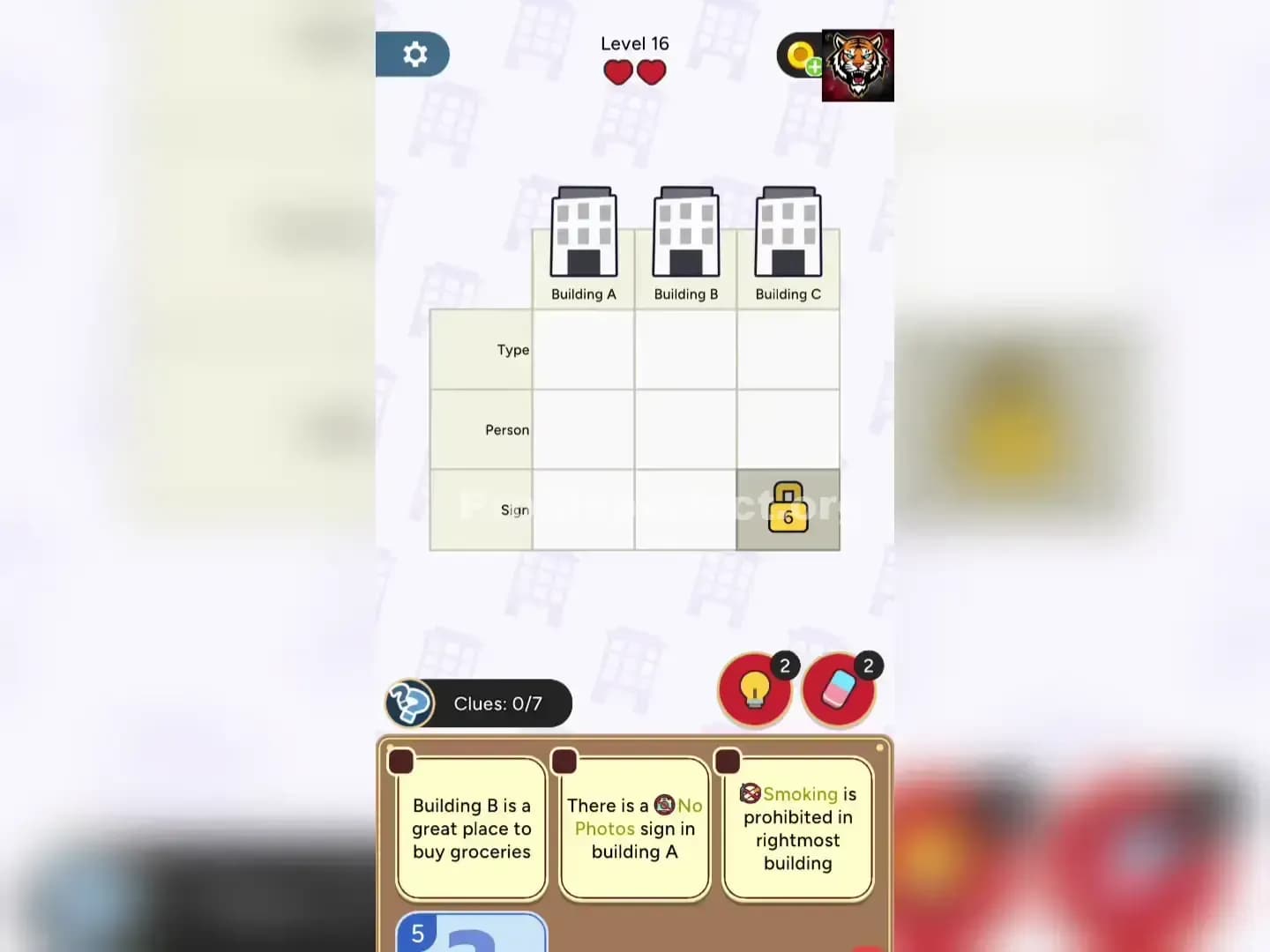
What makes this level worth a second look is a quieter version of the same trick later on. The clue "Mom is visiting her bedridden friend" never says Hospital either. It describes a visit to someone who is sick in bed, and that scene only fits one building on the row. By the time you reach that clue, you already know Building A holds the No Photos sign, so the description of the visit locks Mom into Building A and confirms the Hospital label at the same time. Two clues, two scenes, and neither one needed to spell out the answer.
Groceries reads as an easy translation because almost everyone has stood in a supermarket aisle. A hospital visit works the same way. Both scenes come from ordinary weekly life, which is exactly why the jump from phrase to grid cell feels instant instead of effortful.
Cave levels ask the same kind of translation to carry more weight, and Level 118 shows both how well that can work and where it starts to strain.
The setup gives you three caves, a Sea Cave, an Ice Cave, and a Lava Tube, each holding a discovery and an animal resident. The clue "The cute animal who lives in the Ice Cave cannot fly" describes the Pika without naming it, and it works because the puzzle only offers two animal choices for that cave, Pika and Swallow. Once you know a swallow can fly and the clue rules out flight, Pika is the only option left standing. That is common sense doing real work, most people know birds fly and rodents do not, so the translation lands cleanly.

The next clue pushes further. "Olivine is a mineral found in cave made from dried up lava" asks you to already know that lava, once it dries and hardens, leaves behind a Lava Tube, and that Olivine is the kind of mineral that forms in that setting. That is a bigger ask than knowing birds fly. Geology trivia is not something every player carries around, even if it is technically common knowledge to someone who has taken an earth science class.
This is the tension every common sense clue carries. The translation only feels fair when the real world fact behind it is something close to universal, cooking tools point at a kitchen, a shopping trip points at a supermarket, a bird flying is something almost every player already knows without thinking. The moment a clue leans on a fact that is true but obscure, like the exact mineral that forms from cooled lava, the clue stops testing deduction and starts testing trivia. A player who has never heard of Olivine is not stuck because they failed to reason. They are stuck because the puzzle assumed a fact they never had.
Profile Perfect mostly stays on the safe side of that line by pairing the riskier fact with the earlier animal clue, so the Lava Tube answer is really locked in twice, once through geology and once through elimination once the other two cave types are already taken. That backup path is what keeps Level 118 fair even when one clue reaches slightly past common knowledge.
Here is the mapping from each real life phrase in these three levels to the exact grid value it points to. Keeping a mental version of this table while you play is the fastest way to stop staring at a clue and start tapping with confidence.
| Real life phrase | What it describes | Grid value it points to |
|---|---|---|
| Tools to make food | Cooking equipment in a room | Kitchen |
| Great place to buy groceries | Weekly grocery shopping | Supermarket |
| Room where people sleep | A bed, a night routine | Bedroom |
| Visiting a bedridden friend | Checking on someone sick in bed | Hospital |
| Cute animal that cannot fly | A grounded, non bird animal | Pika |
| Cave made from dried up lava | Hardened volcanic rock | Lava Tube |
| Found along the coastline | A cave shaped by ocean waves | Sea Cave |
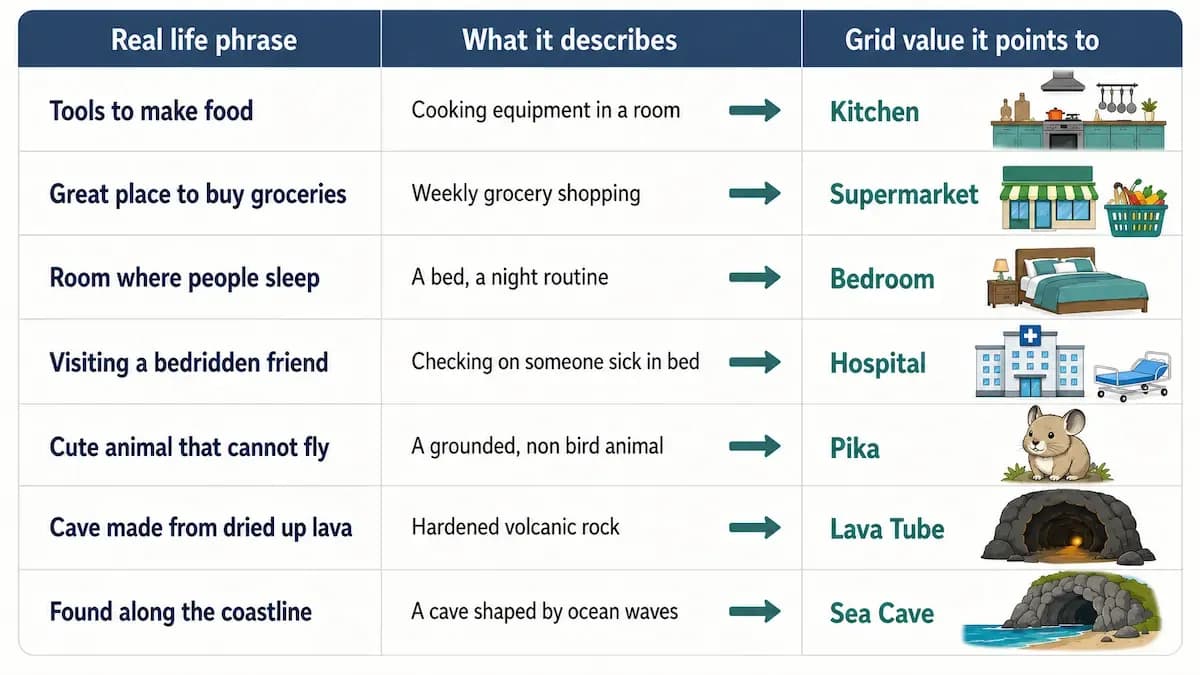
Read the clue once for the scene it describes, not the words it uses. Ask yourself what category of thing that scene belongs to, then check that category against the short list of options the grid already gave you. If the scene only fits one option on that list, you have your answer without needing the puzzle to spell it out. If the scene could fit two options, hold off and look for a second clue instead of guessing, the same rule that applies to every other clue type in the game.
A grid full of direct clues would still be solvable, but it would read like a form you fill out. The common sense clues are what make Profile Perfect feel like it is describing a place instead of listing facts about one. Tools to make food, a shopping trip, a visit to a sick friend, a flightless animal, each of these hands you a small piece of a scene instead of an answer, and your job is to recognize the scene the same way you would in everyday life.
The best examples in this set share one thing in common. Kitchen and Supermarket work because almost every player already carries the real world fact behind them. The cave level works too, but only because the puzzle backs up its riskier trivia with a second path to the same answer. That balance, universal scenes paired with a safety net for the rarer ones, is what keeps a common sense clue feeling like a fair piece of logic instead of a pop quiz on facts you never studied.