
A tour through ten of the strangest, funniest level themes in Profile Perfect, from a dog's name tag to a vampire's drink order, showing how the same deduction logic holds up no matter how weird the setting gets.

Guide By Liam Stone
Published on July 7, 2026
Liam Stone has played Profile Perfect since the app first launched on the Apple App Store. He spotted its potential early, and that early bet turned into hundreds of hours spent solving levels, testing clue logic, and documenting answers for other players. Liam runs the YouTube channel Puzzle Game Answer where his puzzle walkthroughs have earned over 935,000 views and a growing community of more than 800 subscribers. He covers a wide range of mobile puzzle games beyond Profile Perfect, giving him firsthand experience with how these games design clues, structure levels, and trip up even experienced players. Every guide on this site reflects that hands on experience. Liam plays each level himself, verifies every answer against the in game grid, and rewrites confusing clues into plain language so you don't need to guess. If you want more of his walkthroughs, subscribe to his channel.
Loading calendar...
I started tracking themes in Profile Perfect the way some people track birds. At first it felt like a harmless habit. Then I hit a vampire coffin carved with a moon symbol two levels after solving a puzzle about airport lounge seating, and I realized this game does not have a comfort zone. It has a spreadsheet of every genre humans have ever loved, and it turns each one into a grid.
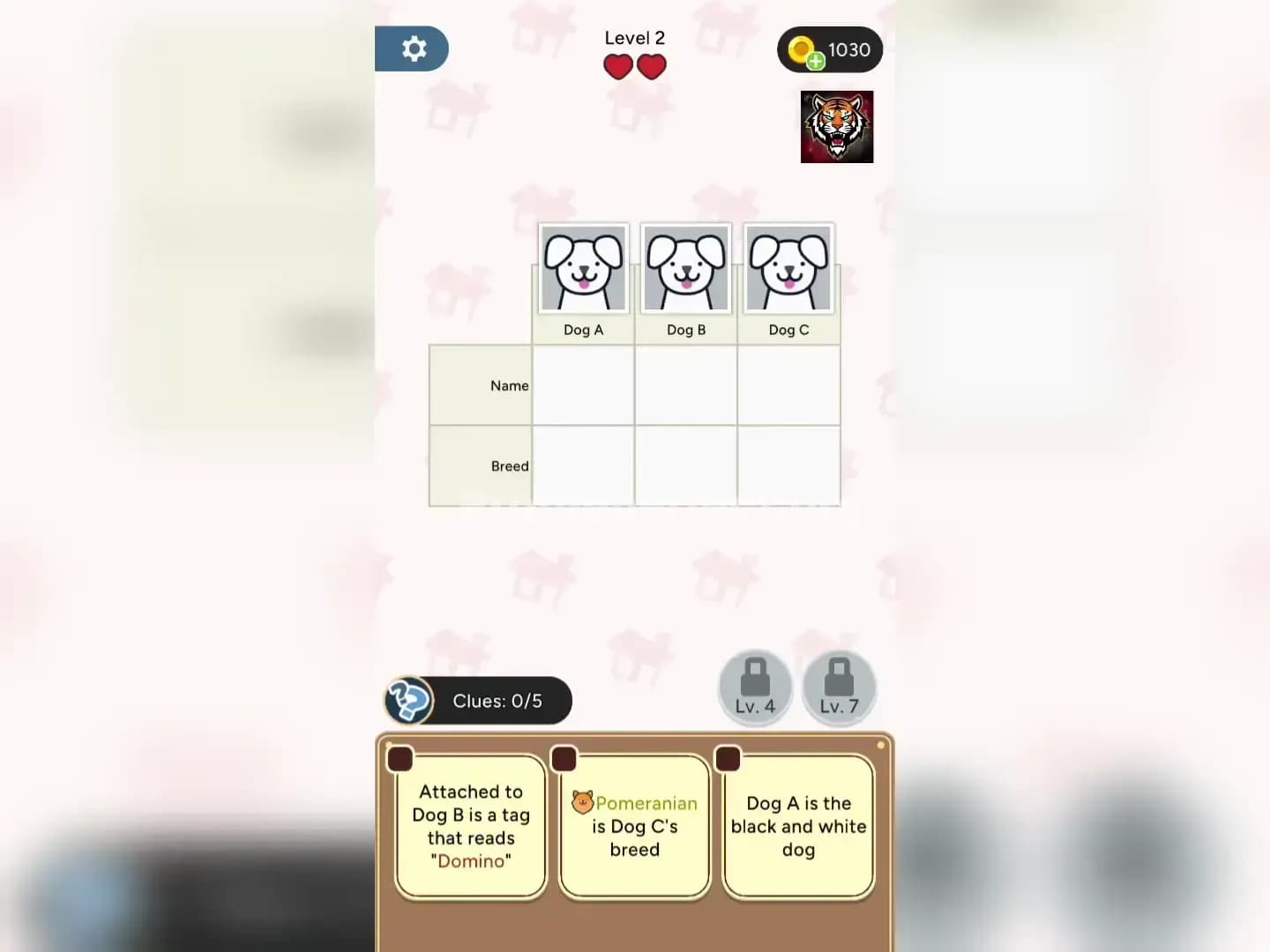
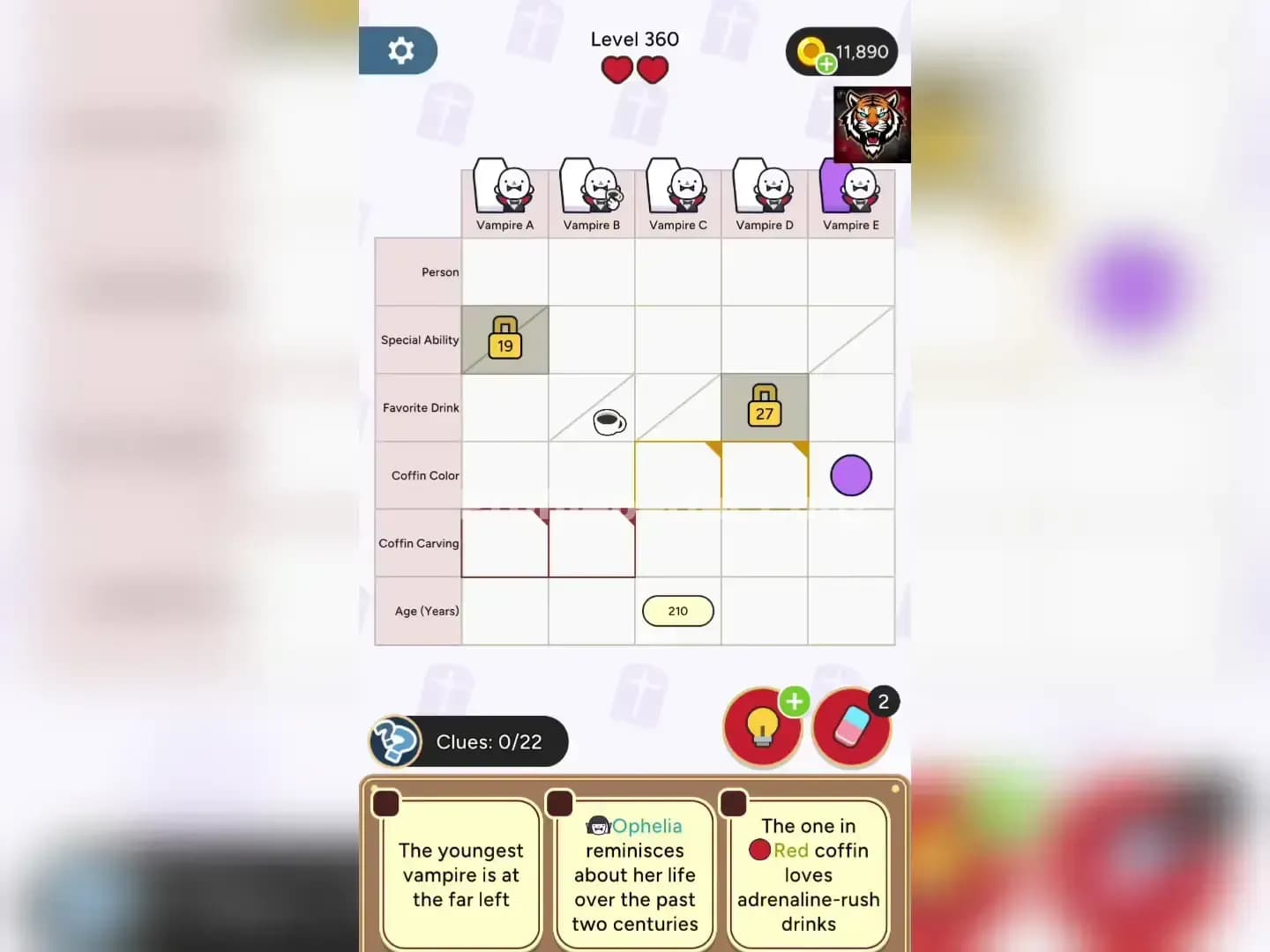
Level 2 asks you to match three dogs to their names and breeds. Level 360 asks you to sort five vampires by coffin color, favorite drink, and how many centuries they have been undead. Same rules apply in both cases. Same five clue types. Completely different planets. That range is the whole appeal once you notice it, so I pulled ten themes that made me laugh, pause, or squint at my phone and ask why an ATM knows my name.
Here they are, in the order I bumped into them, with the logic underneath each one and the screenshot that captures it best.
Level 2 hands you three dogs and two traits, name and breed. That sounds like the easiest puzzle in the game, and structurally it is. But the clue that sticks with you is the one about a name tag. It reads, "Attached to Dog B is a tag that reads Domino." You are not guessing a personality trait or a hidden preference. You are reading a physical object clipped to a physical dog. The game trusts you to treat an accessory as evidence, and that habit becomes important later when levels start hiding answers inside jewelry, luggage tags, and coffin carvings.
This works as logic because a tag is unambiguous. Once you know Dog B wears a tag that says Domino, you are not interpreting tone or inferring color from a nickname. You are reading a label out loud. Early levels use these direct reveals to teach you how a clue attaches to a cell before later levels strip that comfort away.
Screenshot to show. Level 2, the Dog puzzle, with the name tag clue highlighted so readers see how a simple object clue reads.
Level 31 drops five magical portals into a row and asks you to sort them by color, zodiac sign, destination, guardian, and entrance fee. Entrance fee. Somewhere in this game's universe, someone is charging admission to step into the Underworld, and the fairy guarding it apparently takes a cut. The most expensive portal leads to a volcano, guarded by a ghost. Haunted real estate costs more, apparently, even in the afterlife.
The logic here rewards you for treating price like any other trait. Once you know the two priciest portals sit next to each other, you can rule out placements the same way you would with cheaper traits like sign or color. The fantasy setting does not change the math. It just makes the math funnier, because you are ranking mythological destinations by how much they cost to enter, like a theme park pamphlet written by Dante.
Screenshot to show. Level 31, the Portal puzzle, showing the row of five portals with their entrance fee symbols visible.

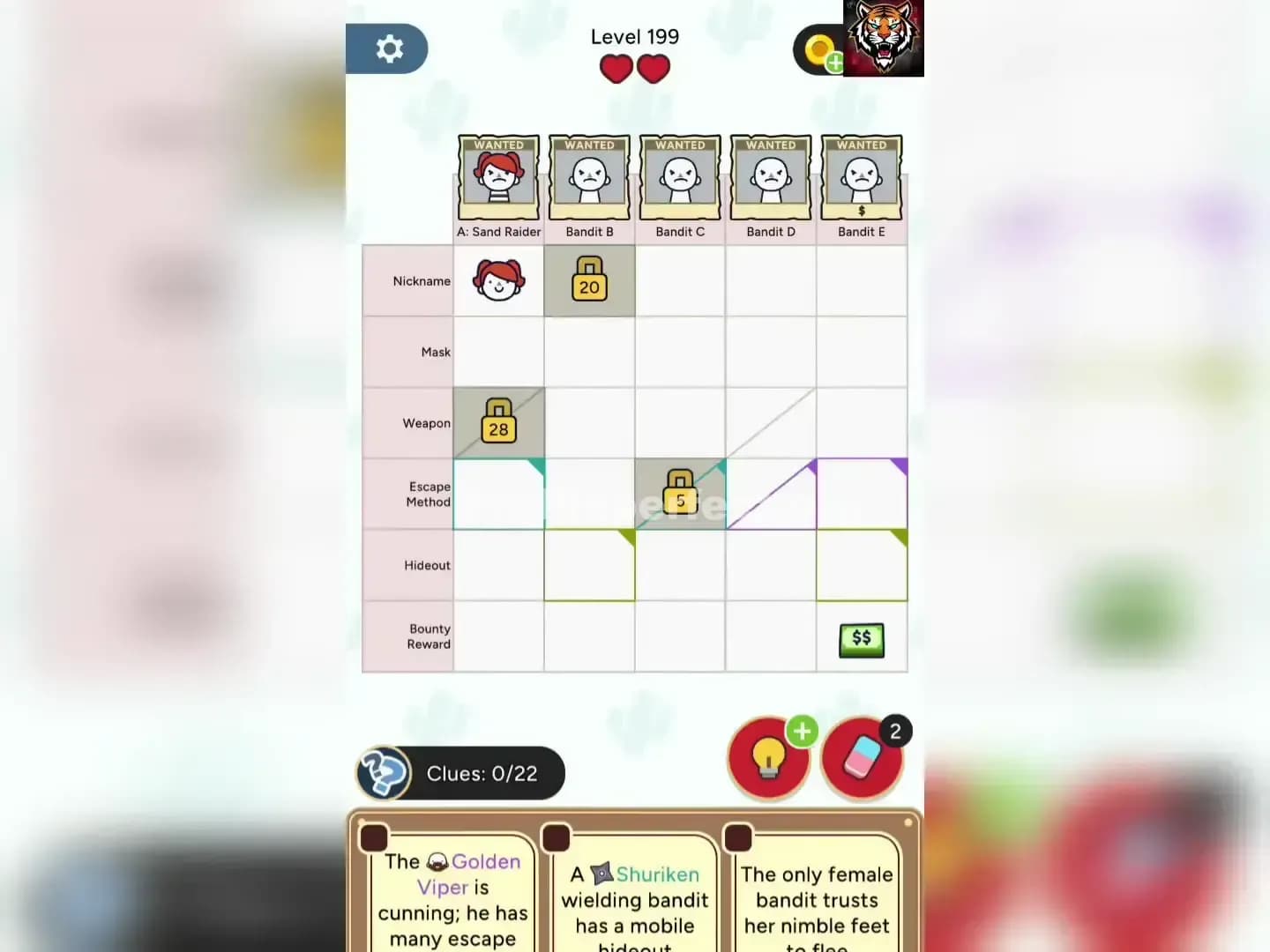
Level 199 puts five desert bandits in a lineup and asks you to sort nicknames, masks, weapons, escape methods, hideouts, and bounty rewards. This is one of the densest puzzles in the whole set, twenty two clues deep, and it reads like a workplace performance review for a crime syndicate. One bandit gets docked because bandits next to Night Mirage do not offer the highest payout. Another gets flagged as a rookie with the lowest bounty because he lives in a cave. Somewhere a bounty hunter has spreadsheets on these people.
What makes this puzzle satisfying is how it reuses a familiar logic move, ranking by reward or seniority, inside a costume that makes it feel new. You are still doing the same relative comparison you would do with a hiker's mood or a chef's years of service. The desert setting and the criminal résumés just make the stakes feel higher than they are.
Screenshot to show. Level 199, the Bandit puzzle, with the bounty reward column visible so readers see the pay scale joke.
Level 360 is where I stopped and reread a clue three times. Five vampires, six traits, and one line explains that the oldest vampire owns a worldwide collection of leaves, which turns out to mean he drinks tea. Another vampire's favorite drink is beer, and the clue insists his special power of weather control kicks in specifically when he wants to go out for a pint. These are three hundred and forty year old immortals with drink preferences as specific as a coworker who will not stop talking about oat milk.
The reason this puzzle works as a logic exercise despite the absurd flavor text is that every joke still resolves into a clean fact. Tea points to a specific vampire. Beer points to a different one. The humor is a costume worn by an ordinary deduction chain, and once you strip the jokes away, you are left with the same kind of elimination grid you saw back in the dress and bag puzzles from level four and six.
Screenshot to show. Level 360, the Vampire puzzle, with the favorite drink and coffin carving columns visible together.
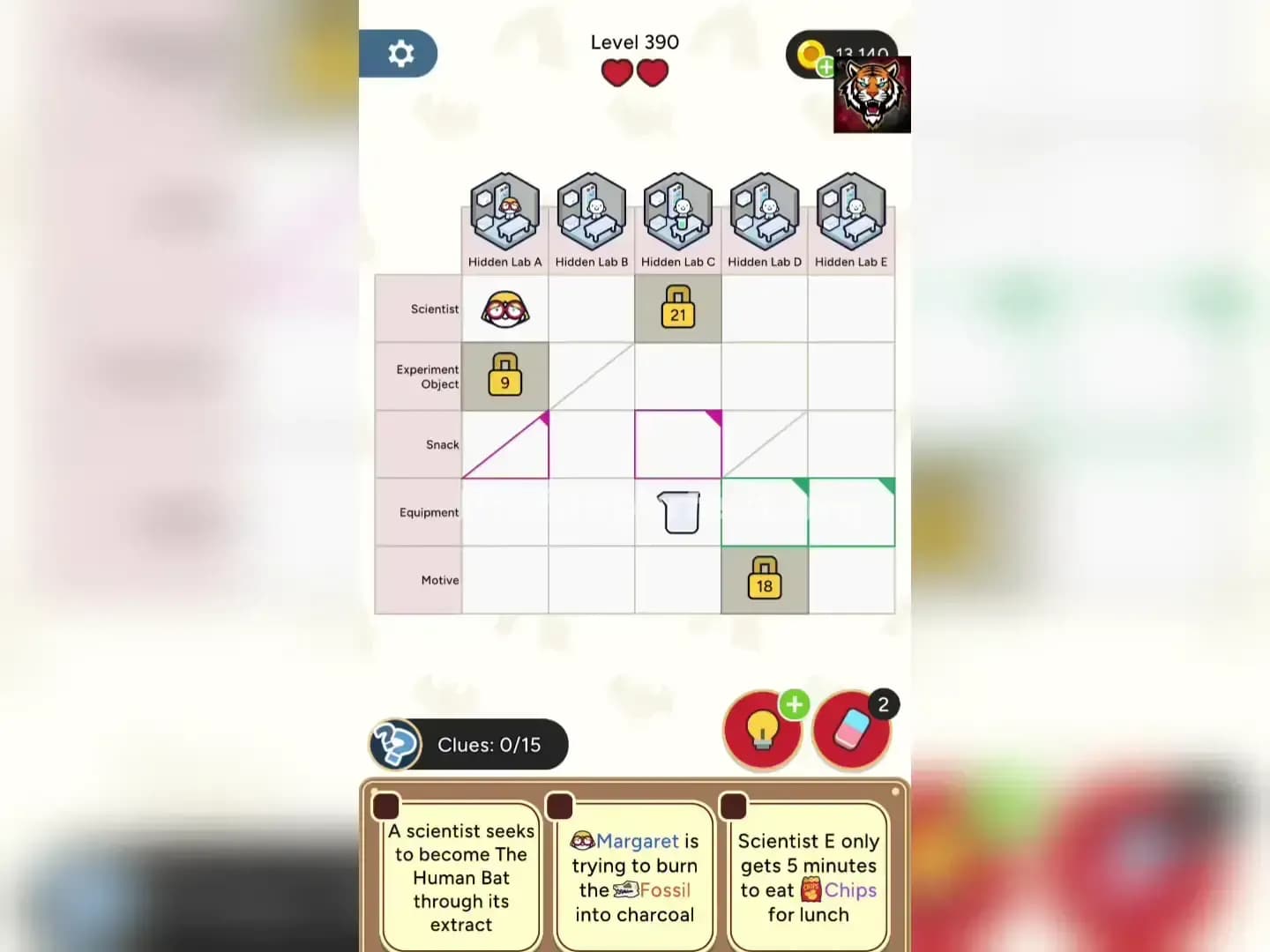
Level 390 sends you into a hidden laboratory with five scientists, and the traits are not about danger or discovery. They cover scientist, experiment object, snack, equipment, and motive. One scientist is trying to achieve time travel. Another wants to summon an alien. A third is building a bioweapon. And the puzzle cares just as much about who is eating a protein bar as it does about who is chasing world altering research, because the snack column carries real clues, not filler.
This is a good example of how Profile Perfect keeps a puzzle fair even when the theme escalates. High stakes motives like time travel and bioweapons could easily make a level feel heavy or serious, but tying them to something as small as a snack choice keeps the tone light and keeps the clue chain grounded in things you can actually compare, like who sits two columns from Alex.
Screenshot to show. Level 390, the Hidden Lab puzzle, showing the snack and motive columns side by side.
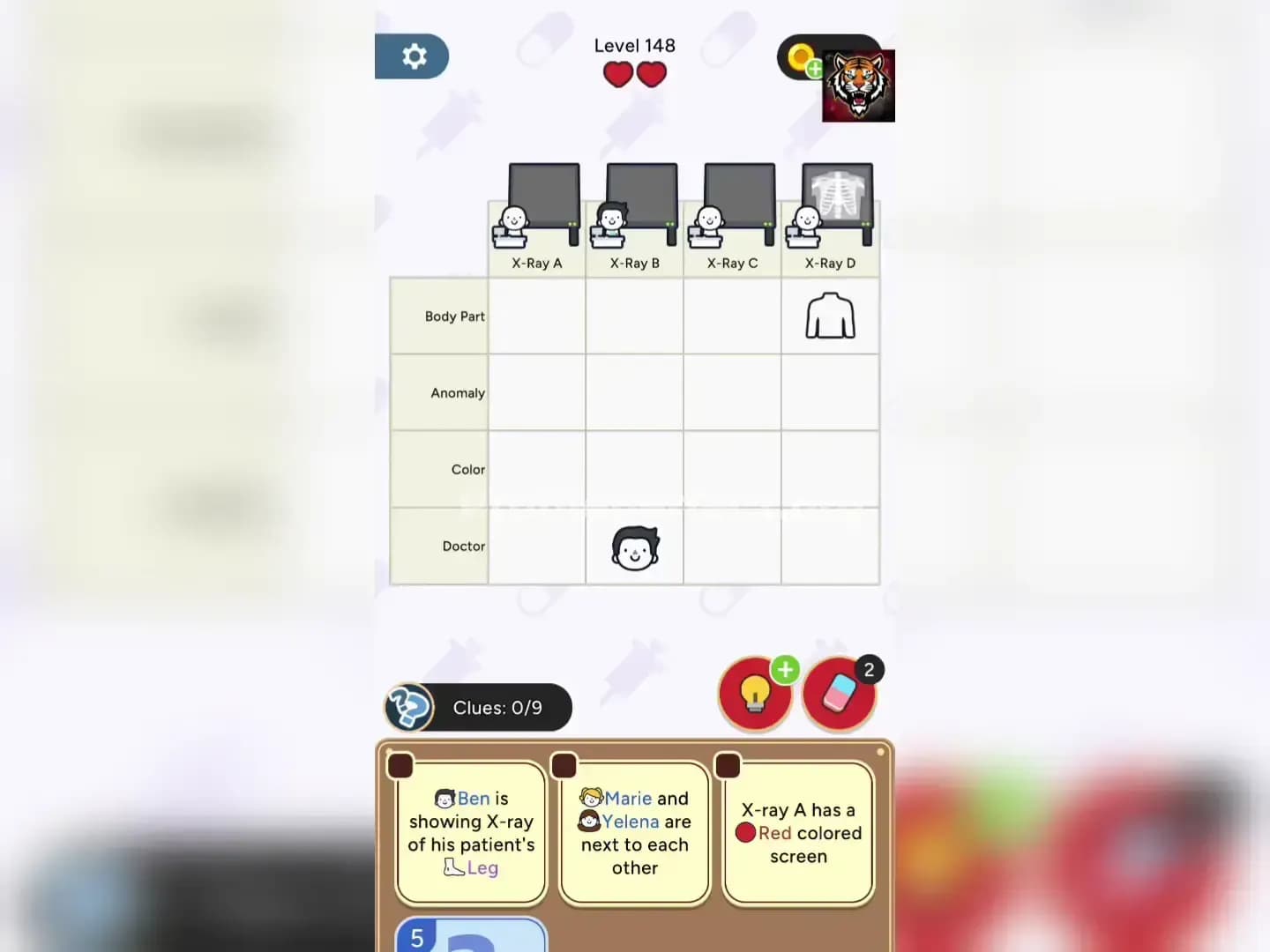
Level 148 puts four X ray scans in a row and asks you to match body part, anomaly, color, and doctor. The anomalies are a ring, a coin, a screw, and a dice, and the clue writing treats a screw stuck inside someone's skull with the same matter of fact tone as a missing wedding ring in someone's arm. You never learn how any of this happened, and the puzzle does not care. It just wants you to know which doctor is holding which screen.
The logic works because color, body part, and doctor all behave as fixed identifiers, the same way name and breed did back in the dog puzzle. The gross factor is pure flavor. Strip it away and you have a four item grid with straightforward positional clues, which is exactly why this level sits early in difficulty despite the memorable subject matter.
Screenshot to show. A wide shot of Level 148's four X ray screens in a row, showing the different colored displays and anomaly shapes.
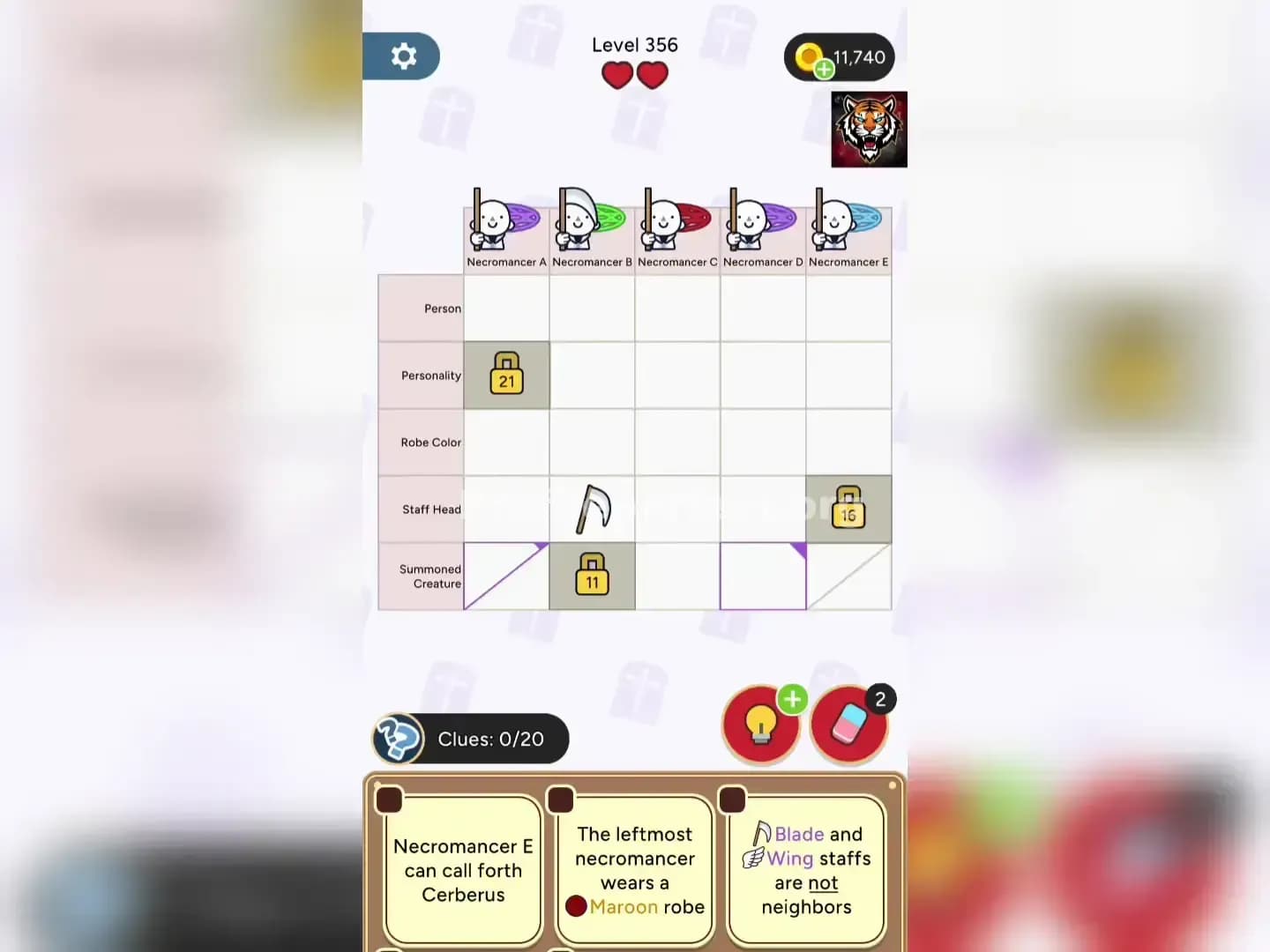
Level 356 gives you five necromancers, each with a personality, a robe color, a staff head, and a creature they summon. Somewhere in the clue chain sits this line, blonde necromancers are dating, and her staff matches his robe. I want to know who runs matchmaking in a necromancer guild, and whether staff and robe coordination is a requirement for a second date.
Despite the wildly specific flavor, the deduction underneath is standard trait linking. You are told two people share a hair color, and that shared trait becomes the bridge that connects an accessory to a personality. The dating detail is a bit of narrative glue holding two facts together, and it works precisely because Profile Perfect trusts silly premises to carry real logical weight.
Screenshot to show. Level 356, the Necromancer puzzle, with the robe color and summoned creature columns visible.
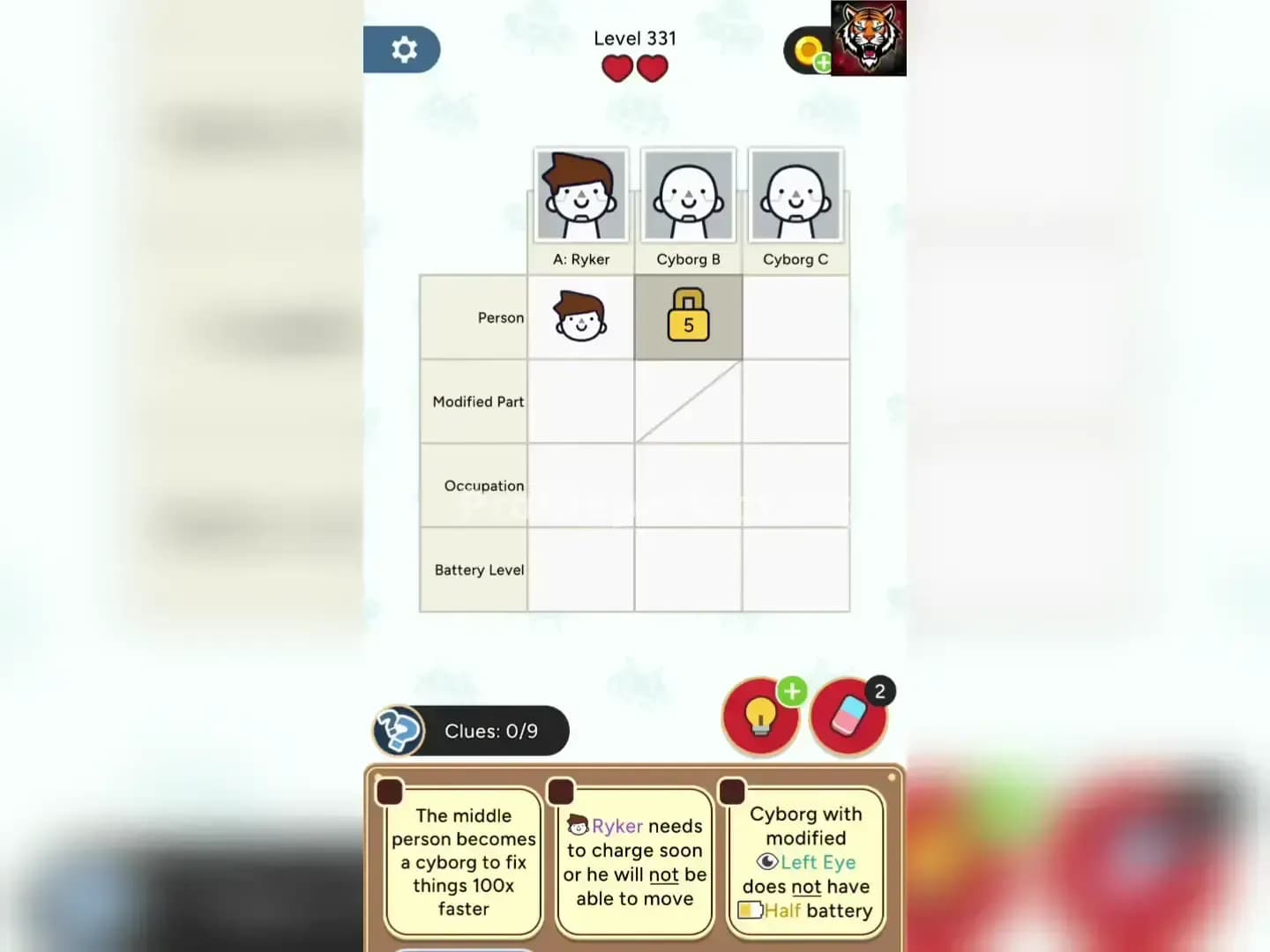
Level 331 only has three subjects, but it made me laugh harder than levels with twenty clues. Three cyborgs, and one clue explains that the low battery cyborg borrows a charger from a fully charged neighbor. These are people who have replaced their eyes, brains, and arms with machinery, and the puzzle's central drama is that one of them forgot to plug in overnight.
The trait set here, battery level, modified body part, occupation, and person, shows how well this game adapts a familiar comparative structure, higher versus lower, first versus last, to any premise. Battery level behaves exactly like the price tiers in the portal puzzle or the years of service in an early office puzzle. The cyborg skin just makes a mundane comparison feel like it belongs in a different genre.
Screenshot to show. Level 331, the Cyborg puzzle, with the battery level indicator visible on each character.
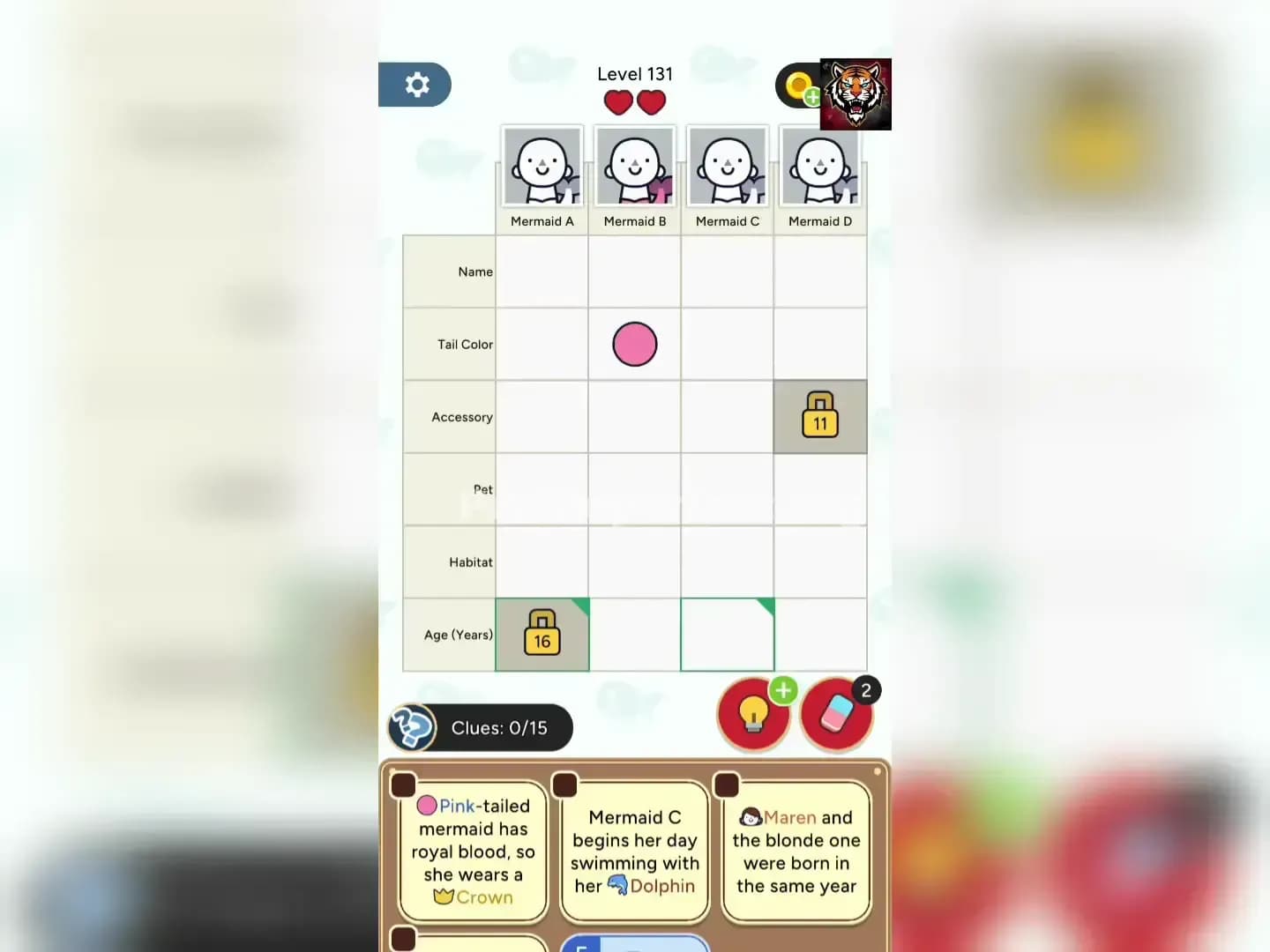
Level 131 sorts four mermaids by name, tail color, accessory, pet, habitat, and age, and one clue tells you flatly that the pink tailed mermaid has royal blood, so she wears a crown. Another mermaid rides around with an octopus while a third owns a crab that outlives most household pets. The puzzle treats undersea social class as something you can read directly off a tail, which is either the most straightforward monarchy in fiction or a very committed dye job.
This level is a good example of trait density done well. Six traits for four subjects is a lot of information to track, but the puzzle grounds it with strong anchor clues, like tail color tying directly to accessory, so you always have a stable starting point before working outward into habitat and age.
Screenshot to show. A wide shot of Level 131's four mermaids together, showing the different tail colors and accessories clearly.
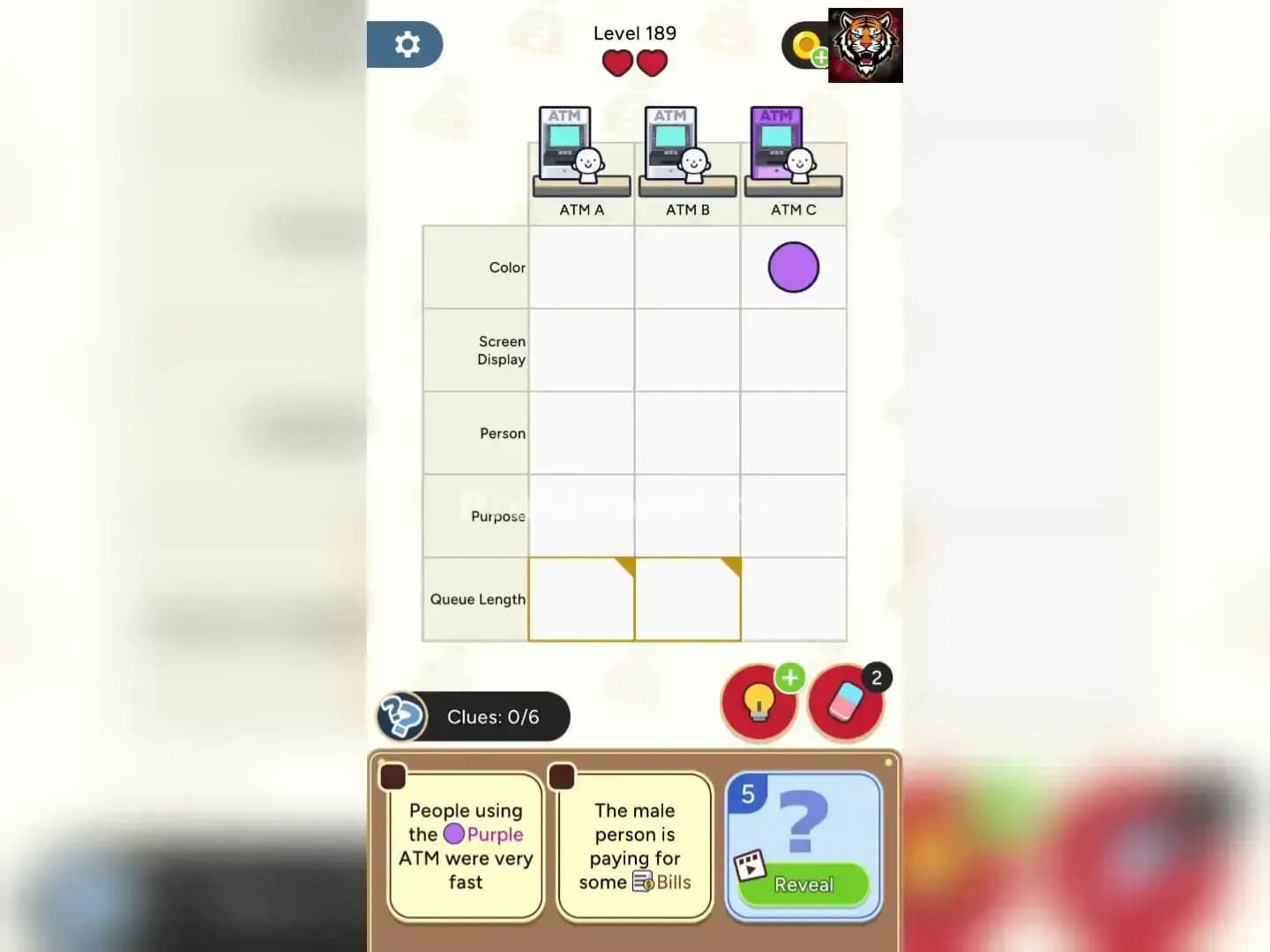
Level 189 has only three ATMs, and somehow it is one of the funniest entries on this whole list. The traits are color, screen display, person, purpose, and queue length, and the clue chain plays out like overheard gossip at a bank branch. Willy can see Monica's screen to his right. Debora is welcomed by the ATM before taking some money. An ATM greeting a specific customer by implication, and a man reading a stranger's screen over her shoulder, is exactly the kind of small scale, everyday weirdness this game specializes in when it is not busy sorting vampires or necromancers.
The logic stays simple because three subjects with five traits still gives you plenty of anchor points. The comedy comes entirely from how ordinary the setting is compared to portals and hidden labs. Profile Perfect proves here that a bank lobby can carry just as much charm as a haunted crypt if the clue writing has personality.
Screenshot to show. Level 189, the ATM puzzle, showing the three machines with their screen displays visible.
None of these ten levels breaks the game's actual rules. Every one of them still gives you subjects, traits, a locked answer or two to start you off, and a chain of clues that connects one fact to the next until the grid fills in. What changes is the costume. A tag on a dog collar and a carving on a vampire's coffin do the exact same job. They each hand you one piece of fixed evidence you can build from. A bounty reward and an entrance fee do the exact same job too. They each let you rank subjects the same way you would rank years of service or age.
That consistency is why jumping from Level 2 to Level 360 does not feel like whiplash once you have played enough of these. You already know how to read a grid. The dogs and the vampires are just wearing different clothes.