
A quick guide for detective game fans with no time to spare, showing how Profile Perfect fits full case solving clues, suspects, and a restart penalty into levels you can finish in five minutes.

Guide By Liam Stone
Published on July 7, 2026
Liam Stone has played Profile Perfect since the app first launched on the Apple App Store. He spotted its potential early, and that early bet turned into hundreds of hours spent solving levels, testing clue logic, and documenting answers for other players. Liam runs the YouTube channel Puzzle Game Answer where his puzzle walkthroughs have earned over 935,000 views and a growing community of more than 800 subscribers. He covers a wide range of mobile puzzle games beyond Profile Perfect, giving him firsthand experience with how these games design clues, structure levels, and trip up even experienced players. Every guide on this site reflects that hands on experience. Liam plays each level himself, verifies every answer against the in game grid, and rewrites confusing clues into plain language so you don't need to guess. If you want more of his walkthroughs, subscribe to his channel.
Loading calendar...
You love the detective fantasy. The clue that changes everything, the profile that finally lines up, the moment you tap the last answer and the whole case clicks shut. What you don't love is clearing your evening for it. Most days you get five minutes, maybe less, between a meeting and a coffee run. Profile Perfect was built for exactly that gap.
Most games built around clues and suspects ask for a real commitment. You open a case, read pages of dialogue, walk between rooms, and slowly build a theory across an hour or more. That's a great way to spend a rainy Saturday. It's a terrible fit for a lunch break.
Profile Perfect strips the detective genre down to the part you actually came for, the deduction. There's no dialogue tree to click through and no map to walk across. You get a small set of subjects, a handful of traits to match, and a stack of clues that read like witness statements. You start reading, and you're already solving.
Every level works like a miniature case file. The subjects are your suspects, or your rooms, or your dogs, or whatever the level happens to be about. The traits are the details you're trying to pin down: a name, a color, a job, a breed. The clues are your evidence, and the grid is where you write down your conclusions.
In a real investigation you'd flip through witness statements looking for the one line that breaks the case open. Profile Perfect gives you the same feeling in a much smaller package. Some clues hand you a fact outright, like a locked answer sitting at the top of the level. Others make you work for it, using position, elimination, or a small piece of common sense, the kind of clue that tells you a room full of pots and pans has to be the kitchen. Either way, you're reading evidence and deciding what it proves before you touch the grid.
A case with no consequences isn't much of a case. Profile Perfect keeps you honest with a two life system. Tap the wrong answer and you lose a life. Lose both and you restart the level from scratch. There's no timer pushing you to rush, so the pressure comes from your own certainty, not the clock. That's the same pressure a good detective feels before naming a suspect. You want proof, not a hunch, before you commit.
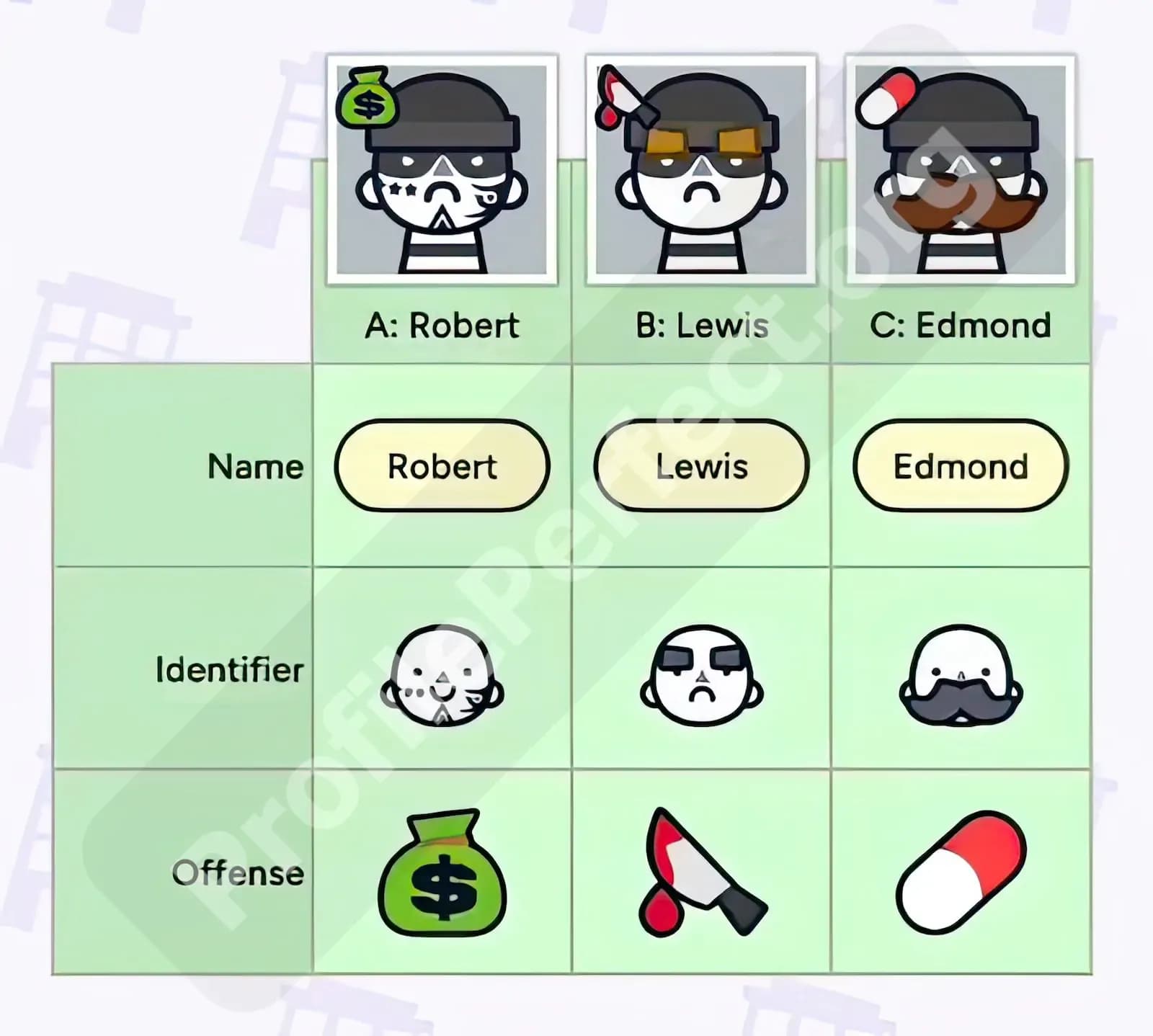
Level 21 hands you the most literal case file in this set, and it's worth handling carefully since it leans straight into crime. Three suspects sit in a lineup, each with a name, an identifying mark, and an offense. One clue tells you straight away that the suspect in the middle is the murderer. Another points at the mustache on your right. From there you're chasing small physical details, a tattoo, thick eyebrows, and working out which offense belongs to which suspect. By the end you know Robert did the robbery, Lewis committed the murder, and Edmond ran the drug operation, all confirmed by a grid you built in a couple of minutes.
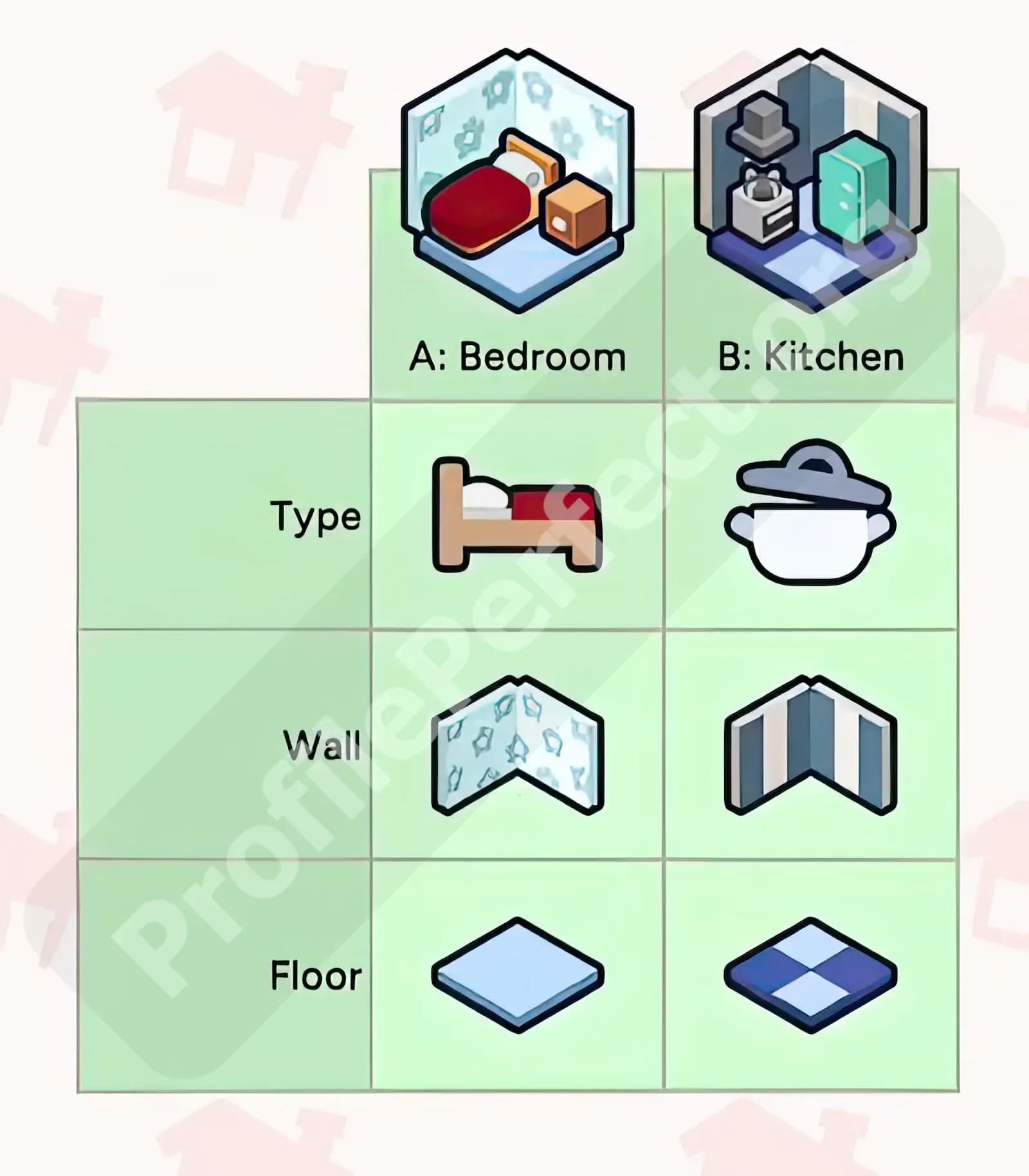
Not every case in this game involves a suspect at all, and Level 3 proves it. This one drops you into a home with just two rooms and asks you to work out which is which, based on wall pattern and floor type. One room already has a tiled floor locked in, which gives you a foothold before you've read a single clue. From there the deduction runs on plain logic. Tools for cooking mean you're standing in the kitchen. A floral wall pattern points you toward the bedroom next door. It's a small case, but it proves the same detective habit works whether you're chasing a criminal or just figuring out what room you're standing in.
Level 51 moves the fantasy out of the interrogation room and into a museum, which is a good reminder that Profile Perfect doesn't need a crime to feel like an investigation. Four museums sit in different locations, each holding its own artifact and running its own exhibit. You already know one museum is hosting a space exhibit before you start, and the clues build out from there. A rock links to the space wing. A map points to history. A tome placed in the city museum turns out to belong to the science exhibit once you follow the clue about lost technology. No suspects, no offense, just a set of details that need matching, and the same satisfaction when the last piece drops into place.

None of these three cases takes more than a few minutes to close, and that's the point. You get the exact feeling detective fiction promises, gathering proof, ruling out the wrong answer, and locking in the one that fits, without blocking out your evening for it. Open a level on your commute, close it before your stop, and pick the next one up tomorrow. The case file never really closes. It just waits for your next five minutes.