
A guide for crossword fans exploring Profile Perfect, showing how the same clue interpretation skill carries over when the answer becomes a grid match instead of a word, with examples from Level 16 and Level 6.


Guide By Liam Stone
Published on July 7, 2026
Liam Stone has played Profile Perfect since the app first launched on the Apple App Store. He spotted its potential early, and that early bet turned into hundreds of hours spent solving levels, testing clue logic, and documenting answers for other players. Liam runs the YouTube channel Puzzle Game Answer where his puzzle walkthroughs have earned over 935,000 views and a growing community of more than 800 subscribers. He covers a wide range of mobile puzzle games beyond Profile Perfect, giving him firsthand experience with how these games design clues, structure levels, and trip up even experienced players. Every guide on this site reflects that hands on experience. Liam plays each level himself, verifies every answer against the in game grid, and rewrites confusing clues into plain language so you don't need to guess. If you want more of his walkthroughs, subscribe to his channel.
Loading calendar...
You finish your crossword every morning. You like the moment a clue clicks and the right word drops into the grid. But you have started to notice something. Most days you are not really thinking about words anymore. You are thinking about letter counts, common suffixes, and whether "ISLE" fits better than "ATOLL." The clue solving you love has quietly turned into word retrieval. Profile Perfect gives you that same clue solving feeling back, minus the spelling.
Crosswords trained you well. You know how to hold a clue in your head, test it against a few possibilities, and wait for the one answer that fits every constraint at once. That skill, clue interpretation, is the actual game. The specific format, letters in boxes, is just the container it usually comes in.
Profile Perfect uses the same skill in a different container. Instead of a blank row waiting for letters, you get a grid of subjects and traits waiting for matches. The clue still gives you a scene or a fact. You still have to figure out what it's pointing at. The only thing missing is a keyboard, because the answer here is a relationship, not a word.
In a crossword, once you know the answer, the work is mechanical. You spell it out, letter by letter, into the squares. The thinking already happened. The typing is just recording it.
In Profile Perfect, once you know the answer, the work is a single tap. You are not filling, you are matching. You take a subject on one side of the grid and a trait on the other, and you connect them. There's no fill to worry about, no crossing letters that have to agree with a different clue's answer running through the same square. Each match stands on its own logic, even though later clues often lean on the matches you already locked in.
That difference sounds small, but it changes what "solving" feels like. A crossword answer is a string of letters you either know or don't. A Profile Perfect answer is a relationship you either can or can't prove yet. You're not recalling a word from memory. You're building a case for why this subject has to pair with that trait, and nothing else.
Here's where the comparison earns its keep. Take Level 16, a set of three buildings, a hospital, a supermarket, and an office, each one holding a person and a warning sign.
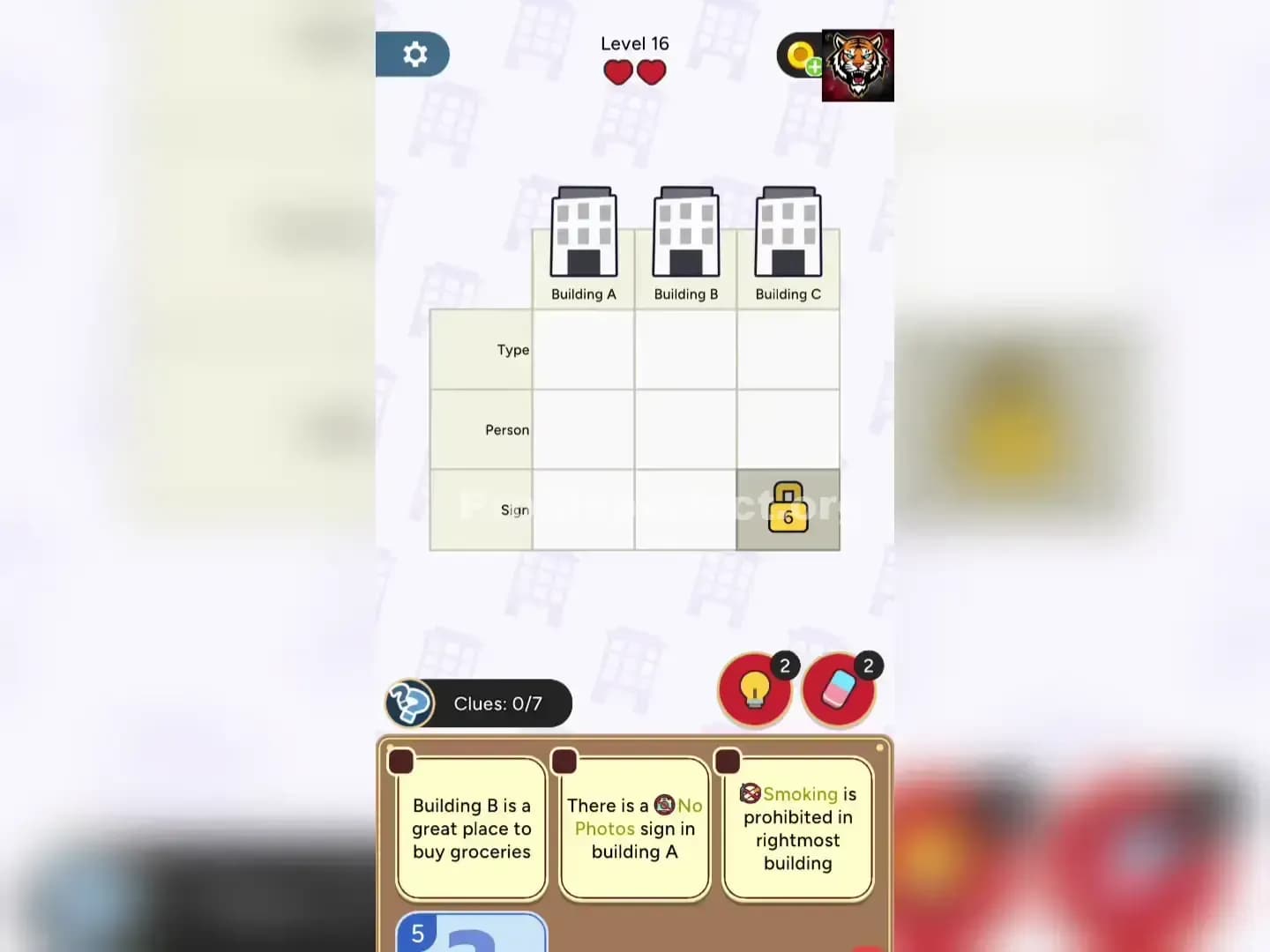
One clue reads, "Mom is visiting her bedridden friend." A crossword clue would hand you a word to spell. This clue hands you a scene, and the scene is the clue's whole trick. Bedridden means confined to a bed because of illness. Visiting someone in that state points to one place, a hospital. There's no dictionary entry to look up. You just have to picture the scene and land on the one building type in front of you that matches it.
Once that lands, the puzzle isn't done, because the clue does double duty. It also tells you Mom is the person tied to that same building. So one sentence gives you two matches at once, building type paired with hospital, and person paired with mom, both crossing through the same subject, Building A. That's about as close as this game gets to a crossing square. The two answers don't share letters, but they share a subject, and neither one makes sense without the other.
"Building B is a great place to buy groceries" skips the word supermarket entirely and trusts you to get there from the scene. "Smoking is prohibited in the rightmost building" hands you a sign instead of naming the building directly, then leans on position to close the loop. Every clue in the level is doing what a crossword clue does, describing without stating, except the thing it wants you to produce isn't a word. It's a link between two things that were sitting apart before you read the clue.
Level 6 makes the same point from a different angle, and it's worth a look because the crossings run heavier here. Three bags, three colors, three countries of origin, three prices.
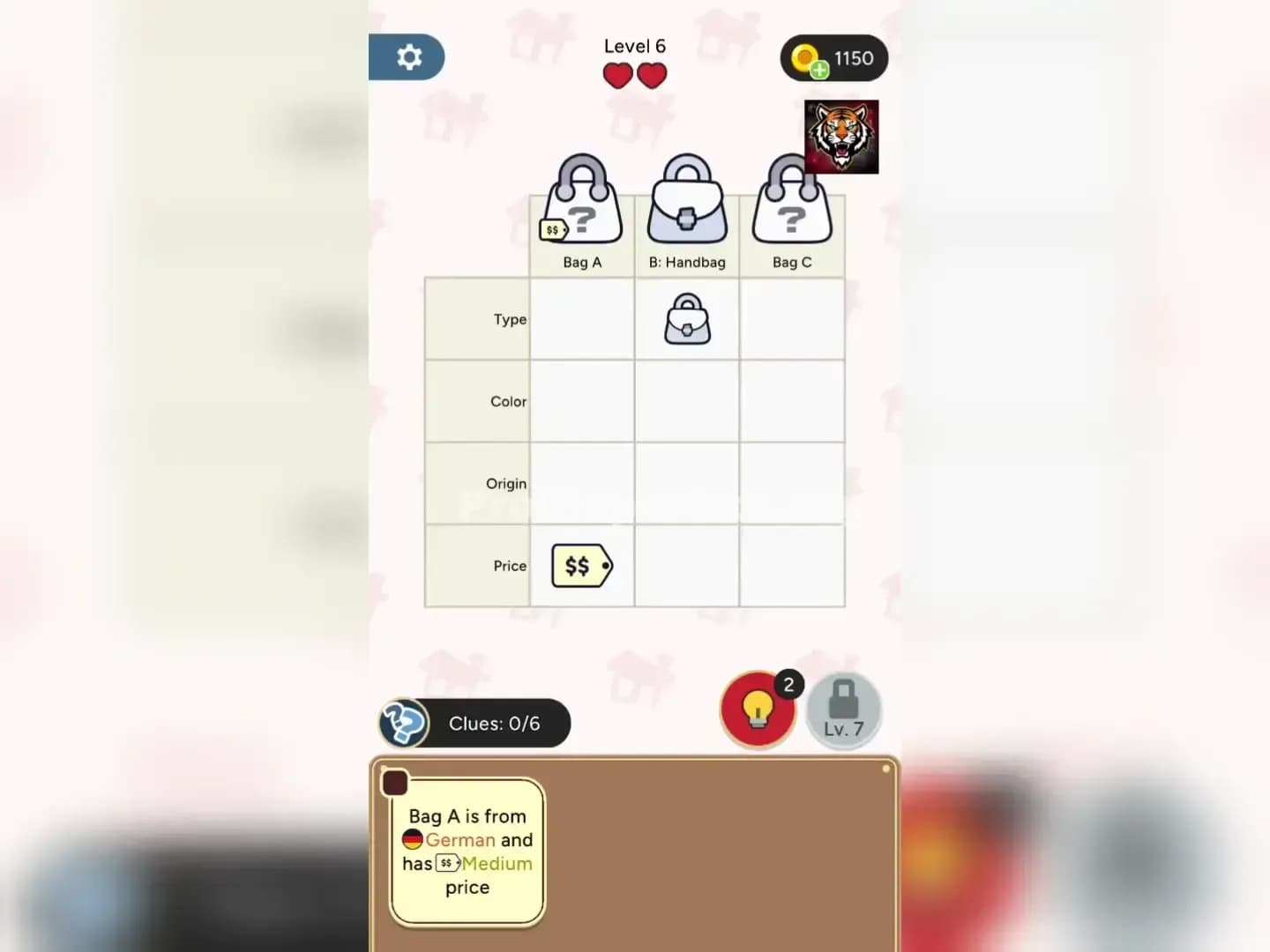
The clue "Bag from France is not colored Red" looks like a straightforward elimination clue on its own. But by the time you reach it, you already know Bag B is the handbag, Bag A is German, and Bag A is priced medium. So this one clue isn't just ruling out red for the French bag. It's confirming purple for Bag B, once you've ruled out the colors the other two bags already claimed. The clue only means anything in relation to the matches sitting next to it, the same way a crossword's down clue only resolves once enough across answers have filled in its letters.
That's the whole comparison in miniature. A crossword's crossing squares force two separate clues to agree on the same letter. Profile Perfect's clues force two separate facts to agree on the same subject. Neither puzzle wants you solving in isolation. Both want you carrying earlier answers forward and checking that the new clue doesn't contradict them.
Nothing here asks you to give up what you like about crosswords. The clue writing style survives the jump almost untouched, indirect phrasing, scene setting, a trust that you'll make the leap without being told the answer outright. What changes is the destination. Instead of proving your vocabulary, you're proving a relationship between a subject and a trait, and instead of spelling, you tap once you're sure.
For a lot of crossword regulars, that swap actually removes friction rather than adding it. You stop losing solves to a word you can picture but can't quite spell, or a synonym you know but the grid wanted a different one. Profile Perfect keeps the part of crossword solving that made you love clues in the first place, and drops the part that was really just testing your memory for words.
If your favorite moment in a crossword is the half second right before you write the answer in, the moment you know you've got it, that's the moment Profile Perfect keeps intact. It just hands you a grid cell instead of a blank square, and asks for a match instead of a word.