
A style focused tour through Profile Perfect's fashion and object levels, covering dresses, bags, hats, jewelry, lipstick, and pomade, showing how visual traits, price ladders, and accessory clues work together to solve some of the most screenshot worthy grids in the game.

Guide By Liam Stone
Published on July 7, 2026
Liam Stone has played Profile Perfect since the app first launched on the Apple App Store. He spotted its potential early, and that early bet turned into hundreds of hours spent solving levels, testing clue logic, and documenting answers for other players. Liam runs the YouTube channel Puzzle Game Answer where his puzzle walkthroughs have earned over 935,000 views and a growing community of more than 800 subscribers. He covers a wide range of mobile puzzle games beyond Profile Perfect, giving him firsthand experience with how these games design clues, structure levels, and trip up even experienced players. Every guide on this site reflects that hands on experience. Liam plays each level himself, verifies every answer against the in game grid, and rewrites confusing clues into plain language so you don't need to guess. If you want more of his walkthroughs, subscribe to his channel.
Loading calendar...
Some Profile Perfect levels hand you a lab coat and a beaker. Others hand you a lipstick tube and a price tag. Based on my gameplay across the fashion and object levels in this game, the closet themed puzzles reward you twice. You get a satisfying grid, and you get a set of subjects that look good enough to screenshot the moment you solve them.
This roundup pulls together seven levels built around style. Dresses, bags, a wall of hats, a jewelry case, a lipstick counter, and a barbershop shelf of pomade. Each one runs on the same deduction habits as any other Profile Perfect level, but fashion themes add a layer that pure logic puzzles rarely get. You are not just matching a subject to a trait. You are building a full look, and the clues make sure every piece fits.
Fashion levels almost always open with the visual trait, the thing you would notice if the item were sitting in front of you. Pattern, color, type, cut. Everything else in the grid builds on top of that first impression.
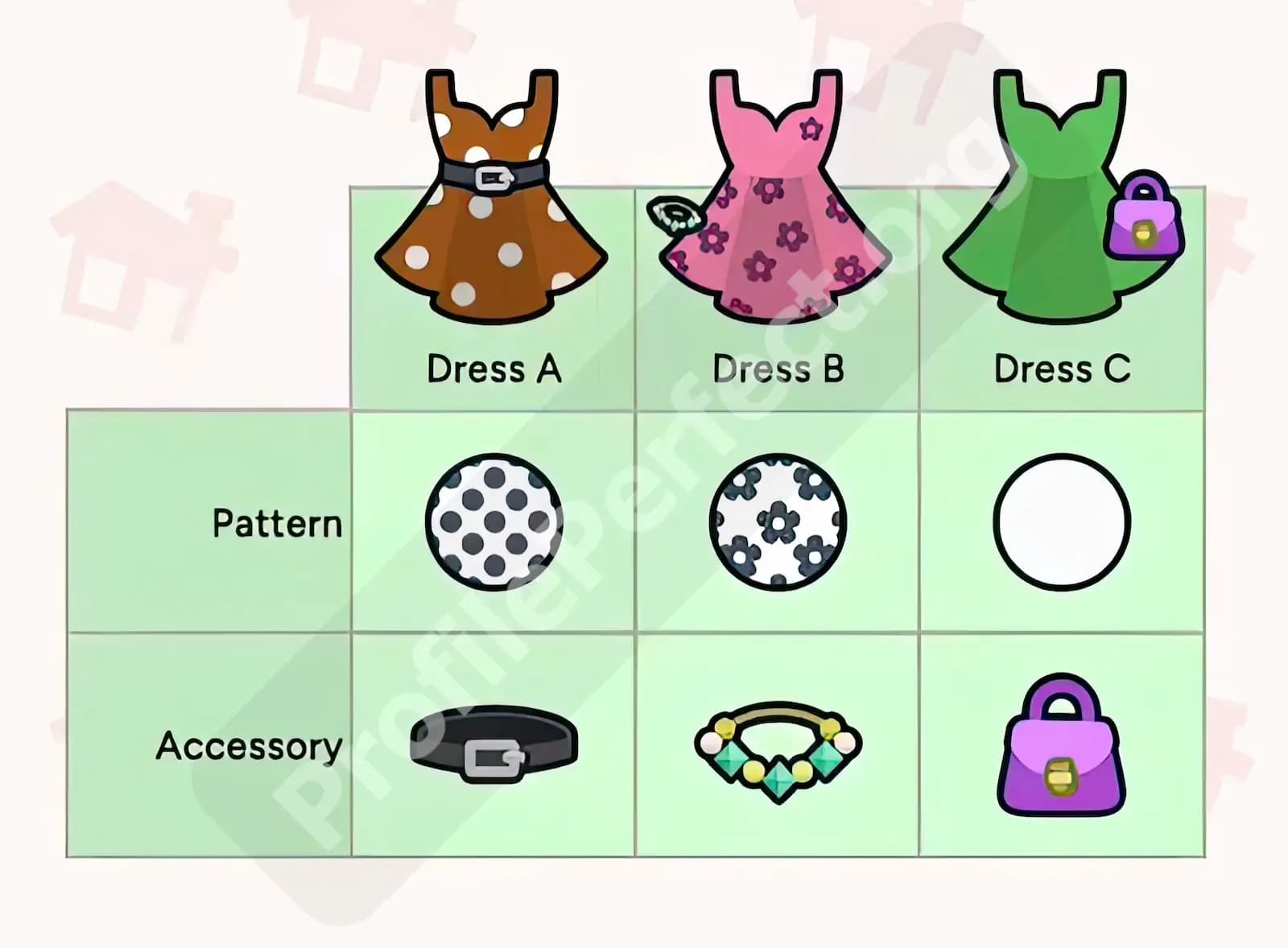
Level 4 is the entry point for the whole dress category, and it shows exactly how light a fashion puzzle can start. Three dresses, two traits, five clues, no initial answers at all. Dress A wears a polkadot pattern with a belt. Dress B goes floral with a bracelet. Dress C settles into a solid pattern with a handbag. The puzzle tells you the rightmost dress carries a handbag, then ties that same dress to a solid pattern because solid pairs well with a handbag in this game's internal logic. From there, floral sits next to polkadot, and floral rules out the belt for itself, which leaves the bracelet as the only option. Five short clues, one clean grid, and a good level to hand someone who has never opened Profile Perfect before.
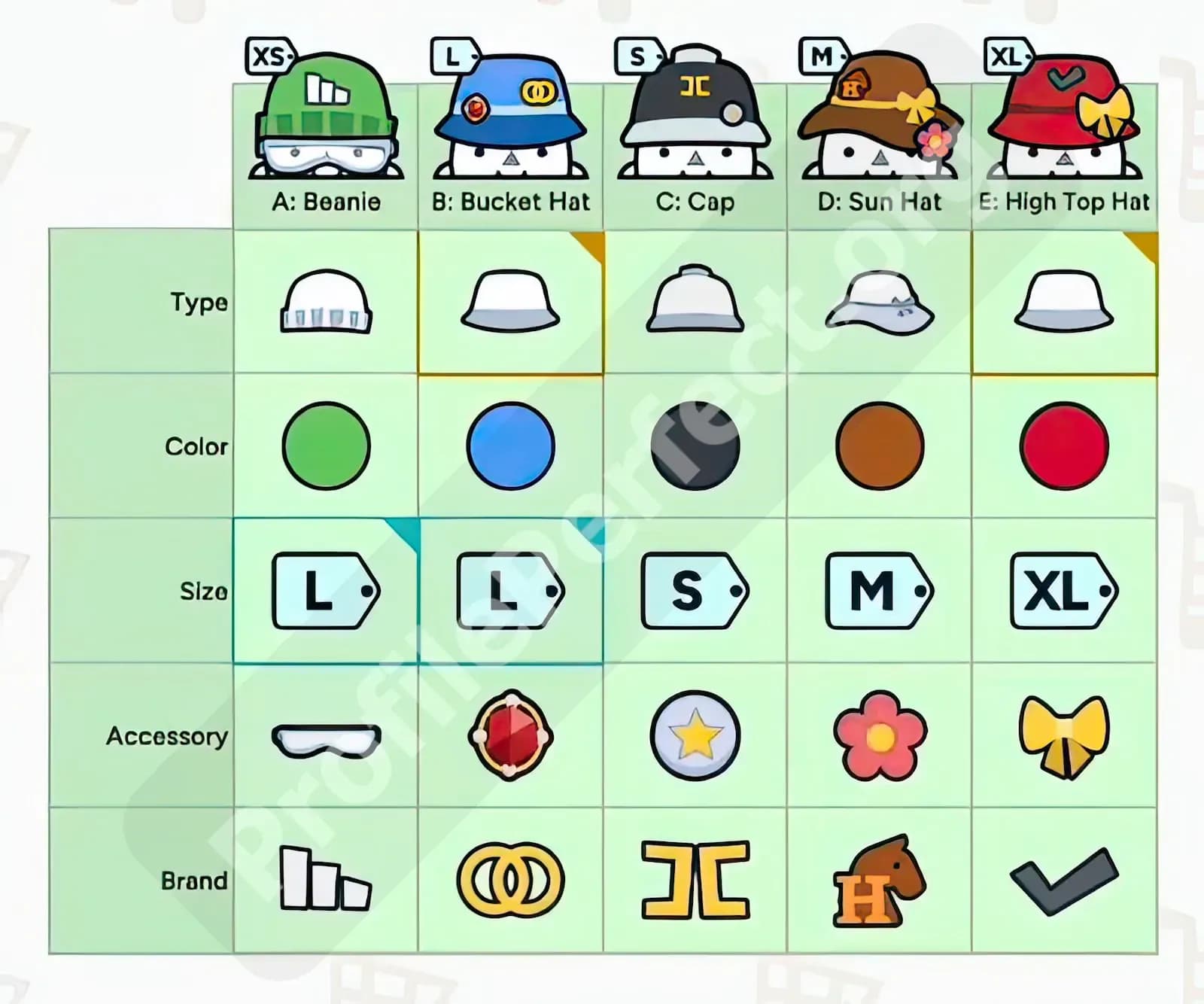
Level 44 shows what happens once the wardrobe puzzle grows up. Five hats carry type, color, size, accessory, and brand, and fifteen clues have to sort all of it. Hat A is a green Beanie in size L wearing goggles from AddiCap. Hat B is a blue Bucket Hat in size L with a brooch from Glowcci. Hat C is a black Cap in size S with a metallic pin from Chapnel. Hat D is a brown Sun Hat in size M with a flower from Hairrò. Hat E is a red Bucket Hat in size XL with a ribbon from NyKey. Notice how two different hats share the Bucket Hat type, which means the puzzle cannot let color or brand carry all the weight. It has to lean on position instead, telling you the Metallic Pin sits nowhere near hats A or E, or that the hat beside the Sun Hat wears a smaller size. By the time you reach clue fifteen, the hat wall reads like a full product lineup instead of a random pile.
Once a fashion level adds a price trait, the puzzle usually stops describing the item and starts describing its value instead. Cheapest, priciest, half the cost of a neighbor. Price clues turn the grid into a small market you have to shop through logically.
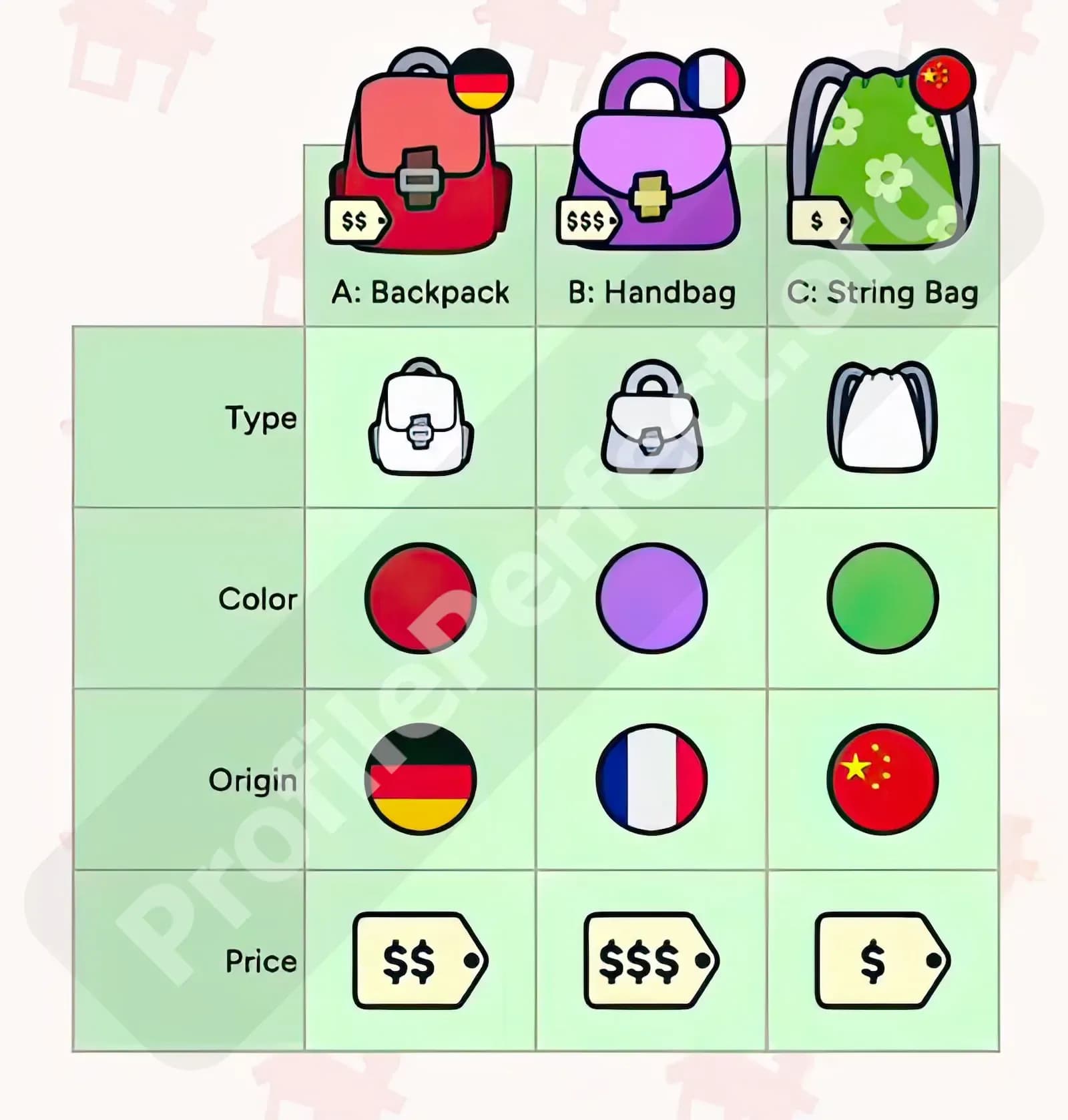
Level 6 gives you three bags with type, color, origin, and price, and the price trait does most of the heavy lifting. Bag A is a medium priced German backpack in red. Bag B is a high priced French handbag in purple. Bag C is a low priced Chinese string bag in green. The puzzle opens by telling you the German bag sits at medium price, then says the string bag costs less than the German one, which locks Bag C into the cheapest spot before you even know its color. A separate clue ties the cheapest bag to green, and another rules out red for the French bag, closing the grid in six clues. Price here is not decoration. It is the anchor the whole level hangs from.
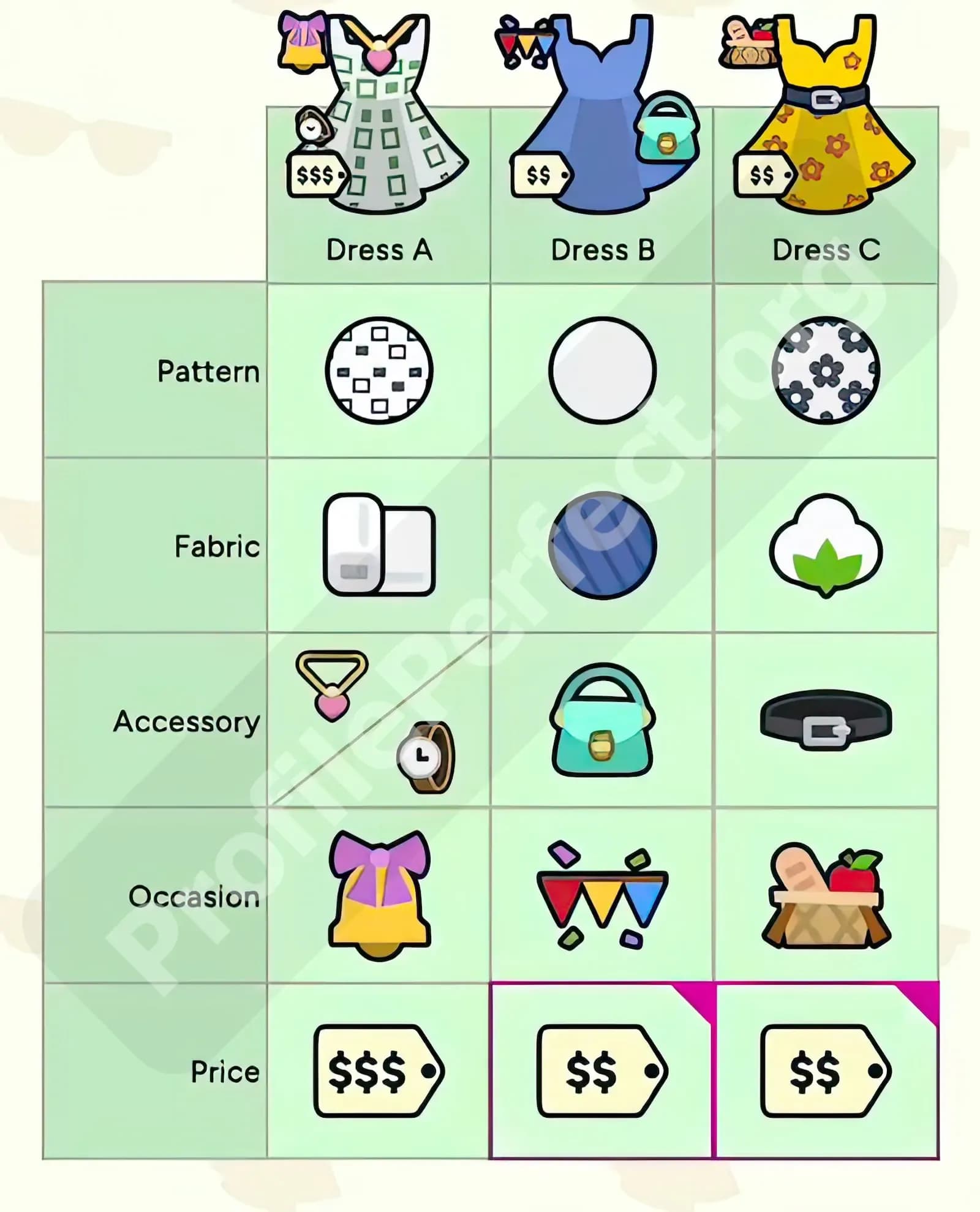
Level 91 pushes three dresses through five traits, pattern, fabric, accessory, occasion, and price, and turns price into the answer for a styling question rather than a plain fact. Dress A wears a geometric pattern in silk, pairs with a necklace and a watch at once, and dresses up weddings at the top price tier. Dress B goes solid in denim with a handbag for festivals at the middle tier. Dress C stays floral in cotton with a belt for picnics, also at the middle tier. The clue that the wedding dress costs more than the picnic dress feels obvious once you say it out loud, but it does real work here, since it locks Dress A into the top tier before several other clues even fire. Notice Dress A's accessory cell holding both a necklace and a watch. That slash means the grid wants both answers standing side by side, not a choice between them.
Not every fashion level puts a dollar sign in the grid. Some rank items by cost tier, and some skip money altogether and rank by something else entirely, like weight. The logic barely changes, but the theme keeps every level feeling different.
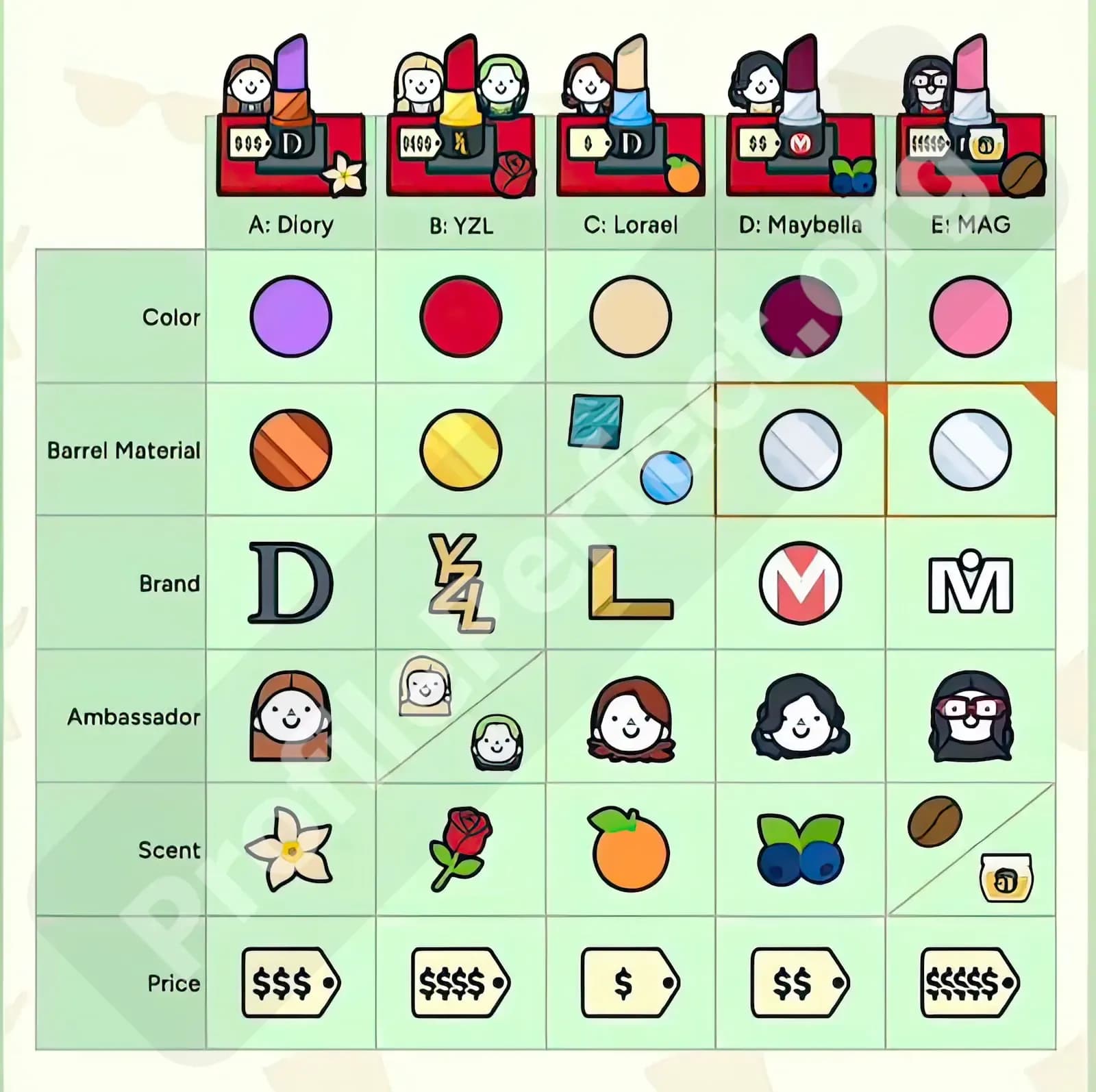
Level 96 is the biggest fashion puzzle in this lineup, five lipsticks across six traits, twenty two clues. Lipstick A comes in purple with a copper barrel from Diory, fronted by Natalie, in vanilla scent, at the third price tier. Lipstick B goes red with a gold barrel from YZL, fronted by both Scarlet and Eilish, in rose scent, at the fourth tier. Lipstick C sits in plum with a barrel made of both plastic and titanium from Lorael, fronted by Emma, in citrus scent, at the cheapest tier. Lipstick D wears nude with a silver barrel from Maybella, fronted by Tessa, in berry scent, at the second tier. Lipstick E finishes in pink with a silver barrel from MAG, fronted by Megan, in a scent that reads as both coffee and honey, at the top tier. Price threads through nearly every clue here. One clue says the ambassador named Eilish fronts a lipstick priced higher than both of its neighbors. Another says one lipstick costs exactly half as much as Lipstick B, which is how Lipstick D's tier gets confirmed. When a level gives you six traits and twenty two clues, price often becomes the thread that ties the rest together.
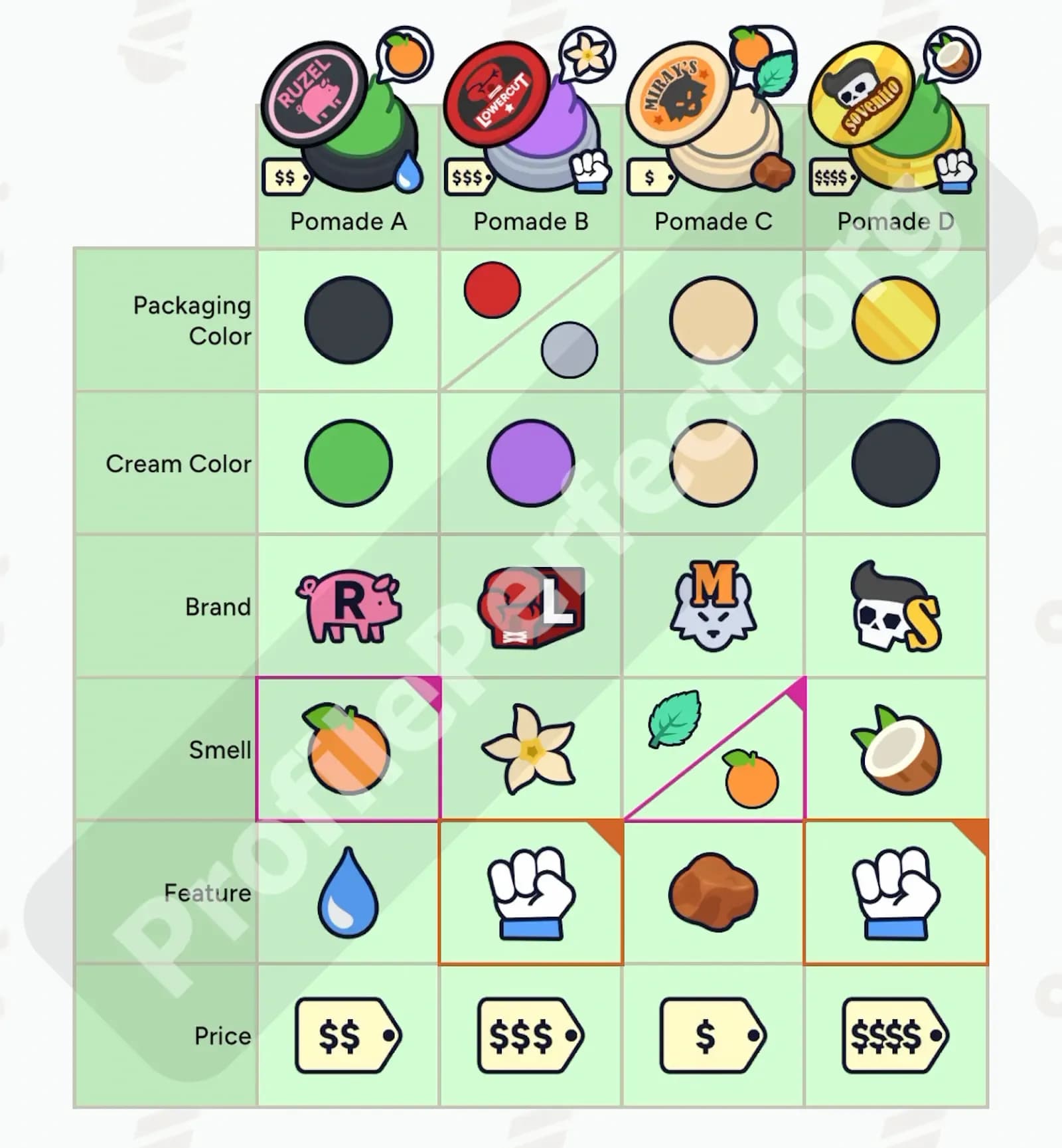
Level 378 swaps a lipstick counter for a barbershop shelf, four pomades ranked from tier one to tier four instead of dollar signs. Pomade A comes in black packaging with a green cream from Ruzel, in citrus scent, giving a wet look finish, at tier two. Pomade B carries packaging that reads as both red and gray with a purple cream from Lowercut, in vanilla scent, with a firm hold finish, at tier three. Pomade C stays beige on beige from Miray's, in a scent that is both mint and citrus, with a clay formula finish, at the cheapest tier one. Pomade D goes gold packaging with a black cream from Sovenito, in coconut scent, with a firm hold finish, at the priciest tier four. The clue that the priciest pomade cannot deliver a wet look finish rules out Pomade A for the top spot, and the clue that the green cream pomade is cheap but not the cheapest locks Pomade A into tier two rather than tier one.
Level 300 drops price altogether and ranks five bags by weight instead, a clever swap that still plays exactly like a price ladder. Bag A is a blue Trolley carrying a forgotten laptop for Liam, weighing in at the second lightest tier. Bag B is a black Backpack with a forgotten water bottle and eraser for Ava, the heaviest bag on the grid. Bag C is a beige Tote Bag with a forgotten wallet and pen shared by Noah and Liam, sitting at the middle weight. Bag D is a green Drawstring bag with a forgotten lunch box and laptop for Emma, the lightest bag of the five. Bag E is a brown Satchel Bag with a forgotten book for Lucas, the second heaviest. The clue that nobody rivals the weight of Ava's bag locks in the heaviest slot immediately, and the clue that the drawstring bag weighs less than both of its neighbors does the same work a cheapest price clue would do in a shopping themed level.
Fashion is never just about the main item. It is about what goes with it, and Profile Perfect's clue writers know that an accessory clue can carry more logic than a color clue ever could.
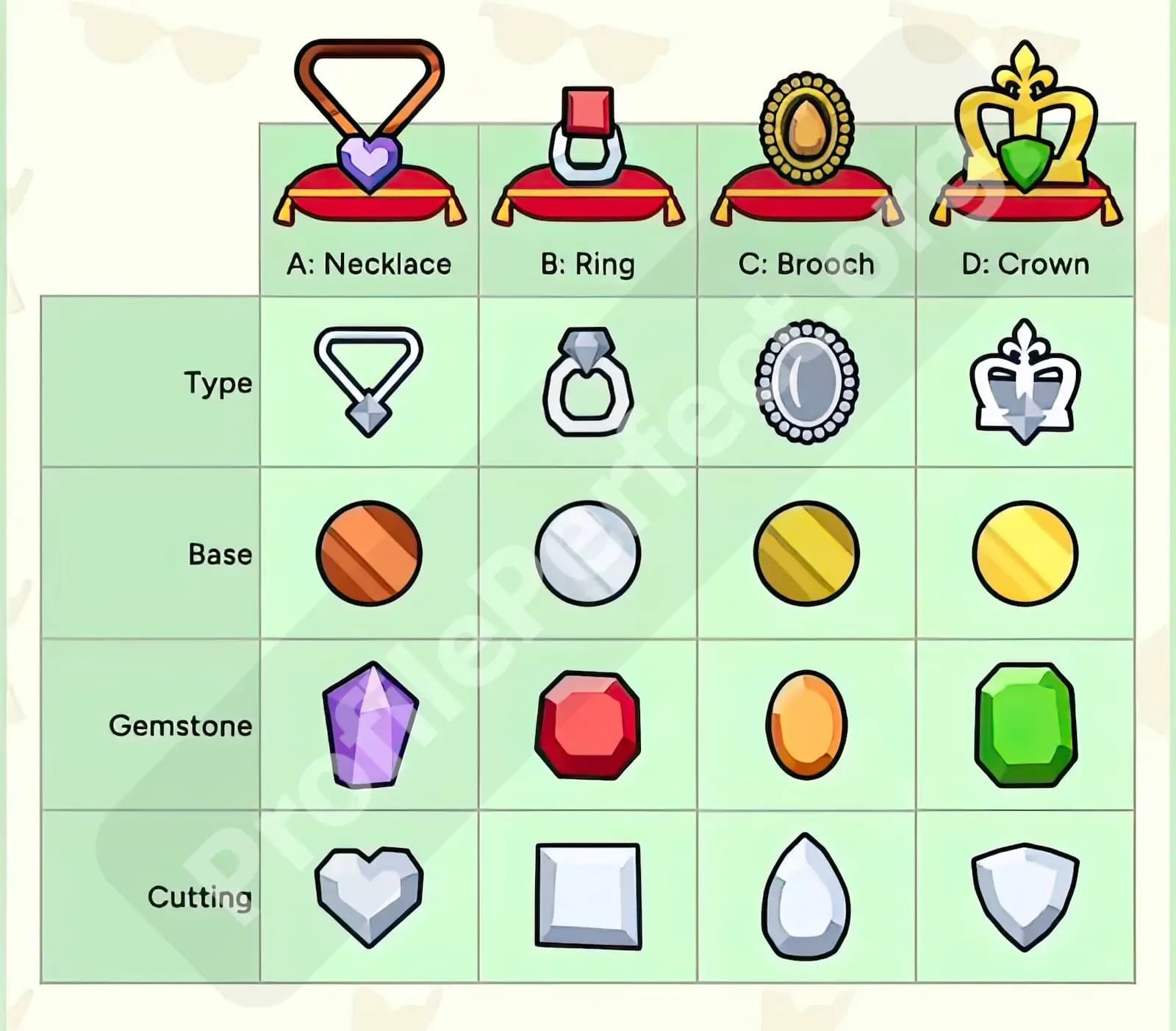
Level 94 sets four pieces of jewelry against type, base metal, gemstone, and cutting style, and never mentions price at all. Jewelry A is a necklace with a bronze base, an amethyst gemstone, cut into a heart shape. Jewelry B is a ring with a silver base, a ruby gemstone, cut square. Jewelry C is a brooch with a brass base, an opal gemstone, cut in a pear shape. Jewelry D is a crown with a gold base, an emerald gemstone, cut trilliant. Instead of ranking by cost, the puzzle ranks by position and material alone. One clue says the purple colored gemstone sits on a bronze base, which is really just a restated fact about Jewelry A dressed up in descriptive language. Another says the crown's base is either bronze or gold, which only becomes useful once you already know the amethyst piece owns the bronze base. Jewelry levels prove that a fashion puzzle does not need a dollar sign to feel complete. Sometimes the accessory itself, its metal, its stone, its cut, carries the whole grid.
Level 300 already showed up above for its weight based ranking, but its forgotten content trait deserves its own mention here, since it works exactly like an accessory clue in disguise. Bag B's forgotten water bottle and eraser, Bag C's forgotten wallet and pen, and Bag D's forgotten lunch box and laptop all carry two valid answers apiece, the same slash pattern you saw in the dress and lipstick levels above. The clue that whoever forgot a water bottle did not also forget a pen keeps those two overlapping lists from tangling into each other, which is the real trick behind any level that hands more than one subject the same kind of item.
Fashion and object levels earn a spot on your camera roll for a reason that has nothing to do with difficulty. A solved grid full of colors, patterns, brand names, and price tiers reads like a catalog page the moment the last cell locks in. Compare that to a plain grid of names and nationalities, and you can see why a hat wall with five brands or a lipstick counter with five scents just looks better sitting on a screen.
The deduction underneath never changes. You are still tracking initial answers, still watching for position words like left, right, and neighbor, still trusting a slash when the grid hands you two valid answers instead of one. What changes is the payoff. A fashion level's finished grid is something you would actually want to look at twice, which is probably why these object heavy puzzles keep showing up throughout Profile Perfect's four hundred levels, from a three dress starter all the way up to a six trait lipstick counter. Style was never separate from the logic here. It was the reward for finishing it.