
A tour of six Profile Perfect pet levels, from a simple two trait dog puzzle to a six trait guard dog squad, showing why dogs, cats, rabbits, and birds make the best starter logic puzzles in the game.

Guide By Liam Stone
Published on July 7, 2026
Liam Stone has played Profile Perfect since the app first launched on the Apple App Store. He spotted its potential early, and that early bet turned into hundreds of hours spent solving levels, testing clue logic, and documenting answers for other players. Liam runs the YouTube channel Puzzle Game Answer where his puzzle walkthroughs have earned over 935,000 views and a growing community of more than 800 subscribers. He covers a wide range of mobile puzzle games beyond Profile Perfect, giving him firsthand experience with how these games design clues, structure levels, and trip up even experienced players. Every guide on this site reflects that hands on experience. Liam plays each level himself, verifies every answer against the in game grid, and rewrites confusing clues into plain language so you don't need to guess. If you want more of his walkthroughs, subscribe to his channel.
Loading calendar...
If you have ever handed a friend their first Profile Perfect level and watched them freeze up, you already know the fix. Skip the chemistry students. Skip the poker table. Start them on a dog.
Pet levels show up all through the game, and they work as a soft landing for a reason. You already know how dogs, cats, rabbits, and birds look and act, so you are not spending brainpower figuring out what a "reaction type" or a "figurehead" even means. Your brain goes straight to the logic. Based on my gameplay across a stretch of these levels, the pattern holds from the very first pet grid all the way to a five dog guard squad packed with sixteen clues. This roundup walks through why that works, which traits keep repeating, how to read a pet grid fast, and six screenshots worth keeping for reference.
Every Profile Perfect level asks you to do two things at once. First you decode what the clue is actually saying. Then you place that information on the grid. Themes like chemistry, poker hands, or corporate mascots add a third task, because you also have to learn what the words mean before you can use them.
Pets skip that third task entirely. A collar, a party hat, a favorite food, a guard post. You already understand every single one of those on sight. When I solved Level 2, the very first dog puzzle in the set, there was nothing to look up and nothing to guess about. The only work left was matching the clues to the right subject, which is the actual game.
That clarity also makes pet levels the easiest ones to screenshot and explain to someone else. A cat wearing sunglasses with a plate of fish next to it tells its own story. A chemistry flask full of unlabeled liquid does not.
Look across enough pet grids and you start noticing the same handful of traits doing most of the work. Name, breed, accessory, favorite food, and guard post cover almost everything you will run into.
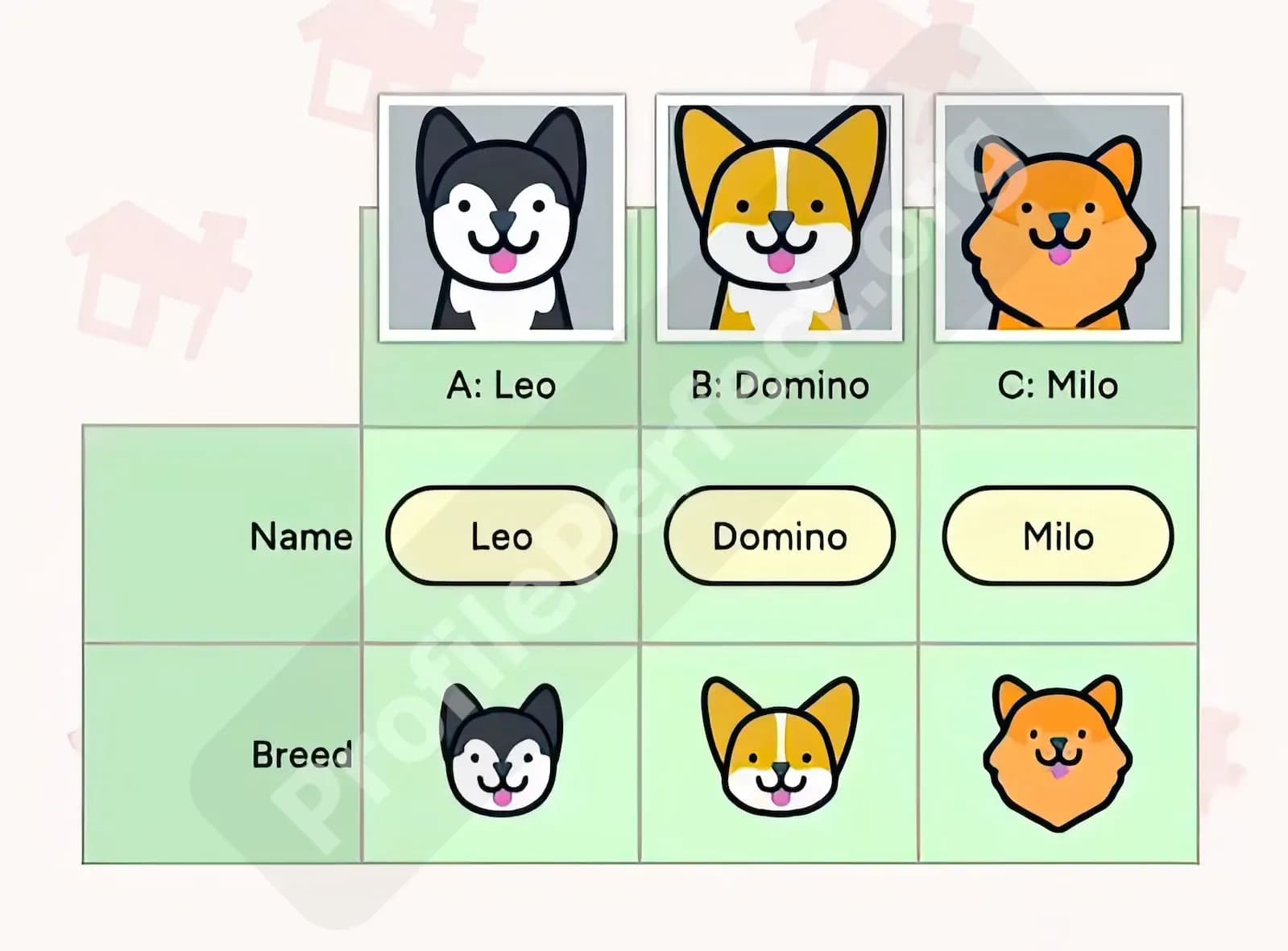
Most pet levels give each animal a name and a breed, and those two traits usually anchor the rest of the grid. In Level 2, the puzzle shows three dogs and only two traits total, name and breed, which makes it about as gentle an introduction as the game offers. Dog A turns out to be Leo, a Siberian Husky, once a clue calls out the black and white dog on the left. Dog C is Milo, a Pomeranian, and Dog B carries a tag reading Domino, which locks her breed and name together before you even reach the harder clues.
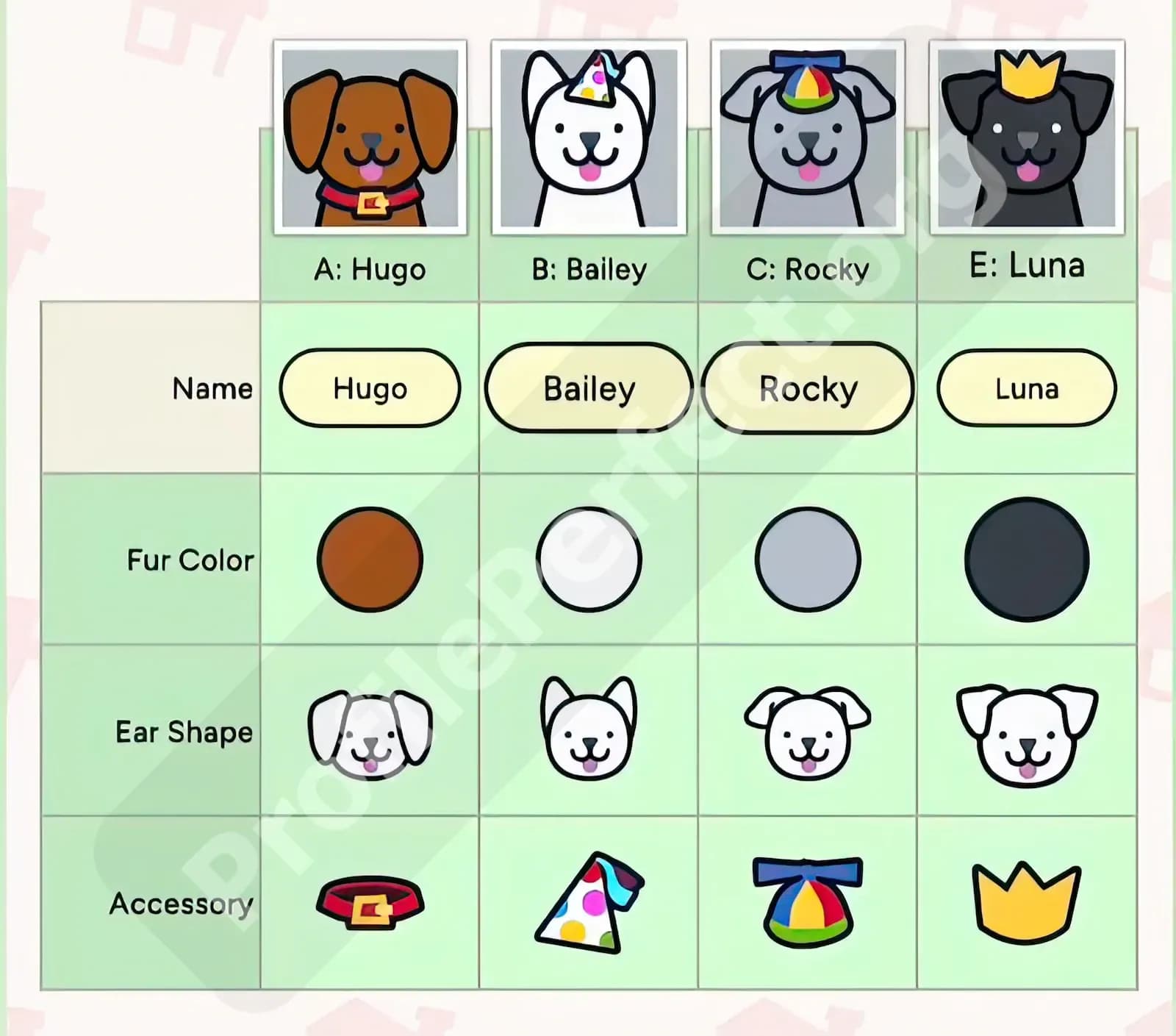
Level 8 keeps the same dog subjects but adds fur color and ear shape on top of name, so you are working with four traits instead of two. Hugo, Bailey, Rocky, and Luna each carry a full profile, and the puzzle starts you off with two locked answers, Bailey's white fur and Luna's button ears, so you already have two footholds before you read clue one.
Once a pet level moves past the basics, accessory and favorite food traits start doing the heavy lifting. Level 64 hands you five cats, each with a name, breed, accessory, and favorite food. This is where the slash rule in these grids becomes worth understanding. Cleo the Sphynx cat comes back with a favorite food listed as fish and chicken together, not one or the other. Simba the Maine Coon shows vegetable and fish as a pair too. When the final grid lists two values in one cell like that, both answers are correct for that cat, and the clues actually support both at once rather than pointing at a single winner.
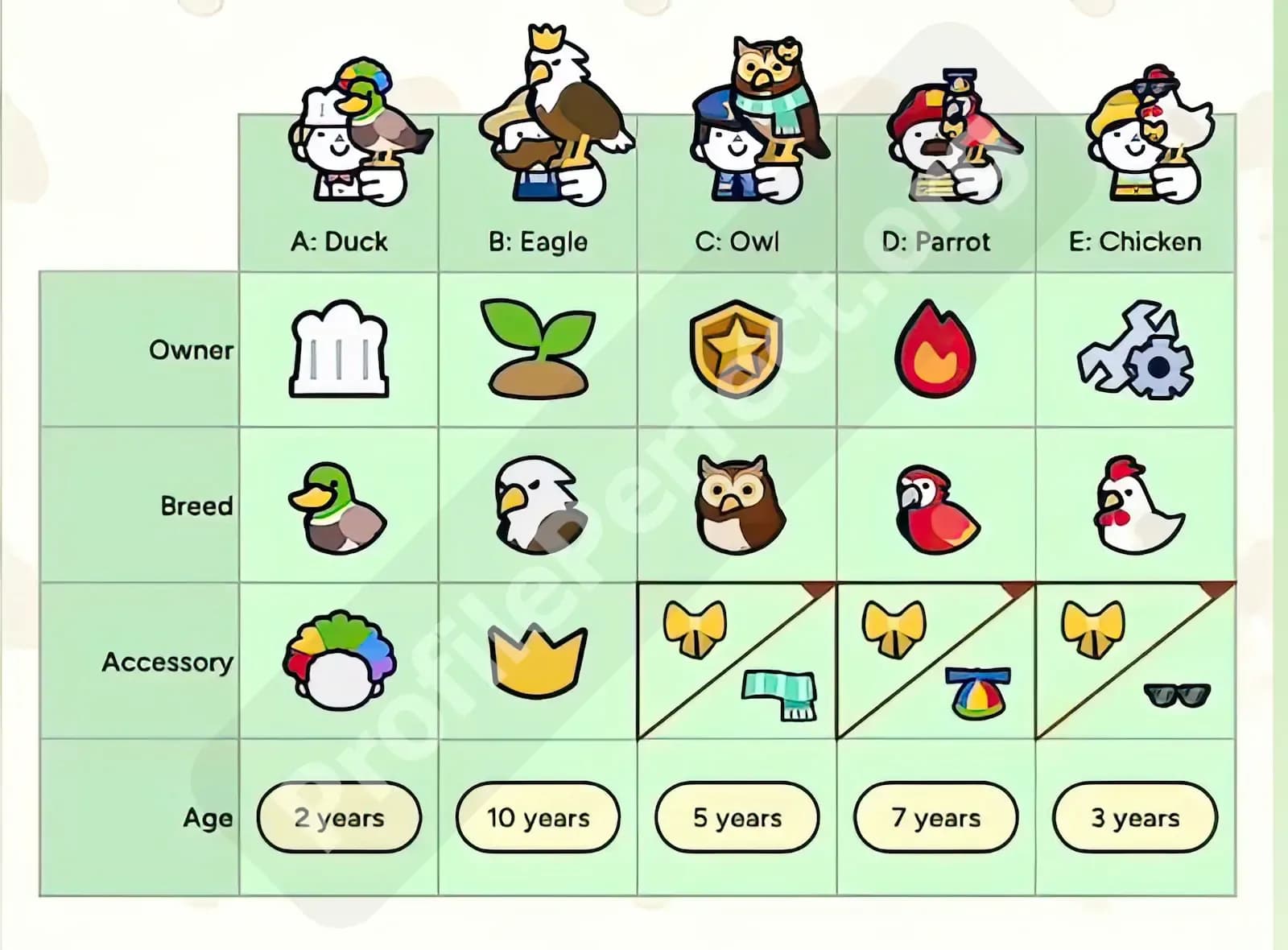
Level 122 swaps in a different kind of accessory logic. Three of the five birds share ribbon as part of their accessory, paired with a second item each, a scarf, a propeller hat, and sunglasses. The puzzle uses owner and age instead of a plain name trait, so the chef, farmer, police officer, firefighter, and engineer become the identifying labels you are actually solving for.
Pet levels are forgiving because the theme is familiar, but the underlying puzzle logic is exactly the same as anything else in the game. The two life system still punishes a rushed tap.
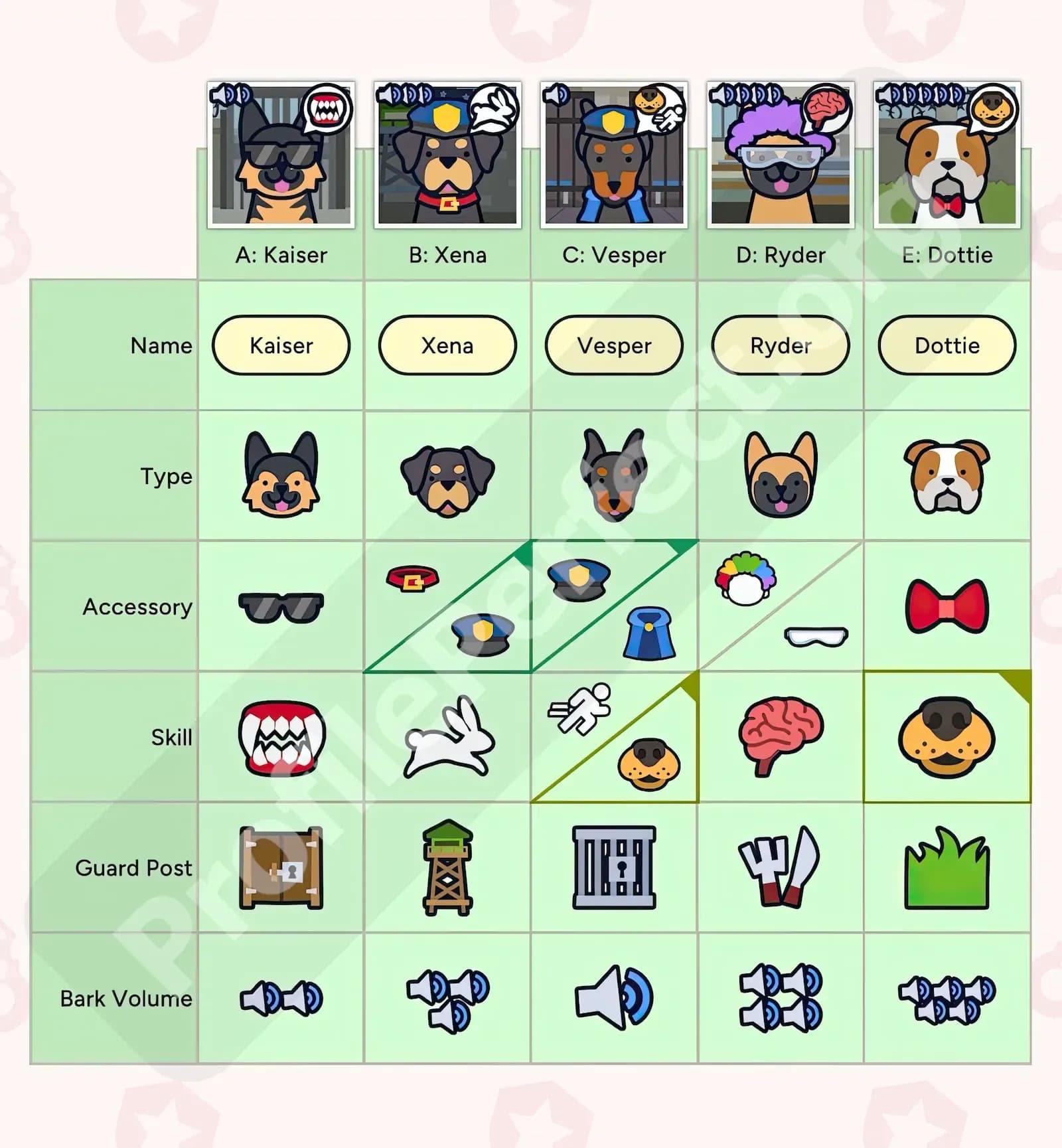
Every pet level in this set gives you at least one starting point, whether that is an initial answer already filled in or a clue marked as a locked fact. Level 205, the guard dog squad, opens with Ryder's name and the Watch Tower assignment already placed. From there, one clue tells you the dog between Ryder and the Watch Tower is a Doberman, which gives you Vesper's breed before you have touched a single ambiguous clue. Building outward from a fact you already know beats guessing every time.
Pet grids lean hard on words like left, right, neighbor, and between, and those words are doing real work. In Level 73, the rabbit level, nobody starts with an initial answer at all, so the entire puzzle rests on position. A clue tells you the Lop rabbit with red eyes sits next to the brown eyed rabbit, and another tells you Leo is not to the left of Pip. Track positions first and the names, breeds, and accessories slot in almost automatically behind them.
Level 2 is the first pet puzzle most players see, and it earns that spot honestly. Three dogs, two traits, five clues. The grid confirms Dog A as Leo the Siberian Husky, Dog B as Domino the Corgi, and Dog C as Milo the Pomeranian. Nothing about it is flashy, but it teaches the core habit every later level rewards, reading a clue fully before committing to a tap.
Level 8 doubles the trait count while keeping the same dog theme, which makes it a natural next step. Hugo the brown furred dog wears a collar and has V shaped ears. Bailey is white with prick ears and a party hat. Rocky is grey with rose shaped ears and a propeller hat. Luna is black with button ears and a crown. The jump from two traits to four is exactly the kind of gentle difficulty curve that keeps new players from bouncing off the game early.
Level 64 is where the cat theme shows off the favorite food trait in full. Oliver the Persian loves fish and wears sunglasses. Mochi the Scottish Fold is celebrating a birthday in a party hat and prefers pet food. Cleo the Sphynx wears a collar and answers to both fish and chicken as her favorite food. Simba the Maine Coon wears glasses and counts vegetable and fish as favorites. Christie the Bombay wears a ribbon and collar together and sticks to canned food. The double answers for Cleo and Simba are a good example of what the slash actually means in these grids. Both foods are correct, and the clues back both up rather than picking a winner between them.

Level 73 takes the same idea and applies it to eye color instead of food. Fluffball the Angora rabbit wears a crown and comes back with red and blue eyes both listed as correct. Pip the Lop rabbit has red eyes and a party hat. Leo the Lionhead rabbit has brown eyes and a monocle. Titan the Flemish Giant has green eyes and sunglasses. With no initial answers handed out at the start, this level leans entirely on position clues, which makes it a good test of whether you have picked up the habit from the tips above.

Level 122 swaps the usual name trait for owner and age, which shifts the whole feel of the puzzle even though it still runs on the same pet logic. The chef owns a two year old duck named for its wig. The farmer owns the ten year old eagle with a crown, the oldest bird on the grid. The police officer owns a five year old owl wearing a ribbon and scarf. The firefighter owns a seven year old parrot in a ribbon and propeller hat. The engineer owns a three year old chicken in a ribbon and sunglasses. Three birds sharing the ribbon accessory, each paired with something different, is a clean example of how one shared trait can still leave each subject with its own identity.
Level 205 pushes the pet formula about as far as it goes in this set, and it makes a strong finale for this list. Five dogs guard a facility, each with a name, type, accessory, skill, guard post, and bark volume, six traits in total across sixteen clues. Kaiser the German Shepherd guards the gate with a super bite skill and the quietest bark on the team. Xena the Rottweiler is the only dog who can reach the Watch Tower thanks to her high jump. Vesper the Doberman patrols the Cell Blocks with quick dash and hyper sniff skills. Ryder the Belgian Malinois handles the Cafeteria with mega intelligence. Dottie the Bulldog guards the Yard with the loudest bark of the group. This level shows that the pet theme is not just for beginners. It scales all the way up to a genuinely dense puzzle once you add enough traits and enough dogs.
Pet levels earn their reputation as a starter category, but they never stop teaching something. The traits stay familiar even as the trait count climbs, which means the growing difficulty comes from logic alone, not from unfamiliar vocabulary. If you want an easy way back into the game after a break, or a level to hand a friend who has never played, start with a dog, a cat, a rabbit, or a bird. The grid will make sense before you have read a single clue.