
A practical five step routine for playing Profile Perfect with a distractible attention span, built around the game's clue counts, with a printable solve card and stopping points for five minute, ten minute, and full level sessions.


Guide By Liam Stone
Published on July 7, 2026
Liam Stone has played Profile Perfect since the app first launched on the Apple App Store. He spotted its potential early, and that early bet turned into hundreds of hours spent solving levels, testing clue logic, and documenting answers for other players. Liam runs the YouTube channel Puzzle Game Answer where his puzzle walkthroughs have earned over 935,000 views and a growing community of more than 800 subscribers. He covers a wide range of mobile puzzle games beyond Profile Perfect, giving him firsthand experience with how these games design clues, structure levels, and trip up even experienced players. Every guide on this site reflects that hands on experience. Liam plays each level himself, verifies every answer against the in game grid, and rewrites confusing clues into plain language so you don't need to guess. If you want more of his walkthroughs, subscribe to his channel.
Loading calendar...
You open Profile Perfect meaning to solve one level. Then a notification pulls your eyes away, you come back, and you cannot remember which bus already had its color locked in. This is not a focus problem you need to fix. It is just how a busy or easily distracted mind works, and a puzzle with a real routine can work with that instead of against it. This is a description of how I play, not a claim about what the game does for anyone's brain.
Telling yourself to concentrate rarely works. What works is having a small set of steps so specific that you can drop in and out of them without losing your place. Across the levels I have played, the average level carries a bit over eleven clues, which is a small enough stack to hold in your head if you break it into a routine instead of reading straight through in one pass.
That routine has five steps. Scan the clues once without solving anything. Anchor on whatever is already locked in or stated outright. Mark the small conclusions those anchors hand you. Verify each mark against the clue that produced it. Tap only once you are sure. Five words, and each one gives your attention a job small enough to survive an interruption.
Level 20 puts five buses in a row, each one carrying a pattern, a destination, a special feature, and a fare. That is four traits across five subjects, plenty of room to practice the routine without it feeling abstract.
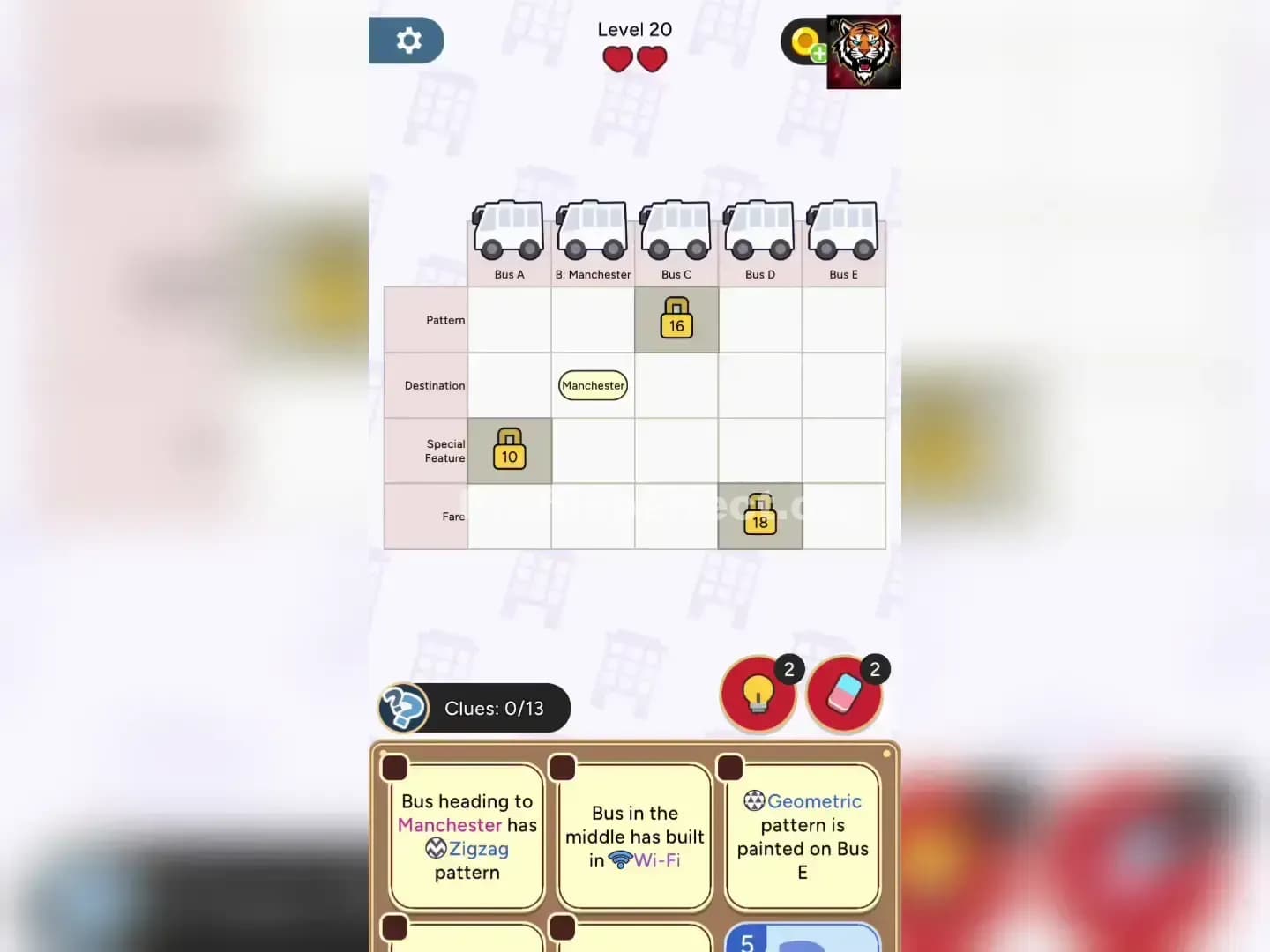
Scan means reading every clue once, fast, with no pen in hand and no answer locked. You are not solving yet. You are noticing shapes, like the fact that one clue names Manchester directly and another says the bus going there has a zigzag pattern.
Anchor means picking out the clues that hand you a fact for free. In Level 20, the starting answer tells you Bus B goes to Manchester. Combine that with the clue about the zigzag pattern and you already have two traits locked for Bus B without touching the harder clues yet.
Mark means writing down what an anchor gives you before you forget it. If your attention drifts here, you have already saved the conclusion instead of losing it. In Level 20 that looks like noting Bus B, Manchester, zigzag, before you even look at the fare.
Verify means checking your mark against the clue one more time before you commit. The clue about Manchester having the highest fare confirms what you marked rather than introducing something new, so verifying takes seconds, not minutes.
Tap is the only step that touches the grid. Everything before it happens in your head or on paper, which means a distraction during scan, anchor, mark, or verify costs you nothing. You just start that step over.
Some days you get five minutes between a meeting and the next thing on your calendar. That is enough time for one full pass of the routine on one clue chain, not the whole level.
Start on any clue that reads like a locked fact, the kind with an obvious anchor such as a named destination or a stated color. Scan just that clue and the two or three clues connected to it. Anchor, mark, verify, tap, and stop there. Do not chase the next clue chain. The stopping point is the tap itself. You close the app with one confirmed row and no half finished thought hanging in your head, which matters more for a short break than finishing the level would.
Ten minutes buys you enough time to work through two or three clue chains, which is where a simple checklist overlay helps keep the steps from blurring together.
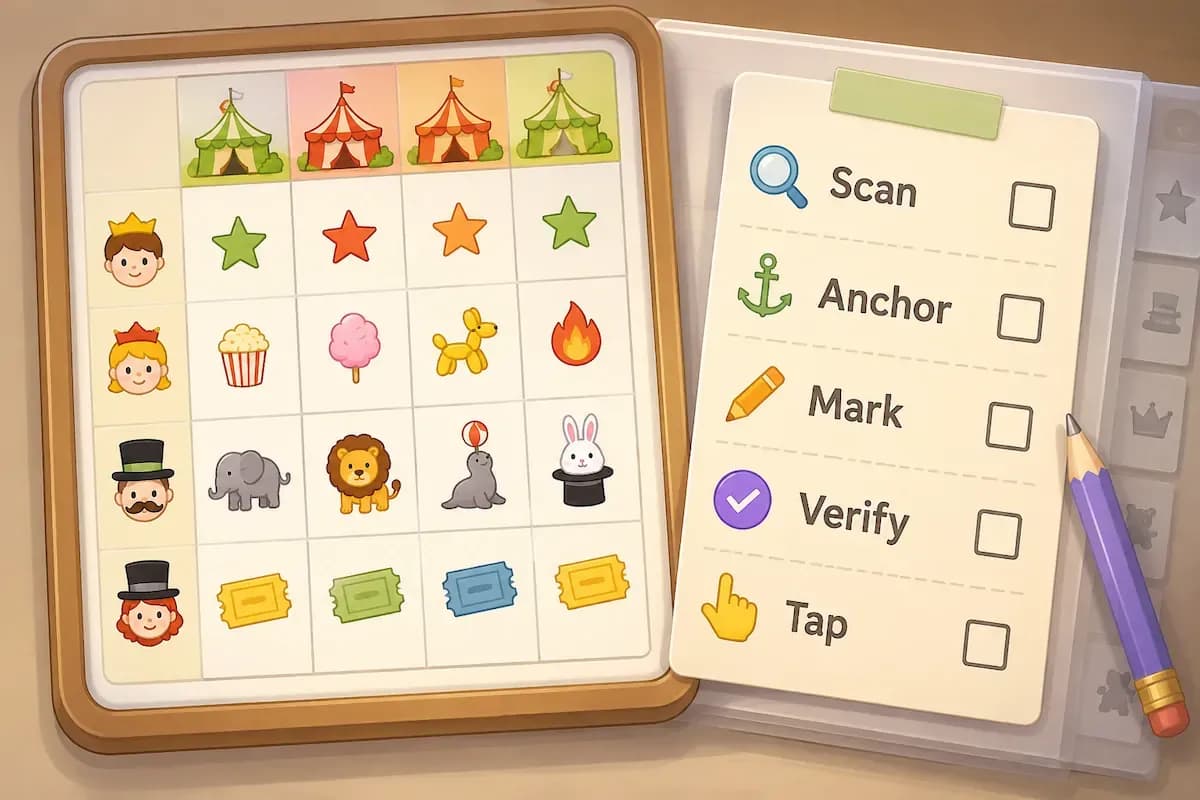
Start where the five minute routine stopped, at the next clue chain that has not been touched. Work through scan, anchor, mark, verify, tap for that chain, then repeat once more if the clock allows. Your stopping point here is the end of a clue chain, not a fixed number of taps. If a chain gets tangled and your attention starts to slide, that is your signal to stop rather than push through, save your marks on paper if you want, and pick the same chain back up later.
Some sessions you get real time, a lull on the couch, a long wait somewhere. This is when you run the routine across the whole level instead of a slice of it.
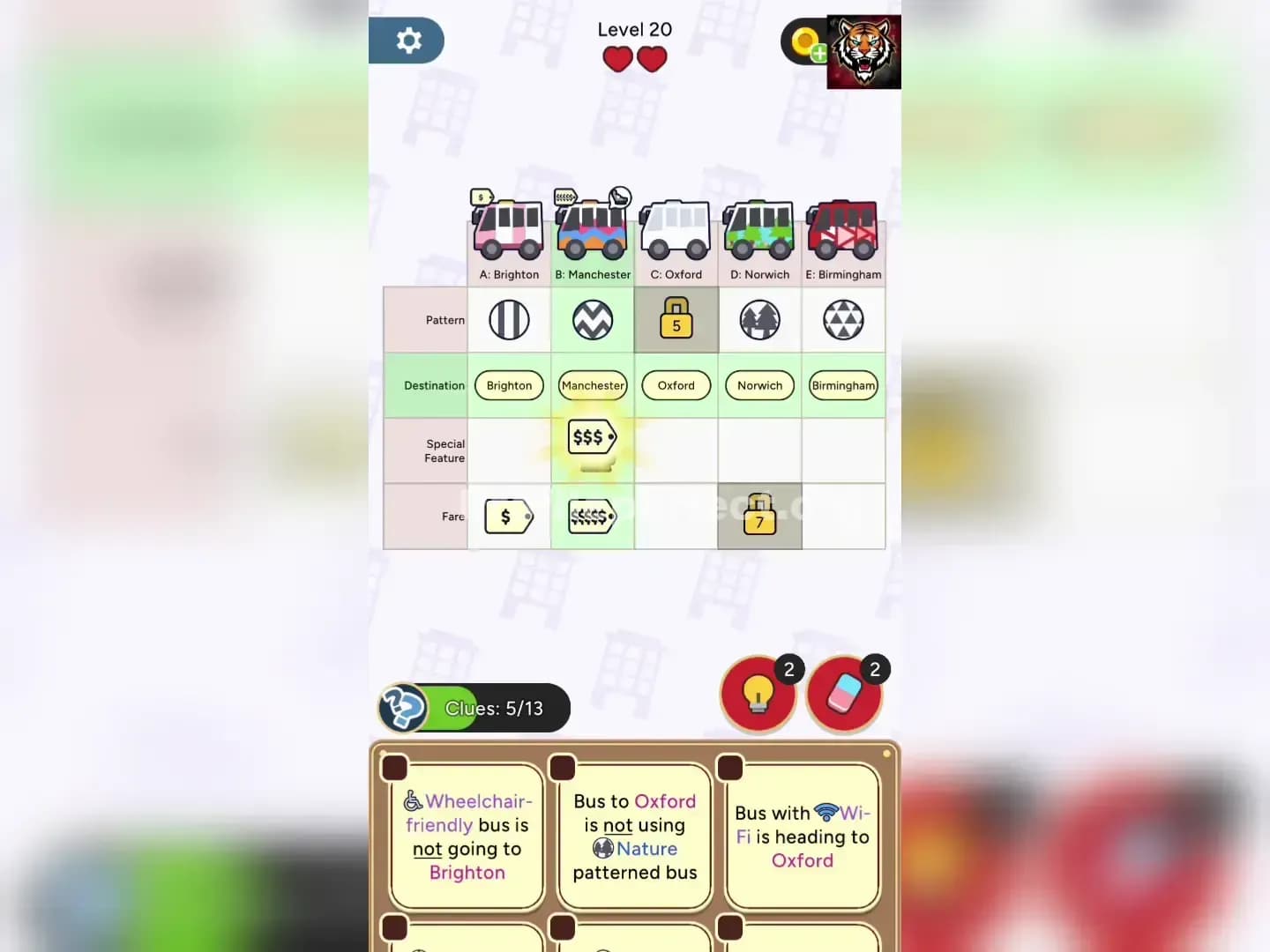
Start at the first anchor in the clue list and let scan, anchor, mark, verify carry you from row to row, tapping only when a row is fully verified, the way Bus B gets filled in above while the other four buses wait their turn. Your stopping point is the moment the grid has no more anchors left to chase, either because you finished it or because you have marked everything you can without a fresh anchor to build from. That is a clean place to put the phone down, even mid level, since your marks hold the work for you.
Copy this onto an index card, a sticky note, or the back of a receipt, and keep it next to your phone.
Profile Perfect solve card
Scan. Read the clues once. Solve nothing yet.
Anchor. Find the clues that hand you a fact for free.
Mark. Write down what each anchor confirms.
Verify. Check every mark against its clue one more time.
Tap. Only touch the grid once a mark is verified.
Stopping point. One tapped row is a full session. You do not owe the level more than that.