
Master Profile Perfect science levels with tips for chemistry, planets, bacteria, samples, and hidden labs using cause-effect logic and smart grid anchors.


Guide By Liam Stone
Published on June 15, 2026
Liam Stone has played Profile Perfect since the app first launched on the Apple App Store. He spotted its potential early, and that early bet turned into hundreds of hours spent solving levels, testing clue logic, and documenting answers for other players. Liam runs the YouTube channel Puzzle Game Answer where his puzzle walkthroughs have earned over 935,000 views and a growing community of more than 800 subscribers. He covers a wide range of mobile puzzle games beyond Profile Perfect, giving him firsthand experience with how these games design clues, structure levels, and trip up even experienced players. Every guide on this site reflects that hands on experience. Liam plays each level himself, verifies every answer against the in game grid, and rewrites confusing clues into plain language so you don't need to guess. If you want more of his walkthroughs, subscribe to his channel.
Loading calendar...
Some Profile Perfect levels feel like clean little logic puzzles. Others suddenly throw you into a sci-fi lab, hand you five suspicious beakers, and say, “Good luck, detective.” I love that shift. It gives the later game a crunchy vibe, because you’re reading planets, reactions, bacteria, rocket durations, sample origins, hazard icons, and experiment motives.
The catch? These levels look scarier than they are. Profile Perfect rarely asks you to become a real chemist, doctor, or astronomer. It wants pattern reading. Science clues usually work through cause and effect: a chemical glows because of light, a tank is dangerous because of its hazard icon, or a hidden lab experiment reveals the scientist’s motive.
The science category ramps up because it stacks more abstract traits together. In a beginner level, “Joyce is Miller” is direct. In a science level, the game might say the “Blue chemical shines brightly when exposed to sunlight.” That one sentence can imply chemical color, reaction type, and time of day all at once.
That’s the trick. Level 272 is a great example: the Blue chemical links to Glow and Noon, while Megan’s experiment connects Bubble and Morning. Nothing here requires advanced chemistry, but it does require you to translate flavor text into grid logic. Before tapping, ask: what is the subject, what is the visible effect, and which trait row does it belong to?
Science levels love flavorful lines, but don’t let the banger wording bait you into guessing. Start with hard anchors: a subject directly tied to a trait.
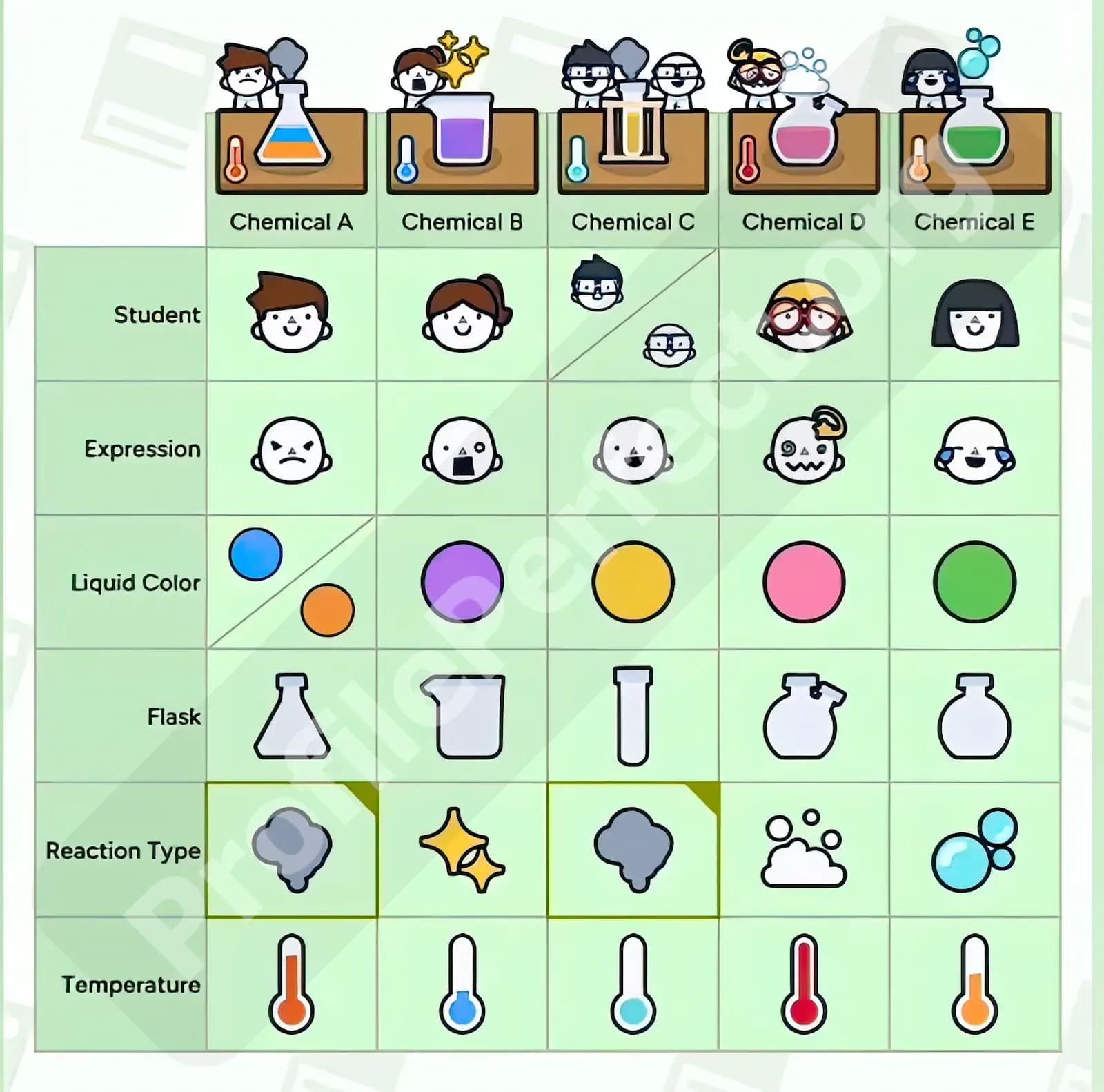
In Level 83, “Erlenmeyer flask has no other flasks on its left” locks the Erlenmeyer flask into the far-left chemical. “Chemical D’s flask has multiple holes” points to the Two Neck flask. Those are strong anchors. Once those are placed, later clues about temperature, reaction type, and neighboring students have something solid to attach to.
The same happens in Level 100 with robots. “Rover was the latest launched craft in 2020” is a clean anchor. “Robot E is a sphere-shaped robot” gives you Orb. “Robot used for Mapping is equipped with 360° Camera” ties a purpose to a feature. After that, clues about year gaps and neighboring robot types stop feeling floaty.
Treat these direct facts like the foundation of the whole lab. If the foundation is wrong, the rest of the puzzle tanks fast.
The most useful science-solving habit is reading cause-effect wording as a trait chain:
Cause → visible result → grid trait.
If a clue says a chemical “shines brightly,” that probably means Glow. If it “nearly melts the flask,” that points to a very high temperature. If a bacteria “causes dementia,” the effect is Memory Loss. If a scientist wants “The Human Bat,” the experiment object is Bat and the motive is Superpower.
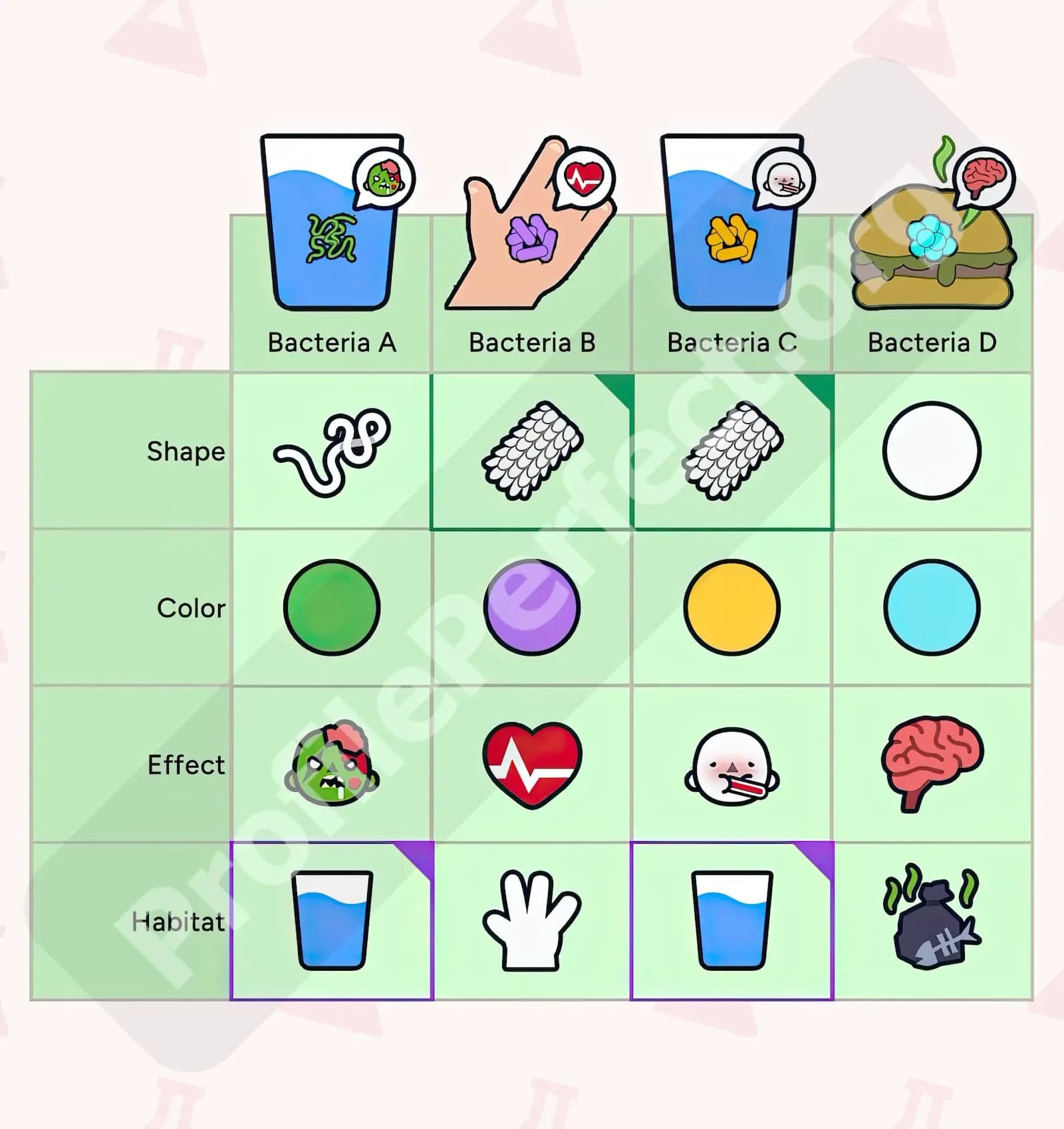
Level 266 is a clean biology example. The clue “The ball-like Bacteria D causes dementia to the victim” gives shape and effect at the same time: Sphere and Memory Loss. Another clue says the Fever bacteria has a radiant orange-like color, which maps Fever to Amber. This is not a biology exam. It’s vocabulary conversion.
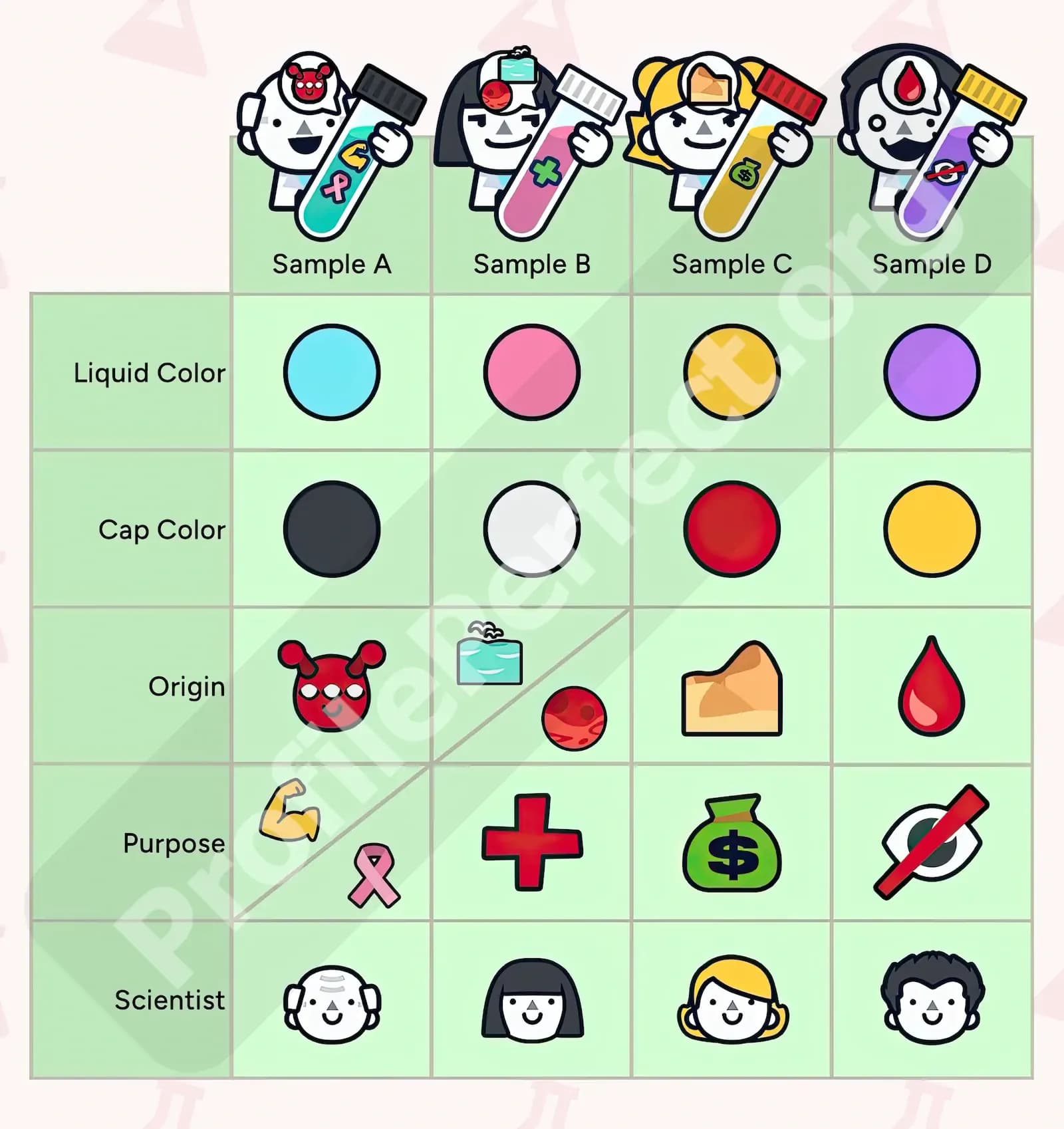
Level 267 does something similar with sample origins and purposes. Ocean links to Regeneration because the sample makes someone look younger. Yellow cap links to Invisibility because it “makes you unseen.” Alien and Mars signal outer space origins. It looks wild, but it’s still a clean association chain.
A lot of players get stuck because they focus on the science noun and miss the position logic. Profile Perfect loves mixing sci-fi flavor with left-right placement.
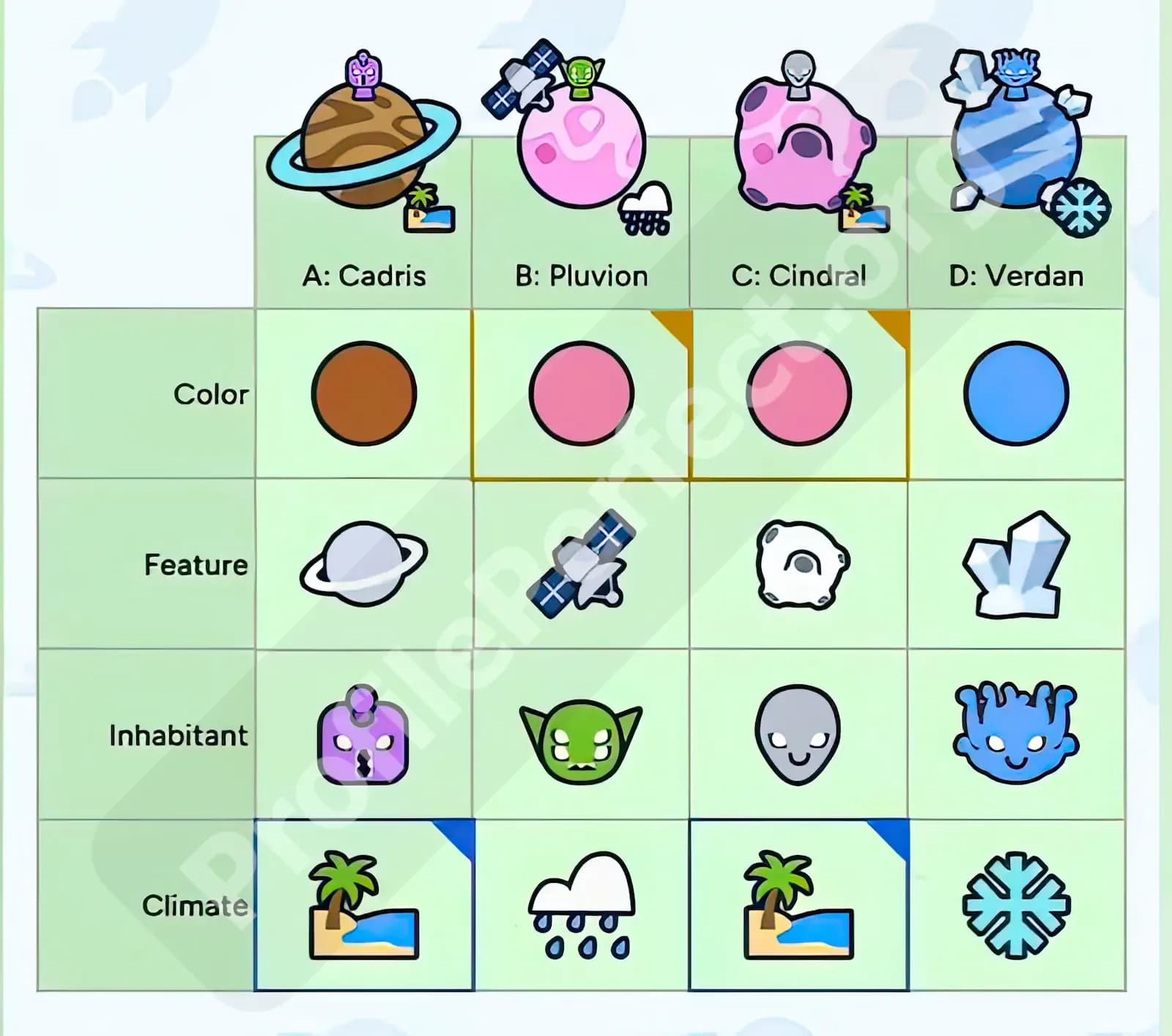
Level 99 uses planets, inhabitants, climates, and features, but several key clues are positional. Doe is on Planet C. Doe’s neighbors have Satellite and Crystal. Brown and Blue planets neighbor a Pink planet. A planet with a Ring is next to Wet climate. The astronomy theme is cool, but the solve is still classic neighbor logic.
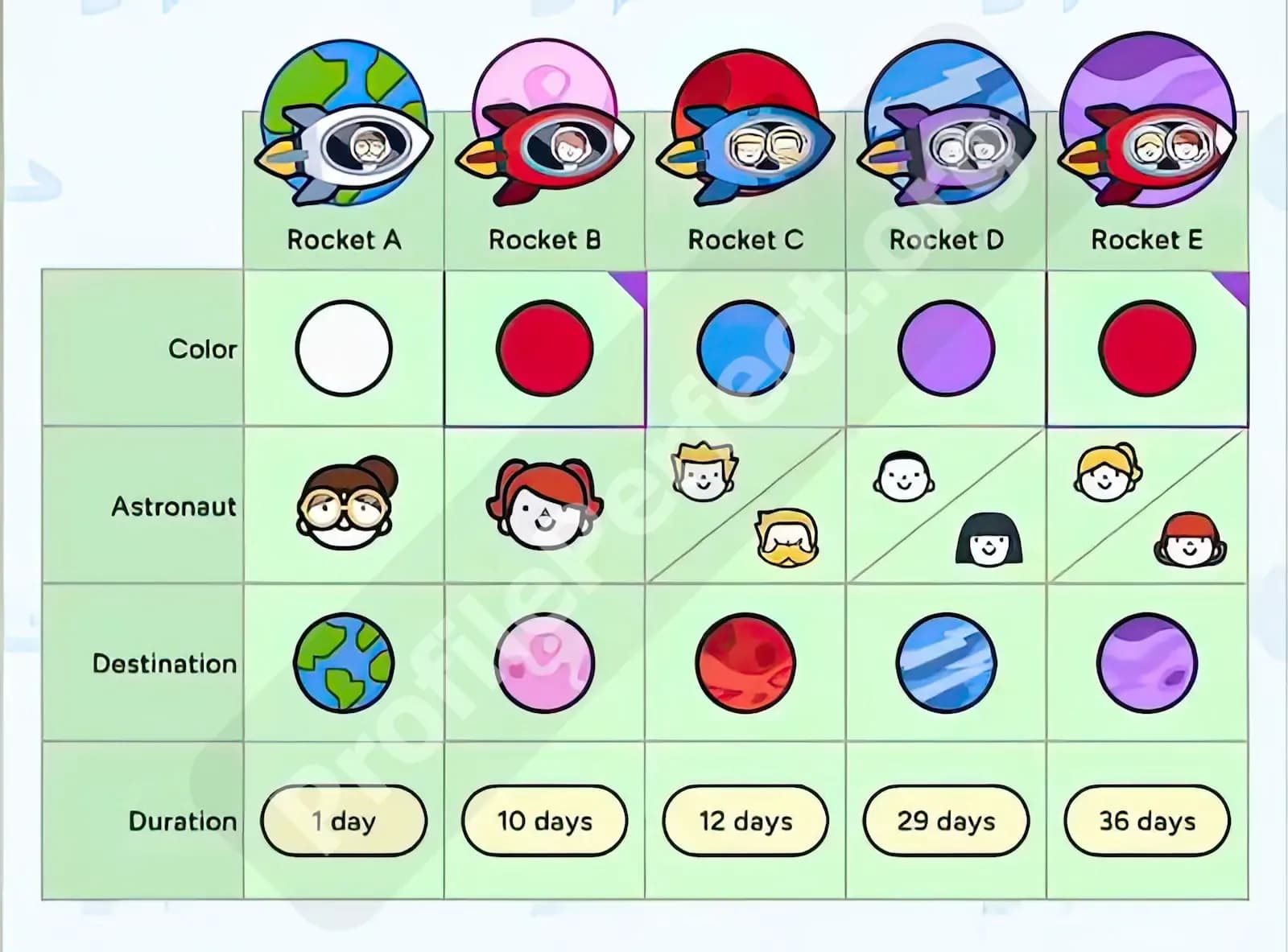
Level 101 does the same thing with rockets. Destination names like Vera, Cindral, Pluvion, Korath, and Zemos sound like lore, but the key clues are distance and adjacency: three columns apart, between, and next to. Don’t get hypnotized by the space names. Treat them as labels on a grid.
Whenever you see “between,” “next to,” “farthest,” “left of,” or “two columns away,” stop reading for trivia. You’re in pure logic-grid territory.
Lab-themed levels often include dangerous objects: hot chemicals, radioactive tanks, toxic pipes, or experimental equipment. These clues work best when you group them as safety tags.
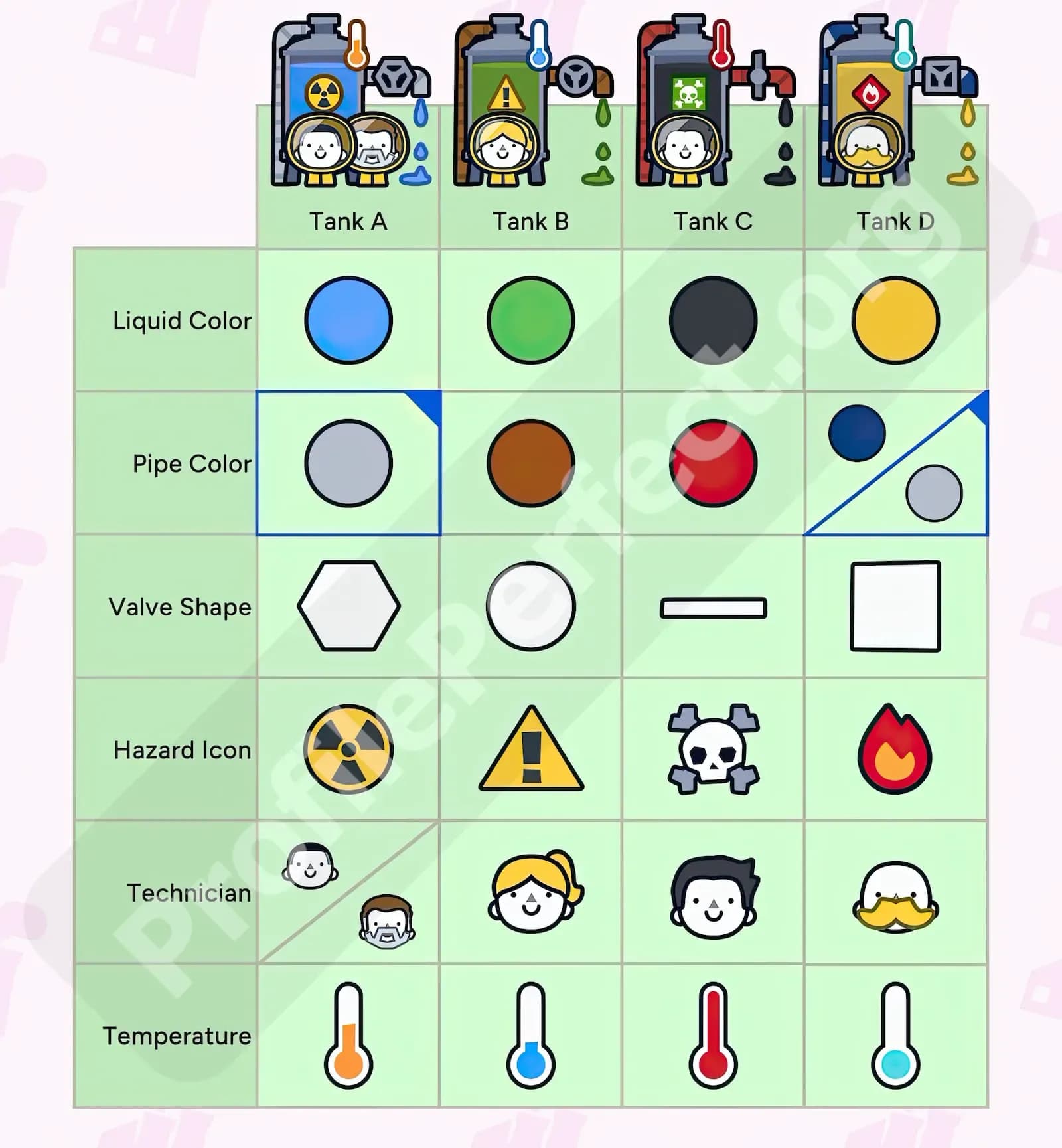
Level 184 is the standout. It combines liquid color, pipe color, valve shape, hazard icon, technician, and temperature. I was frustrated the first time I saw this style because every row looked equally important. The fix is to pair danger terms first: Radioactive-Warm, Flammable, Toxic, Caution, highest temperature, and lowest temperature.
Once you tag the dangerous states, the rest of the grid starts behaving. Gray pipes connect with Square and Hexagon valves. Brown pipe links to Caution. Square valve has the lowest temperature. Green liquid is cooler than the Hexagon valve tank. These aren’t isolated facts; they form a chain.
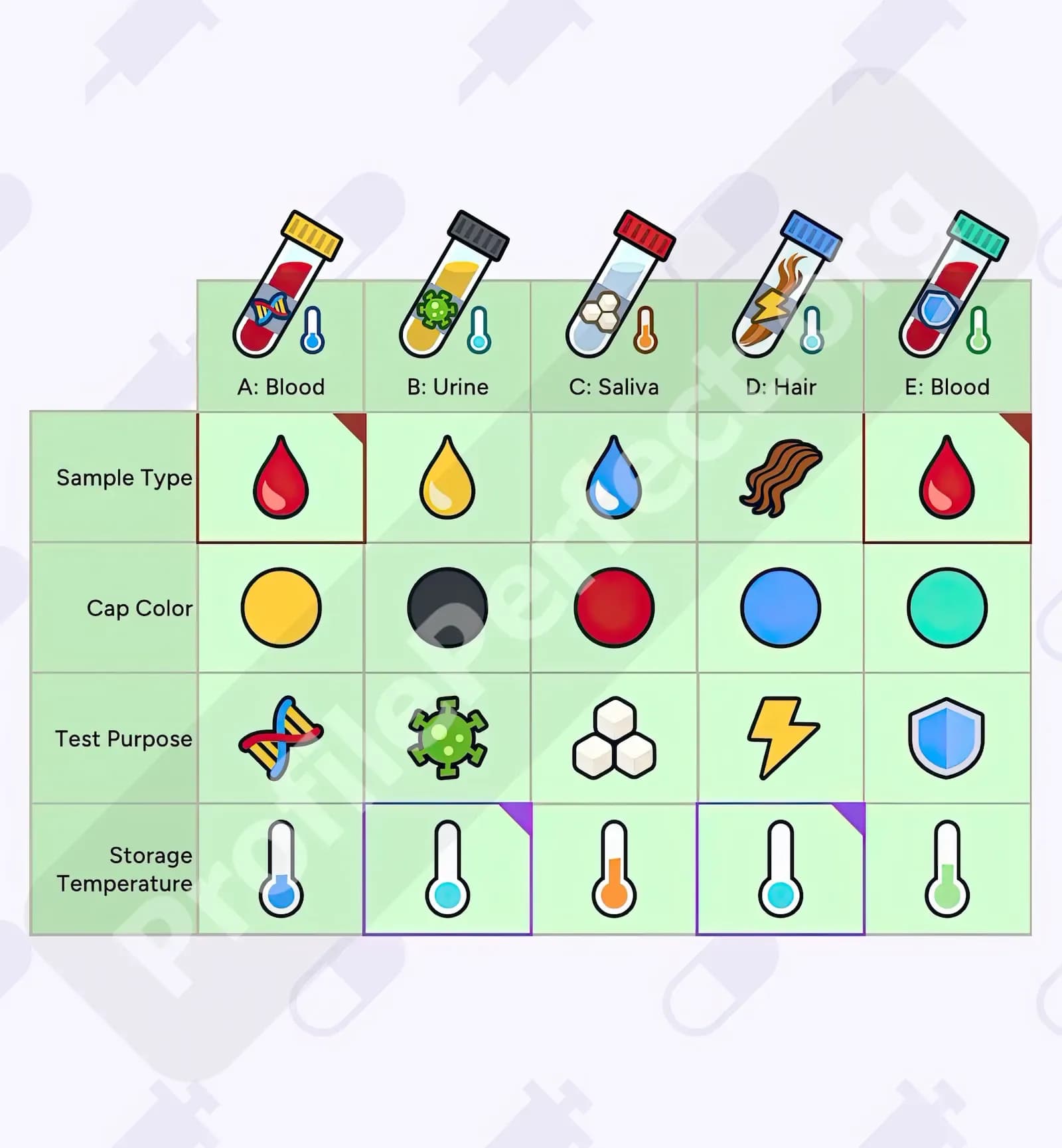
Level 152’s test tubes use a gentler version of the same idea. Storage temperature matters because samples are Cold, Cool, Warm, or Medium. Blood samples are not Cold. Saliva for Sugar testing must be Warm. Cool storage is farthest from the non-liquid sample. The medical wrapper is just temperature sorting plus sample identity.
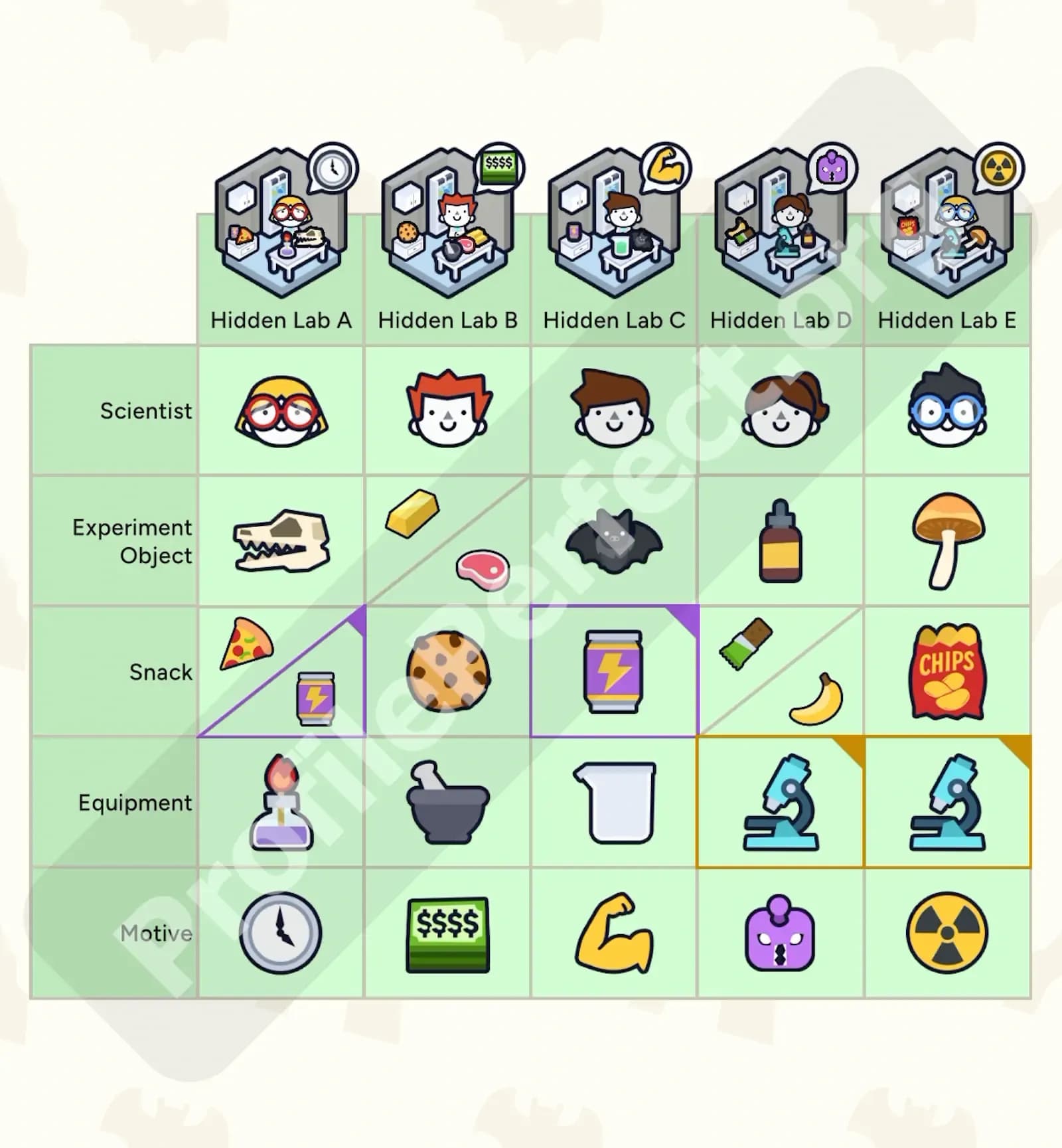
Level 390 is full sci-fi chaos: hidden labs, fossils, bats, gold, meat, serum, mushrooms, snacks, equipment, and motives. It sounds ridiculous in the best way. But the route through is motive tracking.
Start by asking why each scientist is doing the experiment. Bat extract points to Superpower. Sasha wants Alien Contact. Jeff makes a Bioweapon. The scientist two columns left of Alex tries to fix the past, which means Time Travel. Julius coating Meat with Gold leaf points to Money. Suddenly the strange objects stop feeling random.
Then attach equipment and snacks after motives are stable. Bat tissue goes in the Beaker. Margaret burns the Fossil with the Spirit Burner. Sasha’s protein and antioxidant clue links Protein Bar and Banana. These details are messy if you start with them, but they’re serviceable once motive anchors are placed.
When Profile Perfect brings in planets, reactions, bacteria, tanks, samples, or hidden labs, use this order:
That final point matters. Profile Perfect can punish random taps, so guessing is a bad loop. If two clues seem to conflict, don’t force the cooler-sounding answer. Re-read whether the clue describes a subject, a neighbor, or a trait.
The science, space, chemistry, and lab levels are some of the most satisfying puzzles in Profile Perfect because they make deduction feel bigger than a plain grid. Level 83 turns beakers and reactions into a tense classroom lab. Level 99 makes planets feel like a tiny astronomy case file. Level 266 and 267 push biology and sample testing into weird sci-fi territory. Level 390 goes all in on mad-scientist storytelling.
But underneath the vibe, the technique stays rock-solid: don’t memorize science facts, translate science language. Reaction type, sample origin, temperature, effect, and experiment motive are just trait rows wearing a lab coat. Once you see that, these levels stop feeling like a knowledge check and start feeling like what Profile Perfect does best: a sharp, satisfying deduction puzzle with a banger theme.