
Learn how Profile Perfect turns everyday place functions into clues, with examples from kitchens, hospitals, offices, wards, lobbies, and more. Solve faster.

Guide By Liam Stone
Published on June 15, 2026
Liam Stone has played Profile Perfect since the app first launched on the Apple App Store. He spotted its potential early, and that early bet turned into hundreds of hours spent solving levels, testing clue logic, and documenting answers for other players. Liam runs the YouTube channel Puzzle Game Answer where his puzzle walkthroughs have earned over 935,000 views and a growing community of more than 800 subscribers. He covers a wide range of mobile puzzle games beyond Profile Perfect, giving him firsthand experience with how these games design clues, structure levels, and trip up even experienced players. Every guide on this site reflects that hands on experience. Liam plays each level himself, verifies every answer against the in game grid, and rewrites confusing clues into plain language so you don't need to guess. If you want more of his walkthroughs, subscribe to his channel.
Loading calendar...
Some Profile Perfect clues are beautifully direct. “Room B is the Kitchen.” Great. Tap it, move on, feel clever.
But the game doesn’t always hand you the answer like that. Sometimes Profile Perfect does something sneakier: it describes what happens in a place, then expects you to translate that function into the correct room, building, or location. That’s where a casual puzzle can suddenly get crunchy.
A clue like “tools to make food can be found in Room B” doesn’t literally say Kitchen. It trusts you to know that food-making tools belong in a kitchen. “People sleep” points to Bedroom. “A bedridden friend” points to Hospital. “A great place to buy groceries” points to Supermarket. This is one of the most important common-knowledge loops in Profile Perfect, and once you start seeing it, a lot of levels become much easier.
The trick is simple: don’t read these clues as sentences. Read them as job descriptions for places.
Room, building, and place function clues are clues that identify a location by its purpose instead of its name. The game gives you the activity, object, person, or situation connected to the place, and you have to match it with the correct label in the grid.
For example, in Profile Perfect Level 3, Room B has “tools to make food.” That means Room B is the Kitchen. The same level also tells you the room next to the Kitchen is where people sleep, which means Bedroom. It’s a small tutorial-level clue, but it teaches a rock-solid habit: when the game describes a human activity, convert it into a place type before touching the grid.
This clue style appears again and again from early levels to later ones. Level 16 uses buildings. Level 23 uses public building activities. Level 108 throws several household rooms together. Level 186 uses doors leading to places like an ATM, Lobby, and Parking Lot. By the time you reach these later levels, Profile Perfect is no longer asking, “Do you know the word Kitchen?” It’s asking, “Can you recognize a place from context while also tracking the grid?”
That’s a better puzzle. A little mean sometimes, sure, but better.
When you see a descriptive clue, use this four-step method:
That third step matters. Don’t free-associate forever. If the grid options are Kitchen, Bedroom, Garage, Basement, and Living Room, then “cooking” is almost certainly Kitchen. But if the options are Restaurant, Laboratory, Office, and Playground, “tools” might not mean the same thing. The answer always has to fit the available row.
That’s the difference between solving and guessing.
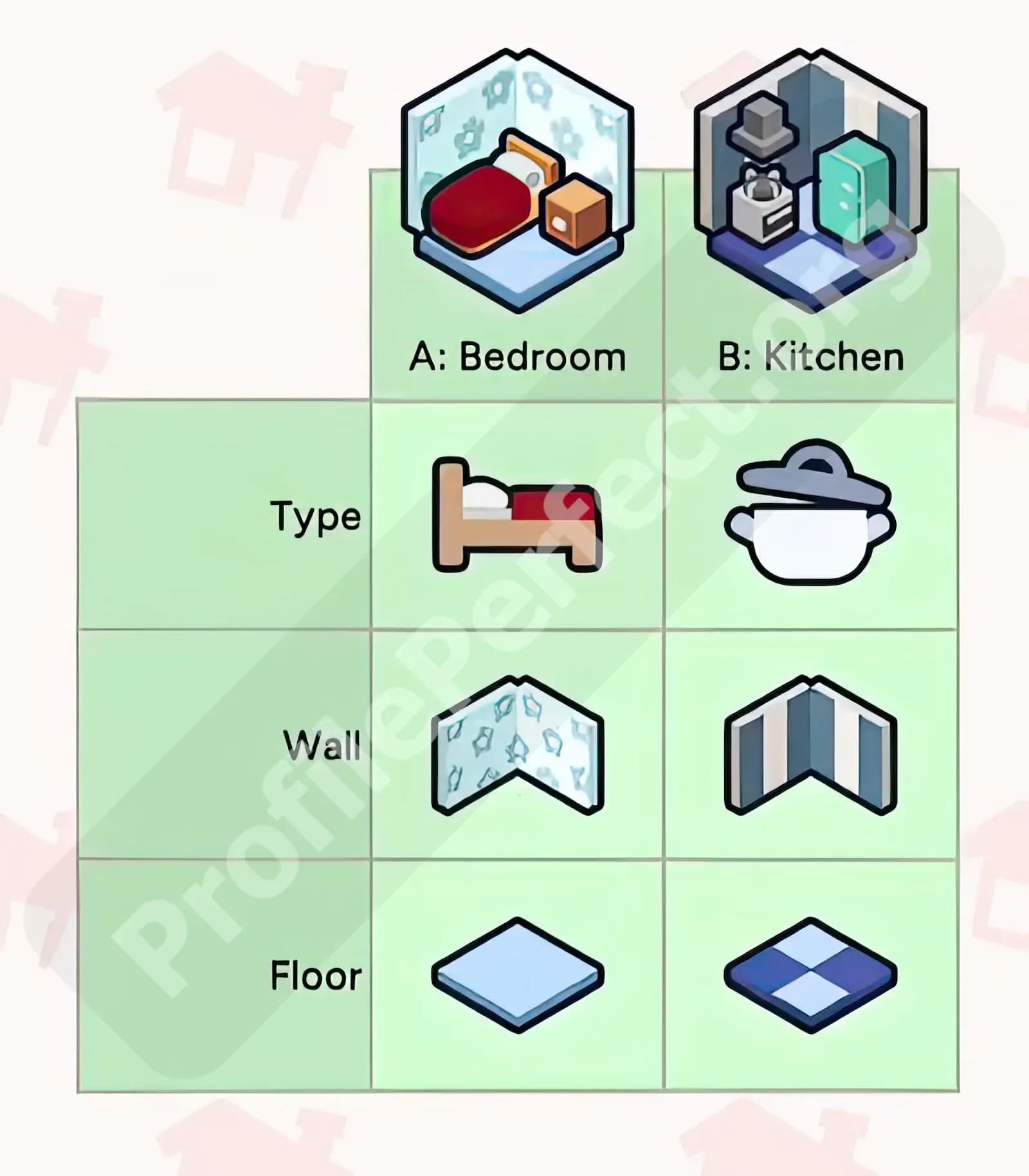
Profile Perfect Level 3 is the banger example because it keeps the logic tight. Room B contains tools to make food, so Room B is the Kitchen. The other room becomes Bedroom by elimination. Then the clue about people sleeping confirms the same idea from another angle.
This is the basic loop:
| Clue Language | What It Means | Grid Answer |
|---|---|---|
| Tools to make food | A place for cooking | Kitchen |
| Where people sleep | A place for sleeping | Bedroom |
| Bedroom has floral wall | Room type links to wall pattern | Floral wall |
The important part isn’t just the Kitchen answer. It’s the habit. Once you translate the function into a room type, every linked clue becomes easier. If the Bedroom has Floral walls, and Room A is the Bedroom, then Room A gets Floral. Room B must take the remaining wall pattern. That’s the Profile Perfect loop at its best: translate, place, eliminate.
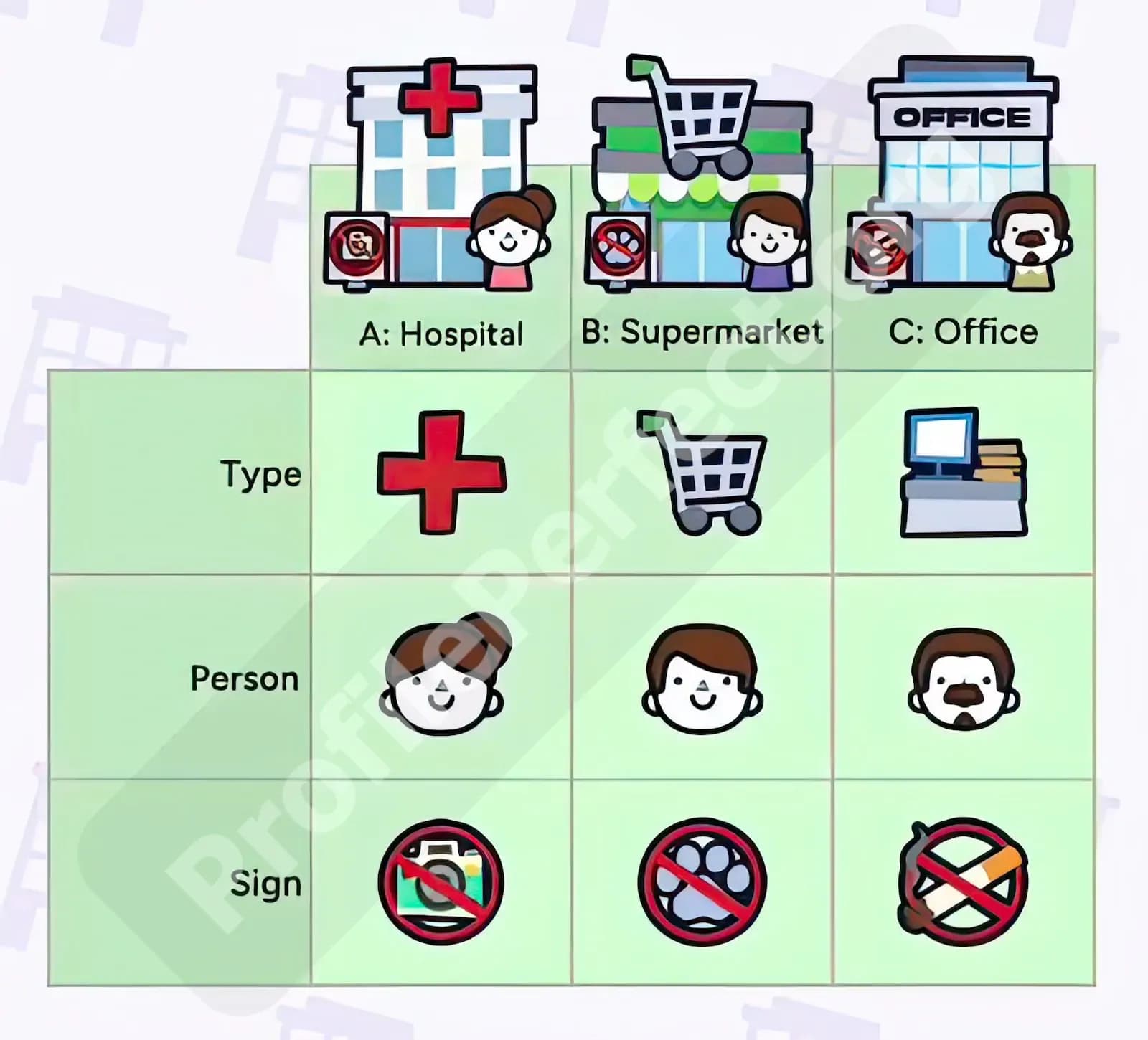
Level 16 expands the same idea into public buildings. “Building B is a great place to buy groceries” means Supermarket. No drama. Groceries equal supermarket.
Then the clue “Mom is visiting her bedridden friend” points to Hospital. The game doesn’t need to say “hospital” directly because “bedridden friend” gives you the situation: someone is sick, staying in bed, and being visited. That’s hospital language.
This level also includes an Office as one of the building types, and by the time Supermarket and Hospital are locked, Office can fall into place through elimination. That’s another key technique: function clues often solve more than one cell. You may identify one building directly, then let the grid force the remaining building type.
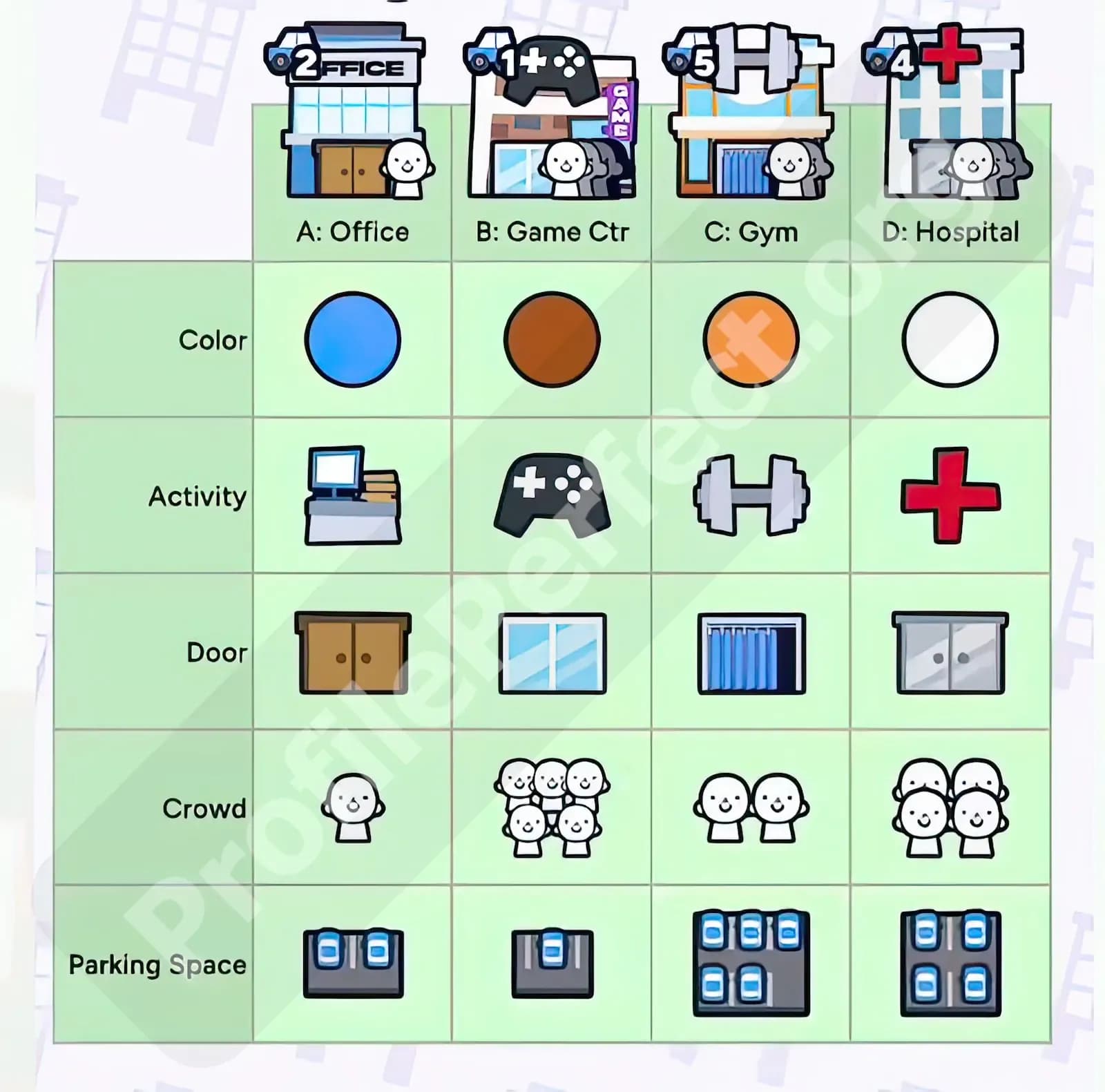
Level 23 makes the place-function pattern more varied. “The Office is the least crowded due to holiday” names Office directly, but “Building D treats sick people” describes Hospital. Again, the clue gives you the purpose: treating sick people. That’s not a house, not a gym, not a gaming center. It’s Hospital.
This level also uses neighbor logic around Office, Gym, and Gaming Center. The Brown building is a neighbor of Office and Gym, which helps position the building activities. Once the function clue locks Hospital, the spatial clues become less floaty. You’re no longer juggling four unknown place types. You’ve got an anchor.
That’s why function clues are so valuable. They are anchor clues disguised as common knowledge.
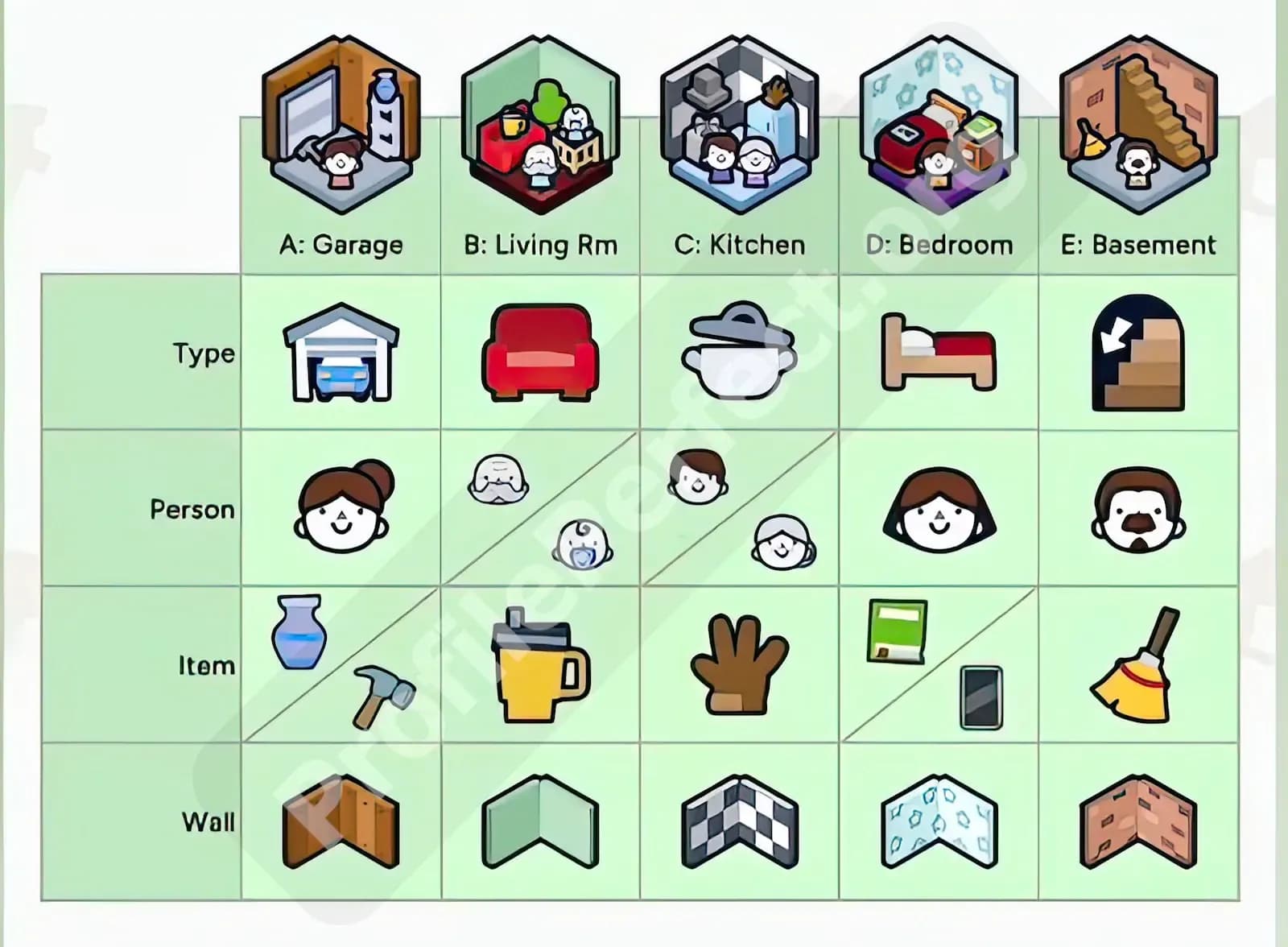
Level 108 is where Profile Perfect starts to feel more like a full logic-grid puzzle than a simple matching game. The room types include Garage, Living Room, Kitchen, Bedroom, and Basement. The clues mention cooking, sleeping, sweeping, drinks, a vase, gloves, a broom, and family members.
“The Daughter does not accompany the Son in cooking” points toward Kitchen. “Dad is on the right of the room where someone is sleeping” points toward Bedroom. “Dad has been sweeping the floor since morning” connects Dad to Broom, and another clue connects Dad to Basement.
This is a great example of how place function clues can chain together. Cooking identifies Kitchen. Sleeping identifies Bedroom. Sweeping plus basement context pushes you toward Basement. None of these clues are hard alone, but together they create a dense, satisfying web.
My advice: when a level has many rooms, write a quick mental tag beside each place type.
Kitchen = cooking. Bedroom = sleeping. Garage = tools/storage/car space. Basement = lower room/storage/utility. Living Room = family/common space.
That little translation layer stops the grid from becoming a shambling corpse of half-remembered clues.
Level 186 is a clever twist because the subjects are doors, not rooms. The places are behind or connected to those doors: ATM, Lobby, and Parking Lot.
“The ATM is behind the Floral wallpaper” is direct enough, but “Door B opens on its own as customers approach” means Automatic door. That’s not a place function clue exactly, but it uses the same real-world recognition skill. Automatic doors open by themselves when people approach. A guard watching an area points to Parking Lot. No lamps in the Lobby helps separate decorations from room type.
This is a good reminder: Profile Perfect often mixes place function with object function. A place clue might sit beside a door clue, a decoration clue, or a person clue. Don’t solve them in separate boxes. Let them talk to each other.
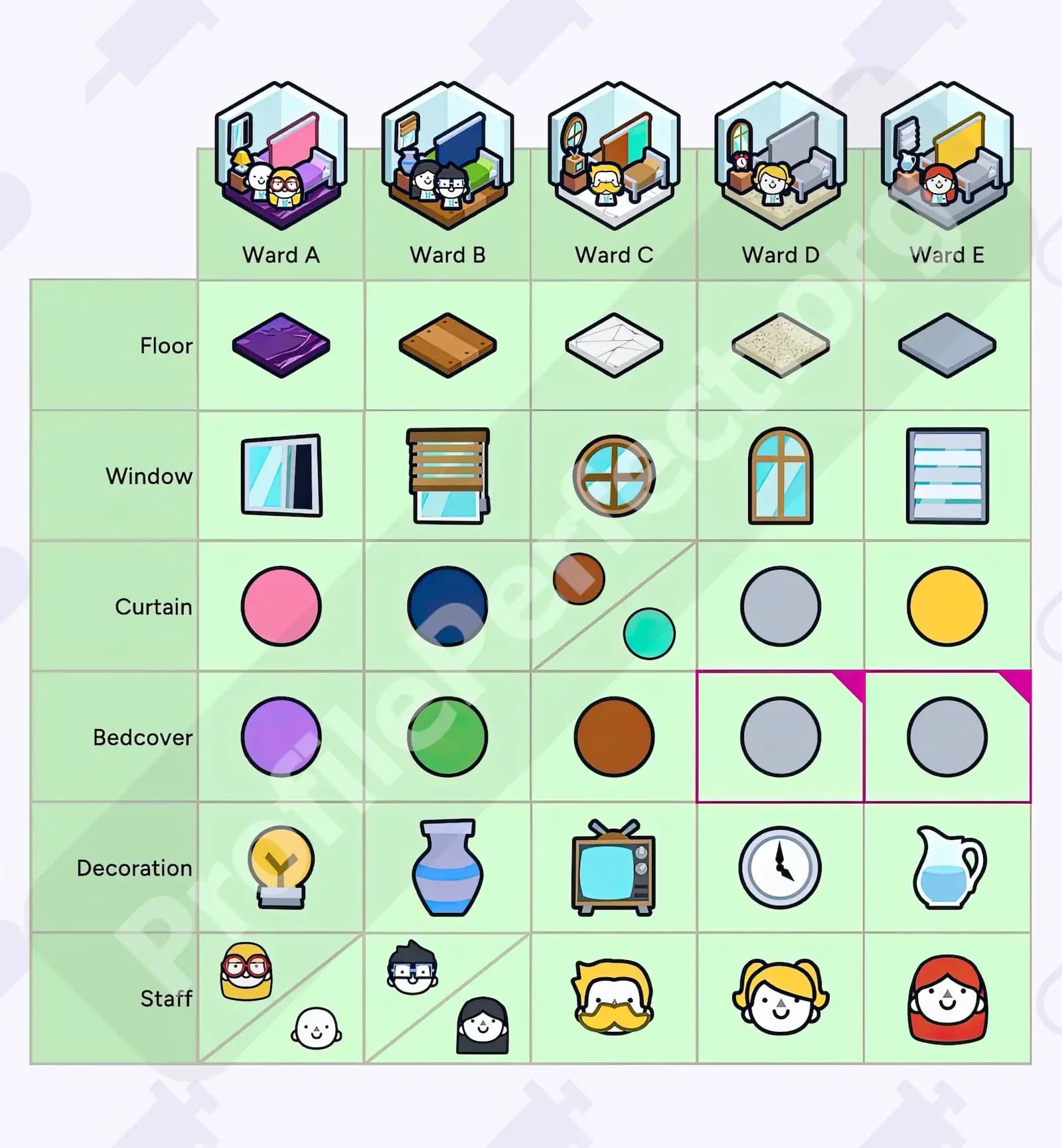
Later examples get more specialized. Level 150 is built around hospital wards. The room type is already implied by the subject name, so the “place” work shifts into details: floors, windows, curtains, bedcovers, decorations, and staff. You’re still reading function, but now it’s medical-space function. A ward with staff, bedcovers, windows, and decorations needs to be treated like a practical room, not just a color puzzle.
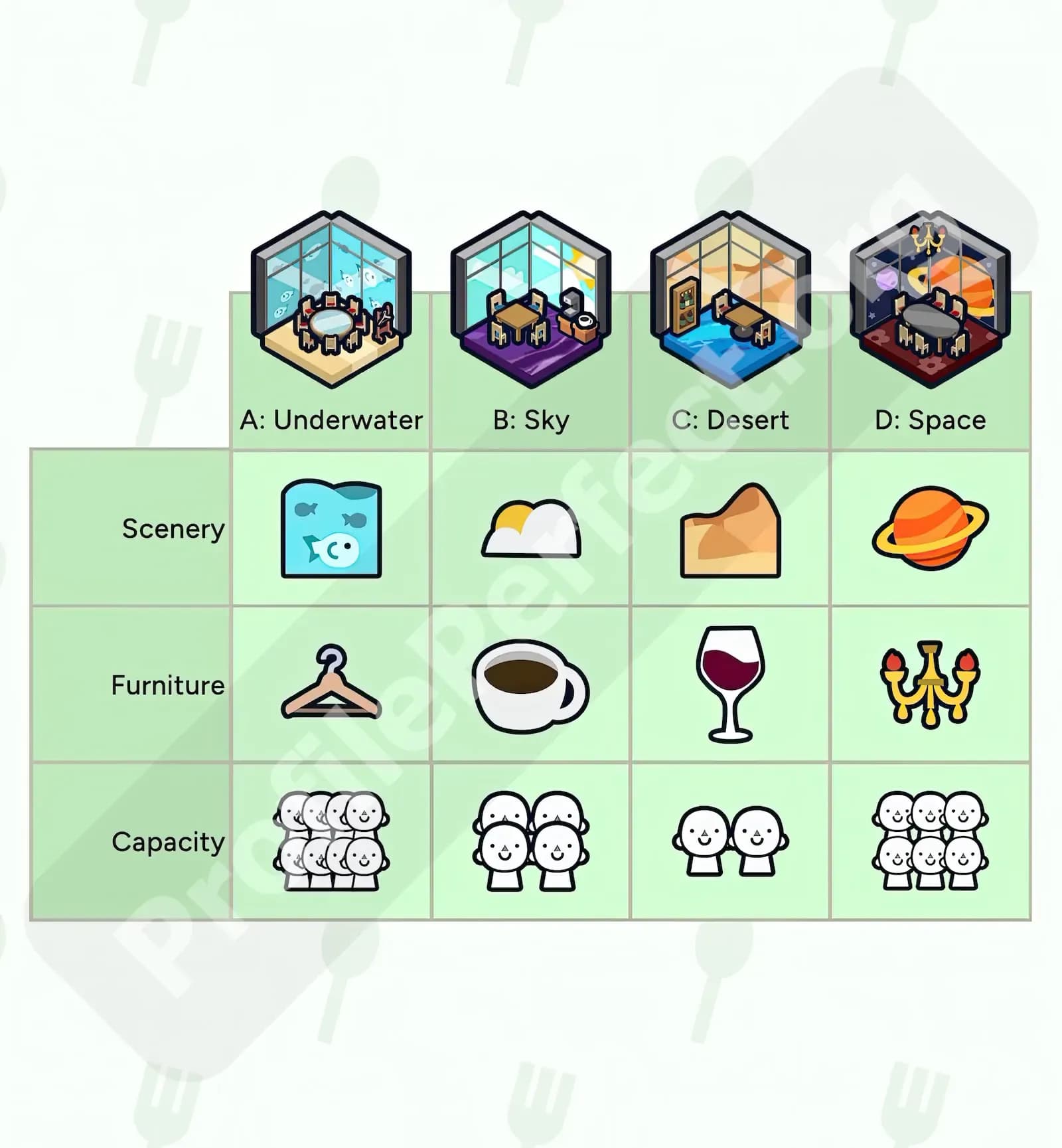
Level 207 uses VIP restaurant rooms with scenery, furniture, and capacity. “People in VIP Room B can enjoy fresh hot Coffee” points to Coffee Station. “Valet Stand is placed inside the room with largest capacity” ties a service object to a room size. This isn’t Kitchen-versus-Bedroom anymore, but it’s the same brain muscle: what object belongs to what kind of space, and what does that imply?
The biggest mistake is tapping too early. Profile Perfect gives you only a small margin for wrong answers, so guessing a place from a vague clue can tank the whole level.
Don’t assume every food clue means Kitchen. In a restaurant-themed level, food might point to a dining room, VIP room furniture, or service station. Don’t assume every sick-person clue means Hospital if the available options include Ward, Clinic, or Pharmacy. Always check the exact grid options first.
The second mistake is ignoring elimination. If Level 16 already gives you Supermarket and Hospital, don’t overthink Office. Sometimes the cleanest solve is just the remaining slot.
The third mistake is treating descriptive clues as flavor text. In Profile Perfect, flavor is often the clue. “Bedridden,” “groceries,” “sick people,” “cooking,” “sleeping,” “customers,” “guard,” “coffee,” and “valet” are not background details. They’re signals.
| Level | Function Clue Pattern | Translation Skill |
|---|---|---|
| Level 3 | Tools to make food, people sleep | Kitchen and Bedroom |
| Level 16 | Buy groceries, bedridden friend | Supermarket and Hospital |
| Level 23 | Treats sick people, office crowd | Hospital and Office |
| Level 42 | Elevator used by staff, guests, boxes, food | Purpose-based matching |
| Level 80 | Bus drop-off locations | Location purpose recognition |
| Level 108 | Cooking, sleeping, sweeping | Household room functions |
| Level 137 | Meeting room props | Office/meeting function logic |
| Level 150 | Ward furniture and staff | Hospital-space detail reading |
| Level 186 | ATM, Lobby, Parking Lot behind doors | Door-to-place matching |
| Level 207 | Coffee station, valet stand, VIP capacity | Restaurant room function |
The easiest way to beat these clues fast is to ask one question: “What place is this clue secretly describing?”
Tools to make food? Kitchen. People sleep? Bedroom. Buy groceries? Supermarket. Treats sick people? Hospital. Customers approach and the door opens itself? Automatic door. A guard watches cars? Parking Lot. Fresh hot coffee? Coffee Station.
Once that translation clicks, Profile Perfect becomes much less about guessing and much more about controlled deduction. And honestly, that’s when the game is at its best. The vibe shifts from “What does this sentence mean?” to “I know what this clue is doing.” That’s a huge difference.
Room and building function clues look casual, but they’re some of the most useful anchors in the entire game. Master them early, and levels like 3, 16, 23, 108, 186, and 207 stop feeling like traps. They become a clean, readable puzzle loop: recognize the purpose, place the room, eliminate the rest, and move on.