Learn how Profile Perfect uses job, tool, workplace, and uniform clues. Use levels 7, 17, 43, 111, 154, 203, 254, 331, and 375 to solve levels faster.

Guide By Liam Stone
Published on June 15, 2026
Liam Stone has played Profile Perfect since the app first launched on the Apple App Store. He spotted its potential early, and that early bet turned into hundreds of hours spent solving levels, testing clue logic, and documenting answers for other players. Liam runs the YouTube channel Puzzle Game Answer where his puzzle walkthroughs have earned over 935,000 views and a growing community of more than 800 subscribers. He covers a wide range of mobile puzzle games beyond Profile Perfect, giving him firsthand experience with how these games design clues, structure levels, and trip up even experienced players. Every guide on this site reflects that hands on experience. Liam plays each level himself, verifies every answer against the in game grid, and rewrites confusing clues into plain language so you don't need to guess. If you want more of his walkthroughs, subscribe to his channel.
Loading calendar...
Profile Perfect loves a good job clue. One minute you’re matching a chef to a shopping trip, the next you’re deciding whether a navy-uniformed officer should carry a flashlight or keys. It sounds simple, right? Jobs are familiar. We all know what doctors, farmers, police officers, guards, chefs, and workers generally do.
But that’s exactly why these clues can be sneaky.
Occupation clues in Profile Perfect often feel obvious until the game starts mixing them with position rules, salary ranks, accessories, tools, shifts, and “not next to” statements. That’s where a casual tap can tank your run. With only a couple of mistakes allowed, guessing is a bad loop. You need a cleaner method.
The best technique is this: match job → tool → place → action before solving relative clues.
That one habit makes occupation puzzles much less floaty. Instead of treating every clue as equal, you build a small common-knowledge map first. What tool belongs to this role? Where does this worker usually operate? What action describes their job? Once those anchors are locked, the position clues become much easier.
Profile Perfect is a logic-grid game, but it isn’t always purely abstract. A lot of levels expect you to bring real-world knowledge into the grid. A chef cooks. A police officer may carry a badge. A guard patrols. A nurse may use a syringe. A farmer may use a scythe, pitchfork, hoe, rake, or spray.
That kind of clue is not just flavor text. It’s usually the key.
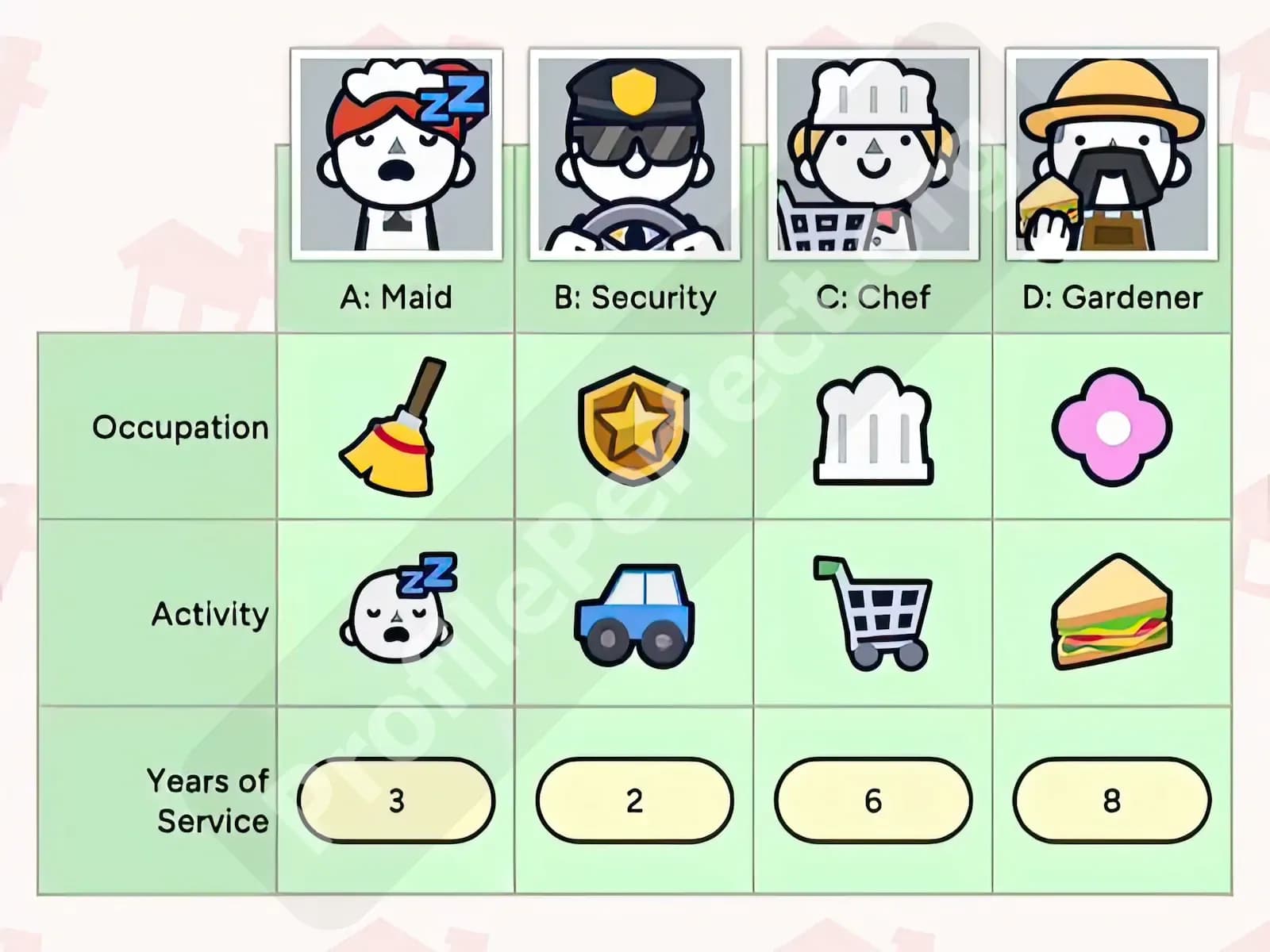
In Level 7, the game gives you a very clean early example. Person A is the Maid, the one going Shopping is the Chef, the Security worker is Driving, and the person having Lunch works in the garden. This level teaches the basic rhythm: job clues often connect directly to activities. Chef links to shopping, security links to driving, and gardener links to lunch in the garden. Once those are placed, the years of service become a secondary layer.
The crunchy part is that Profile Perfect rarely stops at one match. It asks you to chain it.
For Level 7, the Chef has worked for 6 years. The Gardener is not next to the Maid. The person with 3 years of service is next to the Driving person. Suddenly, “Chef = Shopping” is not just a cute clue. It becomes an anchor that lets you solve the surrounding positions.
When I open a job-heavy level, I scan for blunt statements before touching anything. These are clues like:
“The person on the right is the local Police.” “Person A is the Maid.” “The middle person becomes a cyborg to fix things faster.” “Staff D works at the checkout section.”
These are banger clues because they don’t ask you to interpret much. They give you a role, subject, or position directly.
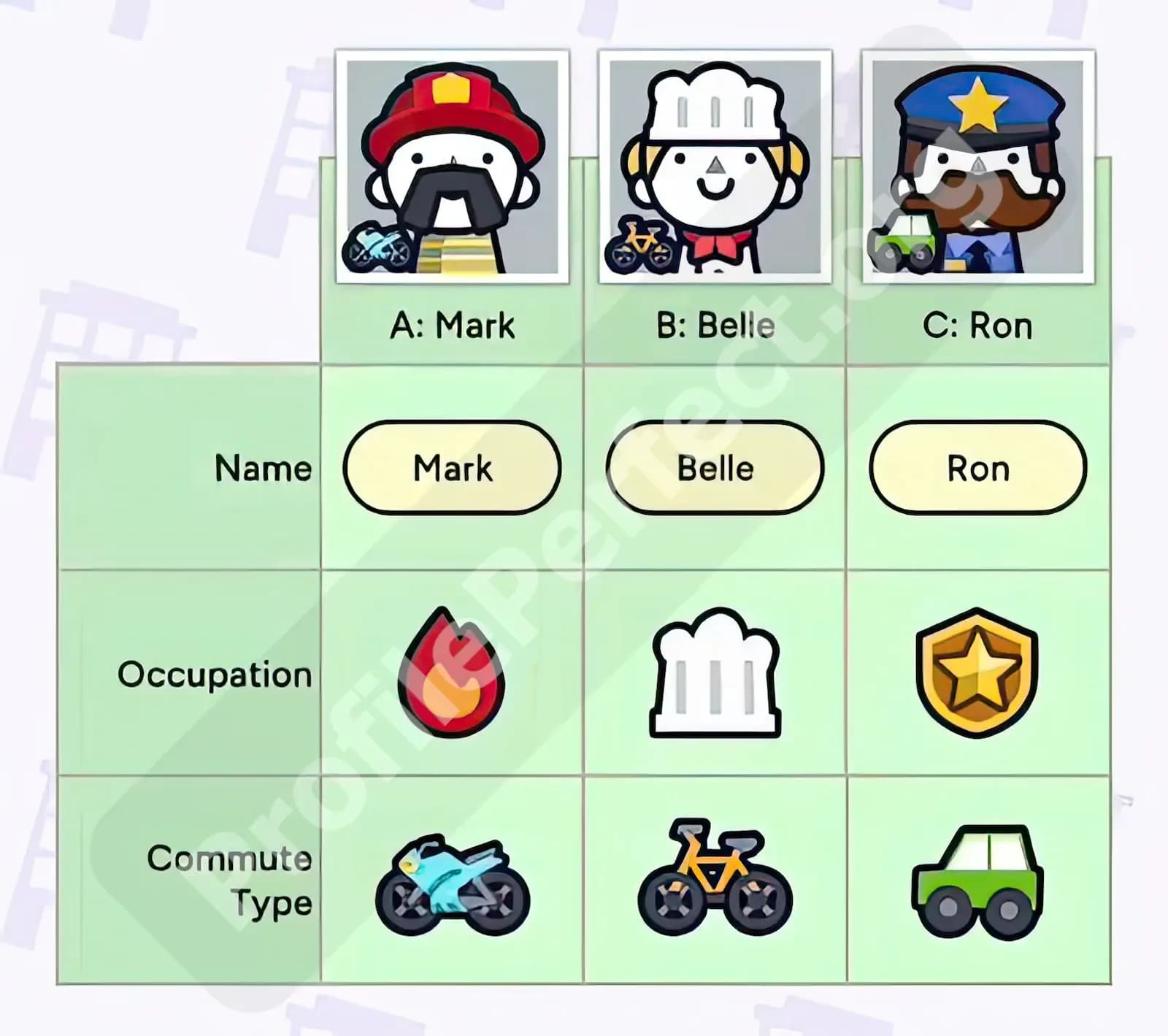
Level 17 is a great example. The person on the right is the local Police, and the badge says Ron Jefferson. That gives you a fast chain: the rightmost person is Police, and that same person is Ron. Then the firefighter clue builds around movement: the Firefighter is next to the Bike rider, while Mark met Ron at fire scenes. You can infer Mark is tied to the Firefighter role, while Ron is tied to Police.
This is how job puzzles should be approached: don’t start with the most complicated sentence. Start with the clue that gives you a fixed identity. The rest of the level will bend around that anchor.
Profile Perfect often avoids saying the exact job immediately. Instead, it describes a workplace or duty.
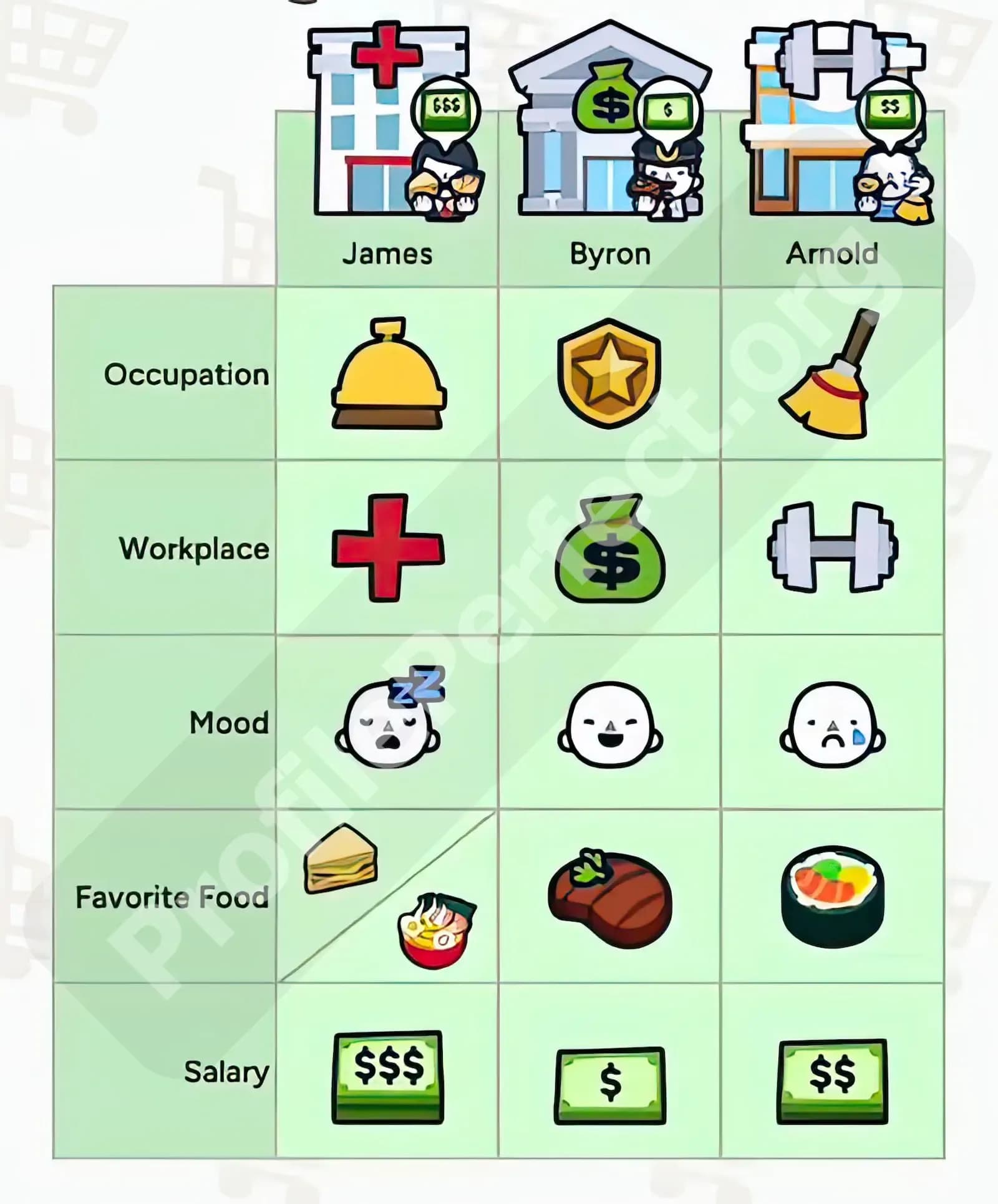
Level 43 is a good one. James works at a place run by a non-profit organization, which points to the Hospital. Arnold works at the Gym as a Janitor. Byron becomes the Security Guard at the Bank. None of these clues are hard individually, but the level stacks mood, food, and salary on top of the job grid.
This is where common knowledge helps. A receptionist fits naturally with a hospital. A security guard fits naturally with a bank. A janitor fits naturally with a gym. Once you lock workplace-to-job logic, the flavor clues stop feeling random.
The same thing happens in Level 203, where the whole level is built around guard-style thinking. Patrol zones, uniforms, and equipment all matter. The Cafeteria belongs to Derick. The Yard is farthest from the Cafeteria. The Navy officer brings a Flashlight for night watch. The Green officer in the Yard does not need Keys. The female officer has self-defense gear, which points to the Baton. This is a classic “uniform → equipment → place” chain.
Don’t solve Level 203 as four separate rows. Solve it like a patrol assignment board.
Tool clues are some of the most important occupation clues in Profile Perfect. They often look like simple object clues, but they quietly reveal the job or usage.
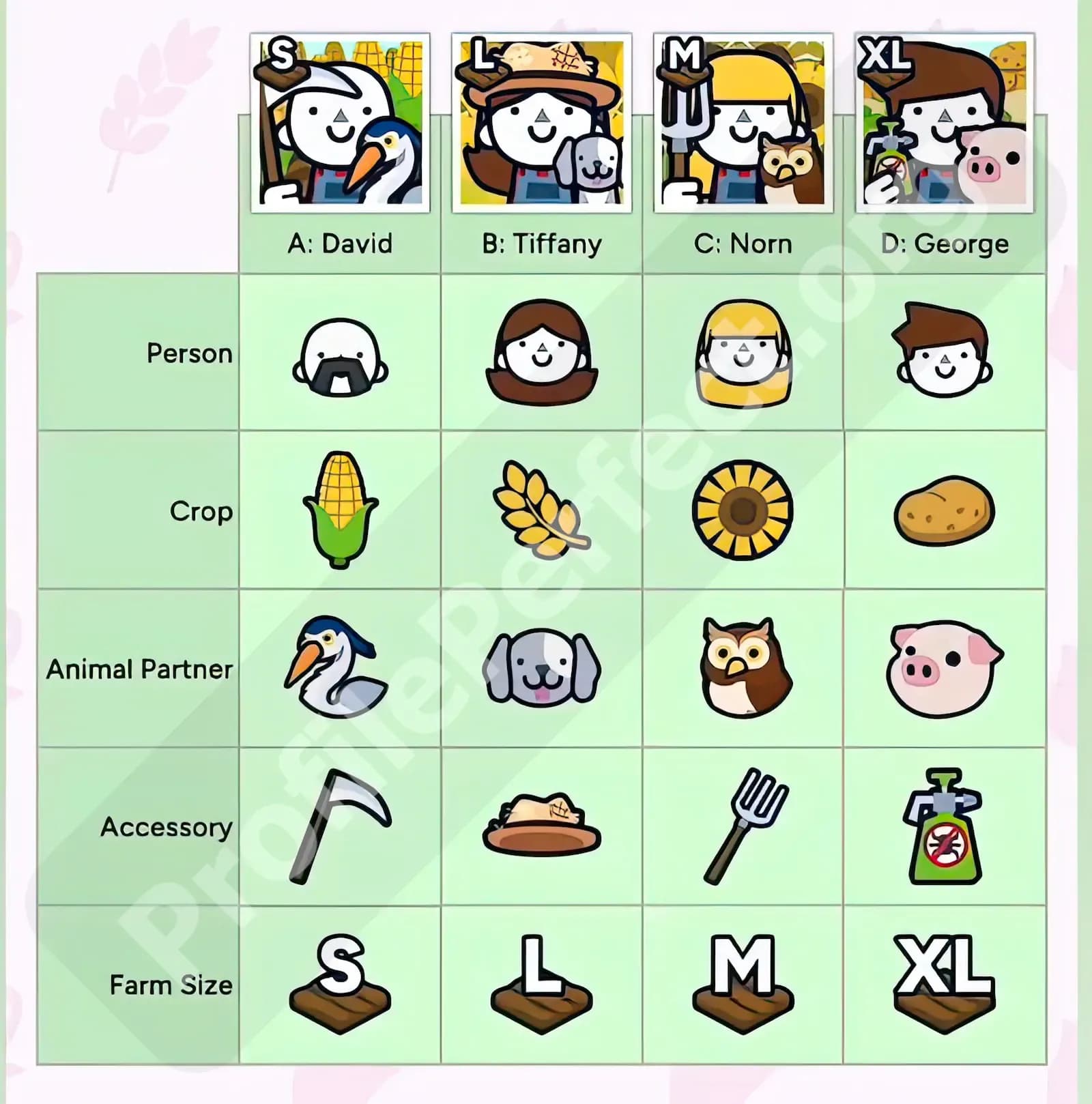
Level 111 turns farming into a full deduction puzzle. David uses a Scythe on a small farm. The Large farm is guarded by a loyal Dog. Norn’s tool is long and sharp, which points toward the Pitchfork. George uses Pesticide Spray to protect his farm. The Medium farm grows Sunflowers. These are not just random rural details. They are job-action clues.
The trick is to ask: what does this tool do?
A scythe cuts. A pitchfork is used around crops, hay, or farm work. Spray protects crops. A straw hat fits a farmer. When you translate tools into actions, you can make faster, safer matches.
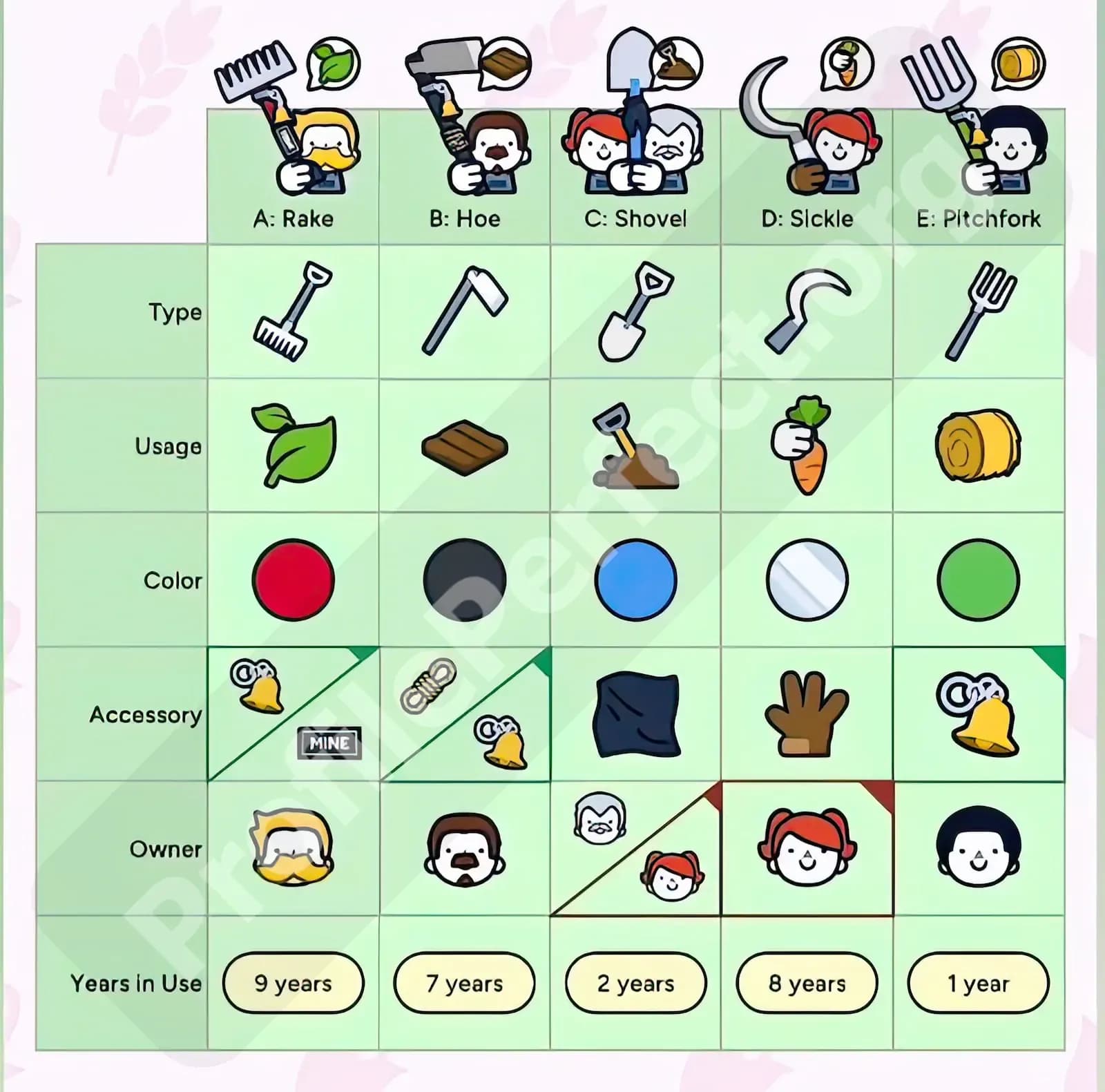
Level 117 pushes this even harder with Rake, Hoe, Shovel, Sickle, and Pitchfork. The Shovel is used for Digging. The Hoe is used for Tilling. The Pitchfork is used for Hays. The Sickle is not used for lifting hay or sweeping leaves, so it slides toward Harvest. The Rake handles Leaves. This level is basically a tool vocabulary test wearing a logic-grid costume.
I love this kind of puzzle because it rewards practical knowledge. But it can also be frustrating if you treat every word as decorative. In Profile Perfect, tool names are never just decoration.
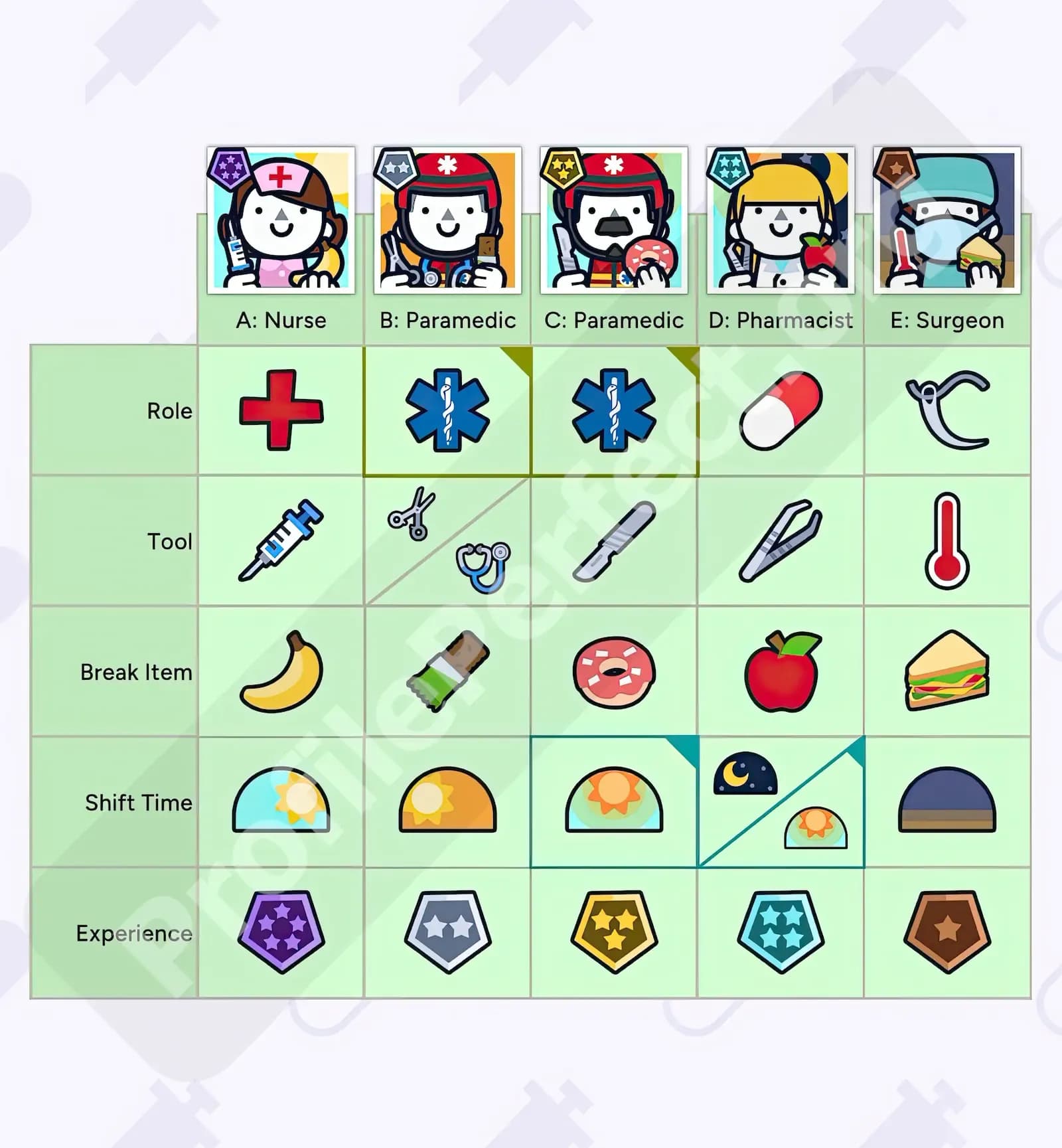
Medical levels can be especially nasty because the tools may overlap in your head. Level 154 uses Nurse, Paramedic, Pharmacist, and Surgeon roles, then mixes them with Syringe, Hemostat, Stethoscope, Scalpel, Tweezers, and Thermometer.
The Surgeon has the Thermometer in this level, while the Pharmacist carries Tweezers. The Paramedics are Junior and Senior. None of the Paramedics brought a Syringe, which helps push the Syringe toward the Nurse. The sharp tool connects to the Donut lunch clue, leading to the Scalpel.
The big lesson: when tools feel medically similar, separate them by clue function instead of vibes. “Sharp tool” is more precise than “medical tool.” “None of the Paramedics brought a Syringe” is more useful than assuming a paramedic should have one. Common knowledge helps, but the clue wording still wins.
Here’s the weird part: occupation clues sometimes use your expectations, then twist them.
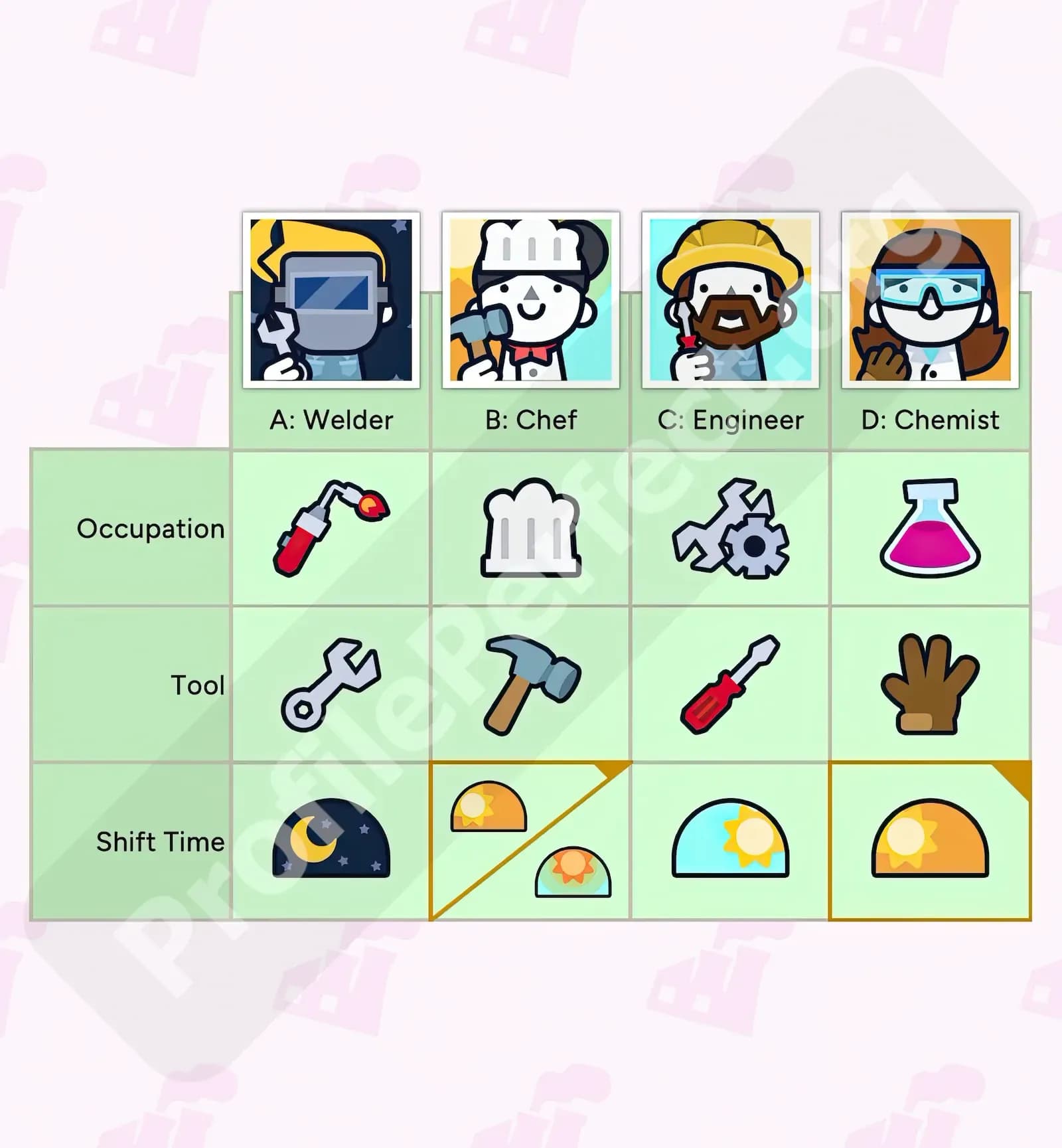
Level 177 is a perfect example. The Chef is using a Hammer to hang the new menu. That sounds wrong if you expect a chef to hold a knife, but it makes sense as an action clue. The Engineer is next to the Gloves wearer. Worker D is a Chemist with Gloves. The Wrench sits left of the Hammer. The Welder ends up with the Wrench and Night shift.
So yes, use common knowledge, but don’t autopilot. A chef can use a hammer if the clue explains why. A tool can describe a side action, not the main job.
That distinction saves lives.
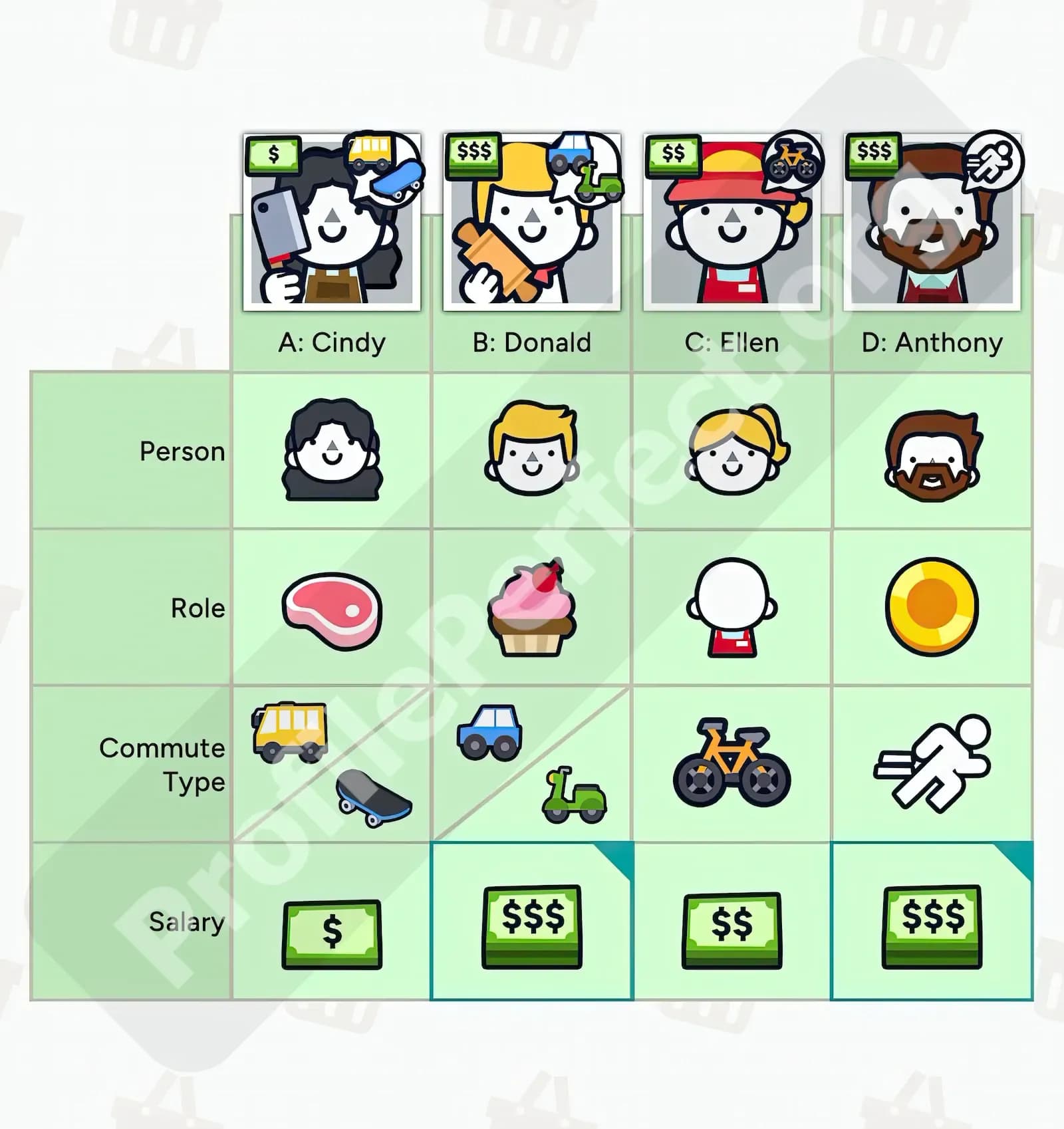
Later occupation levels often add salary or rank. Level 237 uses Butcher, Baker, Clerk, and Cashier, then combines them with commute type and salary. Staff D works at checkout, so that’s the Cashier. Donald brings a Car. Baker and Butcher sit on the left half. The highest earner walks to work. Ellen rides a Bike as a workout.
The role clue gets you started, but salary and commute finish the grid.
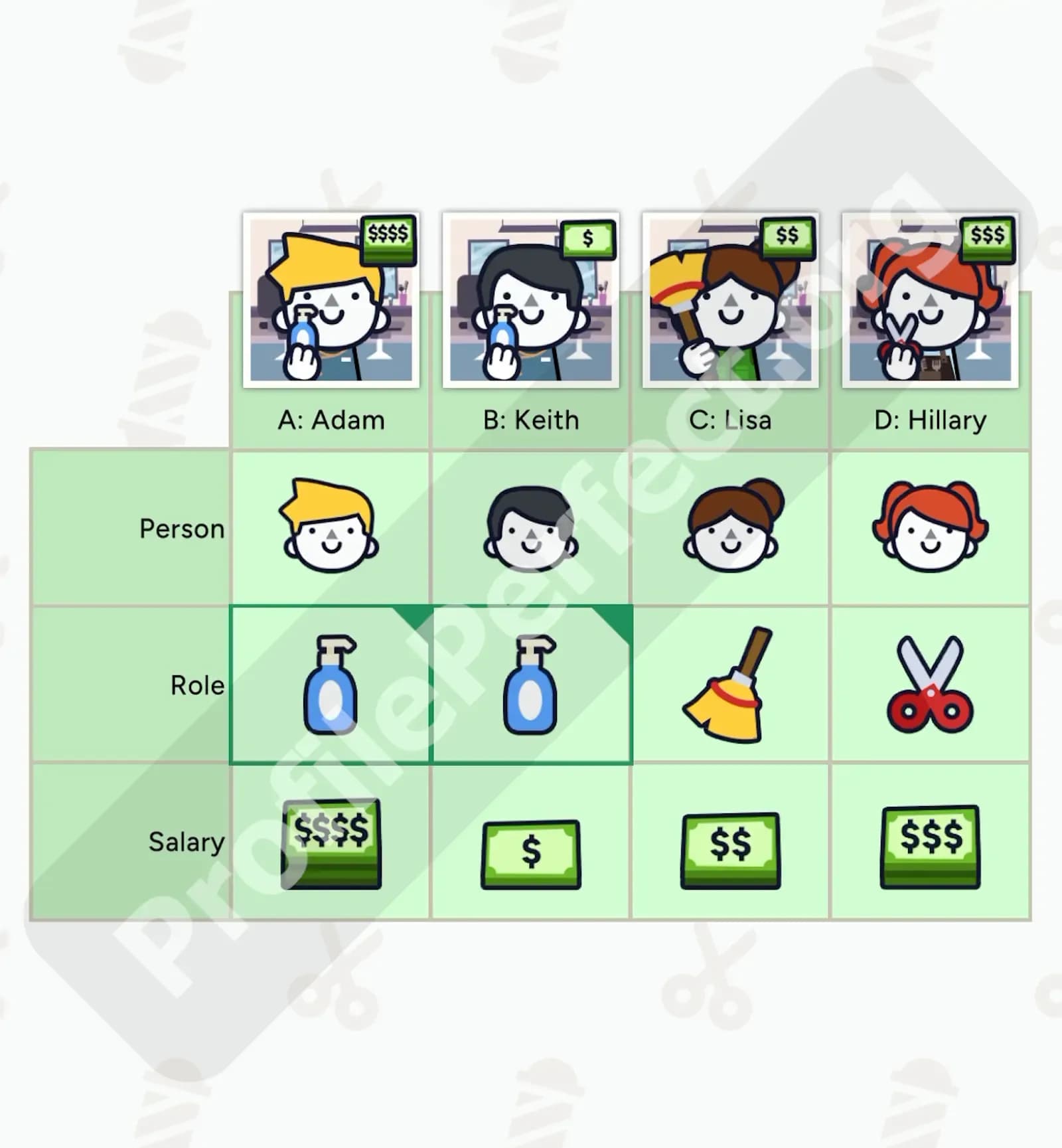
Level 375 does something similar in a smaller, funnier way. Hillary is the rightmost staff. Lisa has the second-lowest salary. The same job has both the highest and lowest salary. Adam’s Hair Washer salary is unreasonable, which points to Shampoo Assistant with the highest salary. Keith is also a Shampoo Assistant, but with the lowest salary. Hillary is the Barber.
This is a great reminder that Profile Perfect sometimes turns workplace logic into a joke. The unreasonable salary clue is funny, but it’s also direct. Don’t roll your eyes and skip it. That joke is the solution.
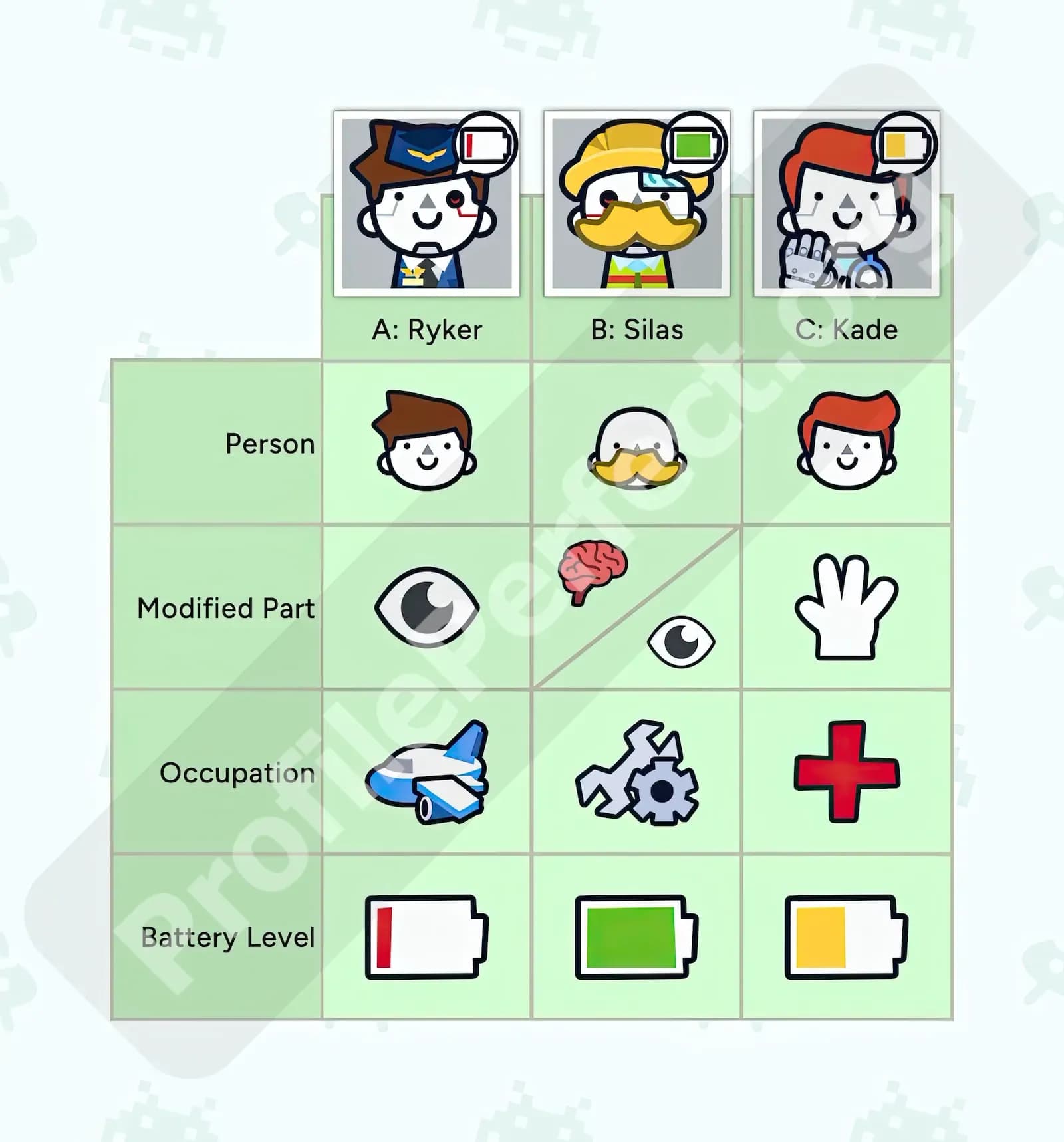
Level 331 looks different because it uses cyborgs, modified body parts, and battery levels, but the job logic still works. The middle cyborg became modified to fix things faster, which points to Engineer. Dr. Kade is tied to Doctor, and his robotic hands support that clue. The Flight Attendant sits two columns away from Dr. Kade.
Even when the theme changes, the technique stays rock-solid: role first, tool or body function second, position third.
Before making a risky move in any occupation-heavy Profile Perfect level, write a tiny mental map:
Chef → food, cooking, kitchen, menu Police / Guard → badge, patrol, uniform, baton, flashlight, keys Doctor / Nurse / Surgeon → medical tools, shifts, hospital logic Farmer / Gardener → crops, animals, farm tools, outdoor actions Worker / Engineer / Chemist → tools, safety gear, machines, shifts Barber / Shampoo Assistant / Janitor → workplace duty, service role, salary clues
Then mark only the clues that are confirmed by the level’s wording. That last part matters. Common knowledge gives you direction, but the actual clue gives you permission.
Occupation clues in Profile Perfect are satisfying because they make the game feel less like a dry grid and more like a little detective scene. When the loop works, it’s a triumph: you spot the job, link the tool, place the workplace, and watch the whole grid collapse into place.