
Learn how to solve Profile Perfect material clues by separating wood, steel, gold, bronze, marble, glass, and concrete from color rows before one bad tap.

Guide By Liam Stone
Published on June 15, 2026
Liam Stone has played Profile Perfect since the app first launched on the Apple App Store. He spotted its potential early, and that early bet turned into hundreds of hours spent solving levels, testing clue logic, and documenting answers for other players. Liam runs the YouTube channel Puzzle Game Answer where his puzzle walkthroughs have earned over 935,000 views and a growing community of more than 800 subscribers. He covers a wide range of mobile puzzle games beyond Profile Perfect, giving him firsthand experience with how these games design clues, structure levels, and trip up even experienced players. Every guide on this site reflects that hands on experience. Liam plays each level himself, verifies every answer against the in game grid, and rewrites confusing clues into plain language so you don't need to guess. If you want more of his walkthroughs, subscribe to his channel.
Loading calendar...
Material clues in Profile Perfect are sneaky. They look simple at first — Wood, Steel, Gold, Bronze, Marble, Glass, Concrete — easy stuff, right? But the game loves using them as a quiet trap. I’ve seen plenty of levels where a clue sounds like it’s talking about color, luxury, shape, weight, or building style, but it’s actually pointing to a material row. That’s where players burn lives.
And because Profile Perfect gives you a strict two-life safety net, one sloppy tap can turn a clean solve into a restart. So this guide is about one specific skill: separating material clues from color clues. Once you get that habit into your loop, levels with construction, furniture, landmarks, armor, keys, luggage, wards, and buildings become way less floaty.
In Profile Perfect, every level is built around subjects and traits. Subjects are your columns: Trap A, Tent B, Landmark C, Ward D, Geode A, and so on. Traits are the rows you’re solving: Material, Color, Floor, Wall, Paint, Building Material, Pedestal Material, Window, Decoration, Owner, Price, Weight, etc.
The problem is that material words often overlap with visual words.
Gold can be a material, but it can also feel like a color. Bronze works the same way. Marble can describe a wall, a floor, or a fancy visual style. Glass might be a material, but it can also imply a modern skyscraper. Concrete can mean a floor, a building, or a general construction vibe. Wood can show up as Wood, Wooden, Wood pedestal, Wooden wall, or Building Material.
That’s why my first rule is simple: before tapping anything, ask, “Is this clue naming what something is made of, or only what it looks like?”
That one question saves lives.
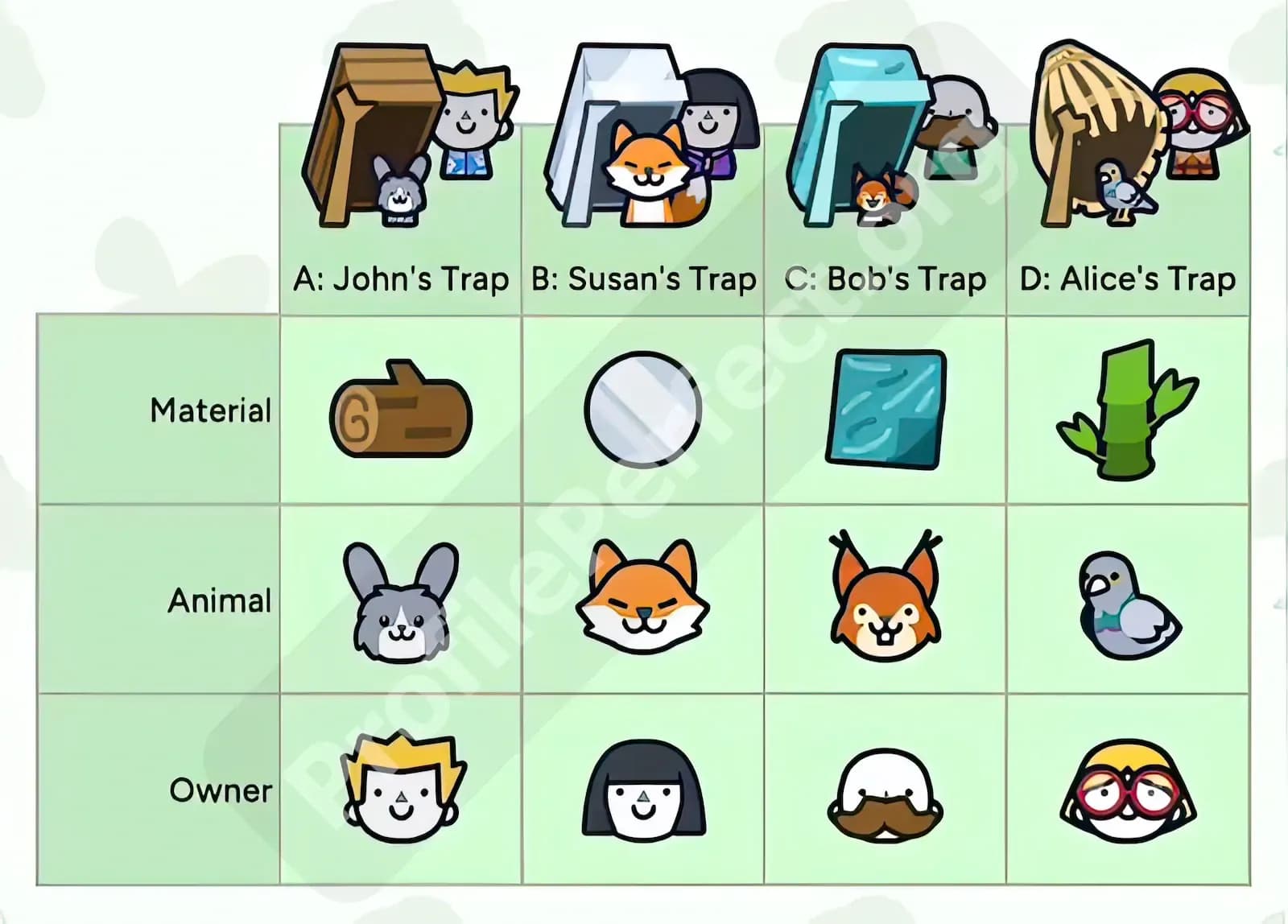
Level 10 is a clean early lesson. The subjects are traps, and one of the key rows is Material. You get direct material logic: the Wood trap, the Steel trap, the Plastic trap, and the Bamboo trap.
The clue “Steel trap is next to the Wood trap” is not a visual clue. It doesn’t mean gray is next to brown. It doesn’t mean heavy is next to natural. It means Steel belongs in the Material row, and Wood belongs in the Material row. Since Trap A is Wood, Steel lands beside it.
Then the game stacks more material logic: Plastic is next to the trap catching the Dove, and Susan’s trap is not made of Wood or Plastic. That last clue is important because it’s a negative material clue. Don’t rush to fill Susan’s owner row first. Mark the material exclusions mentally, then let the row-reduction rule do the crunchy work.
The solve path here is basic but powerful: lock known materials first, then attach owners and animals afterward.
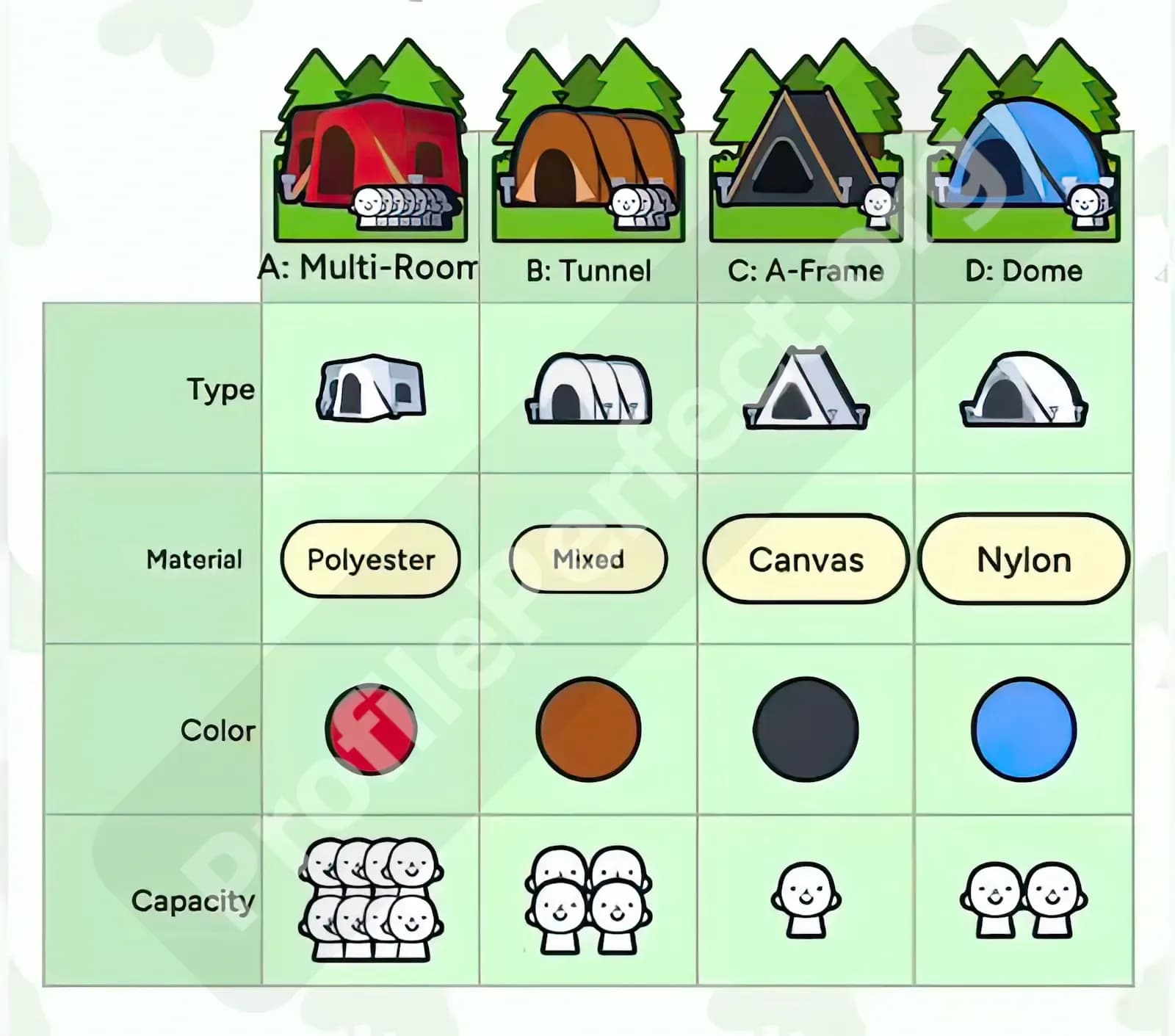
Level 13 is where the game starts mixing material and color more aggressively. The tent has Type, Material, Color, and Capacity rows. That means “Canvas,” “Nylon,” “Mixed,” and “Polyester” live in one row, while “Red,” “Brown,” “Black,” and “Blue” live in another.
The clue “Blue tent is made from Nylon” connects two rows: Color and Material. This is a relationship clue, not a direct single-cell clue. If you only remember “Blue,” you might tap the color row and move on, but the actual value is that Blue and Nylon are paired.
Then there’s “1 person can snug into the Canvas tent.” Again, Canvas is material. It is not a tent type, even though real-world camping knowledge might make your brain associate canvas with classic A-frame tents. Profile Perfect doesn’t care what you assume. It cares what the clues prove.
The winning technique: whenever a level has both Material and Color, treat every clue as a two-step translation. Identify the row first, then identify the relationship.
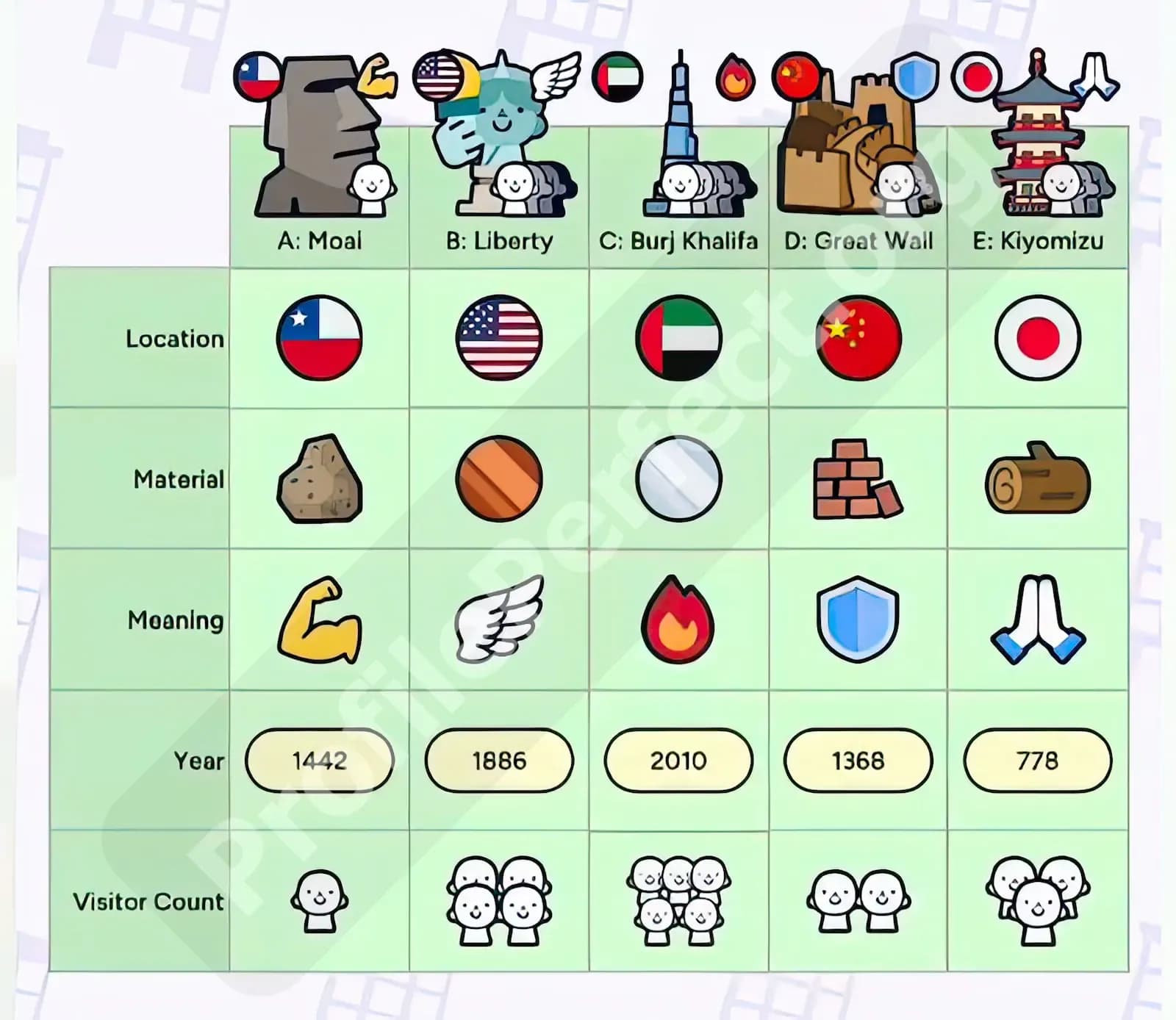
Level 24 is a banger for common-knowledge material clues. The landmarks use materials like Copper, Glass, Brick, Wood, and Tuff. The level also includes Location, Meaning, Year, and Visitor Count, so the material row is only one part of a much bigger grid.
This is where visual association matters. A Copper landmark linked to Freedom strongly nudges the Statue of Liberty idea. A Glass landmark tied to Ambition and a 2010 build year gives a modern skyscraper vibe. A Brick landmark tied to Defense pushes you toward a wall or fortification. Japan plus Wood plus Faith gives a temple/shrine feeling.
But here’s the catch: don’t solve purely from real-world memory. Use common knowledge as a flashlight, not as the final answer. If the clue says the Copper landmark is second most crowded, place Copper in Material and x4 in Visitor Count only when the surrounding clues support it.
Material clues in Level 24 are strongest when paired with meaning, year, and location. That’s the pattern to remember.
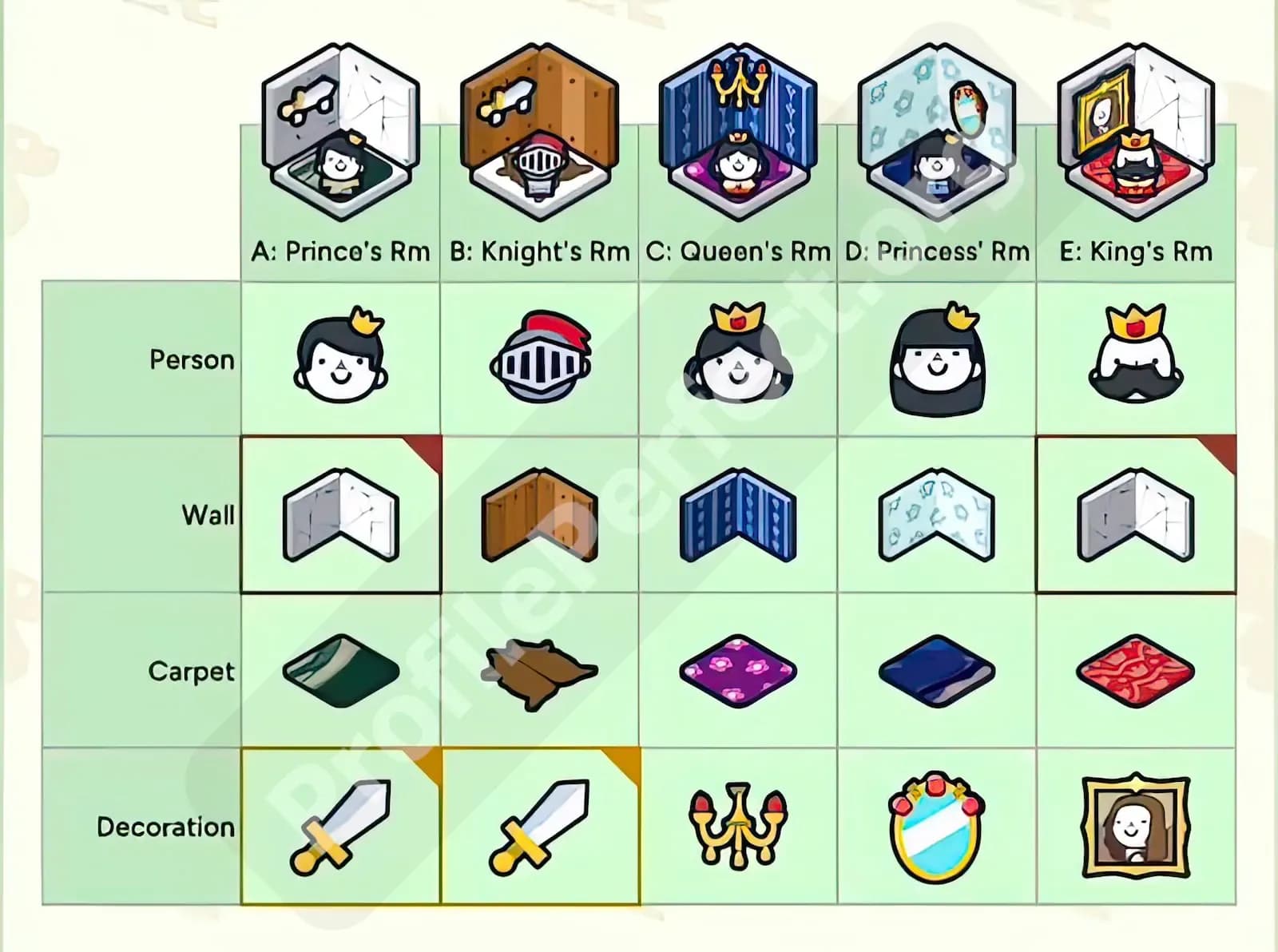
Level 28 is a royal room puzzle, and it’s easy to get baited by colors. You see Emerald, Sapphire, Red Royal, Blue Royal, Floral, Golden Portrait, and suddenly everything feels like a color puzzle. But the wall row includes Wooden and Marble, and those are construction clues.
“Room with Leather Carpet has a Wooden wall” is a perfect example. Leather is a carpet value. Wooden is a wall value. Neither one is a color, even though both create a strong visual picture.
Then “Prince and King have the same type of Wall” turns material into a relationship clue. It doesn’t say Marble directly at first, but once the other walls are excluded, the shared wall type becomes the solve.
This level teaches a key habit: separate luxury words from color words. Golden Portrait is a decoration. Emerald and Sapphire are carpet values. Marble and Wooden are wall values. Same royal vibe, totally different rows.
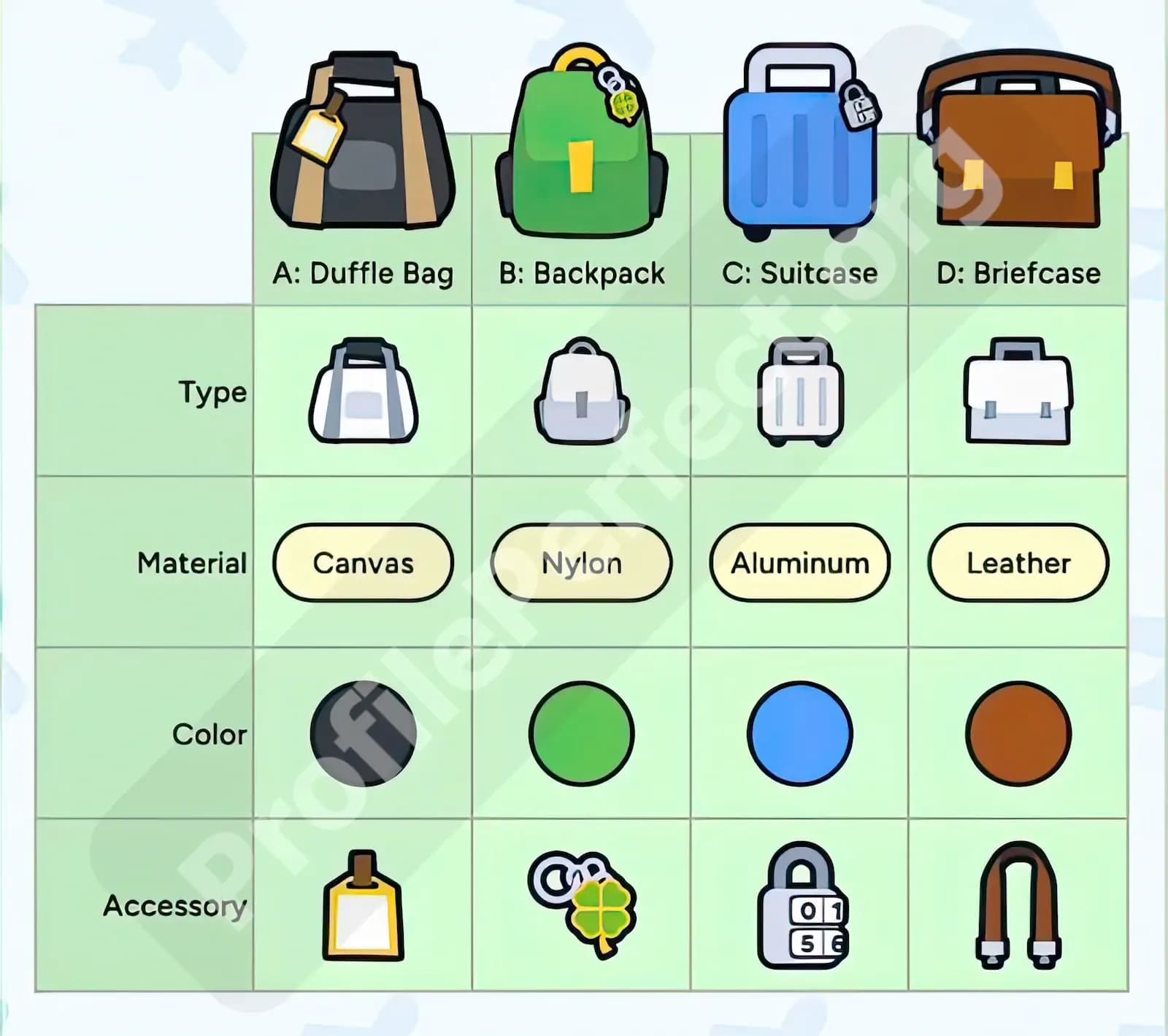
Level 35 gives you Type, Material, Color, and Accessory. That setup is dangerous because luggage clues sound very natural in real life. “Black bag,” “Blue luggage,” “Leather briefcase,” “Canvas duffle,” “Nylon backpack” — all of these feel like one object description, but the grid splits them into separate rows.
“The Briefcase is made from an exquisite Leather” is a material clue attached to a type. “Next to bag with a Tag is a bag in Nylon” connects Accessory to Material through position. “Bag made of Canvas is next to Nylon, it’s not Blue” mixes material, adjacency, and color exclusion in one sentence.
My technique here: underline the material word mentally before anything else. Leather, Nylon, Canvas, Aluminum. Then decide whether the clue is direct, adjacent, or negative.
This turns a messy luggage level into a clean chain.
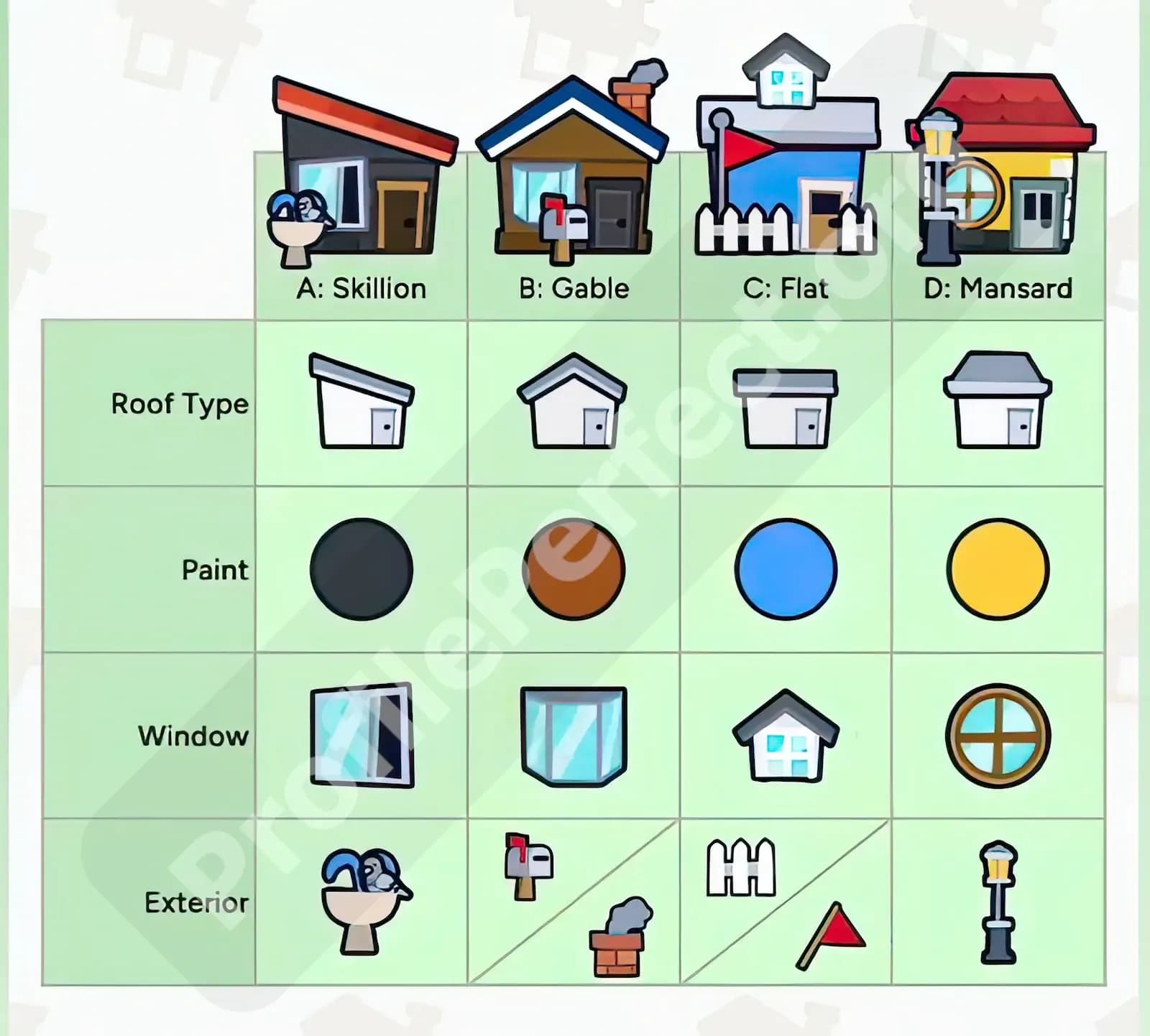
Level 104 doesn’t use a classic Material row, but it absolutely belongs in this guide because it trains construction thinking. The rows include Roof Type, Paint, Window, and Exterior. You’re solving things like Skillion, Gable Roof, Flat, Mansard, Sliding, Bay, Dormer, Circular, Mailbox, Chimney, Flag, and Lamp Post.
This level teaches a different version of the same skill: don’t confuse building parts with colors. “House D is Yellow and has trapezoid roof” gives Paint and Roof Type. “House on the left of Bay window is the darkest” gives Paint and Window. “Chimney is on the left of Dormer window house” gives Exterior and Window.
The row discipline matters more than the vocabulary. Roof type is not paint. Window type is not exterior. Construction clues often sound like one big house description, but Profile Perfect wants each feature in its exact row.
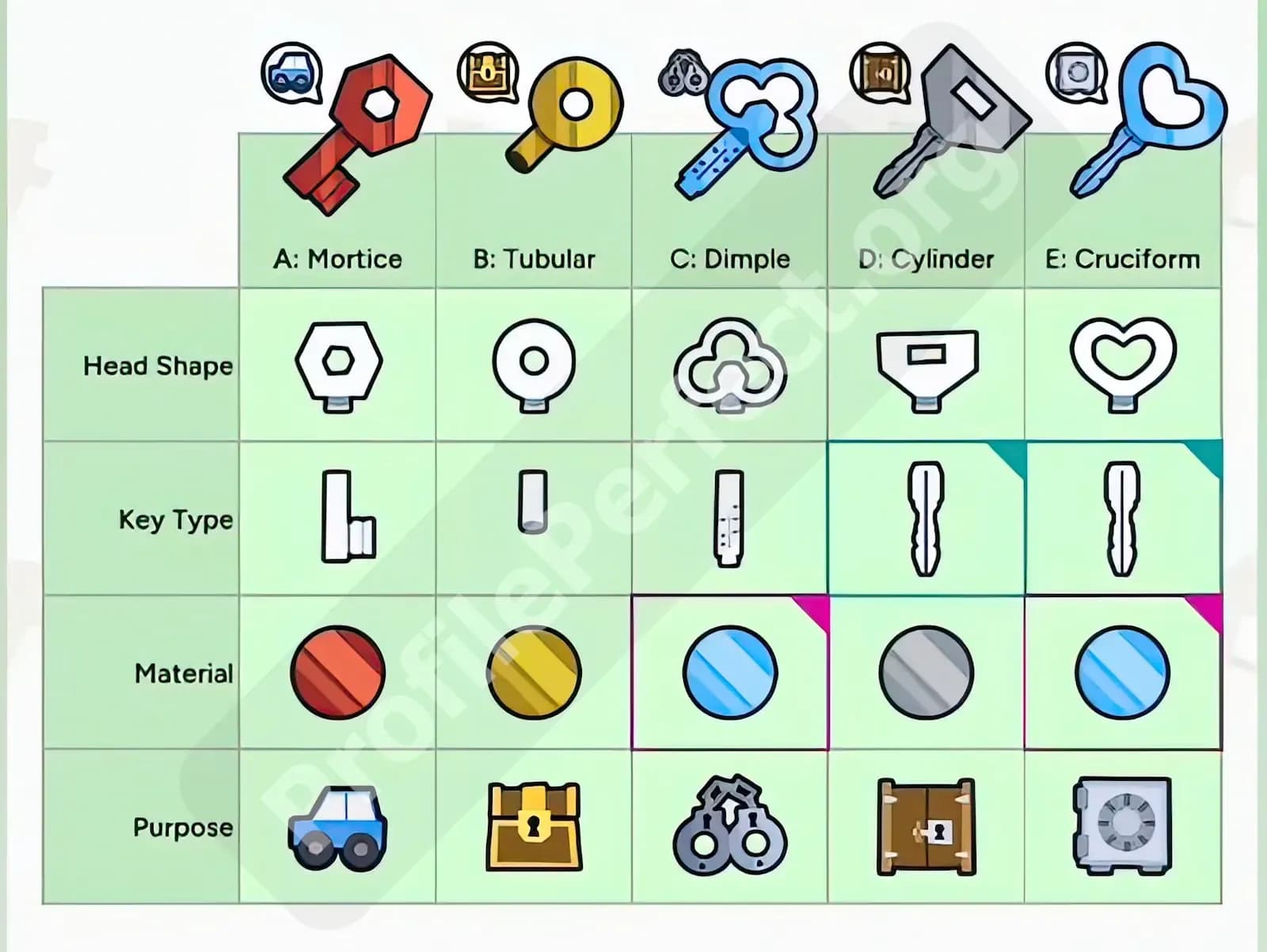
Level 107 is all about keys, and the material row includes Bronze, Brass, Titanium, and Iron. This is one of those levels where common knowledge can help because metals carry associations: bronze feels older, brass feels decorative, titanium feels strong, iron feels sturdy.
But again, don’t overplay the vibe. “Head of Key A is Hexagonal and made of Bronze” is direct. “Clover-head key is next to the one made of Brass” is positional. “Key to open the Gate is not made from Titanium” is negative. “Titanium keys do not have Tubular key type” is category exclusion.
The big lesson: metal clues are often used to eliminate, not just assign. When a clue says something is not Titanium or not Brass, don’t ignore it. Those exclusions set up the final lock.
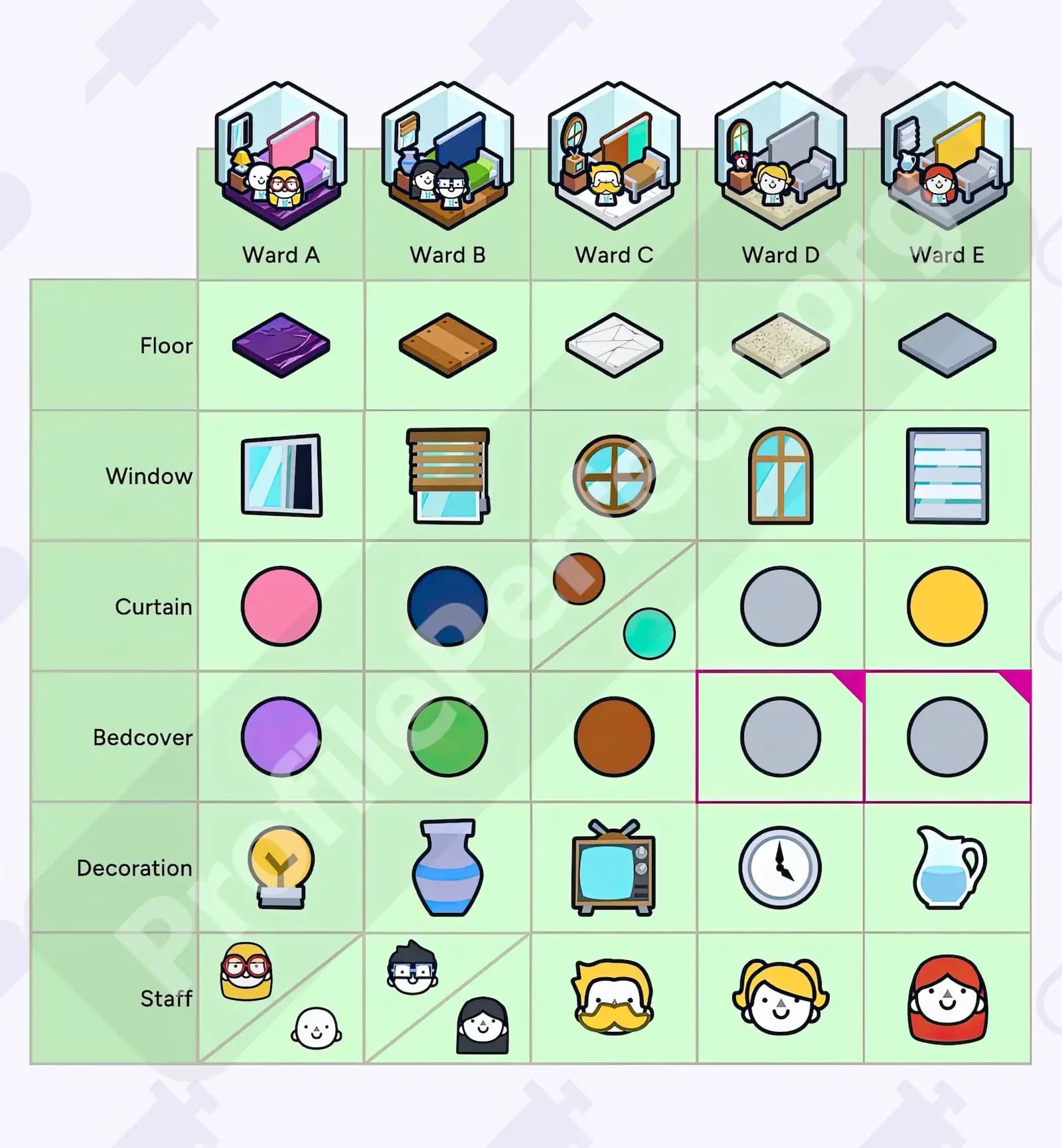
Level 150 is a dense ward puzzle with Floor, Window, Curtain, Bedcover, Decoration, and Staff. The floor row includes Carpet, Wooden, Marble, Granite, and Concrete. This level is a great stress test because colors are everywhere: Pink, Dark Blue, Brown, Tosca, Gray, Yellow, Green, Purple.
That means the material row can get buried.
“The Wooden floor in ward B looks elegant” is a direct floor clue. “Concrete floor is 2 columns away from Billy” is positional. “Marble floor and Arched window never pair well together” is a negative relationship between Floor and Window.
The trick is to sort clues into buckets: floor material, fabric color, window shape, decoration, staff. When a clue mentions Brown curtain and Brown bedcover, that’s not the floor. When it mentions Marble, Granite, Concrete, Wooden, or Carpet, you’re in floor territory.
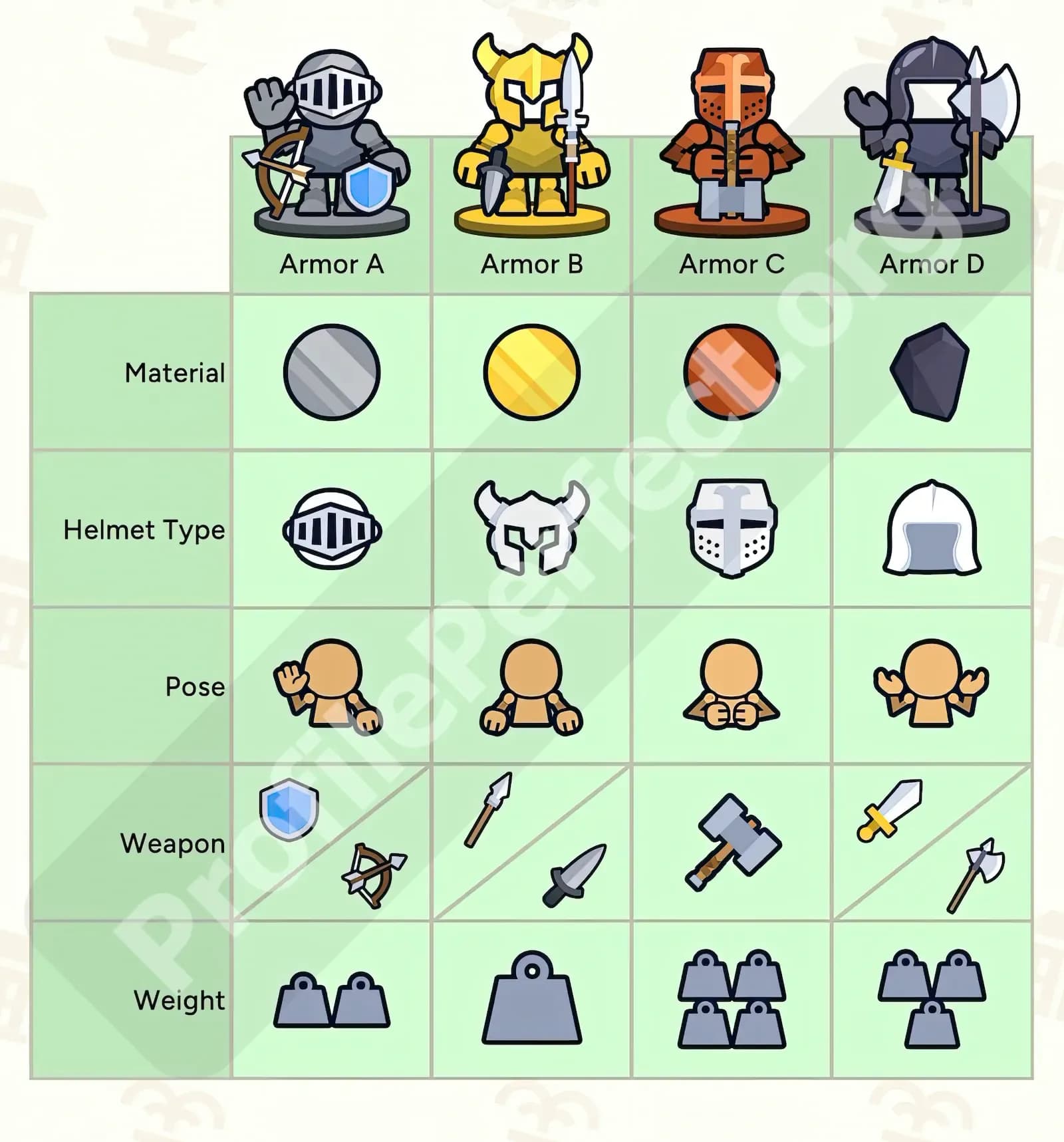
Level 323 uses Steel, Gold, Copper, and Obsidian armor. This is a great example of material clues carrying implied weight and style.
“Leftmost armor is the commonly used Steel plate armor” is direct. “Material 2 columns away from Steel is Copper” is positional. “The heaviest Copper armor’s pose has both hands at the front” links Material, Weight, and Pose. “Gold armor is paired with a ceremonial Horned helmet” links Material and Helmet Type.
This level feels crunchy because material, weight, weapon, and helmet all interact. Steel doesn’t just sit in the Material row; it helps locate Copper. Copper doesn’t just sit there; it points to the heaviest weight. Gold doesn’t just look fancy; it connects to a ceremonial helmet.
When materials have real-world associations, use them to remember relationships — but still solve from the clue chain.
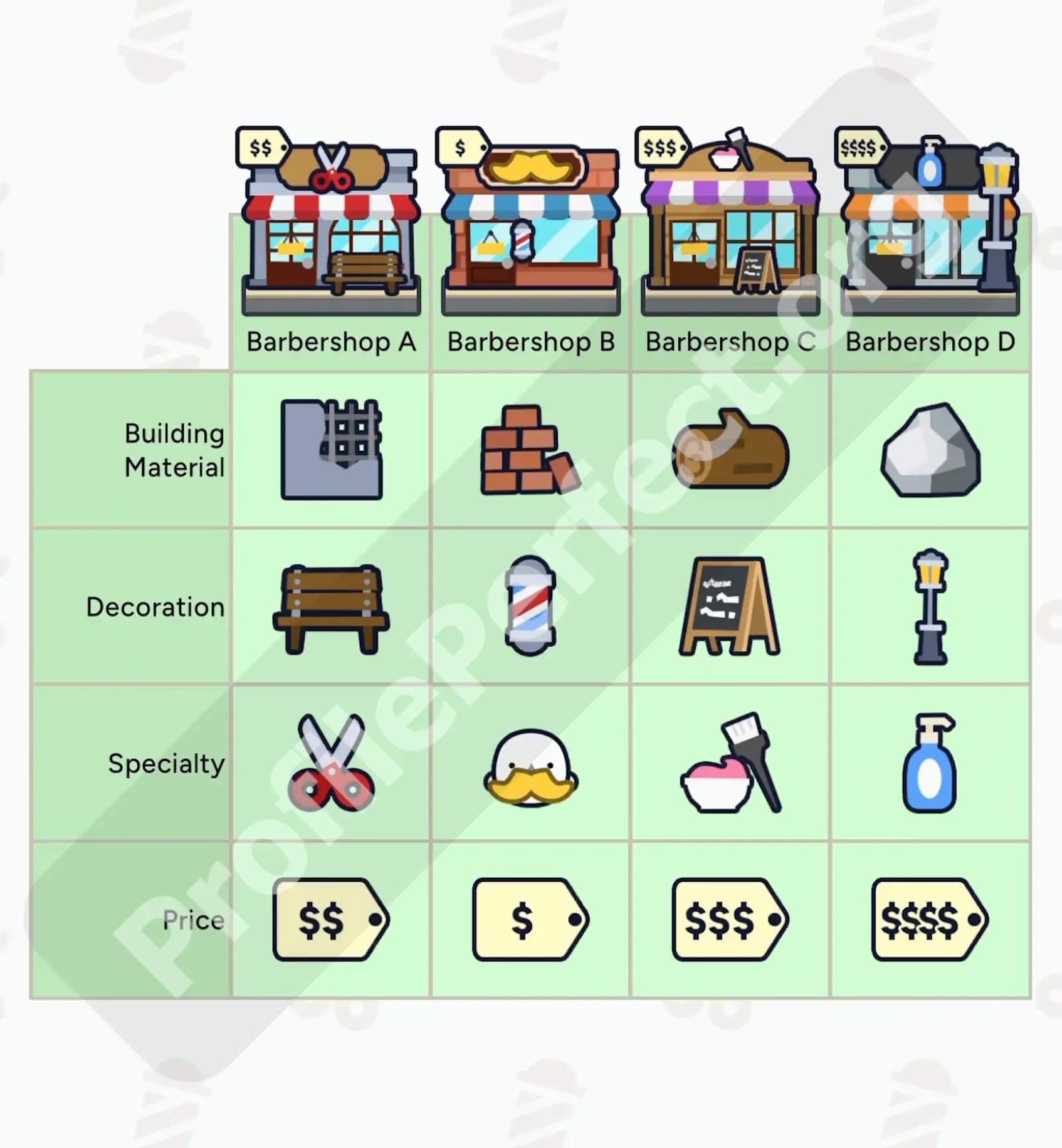
Level 376 focuses on barbershop Building Material: Concrete, Brick, Wood, and Stone. The clue “Hair Coloring is the specialty of the Wooden barbershop” directly links material to service. “Stone barbershop is next to the Wooden one” turns building material into an adjacency clue. “Brick shop with a Barber Pole is in the grid’s left half” combines material, decoration, and position.
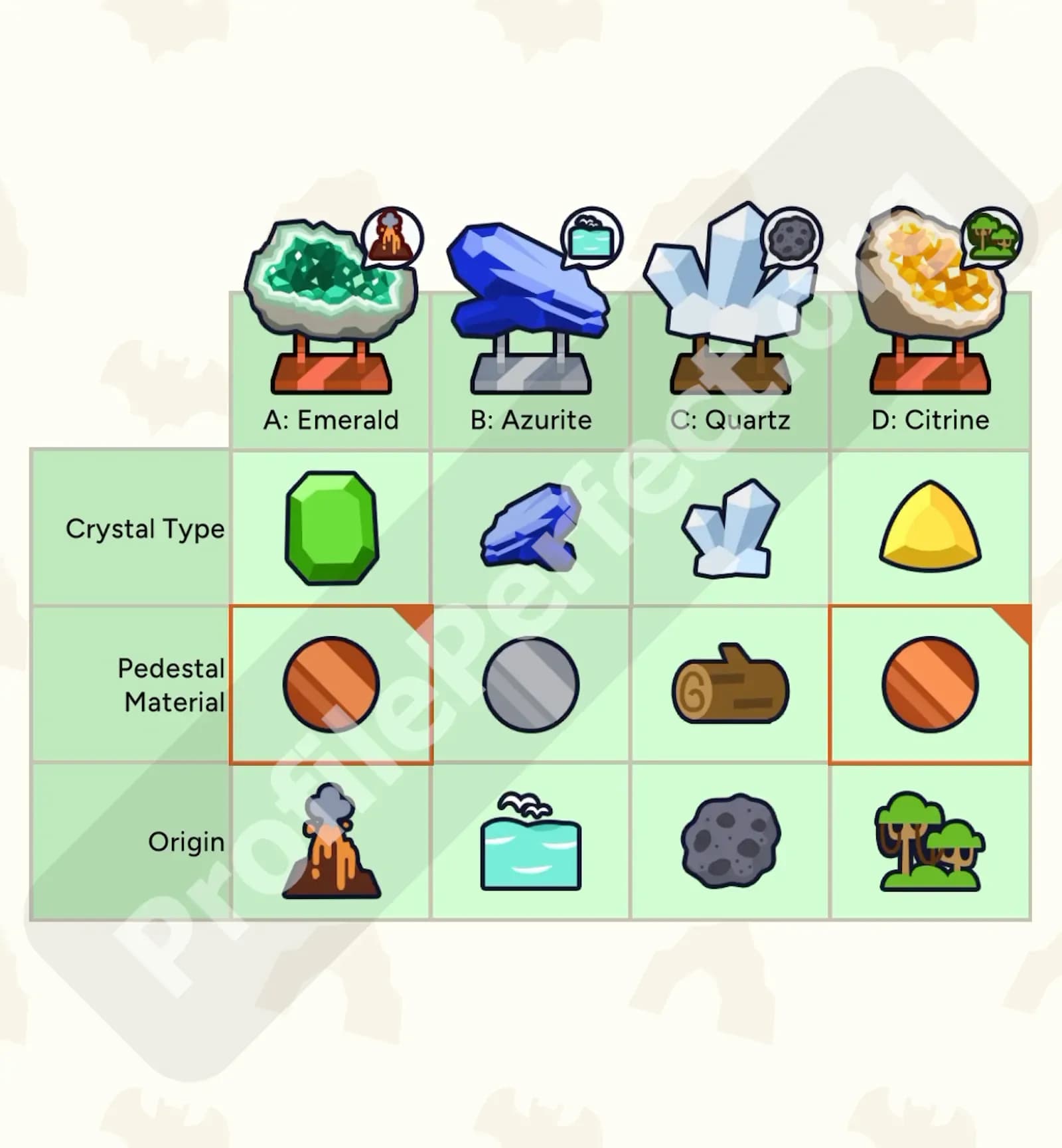
Level 391 shifts the idea to Pedestal Material: Bronze, Steel, and Wood. “Steel pedestal is used to present Geode B” is direct. “The one on Wood pedestal was formed on another planet” links material to origin. “Quartz and Emerald are not displayed using the same pedestal” is a material comparison clue.
These later levels prove the same point: material clues are not always called “Material.” They can be Building Material, Pedestal Material, Floor, Wall, or Exterior-style construction logic.
Here’s the method I use whenever a Profile Perfect level starts throwing Wood, Steel, Gold, Bronze, Marble, Glass, or Concrete at me.
First, scan the row names before reading clues. If there is both Material and Color, slow down. That combination is a classic trap.
Second, tag every clue word by row. Wood goes to Material or Wall. Brown goes to Color or Paint. Marble might be Floor or Wall. Golden Portrait is Decoration, not Material. Glass is Material only if the row supports it.
Third, treat material clues as anchors. They often connect to weight, position, object type, or real-world purpose. Steel armor, Leather briefcase, Wooden barbershop, Bronze key, Glass landmark — these are usually strong relationships.
Fourth, don’t let common knowledge override the grid. Use it to understand the clue faster, then confirm it with row logic.
That’s the whole loop. Material clues look like flavor text, but in Profile Perfect they’re often the backbone of the solve. Once you stop mixing them with color clues, these levels become much more readable — and a lot less likely to eat your two lives.