
Learn the fastest opening move for Profile Perfect levels: fill direct clues first, build anchor points, and solve early puzzles without risky guessing.

Guide By Liam Stone
Published on June 10, 2026
Liam Stone has played Profile Perfect since the app first launched on the Apple App Store. He spotted its potential early, and that early bet turned into hundreds of hours spent solving levels, testing clue logic, and documenting answers for other players. Liam runs the YouTube channel Puzzle Game Answer where his puzzle walkthroughs have earned over 935,000 views and a growing community of more than 800 subscribers. He covers a wide range of mobile puzzle games beyond Profile Perfect, giving him firsthand experience with how these games design clues, structure levels, and trip up even experienced players. Every guide on this site reflects that hands on experience. Liam plays each level himself, verifies every answer against the in game grid, and rewrites confusing clues into plain language so you don't need to guess. If you want more of his walkthroughs, subscribe to his channel.
Loading calendar...
The fastest way to start any Profile Perfect level is not to “figure out the whole puzzle.” That sounds obvious, but it’s where a lot of players tank their run. They read one clue, half-read another, notice a possible pattern, and start tapping like the game is asking for vibes instead of logic. Then one wrong checkmark eats a life. Another risky tap later, the level is gone.
Profile Perfect rewards a much cleaner opening loop: fill the direct clues first.
By direct clues, I mean the clues that tell you a confirmed match with almost no interpretation. “Joyce’s full name is Joyce Miller.” “Attached to Dog B is a tag that reads Domino.” “Tools to make food can be found in Room B.” “Bus heading to Manchester has Zigzag pattern.” These clues are your anchor points. They are the safest first moves in the game because they don’t ask you to compare positions, calculate distance, or decode a chain of relationships. They simply say: this subject matches this trait.
That opening habit is a banger because Profile Perfect levels are built around subjects and traits. The subjects are the columns: Joyce, Bob, Dog A, Dog B, Room A, Room B, Bus A, Bus B, and so on. The traits are the rows or categories: surname, nationality, breed, room type, floor, destination, fare, accessory, occupation. Your job is to connect each subject to the correct trait values.
So before you do anything flashy, scan the clue list and ask one question: which clues already give me a confirmed match?
Direct clues do three things at once.
First, they give you safe checkmarks. That matters because wrong answers cost lives. Profile Perfect is generous in one way: there’s no timer breathing down your neck. But the two-life structure means a careless guess can absolutely wreck a run. The game wants patience, not panic.
Second, direct clues reduce the grid. Once one value is confirmed, the other values in that same category usually become easier to eliminate. If Dog B is Domino, then Dog A and Dog C are not Domino. If Dog C is Pomeranian, the other dogs are not Pomeranian. Even when the game handles some of this automatically, the mental benefit is huge. Your brain has fewer loose pieces to juggle.
Third, anchor points make relative clues readable. Clues like “Milo is next to Domino” or “the room beside the Tiled floor has Solid color” are floaty until you know where Domino or Tiled actually is. Once you lock a direct clue, those relative clues stop feeling vague and start behaving like instructions.
That’s the whole trick: don’t start with the crunchy clue. Start with the obvious one that makes the crunchy clue easier.
Profile Perfect Level 1 is the cleanest example of this opening strategy. The level gives you Joyce and Bob as subjects, with surname and nationality as traits.
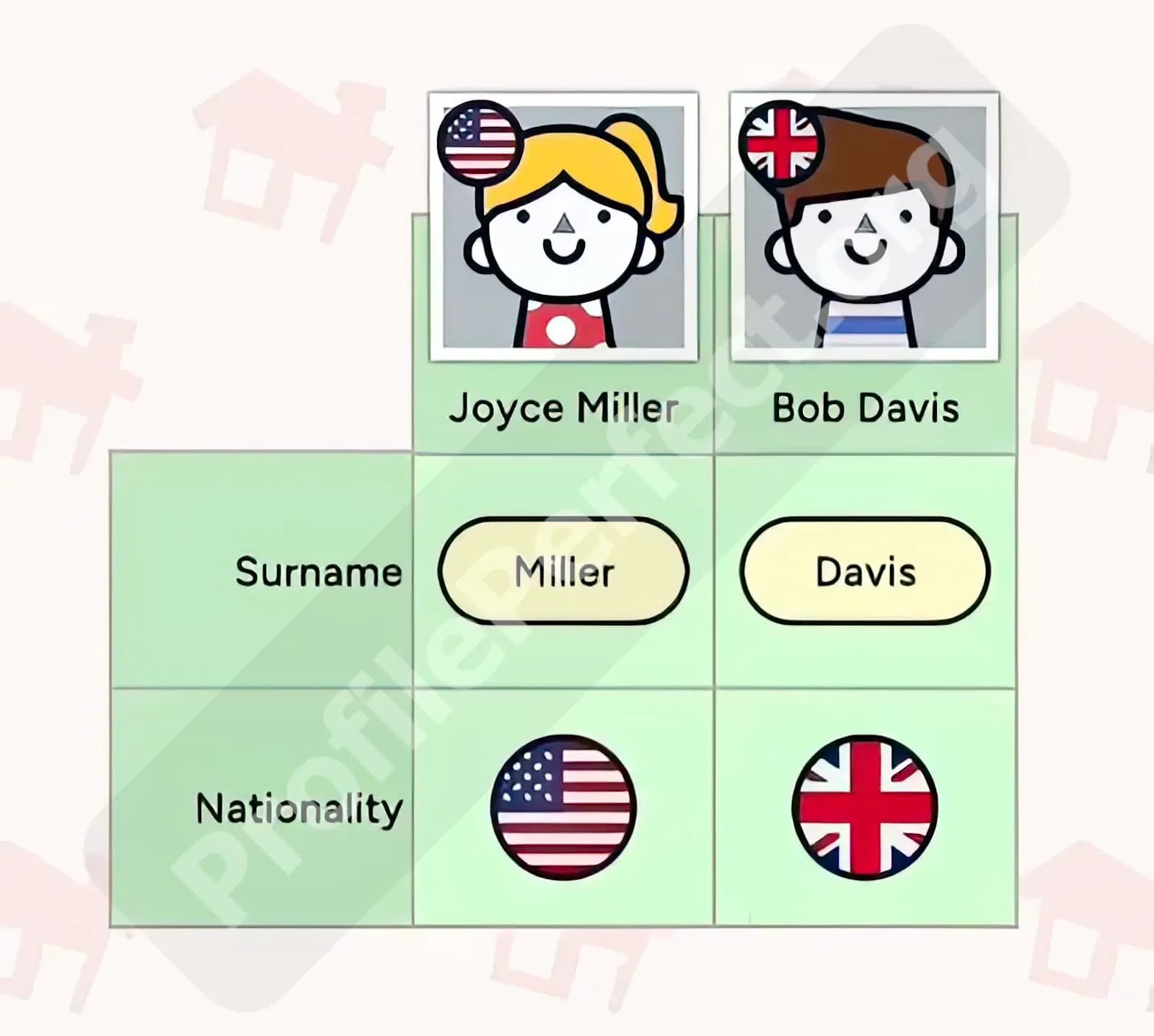
The direct clue “Joyce’s full name is Joyce Miller” should be your first tap. Joyce equals Miller. No guessing, no theory, no weird deduction. Then “Bob is the youngest son of the Davis family” confirms Bob equals Davis.
Now you have two strong anchors. The next clues attach nationality to surname: the Miller family has lived in the USA, and the Davis family has lived in England since the 1800s. Because Joyce is already Miller, Joyce becomes American. Because Bob is already Davis, Bob becomes British.
The entire level falls over because you started with direct identity clues. That’s the ideal Profile Perfect opening: lock the names, then let the connected clues do the rest.
Level 2 adds three dogs, and it’s a perfect lesson in not rushing.
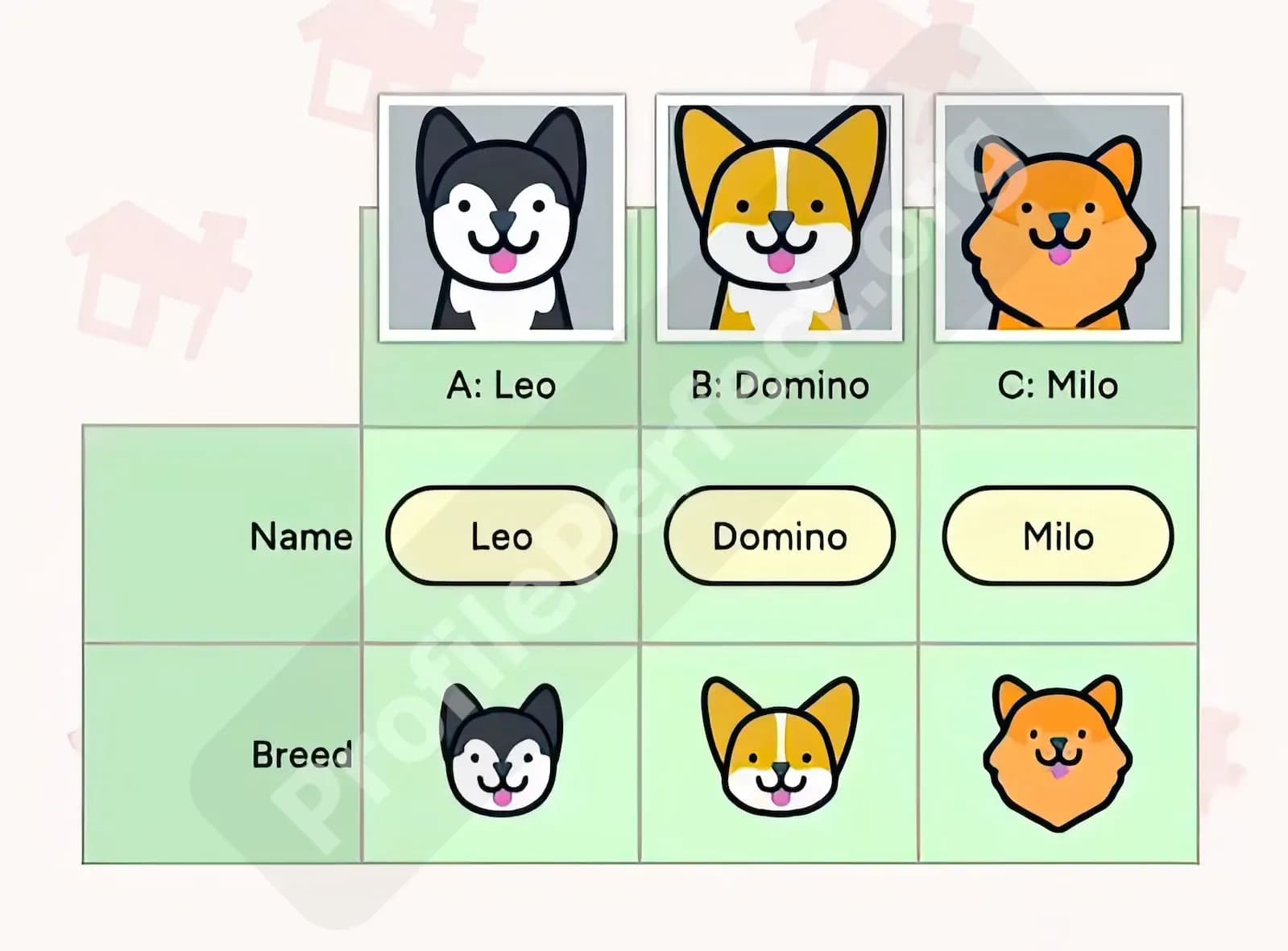
The safe openers are clear: Dog B has a tag reading Domino, and Dog C is Pomeranian. Tap those first. Dog B equals Domino. Dog C equals Pomeranian.
Now the clue “Milo is next to Domino” becomes useful. Without the Domino anchor, that clue is just a relationship floating in space. With Dog B confirmed as Domino, you know Milo has to be adjacent to Dog B. That narrows the field immediately.
Then the Husky being called Leo connects breed and name. Since Dog C is already Pomeranian, Dog C can’t be the Husky and can’t be Leo. From there, the remaining pieces click into place: Dog A becomes Leo and Siberian Husky, Dog C becomes Milo, and Dog B takes the remaining breed, Corgi.
That’s the power of direct clues. They turn a “maybe” clue into a nearly solved chain.
Some direct clues don’t use the exact grid word. That’s where Profile Perfect gets sneaky.
In Level 3, the clue says, “Tools to make food can be found in Room B.” It doesn’t literally say “Room B is Kitchen,” but that’s what it means. Food tools point to Kitchen. So your opening move is Room B equals Kitchen.
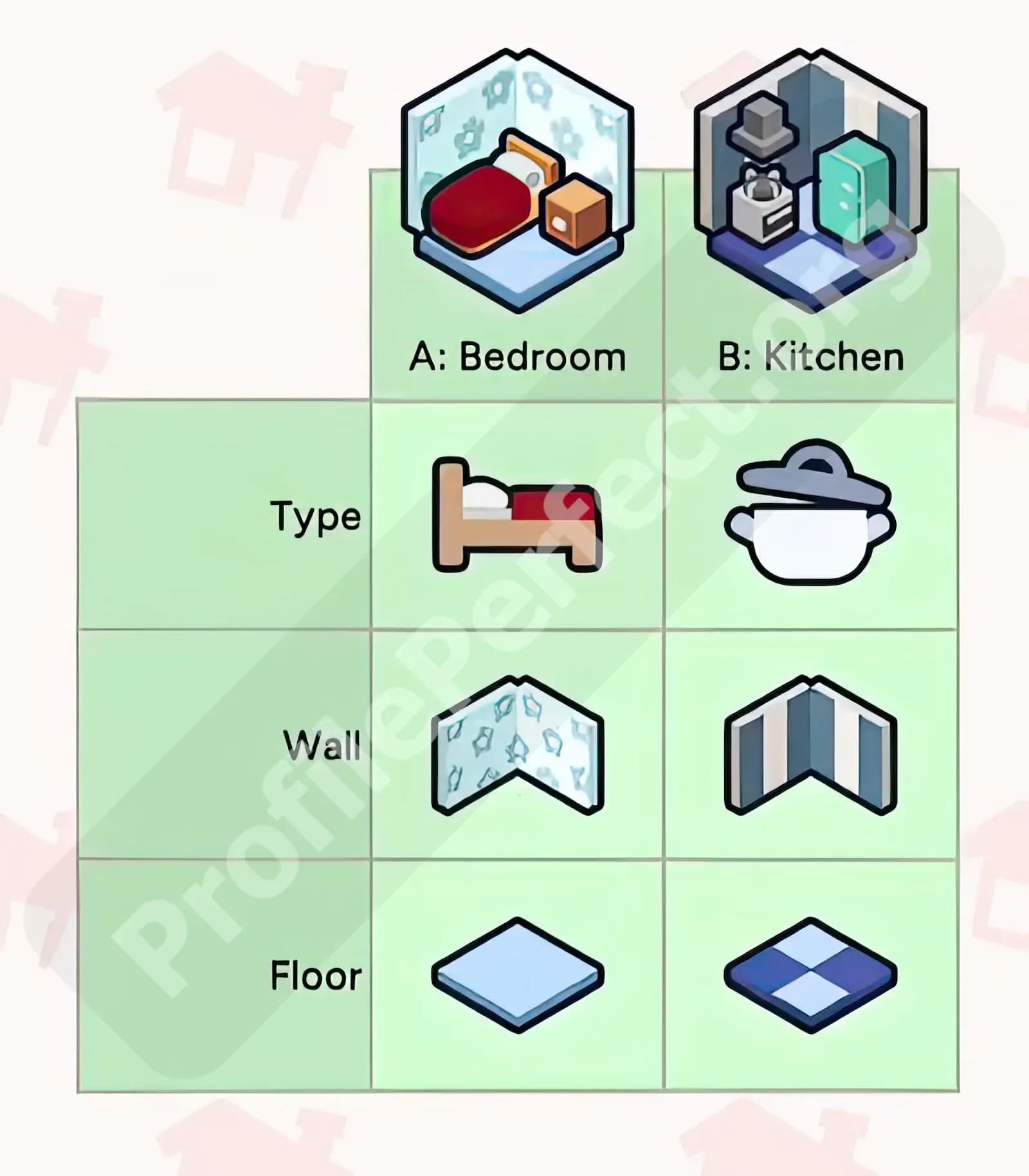
This is still a direct clue. The game is just using descriptive language instead of the row label. Once Room B is Kitchen, Room A must be Bedroom. Then the Bedroom has a Floral wall, so Room A gets Floral. The rest starts to collapse: Room B gets Striped, and the floor clue can be resolved around the Tiled and Solid relationship.
The key lesson is that direct clues can be literal or descriptive. “Dog C is Pomeranian” is literal. “Tools to make food” is descriptive. Both create anchor points.
The opening levels repeat this lesson in different skins. I actually like that. It gives the player a rhythm before the grids get bigger.
In Level 4, “Rightmost dress has a Handbag” and “Dress A has Polkadot pattern” are safe starting moves. Don’t begin with “Floral dress is next to Polkadot dress” if Polkadot is not placed yet. Place Polkadot first, then the next-to clue becomes easier.
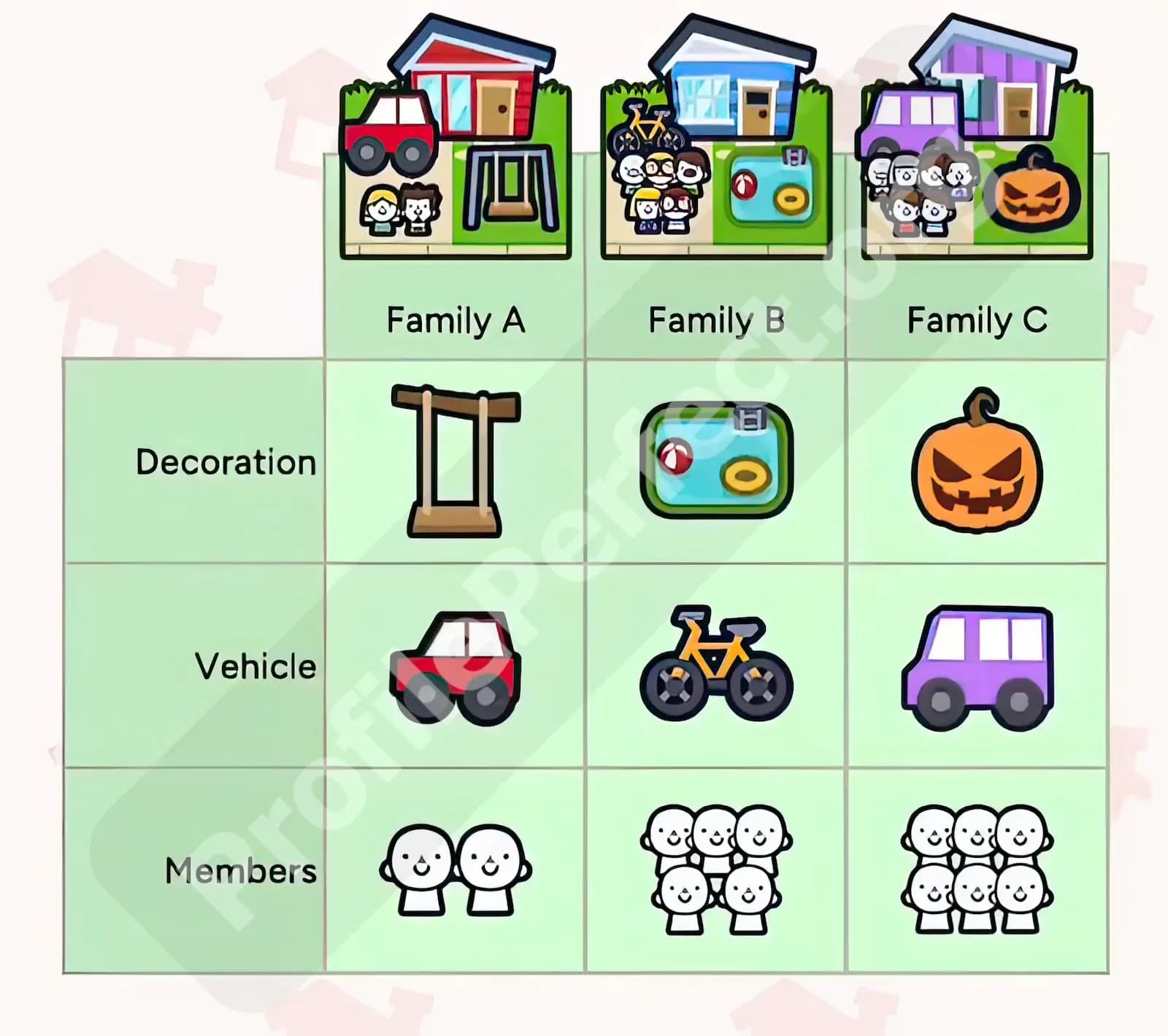
In Level 5, Family C already has the Purple Minivan as an initial answer, and Family C has 6 members. Family A’s car matching the color of the house points to the Red Car. These are anchors. After that, clues about Bicycle, Pool, Halloween decoration, and Swings become much less messy.
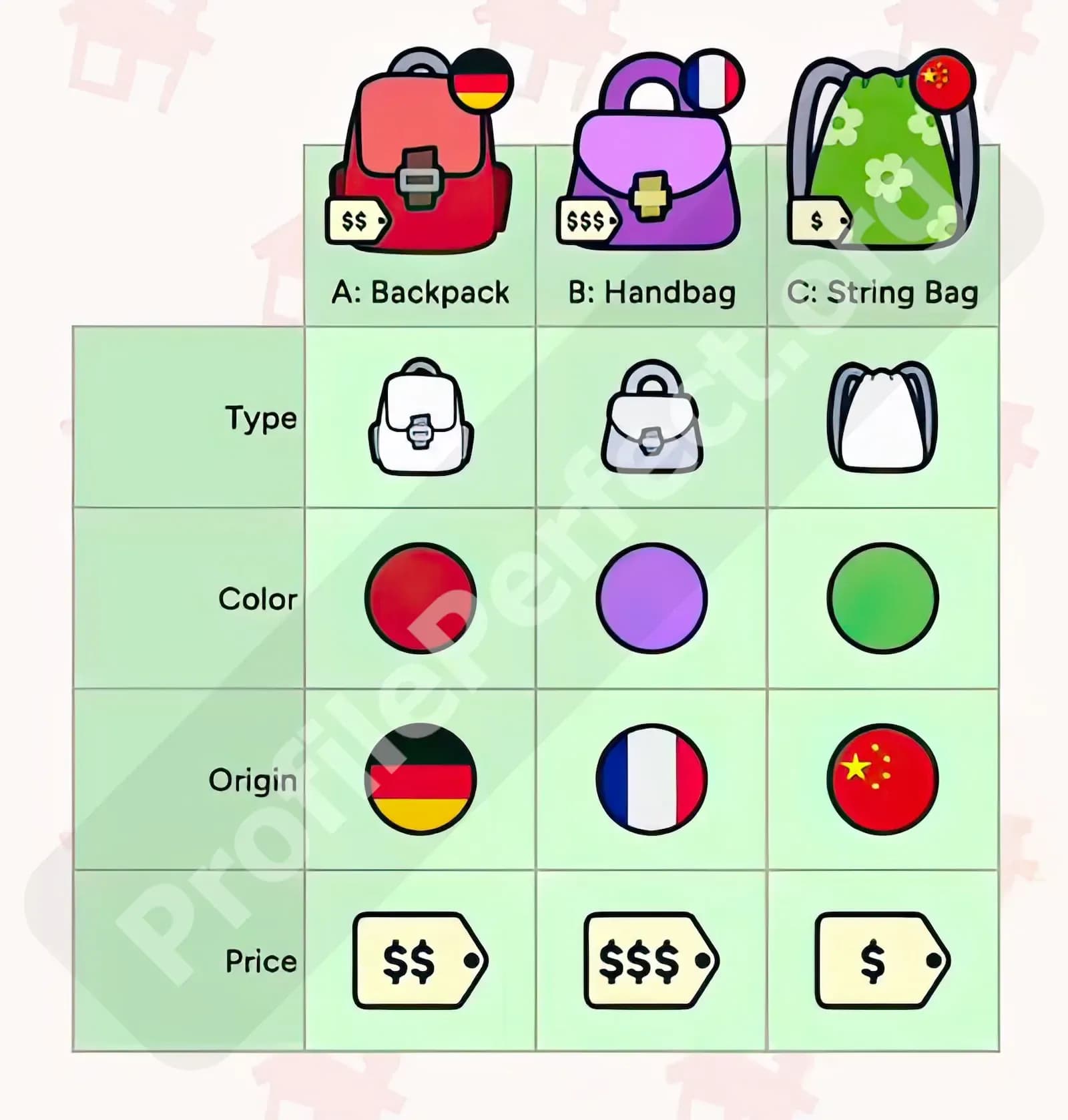
In Level 6, Bag B is a Handbag and Bag A has Medium price. Bag A is also from Germany. Those are excellent first taps. Only after that should you worry about relative price clues like “Bag C is cheaper than German bag.”
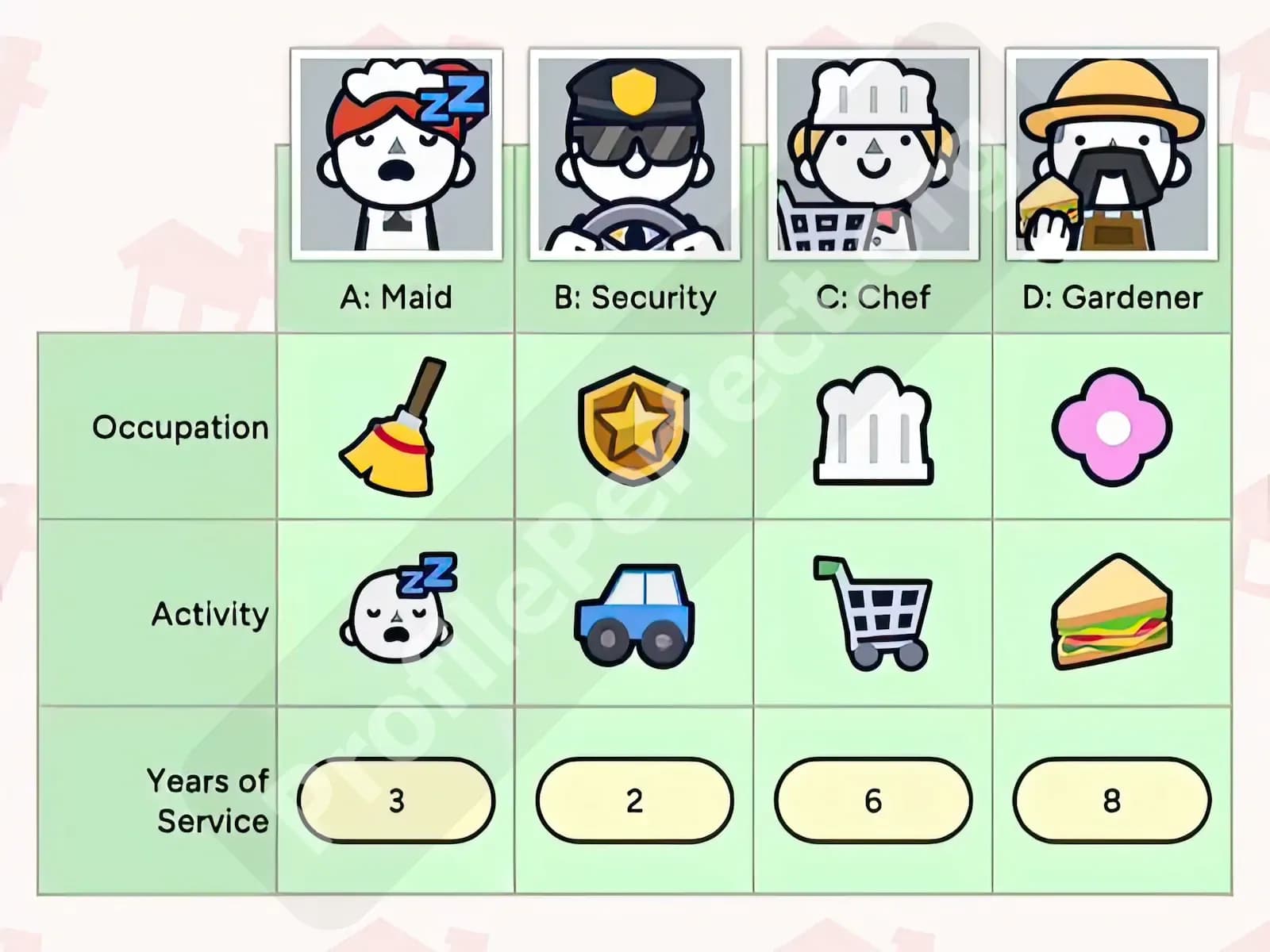
In Level 7, “Person A is the Maid” and “the one going Shopping is Chef” are the first clean matches. Person C is already shopping, so Person C becomes Chef. That one anchor creates a combo: Chef has worked 6 years, which means Person C also gets 6 years of service. That’s the kind of chain reaction you want.
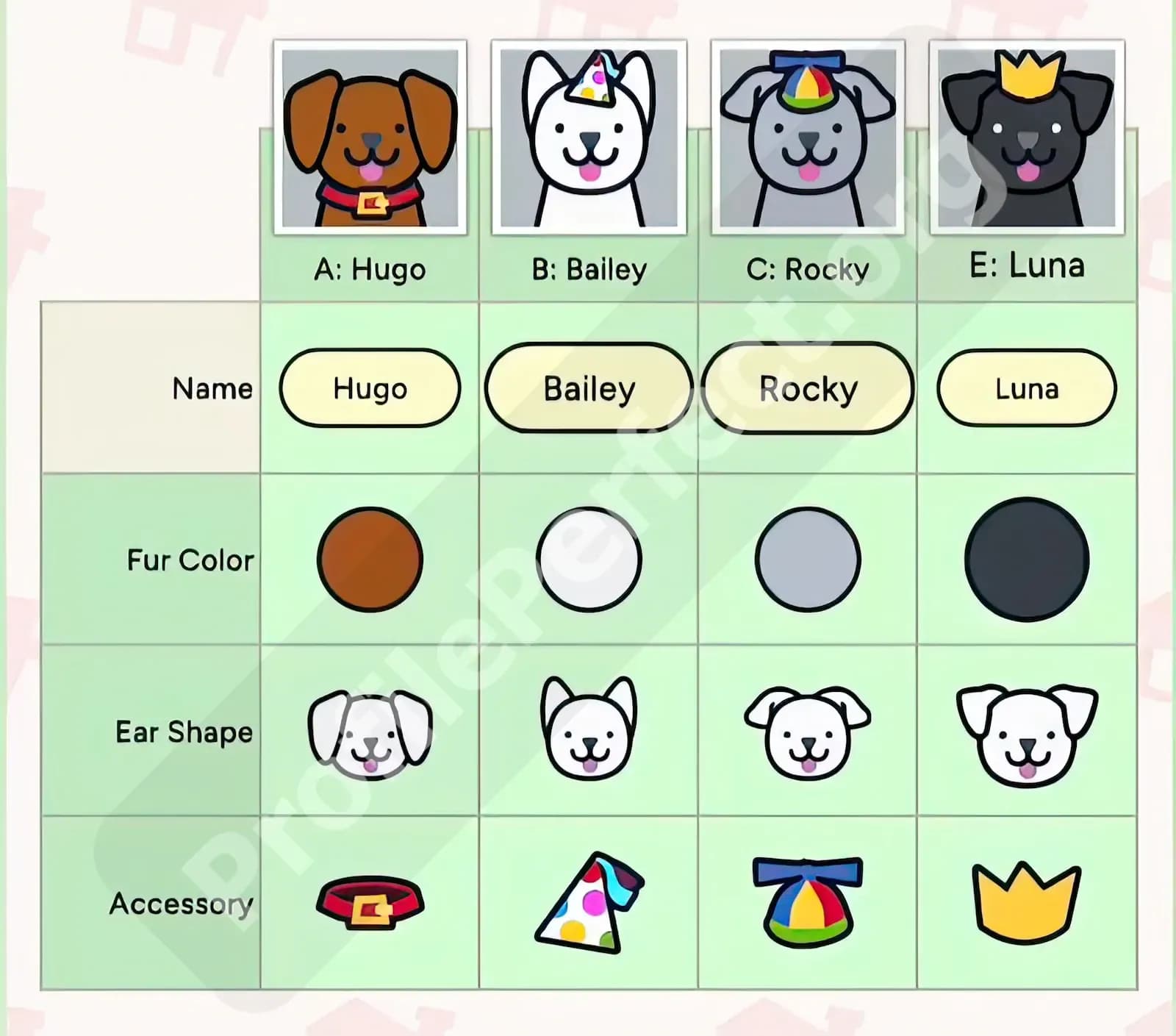
In Level 8, Dog B has White fur, Dog D has Button ears, Dog D has Black fur, the leftmost dog wears a Collar, and the White dog is Bailey. These are not all equally simple, but several are strong openers. Once you place them, the later clues about hats, ears, and names stop being a swamp.
By Levels 10–20, Profile Perfect starts mixing direct matches with position-based facts. Don’t let that throw you. A direct position clue is still a direct clue.
Level 14 says the middle forecast is for Los Angeles, Forecast A is Raining, and Forecast C has the strongest wind. Those are opening anchors. Once they’re in, Chicago’s Thunderstorm and New York’s slowest wind have somewhere to land.
Level 16 says Building B is a place to buy groceries. That means Supermarket. It also says Building A has a No Photos sign, and the rightmost building has No Smoking. These are direct placements. After that, the Son, Dad, Hospital, and Mom clues become easier to connect.
Level 20 is a great bigger-grid example. Bus B goes to Manchester. The Manchester bus has a Zigzag pattern. The Manchester ticket is the most expensive. That means one direct destination clue gives you three useful anchors for Bus B. The middle bus has Wi-Fi, Bus E has Geometric pattern, and the leftmost bus has a Bike Rack. Fill those first before touching cheaper-than or left-of clues.
This is the opening move in its strongest form: find one confirmed match, then immediately attach every other clue that references that match.
When I start a Profile Perfect level, I use this order:
The biggest mistake is treating the first clue as the first move. Sometimes it is. Sometimes it isn’t. The real first move is the safest confirmed match you can find anywhere in the clue list.
Profile Perfect is at its best when the logic loop feels clean: clue, checkmark, elimination, chain reaction. The fastest players aren’t faster because they guess better. They’re faster because they don’t guess at all. They build anchor points early, then let the level shrink around them.
So the next time you open a new Profile Perfect level, don’t chase the hardest clue. Don’t start with “next to,” “between,” “not beside,” or “cheaper than.” Start with the obvious stuff: A is B. Dog C is Pomeranian. Room B is Kitchen. Bus B is Manchester.
That simple opening move turns the whole puzzle from a cluttered grid into a solvable path. It’s not flashy, but it’s rock-solid—and in a two-life logic game, rock-solid is exactly what wins.