
Learn the Profile Perfect row-reduction rule with clear Level 2, 4, 5, and 11 examples, so you can solve rows faster without wasting lives or guesses.


Guide By Liam Stone
Published on June 10, 2026
Liam Stone has played Profile Perfect since the app first launched on the Apple App Store. He spotted its potential early, and that early bet turned into hundreds of hours spent solving levels, testing clue logic, and documenting answers for other players. Liam runs the YouTube channel Puzzle Game Answer where his puzzle walkthroughs have earned over 935,000 views and a growing community of more than 800 subscribers. He covers a wide range of mobile puzzle games beyond Profile Perfect, giving him firsthand experience with how these games design clues, structure levels, and trip up even experienced players. Every guide on this site reflects that hands on experience. Liam plays each level himself, verifies every answer against the in game grid, and rewrites confusing clues into plain language so you don't need to guess. If you want more of his walkthroughs, subscribe to his channel.
Loading calendar...
There’s a moment in Profile Perfect when the whole level suddenly clicks. You’re staring at a row, two answers are already locked in, and the final blank cell stops feeling like a mystery. It’s not a guess anymore. It’s the only thing left.
That’s the Row-Reduction Rule, and honestly, it’s one of the most useful skills you can learn if you want to clear Profile Perfect levels faster.
Profile Perfect looks simple at first: a few subjects across the top, a few trait groups down the side, and a stack of clues telling you who owns what, who sits where, which object belongs to which profile, or which detail matches which character. But the game has teeth. You usually don’t get unlimited mistakes, and wrong taps can tank a run fast. So the smart play isn’t to brute-force the grid. The smart play is to reduce each row until the final answer becomes obvious.
This is a crunchy logic-grid skill. It feels mechanical, but in the best way. Once you learn it, you’ll start seeing free answers everywhere.
The Row-Reduction Rule is simple:
When every value in a trait group must be used once, and all but one value has already been placed, the final unsolved cell must take the final unused value.
In plain English: if a row has three possible names and you already know two of them, the third name has nowhere else to go.
Let’s say a level has three dogs: Dog A, Dog B, and Dog C. Their names are Leo, Domino, and Milo. If Dog A is Leo and Dog B is Domino, then Dog C has to be Milo. You don’t need another clue that says “Dog C is Milo.” The row itself gives you the answer.
That’s the magic. Profile Perfect often gives direct clues first, then expects you to finish the grid through elimination. New players sometimes wait for one more clue. Experienced players squeeze the row.
Profile Perfect isn’t just about reading clues. It’s about knowing when a clue has already done enough work.
A lot of players lose lives because they treat every empty cell as equally unknown. That’s a trap. Some empty cells are genuinely unsolved, but others are already solved by the structure of the row. The game’s grid is mutually exclusive: one subject can’t take every value, and the same value usually won’t belong to multiple subjects in the same trait group.
That means every confirmed answer narrows the remaining options.
I like to think of each row as a shrinking suspect list. At the start, everyone is possible. After one clue, the list gets smaller. After two clues, the final answer is basically standing there waving at you.
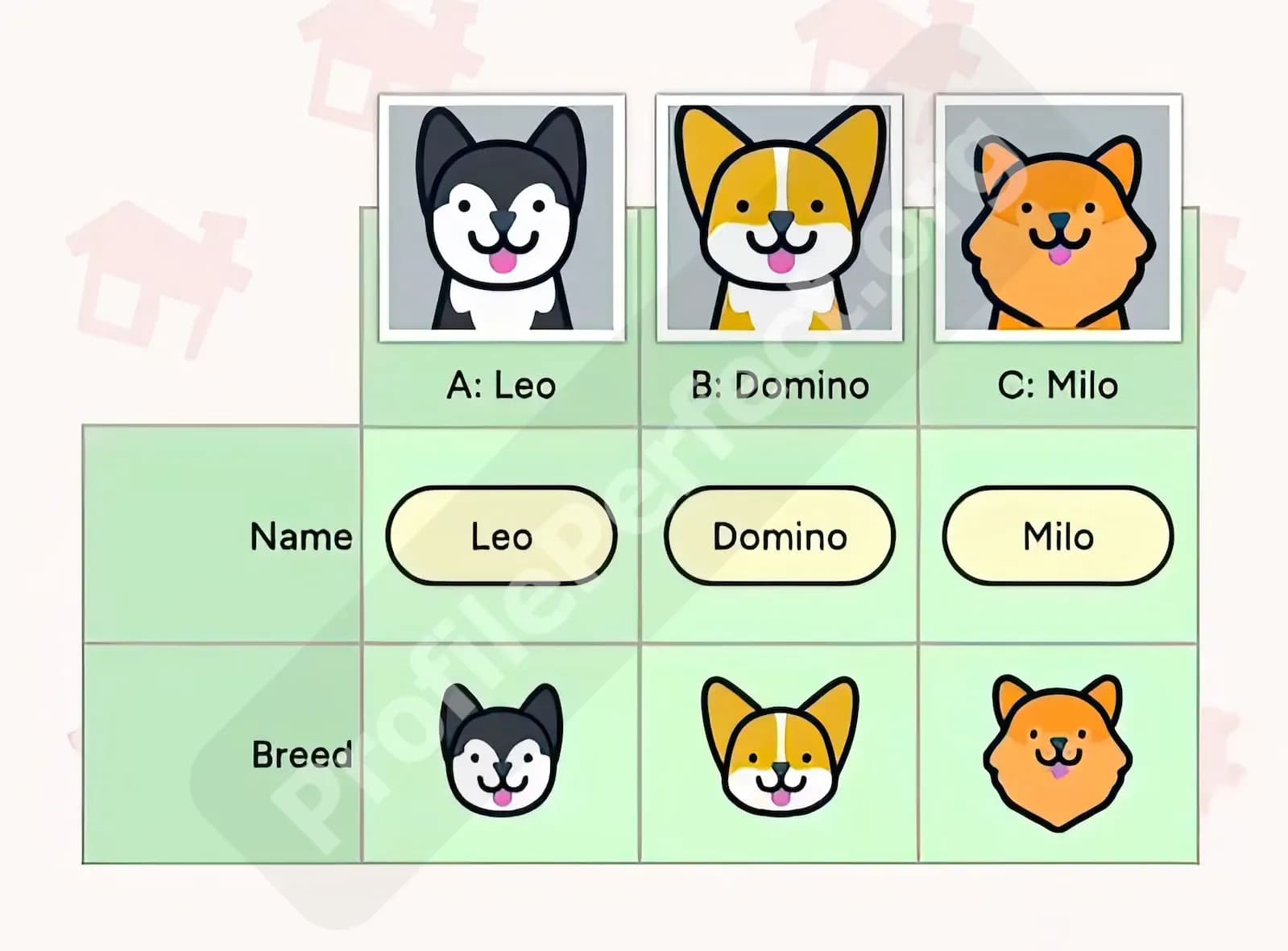
Level 2 is a clean early example because it teaches row-reduction without burying you in too many categories.
The subjects are Dog A, Dog B, and Dog C. The main trait groups are Name and Breed.
The solved grid is:
| Subject | Name | Breed |
|---|---|---|
| Dog A | Leo | Siberian Husky |
| Dog B | Domino | Corgi |
| Dog C | Milo | Pomeranian |
The level gives you several direct anchors. Dog B has a tag that reads “Domino,” so Dog B’s name is Domino. Dog C is a Pomeranian. Dog A is the black and white dog, which points to Siberian Husky. Then another clue says the Husky is called Leo.
At this point, don’t overthink it. In the Name row, Dog A is Leo and Dog B is Domino. The only name left is Milo, so Dog C must be Milo.
That is row-reduction doing work.
The same idea helps with Breed. Dog A is Siberian Husky. Dog C is Pomeranian. The only remaining breed is Corgi, so Dog B must be Corgi.
What’s important here is that the game doesn’t need to hand you a direct “Dog B is a Corgi” clue. The row already proves it. That’s the loop you want to build into your solving habit: place anchors, scan the row, claim the leftover.
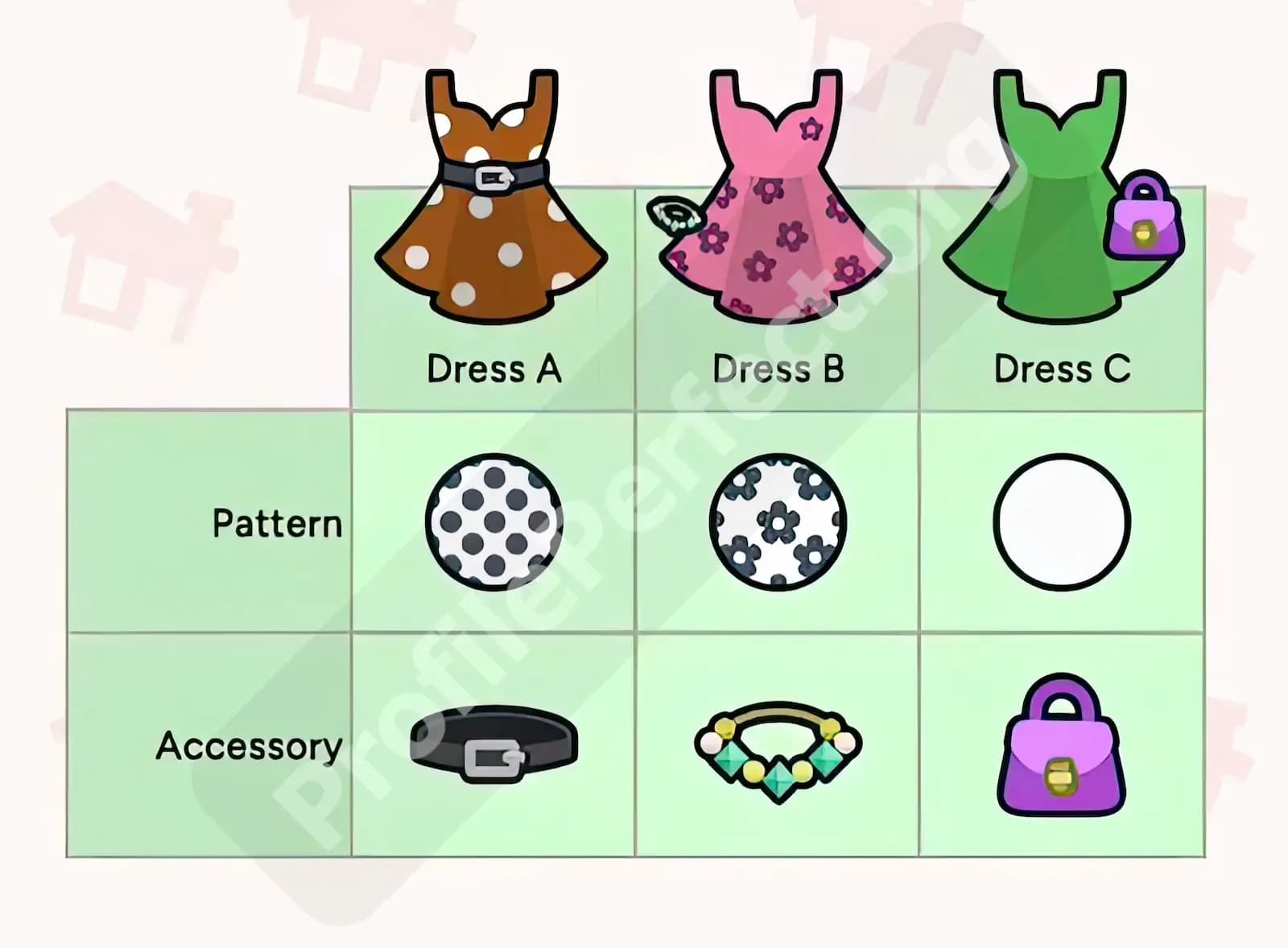
Level 4 uses dresses instead of dogs, but the logic is the same. The subjects are Dress A, Dress B, and Dress C. The trait groups are Pattern and Accessory.
The solved grid is:
| Subject | Pattern | Accessory |
|---|---|---|
| Dress A | Polkadot | Belt |
| Dress B | Floral | Bracelet |
| Dress C | Solid | Handbag |
The rightmost dress has a Handbag, so Dress C gets Handbag. Dress A has a Polkadot pattern. Then the clue says the Solid patterned dress pairs with a Handbag. Since Dress C already has the Handbag, Dress C must be Solid.
Now look at the Pattern row. Dress A is Polkadot. Dress C is Solid. The only pattern left is Floral, so Dress B must be Floral.
That’s row-reduction again.
Then comes the accessory row. Dress C has Handbag. Another clue says the Floral dress is not paired with a Belt. Since Dress B is Floral, Dress B can’t be Belt. With Handbag already taken by Dress C, Dress B must be Bracelet. That leaves Belt for Dress A.
This is where the rule starts to feel a bit more powerful. You’re not just filling a final blank because two cells are done. You’re combining a negative clue with row-reduction. “Not Belt” doesn’t directly say Bracelet, but when Handbag is already taken, Bracelet becomes the only legal answer.
That’s a banger deduction because it saves a life and keeps the level moving.
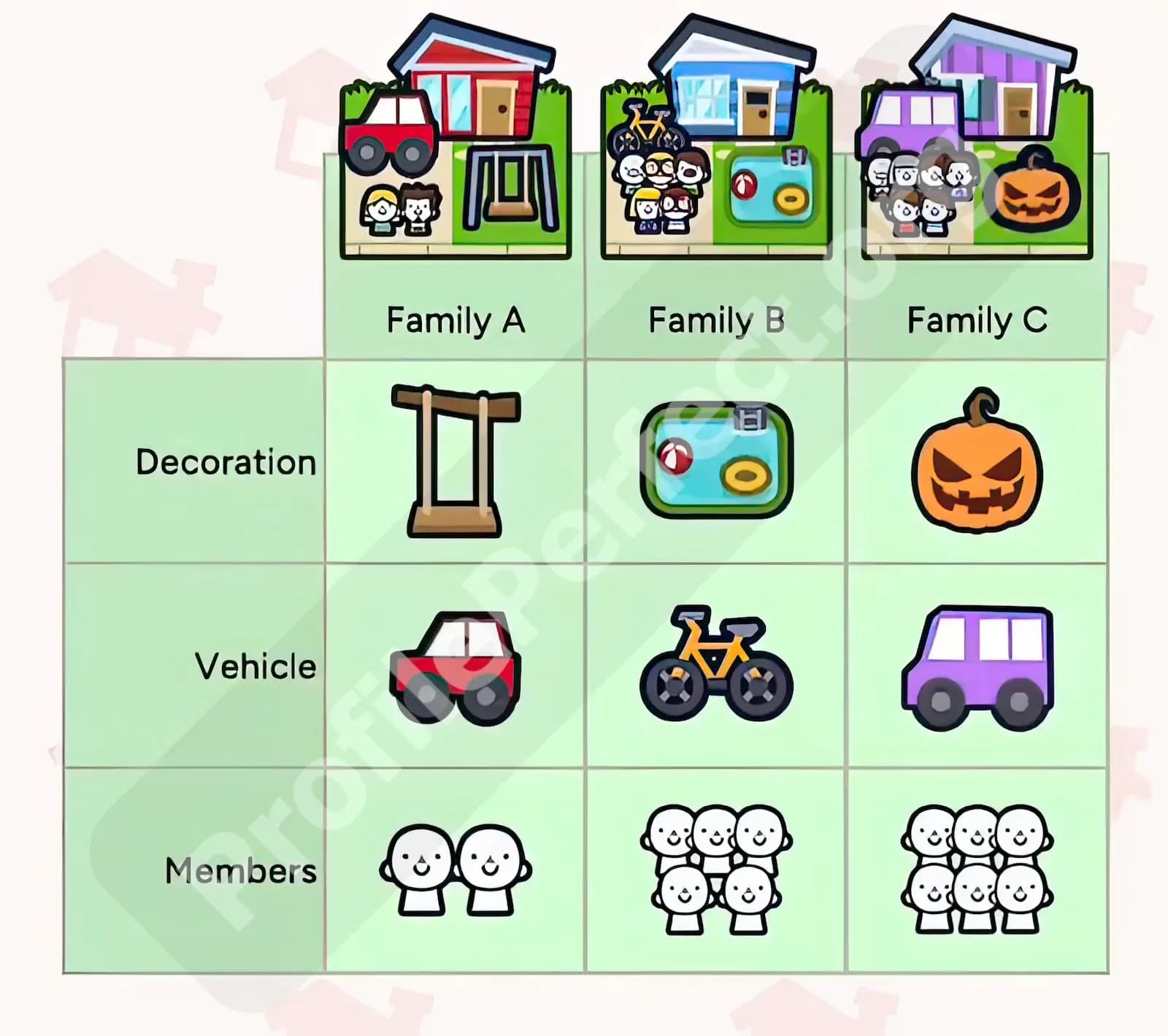
Level 5 adds more weight. The subjects are Family A, Family B, and Family C. The trait groups are Decoration, Vehicle, and Members.
The solved grid is:
| Subject | Decoration | Vehicle | Members |
|---|---|---|---|
| Family A | Swings | Red Car | 2 |
| Family B | Pool | Bicycle | 5 |
| Family C | Pumpkin | Purple Minivan | 6 |
This level has several strong anchors. Family C has the Purple Minivan and 6 members. Family A has the Red Car. The Red Car belongs to the family of 2, so Family A has 2 members.
Now reduce the Members row. Family A has 2. Family C has 6. The only remaining number is 5, so Family B has 5 members.
Then the clue says the family with the Bicycle has a Pool. Since Family A has Red Car and Family C has Purple Minivan, the remaining vehicle is Bicycle. So Family B gets Bicycle, and then Family B gets Pool.
Now the Decoration row starts to collapse. Family B has Pool. The Halloween decoration is on the right of the Pool, so Family C gets Pumpkin. That leaves Swings for Family A.
Notice how fast this level opens once you stop waiting for direct confirmations. The clues give you hooks, but row-reduction finishes the job. This is exactly how you should play Profile Perfect: every time you place a value, check whether that placement has solved another row for free.
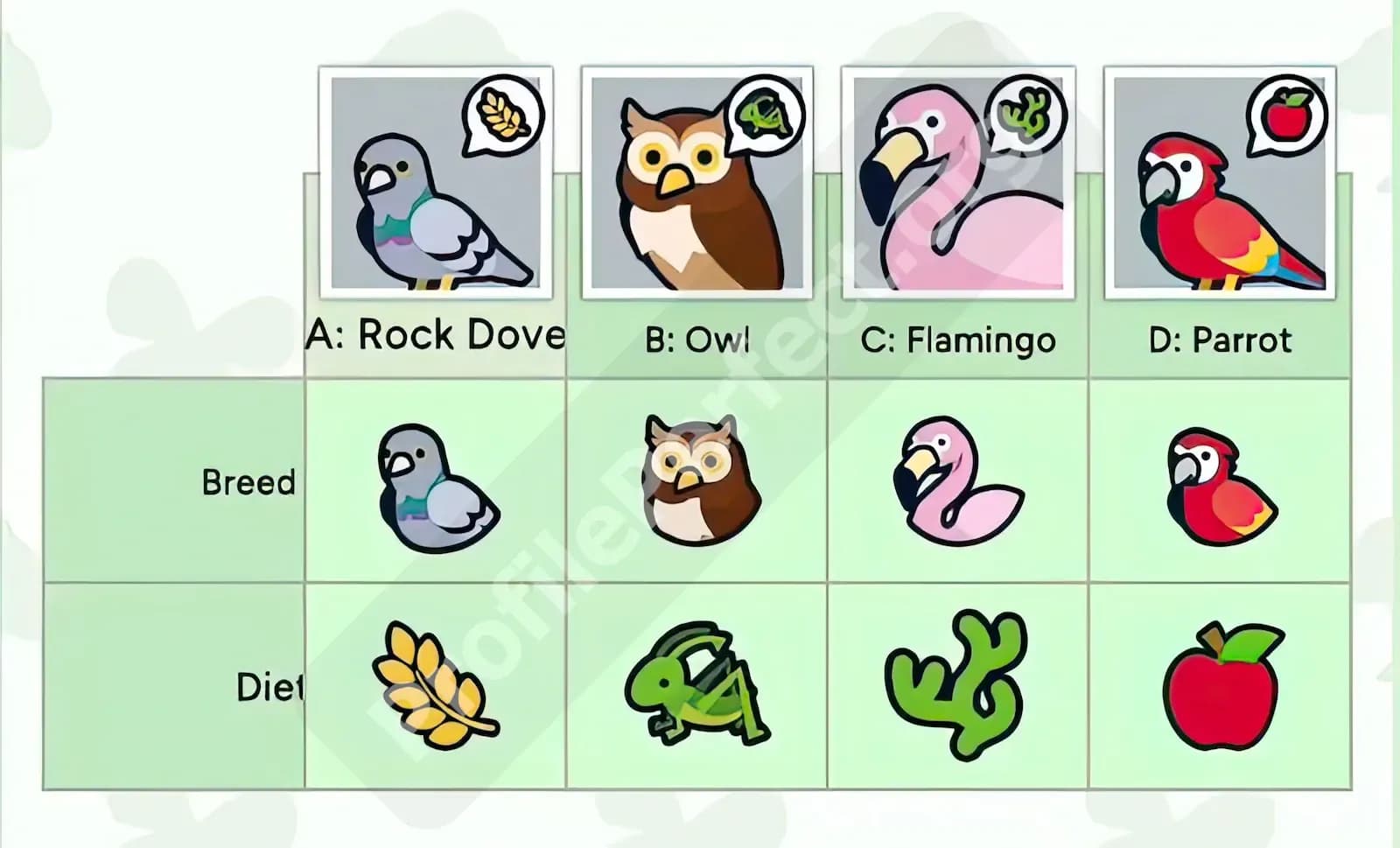
Level 11 is where the Row-Reduction Rule starts feeling even better because the grid has four subjects instead of three: Bird A, Bird B, Bird C, and Bird D. The trait groups are Breed and Diet.
The solved grid is:
| Subject | Breed | Diet |
|---|---|---|
| Bird A | Rock Dove | Grains |
| Bird B | Owl | Insect |
| Bird C | Flamingo | Algae |
| Bird D | Parrot | Fruit |
You’re told Bird D is a Parrot, and Parrot loves Fruit. So Bird D gets both Parrot and Fruit. The second bird eats Insect, so Bird B gets Insect. The bird next to Parrot has pink feathers, which points to Flamingo. Since Bird D is the Parrot, Bird C is Flamingo. Flamingo eats Algae, so Bird C gets Algae.
Now look at the Diet row. Bird B has Insect. Bird C has Algae. Bird D has Fruit. The only diet left is Grains, so Bird A must eat Grains.
That final diet doesn’t need a direct clue. It’s the last legal value.
Then the breed row finishes in the same style. Bird D is Parrot. Bird C is Flamingo. The Insect-eating bird is nocturnal, so Bird B is Owl. The only breed left for Bird A is Rock Dove.
Four-subject rows can look more intimidating, but they actually make row-reduction more satisfying. Once three answers are placed, the fourth is a freebie. The mistake is staring at the remaining cell like it’s still unknown. It isn’t. The row has spoken.
Here’s the habit I recommend: after every clue, pause and scan the full trait group.
Don’t just ask, “What did this clue solve?” Ask, “What did this clue leave behind?”
That second question is where faster solves come from.
For example:
You’re looking for rows with only one empty slot or only one unused value. Those are your safest taps.
The biggest beginner mistake is using row-reduction too early.
You can’t reduce a row until you know the option pool. If a trait group has three possible values, you need to know which values are already locked and which values are still available. Don’t assume “leftover” based on vibes. That’s how a clean run turns into a restart.
Also, be careful with clues that describe a value indirectly. In Profile Perfect, “black and white dog” can mean Siberian Husky. “Nocturnal bird” can mean Owl. “Halloween decoration” can mean Pumpkin. These clues are still valid anchors, but you need to translate them correctly before reducing the row.
When in doubt, slow down. Profile Perfect doesn’t reward panic tapping. It rewards controlled deduction.
Use this loop for almost any Profile Perfect level:
That loop sounds basic, but it’s rock-solid. It turns the game from “Where do I tap next?” into a clean deduction chain.
The Row-Reduction Rule is one of those Profile Perfect skills that feels small until you start using it every level. Then it becomes part of your muscle memory. You place a direct clue, scan the row, spot the missing value, and suddenly the puzzle has less fog on it.
Levels 2, 4, 5, and 11 all teach the same lesson with different skins: dogs, dresses, families, birds. The theme changes, but the logic stays consistent. Once all but one value in a row is solved, the final answer isn’t a gamble. It’s the only move left.
That’s the difference between playing Profile Perfect casually and playing it cleanly. Don’t guess. Reduce the row, trust the grid, and let the final answer reveal itself.