
Learn how to solve Profile Perfect number clues faster with highest, lowest, older, younger, deeper, score-order, and price comparison logic for hard levels.


Guide By Liam Stone
Published on June 10, 2026
Liam Stone has played Profile Perfect since the app first launched on the Apple App Store. He spotted its potential early, and that early bet turned into hundreds of hours spent solving levels, testing clue logic, and documenting answers for other players. Liam runs the YouTube channel Puzzle Game Answer where his puzzle walkthroughs have earned over 935,000 views and a growing community of more than 800 subscribers. He covers a wide range of mobile puzzle games beyond Profile Perfect, giving him firsthand experience with how these games design clues, structure levels, and trip up even experienced players. Every guide on this site reflects that hands on experience. Liam plays each level himself, verifies every answer against the in game grid, and rewrites confusing clues into plain language so you don't need to guess. If you want more of his walkthroughs, subscribe to his channel.
Loading calendar...
Numeric clues in Profile Perfect look harmless until they start chaining together. One clue says someone is the oldest. Another says someone is 10 years younger. A third says the cheapest item sits two columns away from a brand. Suddenly, the puzzle stops feeling like a cute profile-matching game and starts feeling like a tiny math boss fight.
I actually like these clues, though. They’re crunchy in the best way. Price, age, score, queue length, depth, and other number-based rows give Profile Perfect a tighter deduction loop than simple “this person owns this pet” clues. The trick is not to treat numbers as random values. Treat them as an ordered ladder.
Once you build that ladder, the whole level starts to snap into place.
The biggest mistake players make with numeric clues is tapping too early. Profile Perfect usually gives you only a small error allowance, so guessing a number row is a fast way to tank a clean run.
Before touching the grid, sort every numeric clue into one of four types:
That last group is where the game gets spicy. Numeric clues rarely live alone. They connect to names, positions, colors, scents, pets, brands, and accessories. Your job is to lock the number row into the rest of the grid instead of solving it in isolation.
Age clues are the cleanest place to learn numeric deduction in Profile Perfect. Level 36 is a perfect example because it gives you several age anchors at once.
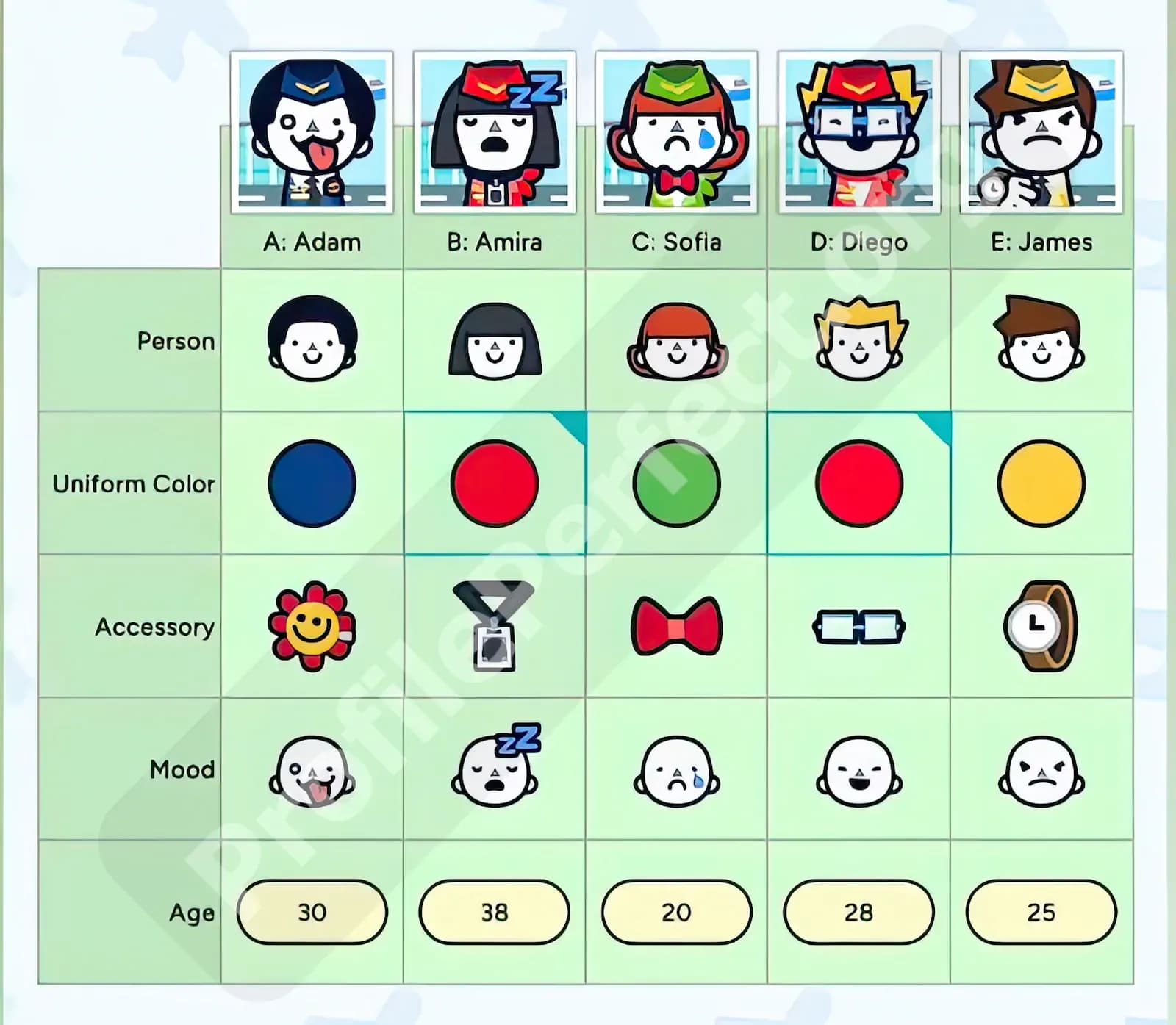
In Level 36, Attendant B is the oldest at 38. Then another clue says Diego is 10 years younger than Amira. Since Amira is Attendant B, Diego must be 28. The youngest attendant wears Green, which locks Attendant C at 20. Another clue gives the 25-year-old a Watch and an Angry mood, which places that bundle on Attendant E. Once those are in, the remaining age, 30, belongs to Attendant A.
That’s the clean loop: oldest, younger by 10, youngest, direct value, leftover.
The important thing is that “oldest” and “youngest” are not just labels. They are limits. If someone is the oldest, no other person can be above that value. If someone is the youngest, no other person can be below it. Every comparison clue should respect those boundaries.
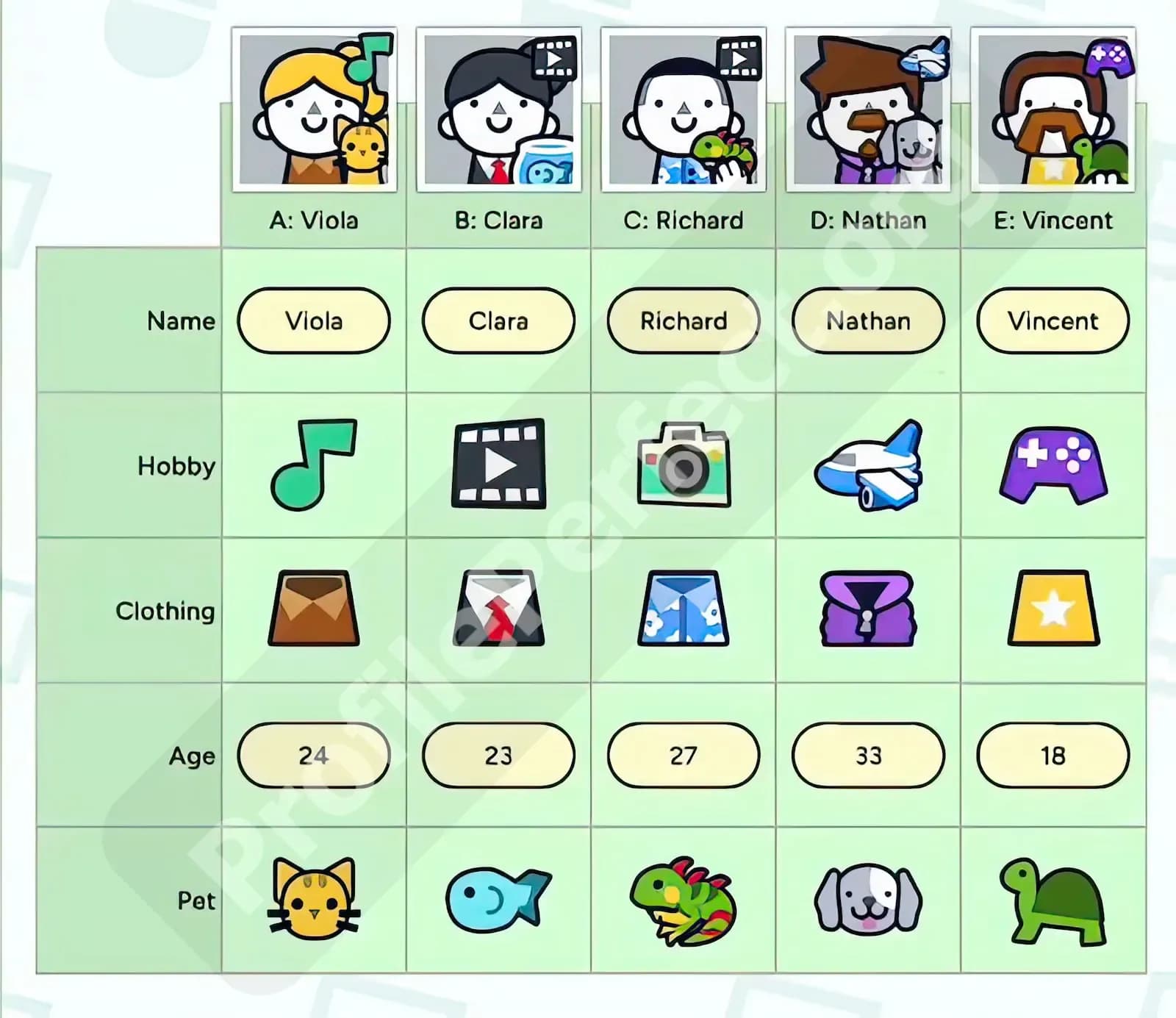
Level 67 pushes this further. Nathan is the oldest and 10 years older than Employee B, so Nathan becomes 33 and Employee B becomes 23. The youngest and oldest employees are neighbors, which places the 18-year-old beside Nathan. Then the age gap between Viola and Richard is 3 years, giving Viola 24 and Richard 27. The “second youngest” clue points to Employee B at 23, and the Iguana sits to her right.
Notice how the number row doesn’t just solve ages. It solves pets, hobbies, clothing, and positions. That’s why numeric clues are so powerful. They’re not side details. They’re the skeleton of the puzzle.
A common Profile Perfect trap is reading comparison clues emotionally instead of mathematically. “The wolf tamer is slightly younger than Mira” in Level 86 sounds like flavor text, but it’s really an equation.
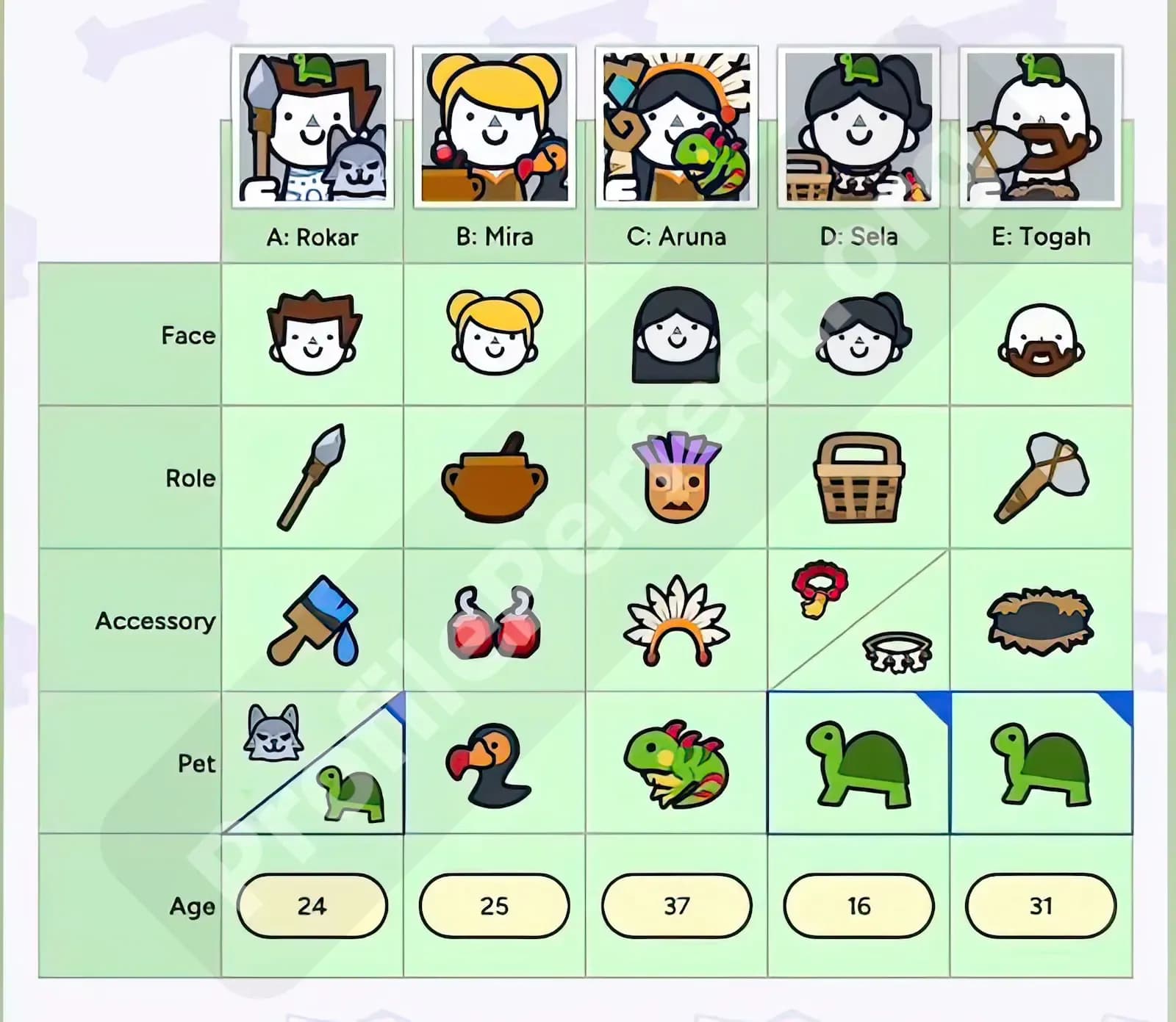
Mira is 25. The wolf tamer is Person A. Slightly younger means Person A is 24. That clue then supports another clue: the Fur Belt is farthest from the 24-year-old person, which sends the Fur Belt to the far-right slot. From there, the grid starts opening up.
Level 86 also uses “eldest” as a hard ceiling. Aruna is the eldest at 37. Sela’s Necklace wearer is younger than Togah, placing Sela at 16 and Togah at 31. Once you order the ages as 16, 24, 25, 31, and 37, the remaining traits become much easier to place.
My rule: whenever I see “older,” “younger,” “eldest,” or “youngest,” I stop and write the age ladder mentally before solving anything else.
Not every numeric row is called “Age” or “Price.” Profile Perfect often hides number logic inside rows like Queue Length, Hole Depth, score, rank, or distance. Don’t let the label fool you. The deduction is the same.
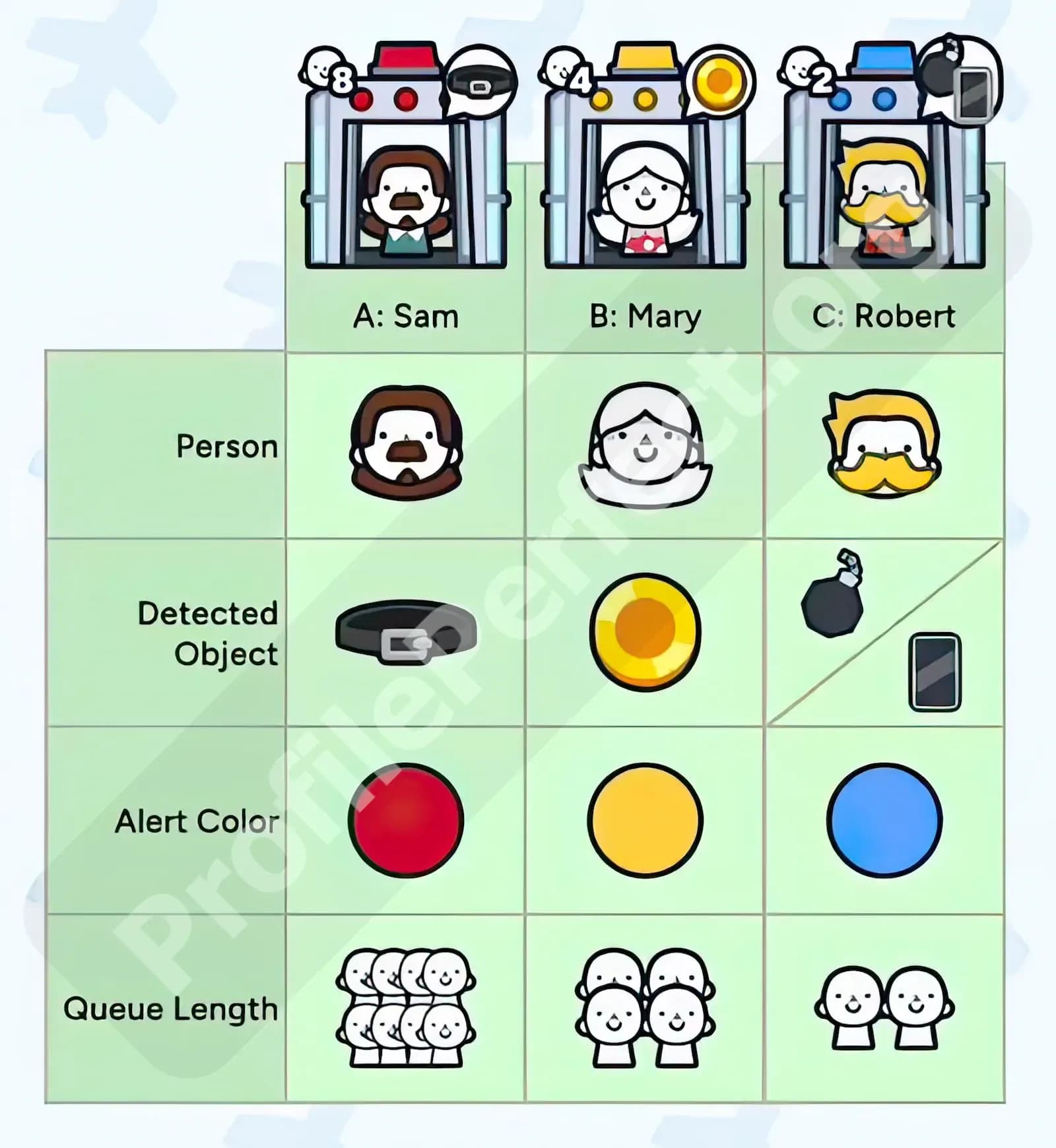
Level 37 uses Queue Length. Scanner A has the longest queue, so it gets 8. Scanner C scans faster than Scanner B, which means Scanner C has the shorter queue. With the solved row, Scanner B is 4 and Scanner C is 2. “Faster” is not a number word, but it implies a smaller queue. That’s the key translation.
This is where Profile Perfect can feel a little floaty if you read too fast. “Faster,” “deeper,” “higher,” “lower,” “more expensive,” and “half as much” all need to be converted into number direction.

Level 72 does this with Hole Depth. The Rabbit’s burrow is deeper than the Mole’s, so Rabbit beats Mole. The Chipmunk digs deeper than Rabbit, and the combined depth is more than 20 m. With Mole at 6 and Rabbit at 10, the Chipmunk lands at 14. The final order is Mole 6, Rabbit 10, Chipmunk 14.
If this row were a score row, the logic would be identical. Highest score beats the others. Lowest score becomes the floor. “More than,” “less than,” and “two points higher” all become ranking clues first and exact values second.
Price clues in Profile Perfect often use symbols instead of digits, but don’t overthink it. One dollar sign is 1. Five dollar signs is 5. That’s your ladder.
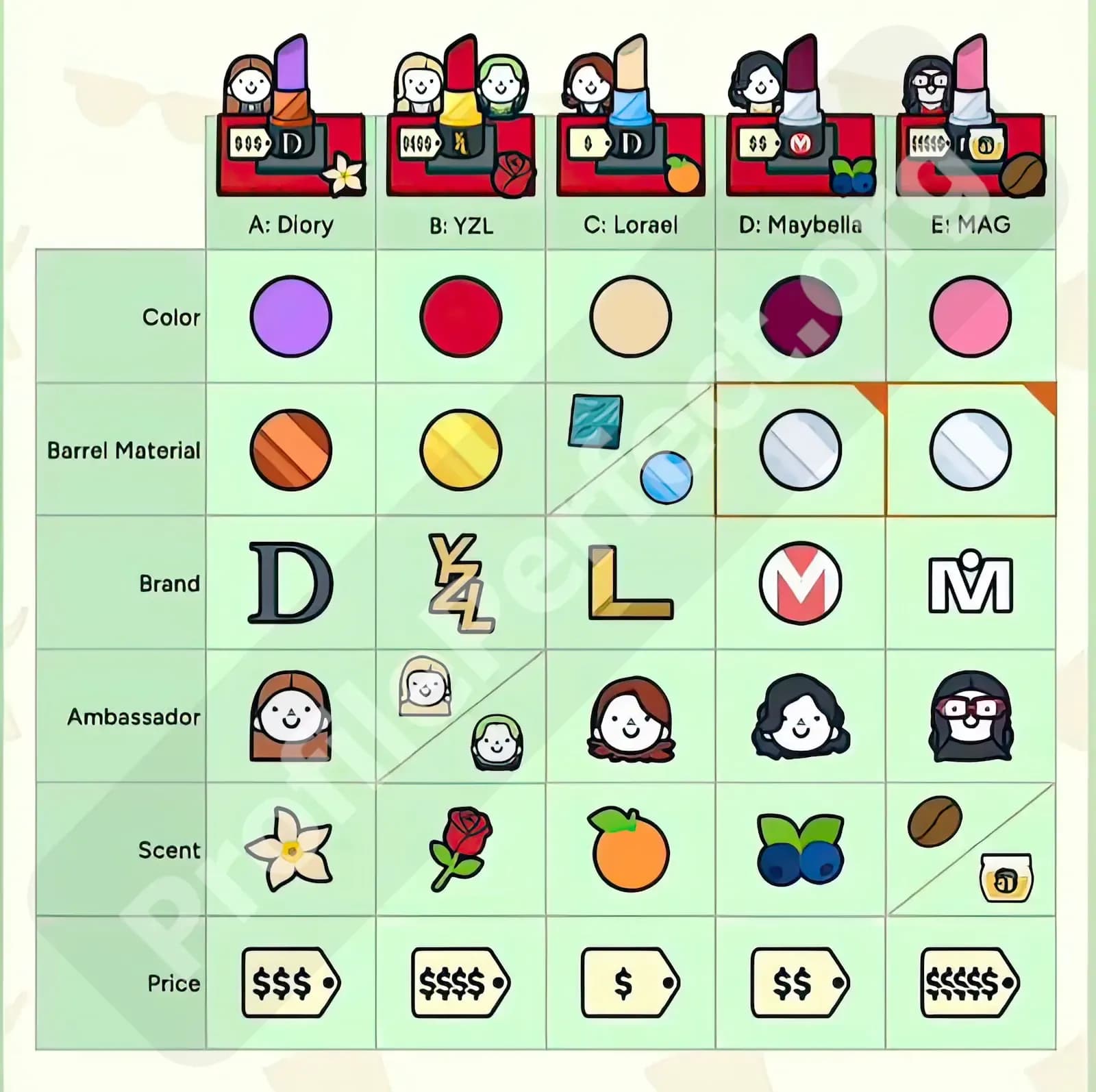
Level 96 is a banger example because the price row connects to brands, scents, colors, ambassadors, and barrel materials. The cheapest lipstick is Lipstick C, so C is $. MAG is two columns away from the cheapest lipstick, placing MAG at Lipstick E. Eilish’s lipstick is more expensive than its neighbors, which makes Lipstick B $$$$, while Lipstick A is $$$ and Lipstick C stays $. Another clue says there’s a lipstick that costs half as much as Lipstick B, so Lipstick D becomes $$. The remaining highest price, $$$$$, goes to Lipstick E.
The big lesson: price clues are rarely about money. They’re about order. Cheapest, most expensive, half as much, more expensive than neighbors — these all create a ladder from low to high.
I like to translate it like this:
$ = 1 $$ = 2 $$$ = 3 $$$$ = 4 $$$$$ = 5
Once you do that, Level 96 stops being a messy lipstick grid and becomes a clean ranking puzzle.
Numeric clues become even stronger when they mention columns. Profile Perfect loves phrases like “next to,” “two columns away,” “farthest from,” “left of,” and “right of.” These clues let you test whether your number ladder actually fits the board.
For example, in Level 36, the Dark Blue uniform is farthest from the Yellow one, placing them at opposite ends. That helps separate Attendant A and Attendant E. In Level 86, the Fur Belt is farthest from the 24-year-old person, so once 24 is locked on Person A, the Fur Belt jumps to Person E. In Level 96, MAG being two columns away from the cheapest lipstick turns a price clue into a brand placement.
This is why I never solve number rows as pure math. I solve them as map clues. Every number should point somewhere on the board.
Here’s the loop I use when a Profile Perfect level starts throwing ages, prices, scores, and measurements at me:
First, mark direct values. If the clue says Mira is 25 or the cheapest lipstick is C, that’s an anchor.
Second, create the ladder. Put values in order from lowest to highest, youngest to oldest, cheapest to most expensive, or shortest to longest.
Third, translate comparison language. “Older than,” “more expensive than,” “deeper than,” and “higher score than” all push a subject upward. “Younger,” “cheaper,” “faster queue,” and “lower score” push downward.
Fourth, connect numbers to positions. If a clue says the number is next to, farthest from, or two columns away from something, don’t tap until the position makes sense.
Fifth, let leftovers finish the row. Profile Perfect often gives you four numbers in a five-subject puzzle and expects the final number to fall into place. Don’t waste a life proving the obvious.
Numeric clues are some of the best clues in Profile Perfect because they reward disciplined thinking. They look intimidating, but they’re usually more reliable than vague flavor clues. Ages tell you hierarchy. Prices tell you value order. Scores tell you rank. Depths, queues, and measurements tell you direction.
The moment I stopped treating number rows as “extra information,” the game became much smoother. Levels like 36, 37, 67, 72, 86, and 96 all prove the same point: when Profile Perfect gives you numbers, it’s handing you the backbone of the puzzle.
Build the ladder first. Tap later. That one habit will save more lives than any booster.