
Learn how to solve Profile Perfect negative clues without wasting lives. Use Not and Doesn’t clues to eliminate bad options in Levels 4, 6, 7, 8, and 10.


Guide By Liam Stone
Published on June 10, 2026
Liam Stone has played Profile Perfect since the app first launched on the Apple App Store. He spotted its potential early, and that early bet turned into hundreds of hours spent solving levels, testing clue logic, and documenting answers for other players. Liam runs the YouTube channel Puzzle Game Answer where his puzzle walkthroughs have earned over 935,000 views and a growing community of more than 800 subscribers. He covers a wide range of mobile puzzle games beyond Profile Perfect, giving him firsthand experience with how these games design clues, structure levels, and trip up even experienced players. Every guide on this site reflects that hands on experience. Liam plays each level himself, verifies every answer against the in game grid, and rewrites confusing clues into plain language so you don't need to guess. If you want more of his walkthroughs, subscribe to his channel.
Loading calendar...
Negative clues are where Profile Perfect quietly starts playing hardball.
At first, a clue like “Dress A has Polkadot pattern” feels clean. You read it, tap the right cell, and move on. Easy. But then the game drops something like “Floral dress is not paired with a Belt,” and suddenly the vibe changes. That clue doesn’t give you a shiny checkmark right away. It gives you a wall. It tells you where something cannot go.
And honestly? That’s where a lot of players burn lives.
In Profile Perfect, negative clues are not filler. They’re one of the game’s core logic tools. “Not,” “does not,” “without,” and “not next to” clues appear constantly, especially once the levels expand past simple two-column setups. If you treat them like direct answer clues, you’ll guess too early. If you treat them like elimination clues, they become banger shortcuts.
The rule is simple: negative clues should usually create X marks in your head before they create checkmarks on the grid.
Profile Perfect is a logic-grid puzzle game dressed up like a slick investigation game. Each level gives you subjects, traits, and clues. Your job is to match each subject with the correct values. The trick is that every row or trait group has a mutually exclusive answer set. If one dress has the Belt, the other dresses don’t. If one trap is Bamboo, the others aren’t.
That’s why negative clues hit so hard. They don’t always tell you the answer directly, but they shrink the board. They nerf bad choices until only one safe option remains.
The mistake beginners make is reading a negative clue and immediately trying to “solve” it with a tap. Don’t. A clue that says “X is not Y” does not automatically mean “X is Z” unless every other option has already been eliminated.
Think of negative clues as safety rails. They keep you from driving into a bad answer.
When you see a negative clue, rewrite it in your head like this:
“X is not Y” becomes “X cannot be Y.”
That sounds tiny, but it changes how you play. You stop hunting for a direct answer and start crossing off bad links.
For example, in Level 4, the key negative clue is:
“Floral dress is not paired with a Belt.”
By itself, this does not tell you the Floral dress has a Bracelet. Not yet. It only tells you:
Floral ≠ Belt.
That’s it. That’s the whole clue. But when you combine it with the rest of the level, it becomes powerful.
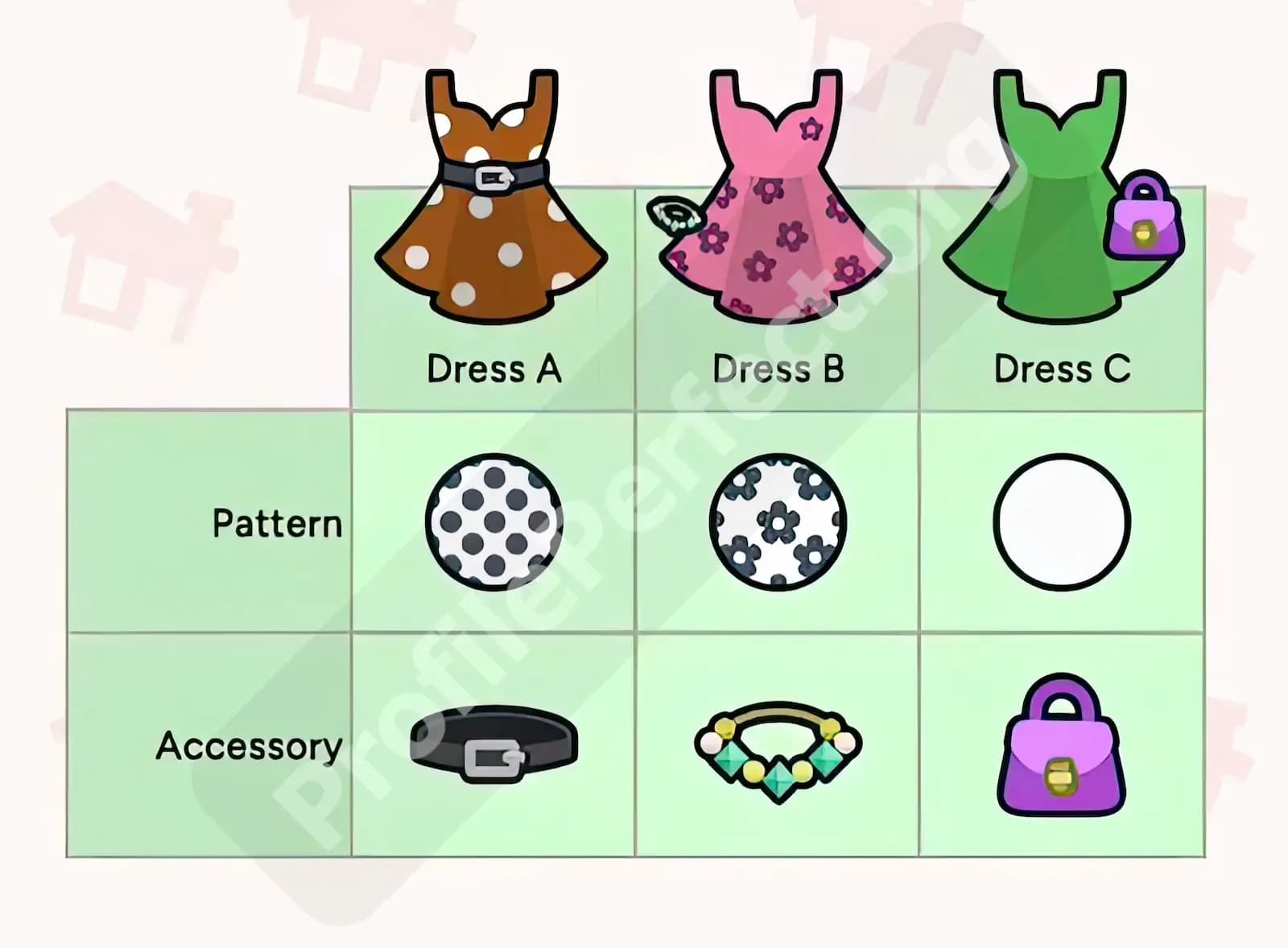
Level 4 has three dresses: Dress A, Dress B, and Dress C. Dress C has the Handbag. Dress A has the Polkadot pattern. The Solid dress pairs with the Handbag, so Dress C is Solid. Then the Floral dress is next to the Polkadot dress, which places Floral on Dress B.
Now the negative clue matters. Dress B is Floral, and Floral is not Belt. Dress C already has Handbag. So Dress B must have Bracelet, leaving Belt for Dress A.
That’s the clean Profile Perfect loop: anchor first, eliminate second, confirm third.
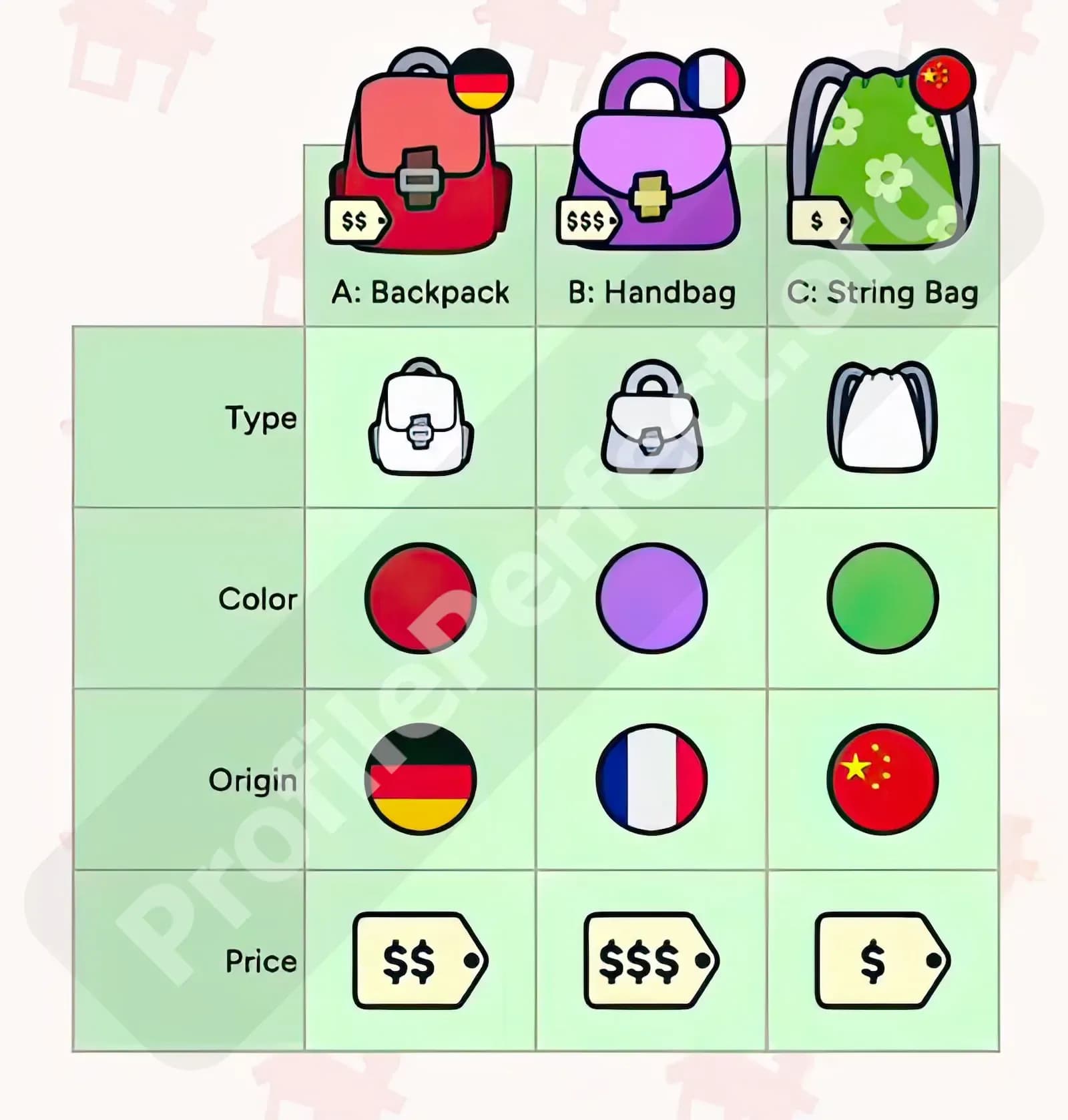
Level 6 is a nice crunchy example because it uses two negative-style clues around bags:
“The String Bag does not originate from German.”
“Bag from France is not colored Red.”
This level has Bag A, Bag B, and Bag C. Bag A is from Germany and has Medium price. Bag B starts as the Handbag. Bag C is cheaper than the German bag, which pushes Bag C toward Low price. The cheapest bag is Green, so Bag C becomes Green.
Now look at the String Bag clue. Since Bag A is German, the String Bag cannot be Bag A. Since Bag B is already the Handbag, the String Bag cannot be Bag B either. That leaves Bag C.
Notice the technique: the negative clue alone didn’t say “Bag C is the String Bag.” The board did. The clue only removed Germany. The existing Handbag clue removed Bag B. Once both blocks were in place, the answer became obvious.
The France clue works the same way. The French bag is next to the German bag, so Bag B is from France. Then “Bag from France is not colored Red” means Bag B cannot be Red. Bag C is already Green. So Bag B must be Purple, and Bag A gets Red.
That’s how Profile Perfect wants you to play. Not by vibes. Not by guessing. By making every wrong option impossible.
Negative clues become more dangerous when they involve position.
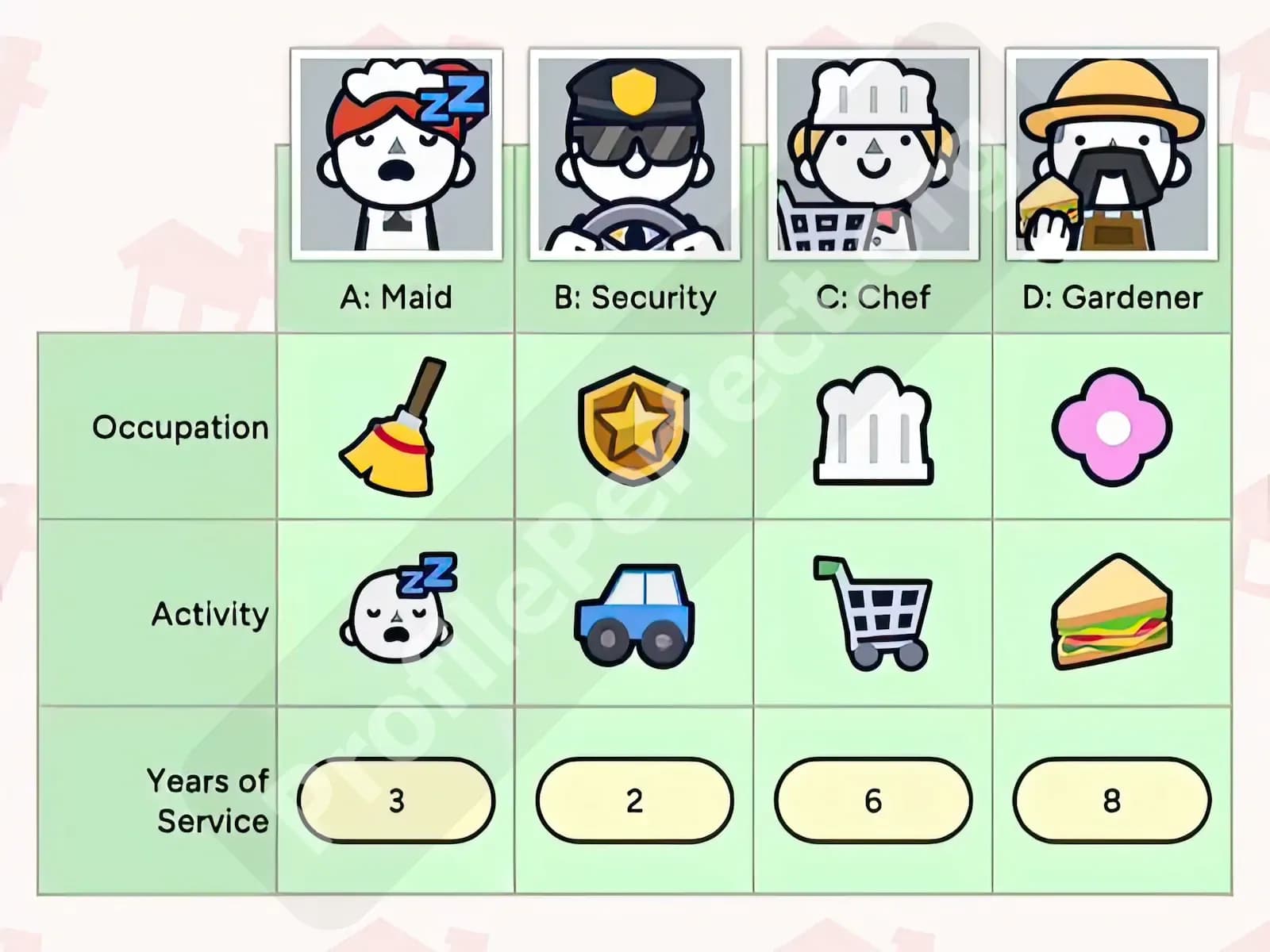
In Level 7, the important clue is:
“Gardener is not next to Maid.”
At first glance, it feels vague. But it’s actually sharp if you respect the layout.
Person A is the Maid. In a four-person row, the person next to Person A is Person B. So the Gardener cannot be Person B. Person C is already the Chef because the shopping person is Chef. That means the Gardener cannot be Person C either.
So where can the Gardener go? Person D.
That one “not next to” clue locks down a whole occupation because the row position is doing hidden work. This is one of those Profile Perfect techniques that makes you feel smart once it clicks. The game isn’t just asking “what matches what?” It’s also asking “where can this still physically fit?”
From there, Level 7 opens up. The Security is Driving, the person with 3 years of service is next to the Driving person, and the Gardener has worked longer than Security. Once Gardener sits on Person D, the rest of the grid starts falling into place.
The lesson: whenever you see “not next to,” immediately check the edge positions. Leftmost and rightmost subjects have fewer neighbors, which makes them excellent elimination anchors.
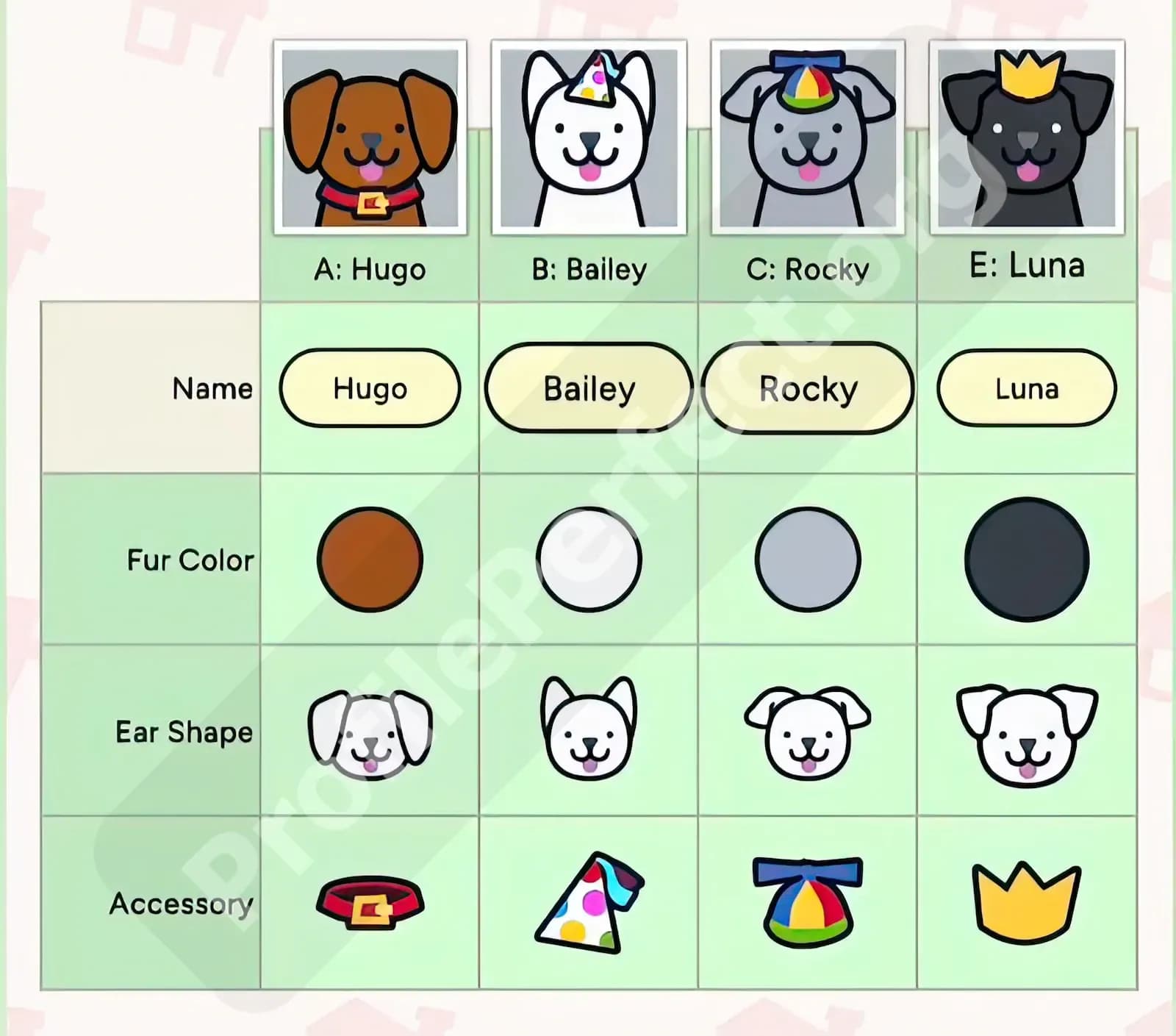
Level 8 is where Profile Perfect starts making the negative-clue loop feel spicy. The dog puzzle includes several elimination clues:
“Party Hat dog is not Crown dog’s neighbor.”
“The Grey dog is not named Luna.”
“Rose ear dog is not Brown dog’s neighbor.”
Each one blocks a bad pairing, but none of them should be tapped blindly.
Start with the anchors. Dog D has Black fur. The leftmost dog, Dog A, wears the Collar. Dog B is White and named Bailey. The dog next to the White dog is Grey without a Collar, so Dog C is Grey. The Collar dog has V-Shaped ears, making Dog A’s ears V-Shaped. The V-Shaped dog is named Hugo, so Dog A is Hugo.
Now bring in the negative clues.
The Black dog wears the Crown, so Dog D has the Crown. “Party Hat dog is not Crown dog’s neighbor” means the Party Hat cannot be Dog C, because Dog C is next to Dog D. Dog A already has Collar. Dog D has Crown. So the Party Hat lands on Dog B.
“The Grey dog is not named Luna” means Dog C cannot be Luna. Dog A is Hugo and Dog B is Bailey. Dog D, the remaining dog, becomes Luna. That leaves Rocky for Dog C.
Then the Rose ear clue kicks in. Once Dog A is Brown, “Rose ear dog is not Brown dog’s neighbor” means Rose ears cannot be Dog B. Dog A already has V-Shaped ears. Dog D has Button ears. That leaves Rose ears for Dog C.
This is the good stuff. Level 8 shows why negative clues are rarely one-and-done. They stack. One elimination sets up the next, and suddenly the grid goes from foggy to solved.
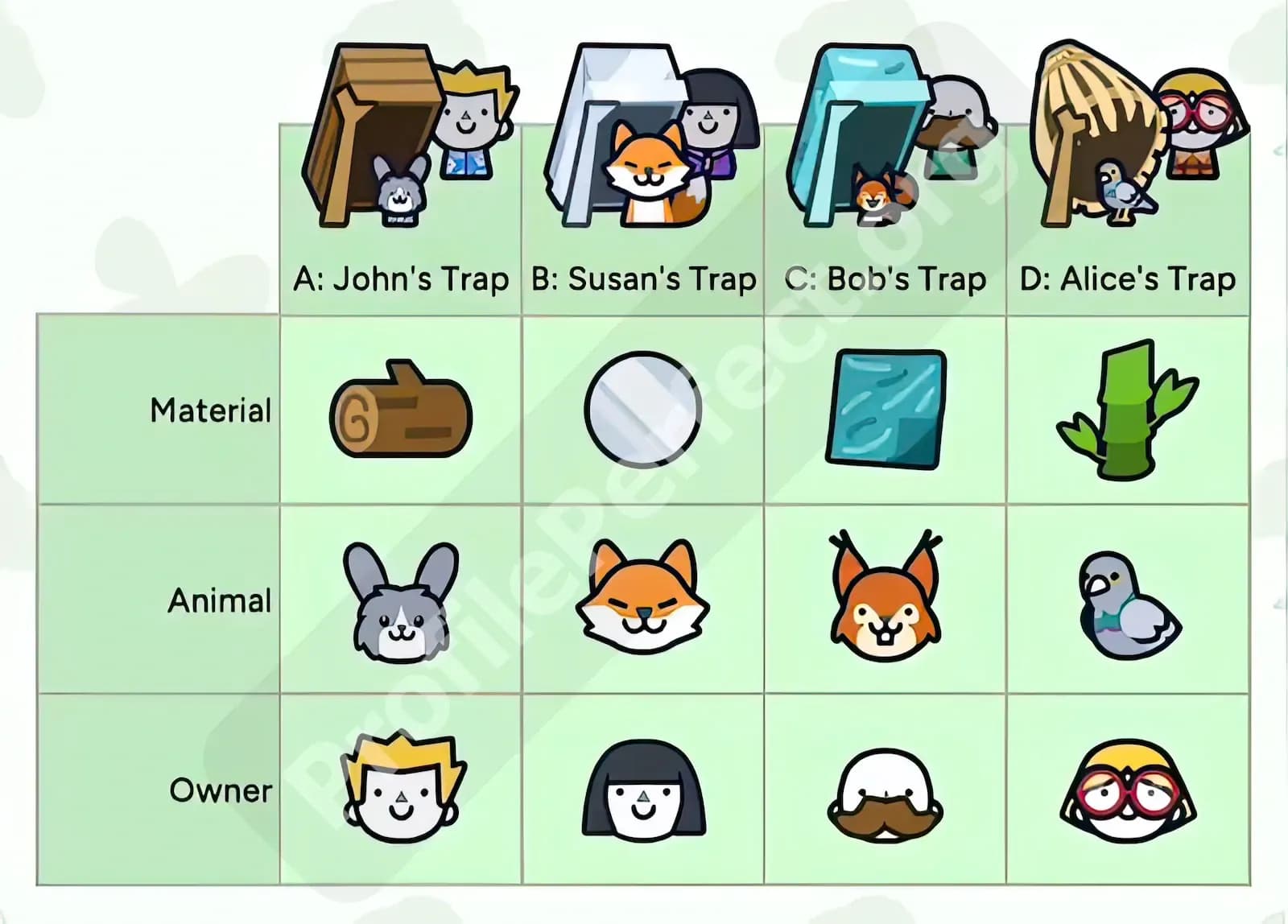
Level 10 gives a very practical trap example:
“Susan’s trap is not made of Wood or Plastic.”
This is a stronger negative clue because it removes two materials at once. Trap A is Wood. Trap C is Plastic. Alice uses the rightmost trap, Trap D, to catch a Dove. Since Trap D is already Alice’s, Susan cannot be Trap D. That leaves Trap B for Susan.
Then the material follows. Trap B is next to the Wood trap, so it is Steel. The clue “Steel trap is prepared for the Fox” gives Trap B the Fox. Clean.
The second big negative clue is:
“John’s trap is not next to Bamboo trap.”
By this point, Trap D is Bamboo. The trap next to Trap D is Trap C, so John cannot be Trap C. Trap B is Susan, Trap D is Alice, and Trap C becomes Bob because Bob is catching the Squirrel. That leaves John for Trap A.
Again, the negative clue doesn’t scream the answer. It quietly removes the unsafe cells until only one checkmark is legal.
Here’s the method I use when a Profile Perfect level starts throwing “not” clues at me:
First, find the anchor. A negative clue needs a known subject, position, or trait before it becomes useful. “Not next to Bamboo” means nothing until you know where Bamboo is.
Second, eliminate only what the clue says. Don’t overreach. “Not Red” does not mean Purple unless Green and every other color are already impossible.
Third, combine it with row reduction. Once only one option remains in a trait group, then you tap. That’s the moment the clue becomes a checkmark.
Fourth, handle position clues carefully. “Not next to” depends on neighbors, and edge subjects behave differently from middle subjects.
Finally, save guesses for never. Profile Perfect is at its best when every answer feels earned. Random tapping is a shambling corpse of a strategy, especially with limited lives.
Negative clues in Profile Perfect are not meant to slow you down. They’re meant to keep you honest.
When a clue says “not,” “doesn’t,” or “without,” don’t panic and don’t guess. Translate it into a cannot statement. Cross off the bad option mentally. Then wait for the grid to tighten.
Level 4 teaches simple pairing elimination. Level 6 shows how negative clues can finish a trait row. Level 7 turns “not next to” into a positional weapon. Level 8 stacks multiple negative clues into a full solve path. Level 10 proves that even a clue removing two options can be totally clean if you anchor it first.
That’s the real Profile Perfect skill: don’t chase the answer too early. Remove what’s impossible, protect your lives, and let the final checkmark reveal itself.