
Learn how to solve Profile Perfect geography clues by linking countries, nationalities, landmarks, routes, flags, and destinations without wasting lives.


Guide By Liam Stone
Published on June 15, 2026
Liam Stone has played Profile Perfect since the app first launched on the Apple App Store. He spotted its potential early, and that early bet turned into hundreds of hours spent solving levels, testing clue logic, and documenting answers for other players. Liam runs the YouTube channel Puzzle Game Answer where his puzzle walkthroughs have earned over 935,000 views and a growing community of more than 800 subscribers. He covers a wide range of mobile puzzle games beyond Profile Perfect, giving him firsthand experience with how these games design clues, structure levels, and trip up even experienced players. Every guide on this site reflects that hands on experience. Liam plays each level himself, verifies every answer against the in game grid, and rewrites confusing clues into plain language so you don't need to guess. If you want more of his walkthroughs, subscribe to his channel.
Loading calendar...
Profile Perfect looks simple when it’s asking you to match a name with a surname. Then the game starts throwing countries, flags, cities, flight routes, landmarks, passports, and nationalities into the grid, and suddenly the whole thing gets a lot crunchier.
That’s where geography clues become a real skill check.
In a normal Profile Perfect level, you’re matching subjects with traits: a person has a nationality, a plane has a destination, a landmark has a location, a climber carries a flag, and so on. The trick is that the game doesn’t always say the exact grid value. Sometimes it gives you a real-world hint and expects you to translate it before you tap anything.
That means “England” may point to “British.” “USA” may point to “American.” “Japanese sea” may point to “Japan.” “Land of pizza” may point to “Italian.” If you miss that translation, the level starts feeling unfair. I get it. I’ve hit those clues and thought, “Come on, just say the thing.” But once you learn the pattern, these levels become some of the most satisfying in the game.
Geography clues are powerful because they often create hard anchors. A hard anchor is a clue that gives you a fixed relationship with very little wiggle room.
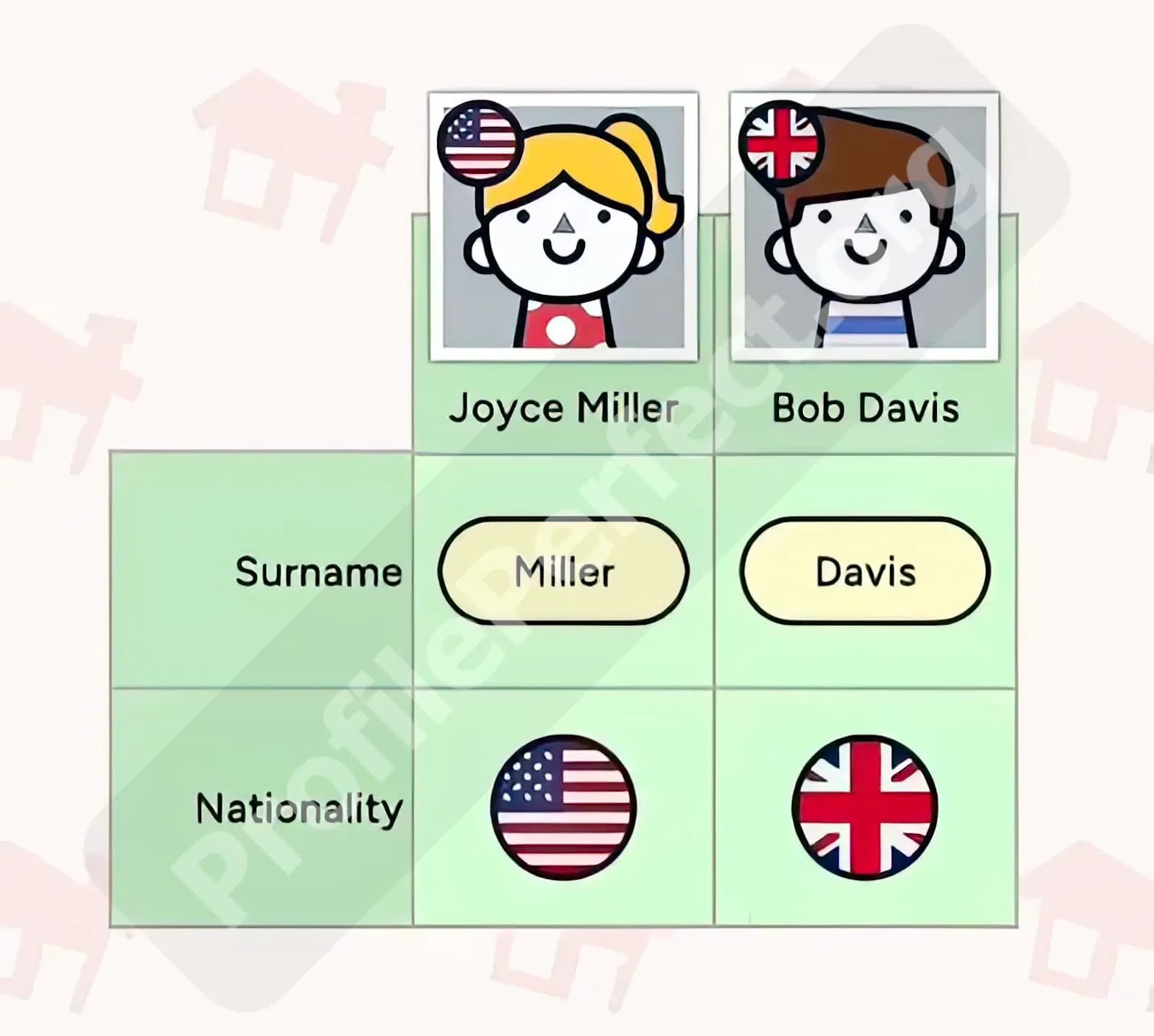
In Level 1, the game says the Miller family has lived in the USA for generations. The answer row doesn’t use “USA”; it uses “American.” The Davis family has lived in England, which becomes “British.” That’s the basic geography loop: location clue first, nationality answer second.
This small move shows up again and again across later levels. Profile Perfect loves using world knowledge as a bridge between clue text and grid value. If the clue says a person is from England, Brazil, China, Italy, Russia, France, or Japan, don’t only look for that country name. Look for the matching nationality too.
Here’s the mental conversion table I keep in my head while playing:
| Clue Says | Grid May Use |
|---|---|
| England | British |
| USA / US | American |
| Brazil | Brazilian |
| China | Chinese |
| Italy / land of pizza | Italian |
| Russia | Russian |
| France | French |
| Japan | Japanese |
| Germany | German |
| Greece | Greek |
| Spain | Spanish |
| Korea | Korean |
This is not fancy geography. It’s just fast translation. But in Profile Perfect, fast translation saves lives.
When a level has a geography category, scan every clue for direct country words before solving the relative clues. Direct country clues are usually safer than “next to,” “between,” or “not beside” clues.'
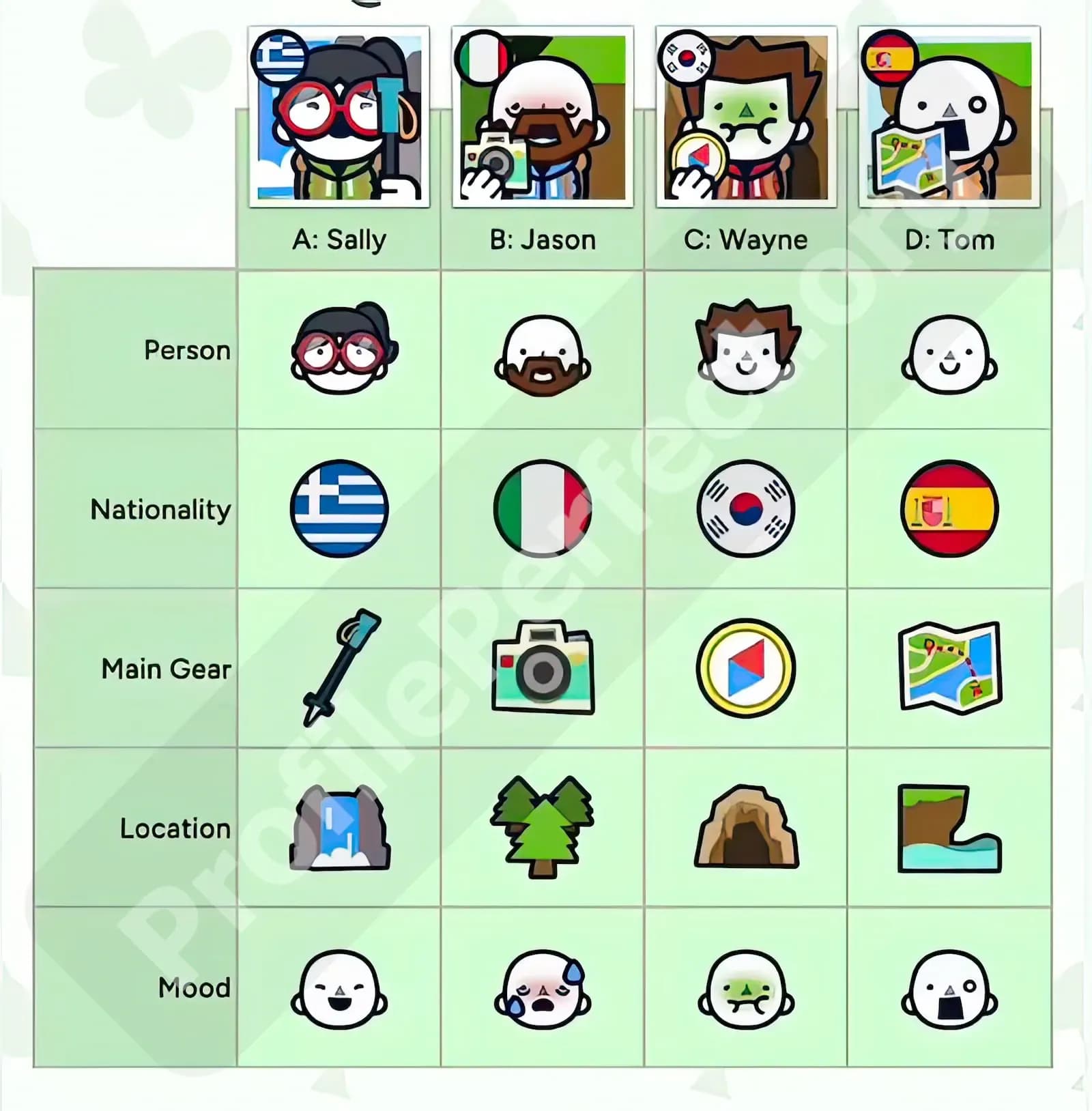
Level 15 is a good example. It has hikers with nationalities like Greek, Italian, Korean, and Spanish. One clue says the Spanish hiker is shocked. Another says the Korean is resting inside a cave. Jason is the Italian, and Sally is not Korean or Italian, which helps push her toward Greek.
The clean technique here is to build a geography chain:
Sally is not Korean or Italian, and another clue separates her from Wayne. The Spanish hiker is tied to Tom and Shocked. The Korean hiker is tied to Cave. Jason is Italian. Once those country anchors land, the rest of the grid starts collapsing beautifully.
That’s the banger feeling Profile Perfect is built around: one translated clue knocks down three other cells.
Plane levels are where geography becomes especially important, because “destination” clues usually lock a column hard.
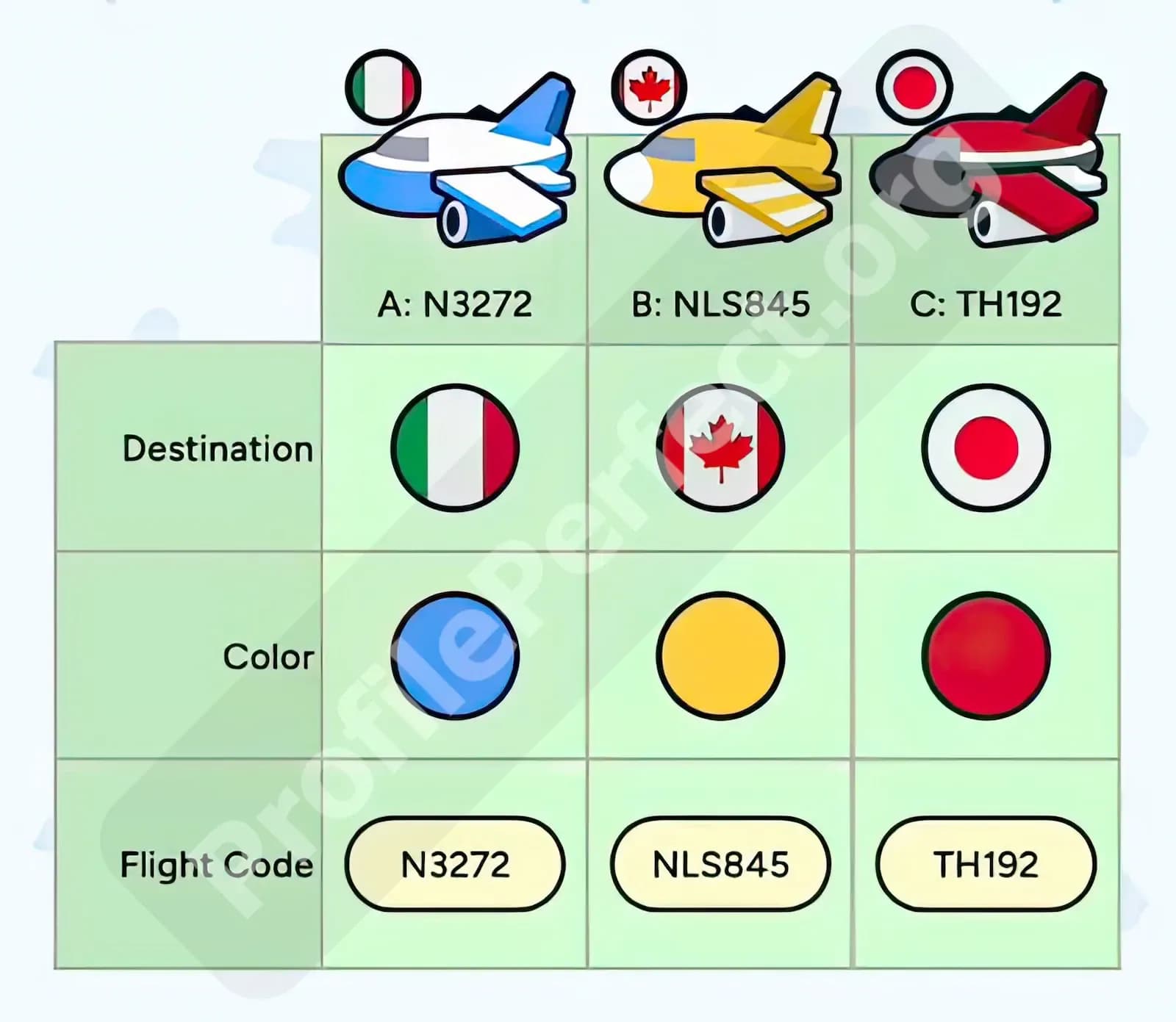
In Level 33, Plane A is heading to Italy. Plane C’s flight code is TH192, and TH192 is heading to Japan. The plane to Canada has a three-letter flight code. Once you place Italy and Japan, Canada has nowhere else to go.
This is the basic destination method:
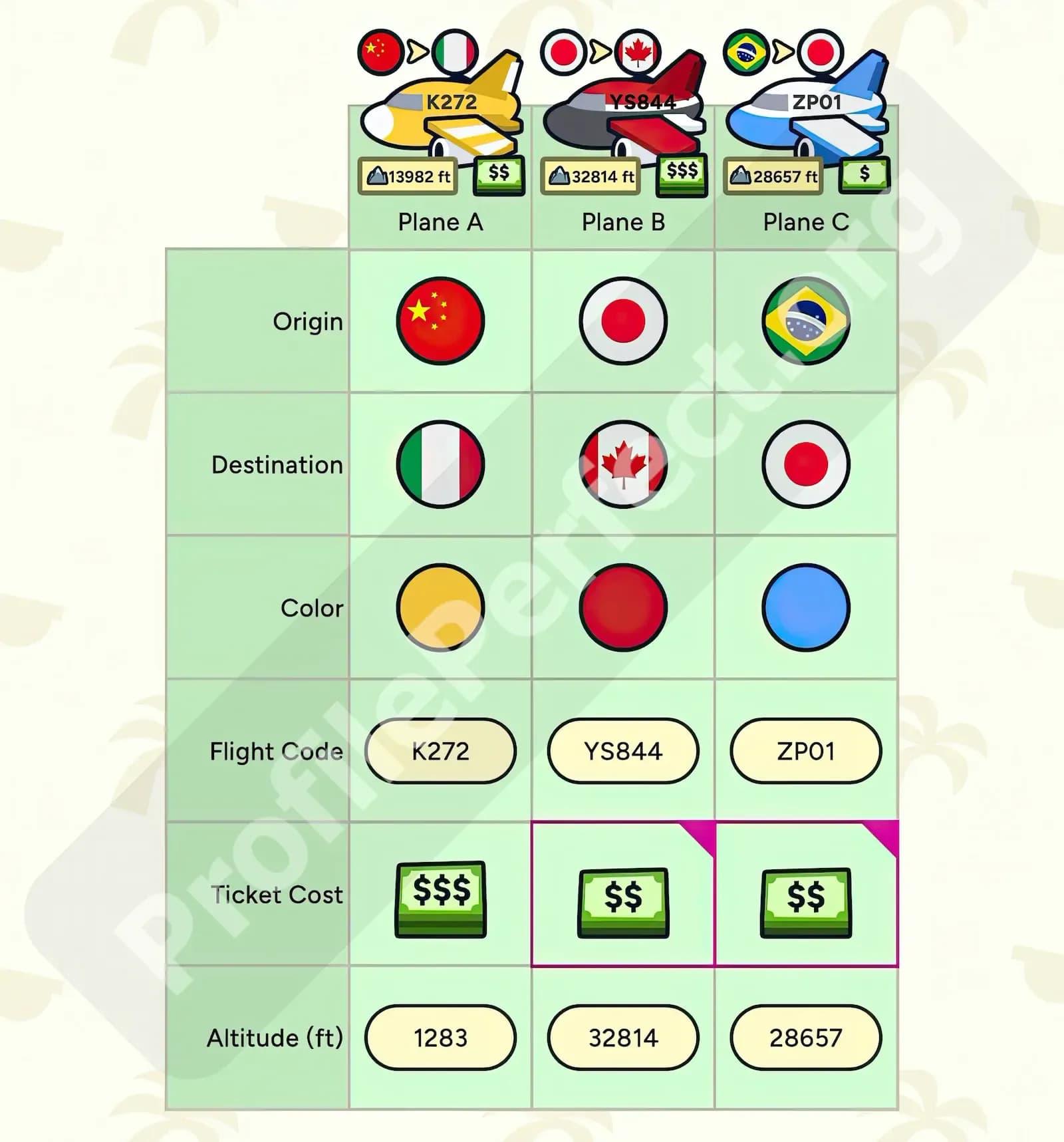
Level 291 builds on the same loop but adds origin, ticket cost, and altitude. Plane C is departing from Brazil. The most expensive plane is heading to the largest wine producer, which means Italy. The Blue plane arrives in Japan. The Red plane departs from Plane C’s destination, so it departs from Japan. Plane A goes from China to Italy.
That level looks busy, but its geography logic is rock-solid. Origin and destination are separate rows, so don’t merge them in your head. A plane can depart from Japan and another can arrive in Japan. Keep “from” and “to” in separate buckets, or you’ll tank the solve.
Landmark levels are a different vibe. They don’t just ask “who is from where?” They ask you to connect a place with a structure, material, year, meaning, or visitor count.
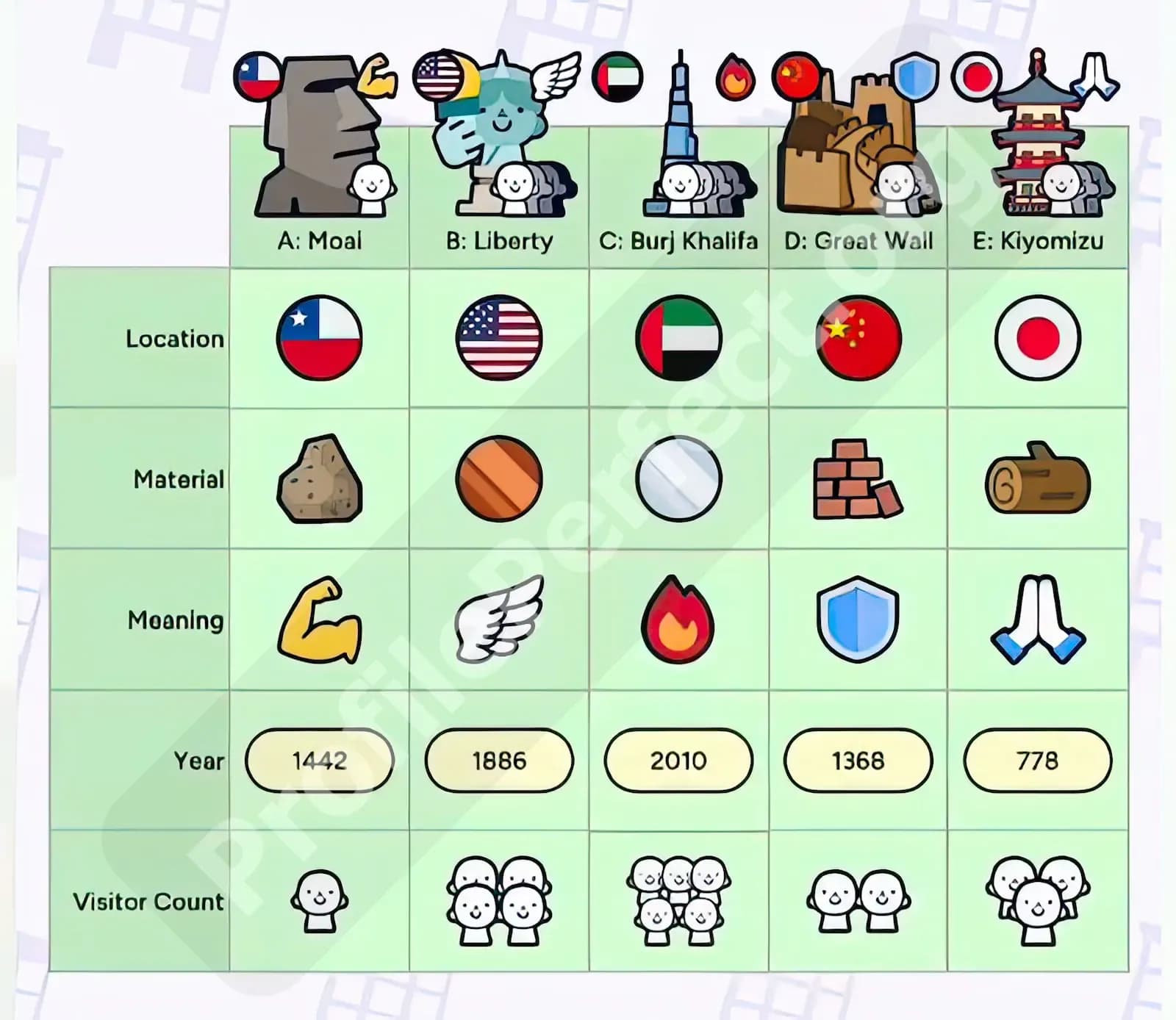
Level 24 includes locations like Chile, USA, UAE, China, and Japan. It also includes materials like Copper, Glass, Brick, Wood, and Tuff. A clue says Landmark B was built in the 19th century, and another clue ties the Copper landmark to a high visitor count. The USA location, Copper material, and Freedom meaning line up like a clear Statue of Liberty-style clue, even if the game doesn’t spell out the landmark name directly.
The best way to solve landmark clues is to ask: is this a real-world reference or just a grid relationship?
For example, “Japan’s landmark is made out of Wood” is direct. “China’s landmark was made in 1368” is also direct. “The landmark that means Freedom is next to Chile” is positional. Direct clues first, positional clues second. That order keeps the loop clean.
Some Profile Perfect levels use flags without saying “nationality” directly. This is where general knowledge becomes a cheat code.
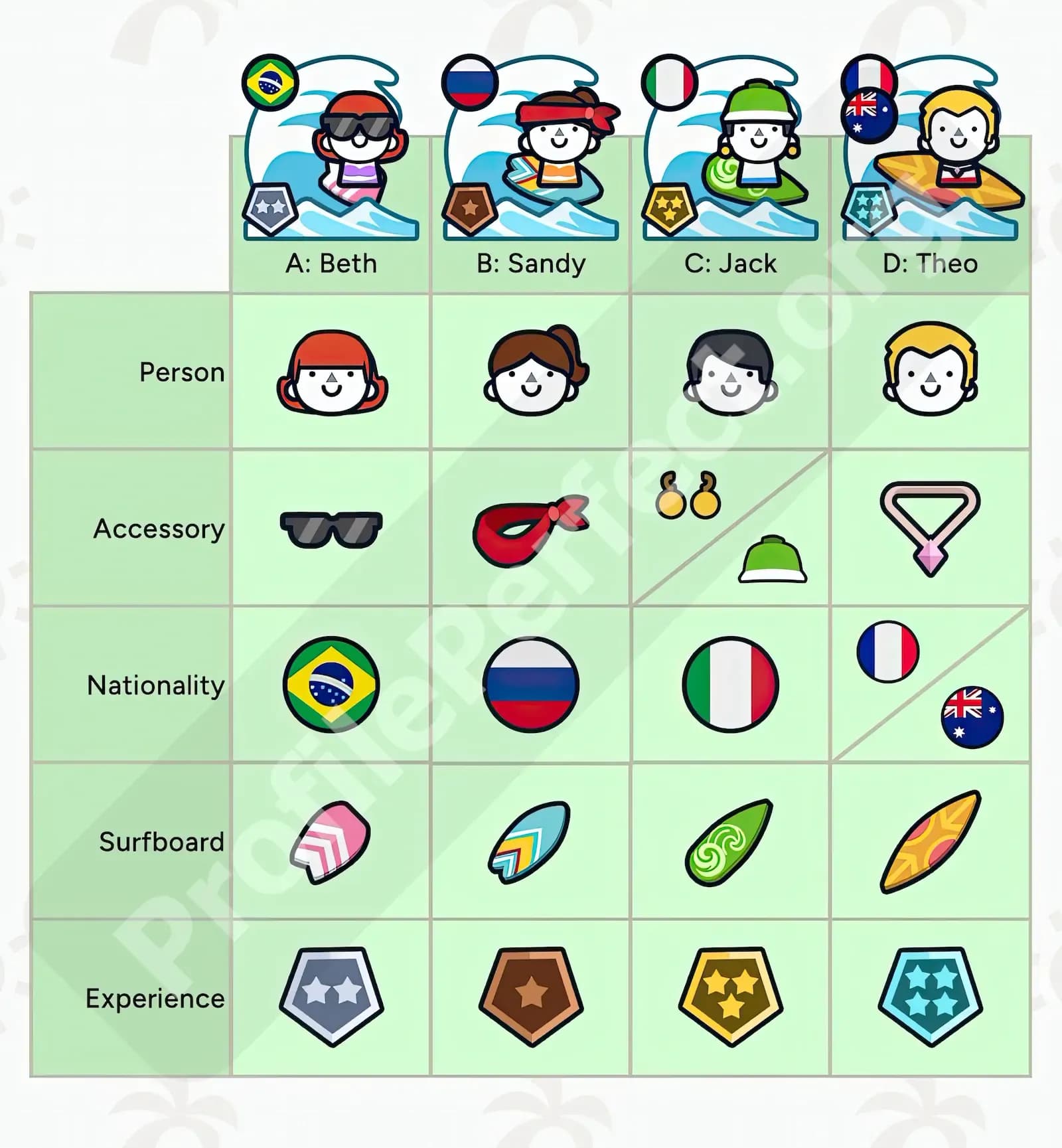
Level 171 says the color of grass dominates Surfer A’s flag. That points to Brazil because green is a major flag color. Another clue says the neighbor of the Pro surfer comes from the land of pizza, which points to Italy. Theo’s flag resembles Sandy’s if rotated, which helps connect French, Russian, and Australian possibilities depending on the nearby placements.
This kind of clue is messier than “Jason is Italian,” but it’s not random. The game wants you to recognize flag colors, cultural nicknames, and visual similarities. When you see a flag clue, don’t tap instantly. Translate the clue into two or three candidates, then wait for another clue to narrow it.
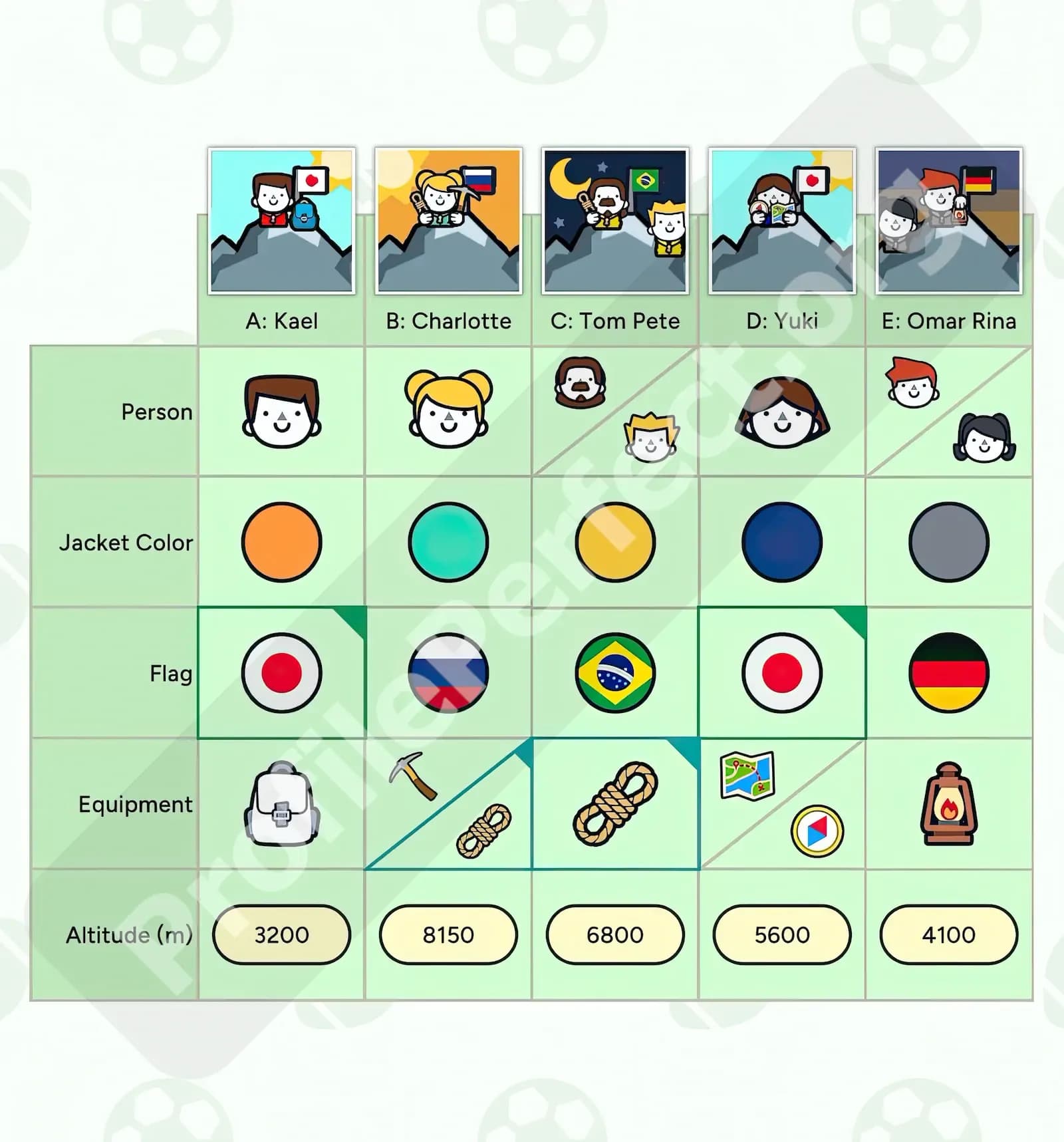
Level 278 does something similar with climber flags. Japan appears at two altitudes, Russia is tied to a female climber, Brazil sits between neighboring equipment logic, and Germany lands with the Oil Lamp clue. The geography isn’t alone here; it’s blended with altitude, equipment, jacket color, and gender clues. That means your first goal is not to solve the whole country row. Your first goal is to lock one or two country anchors, then let the equipment and altitude rows do the rest.
Profile Perfect sometimes uses a city instead of a country. Don’t let that throw you.
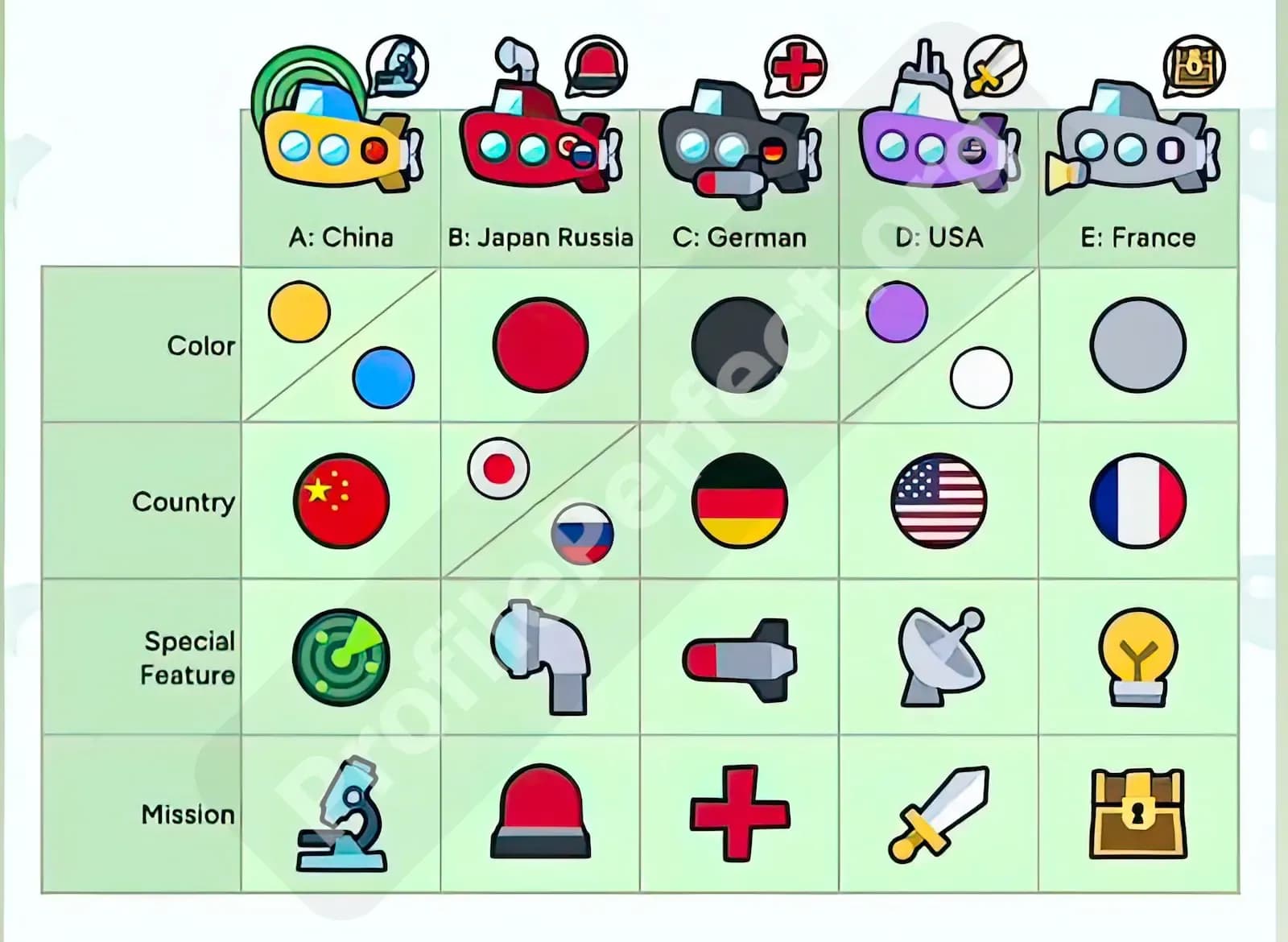
In Level 130, “Beijing’s submarine” points to China. That’s the translation. The same level uses countries like Japan, Russia, Germany, USA, and France. It also says Submarine C and E are from European countries, which narrows them to Germany and France. “Asian vessel” narrows another set to China or Japan. “France’s submarine is looking for Treasure in Atlantic Ocean” directly places France with Treasure.
This level is a great reminder: geography clues can be regional, not just national. “European countries” is a filter. “Asian vessel” is a filter. “Beijing” is a city-to-country conversion. Use those filters before messing with color placement.
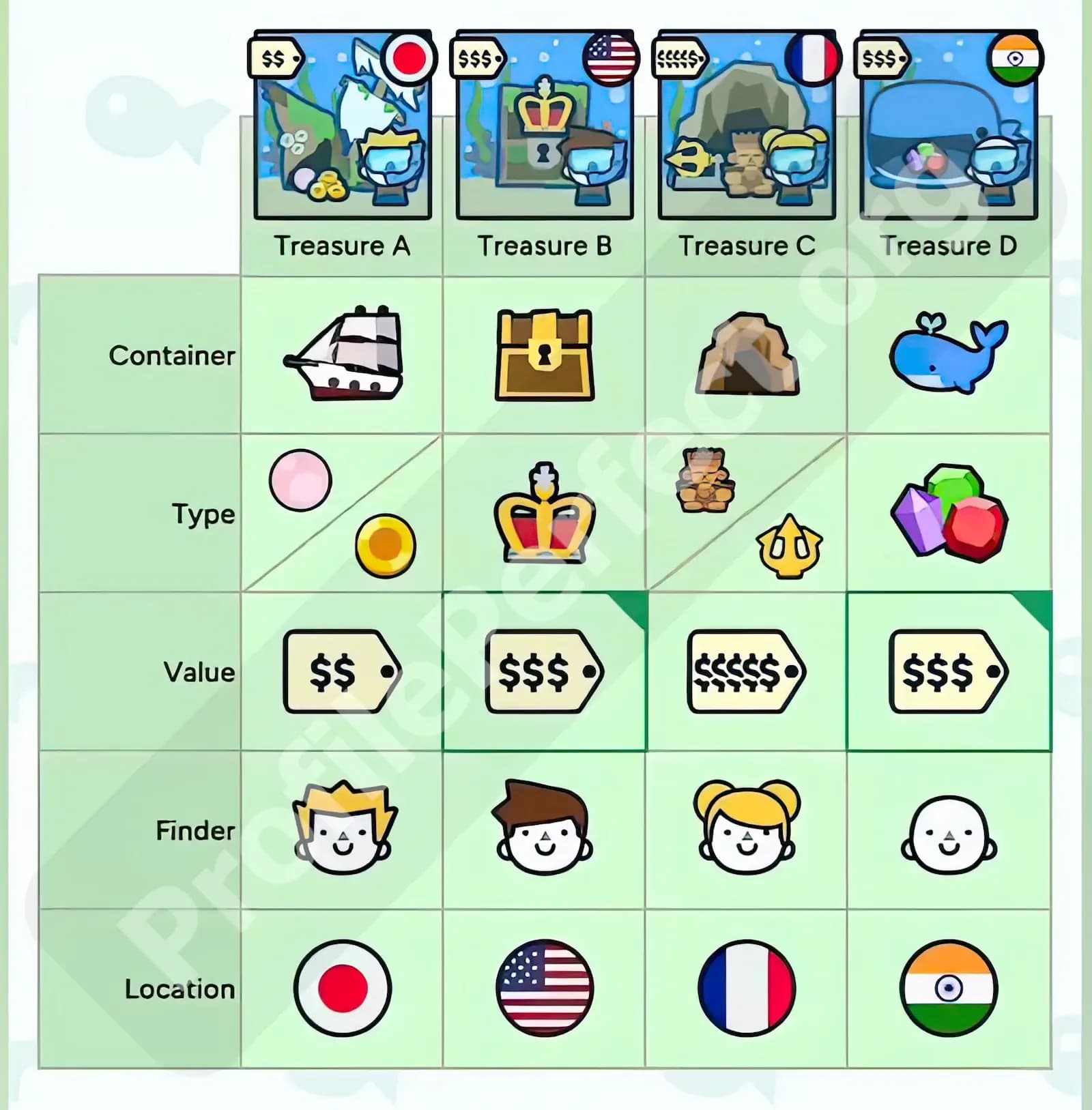
Level 127 is a treasure level, but geography still does heavy lifting. A clue says a male captain found treasure in the Japanese sea, which places Japan. Another says treasure from the US is on France’s left. Hector found treasure in the Ganga river, which points to India.
This is a fun one because “Ganga river” is not formatted like a normal country clue. It expects you to know the Ganges/Ganga association with India. If you don’t, the level feels like a wall. Once you catch it, though, it becomes a hard anchor: Hector equals India.
For any river, sea, route, or travel clue, ask this: what country is the clue trying to imply?
Here’s my go-to loop for Profile Perfect geography levels:
First, mark exact countries, nationalities, origins, and destinations. Don’t solve the cute clues yet. Just grab the freebies.
Second, translate indirect wording. England becomes British. Land of pizza becomes Italian. Beijing becomes China. Ganga becomes India. Japanese sea becomes Japan.
Third, separate similar categories. Origin is not destination. Nationality is not location. Flag is not always nationality, but it usually points there.
Fourth, use geography as an anchor for other rows. Once you know someone is Russian, connect the nearby clue about accessory, equipment, mood, or mission.
Fifth, let elimination finish the row. Profile Perfect rewards patience. You don’t need to guess the last country if every other country is already boxed in.
The biggest mistake players make with geography clues is tapping too early. I’ve done it. You see “England,” you rush to “British,” and then realize the clue was about a family surname, not the person directly. The better play is to build the chain: England → Davis family → Bob → British.
That’s the Profile Perfect rhythm. Don’t just translate words. Translate relationships.
Geography clues can look like trivia, but most of them still follow the game’s normal logic-grid rules. Countries become nationalities. Cities become countries. Destinations lock planes. Flags narrow candidates. Landmarks connect locations with materials and meanings. Once you treat every place name as a possible anchor, these levels stop feeling floaty and start feeling fair.