Solve Profile Perfect food and cuisine clues faster by reading dishes, ingredients, prices, drinks, calories, and meal pairings before you tap any cells.

Guide By Liam Stone
Published on June 15, 2026
Liam Stone has played Profile Perfect since the app first launched on the Apple App Store. He spotted its potential early, and that early bet turned into hundreds of hours spent solving levels, testing clue logic, and documenting answers for other players. Liam runs the YouTube channel Puzzle Game Answer where his puzzle walkthroughs have earned over 935,000 views and a growing community of more than 800 subscribers. He covers a wide range of mobile puzzle games beyond Profile Perfect, giving him firsthand experience with how these games design clues, structure levels, and trip up even experienced players. Every guide on this site reflects that hands on experience. Liam plays each level himself, verifies every answer against the in game grid, and rewrites confusing clues into plain language so you don't need to guess. If you want more of his walkthroughs, subscribe to his channel.
Loading calendar...
Food clues in Profile Perfect look cozy at first. Ramen, sushi, tacos, burgers, coffee, cookies — what could go wrong? Then the game casually asks you to connect a dish to a price tier, a drink, a chef, a garnish, a tray color, a calorie count, and sometimes a weird ingredient clue that sounds like it wandered in from a science quiz. That’s when a simple food level can tank your run.
The trick is not to treat every food clue as “what dish is this?” In Profile Perfect, food is often just the theme. The real logic may be about cuisine type, ingredient placement, meal value, nutrition, store rating, or a side dish relationship. Once you know which kind of clue you’re reading, the puzzle loop gets much cleaner.
I like food levels because they’re some of the most readable puzzles in the game. They use real-world associations we already understand: ice cream is cold, rice is cheap, sushi is premium, coffee pairs with meals, and salad usually has a lower calorie count. But they’re also dangerous because these associations can bait you into guessing. Profile Perfect gives you just enough real-world logic to feel confident, then punishes you if you tap before checking the grid.
Here’s how to read food and cuisine clues without wasting lives.
Before tapping anything, sort the clue into one of four buckets:
For example, “Stall D sells a refreshing cold treat” is a dish identity clue. It points to Ice Cream. “Ramen costs the same as two Tacos” is not really about ramen or tacos; it’s about price comparison. “Bread meal almost has 10x the calories of Salad” is a nutrition clue. “Bean curd” is an ingredient vocabulary clue that means Tofu.
That one-second classification matters. It stops you from forcing every clue into the wrong row.
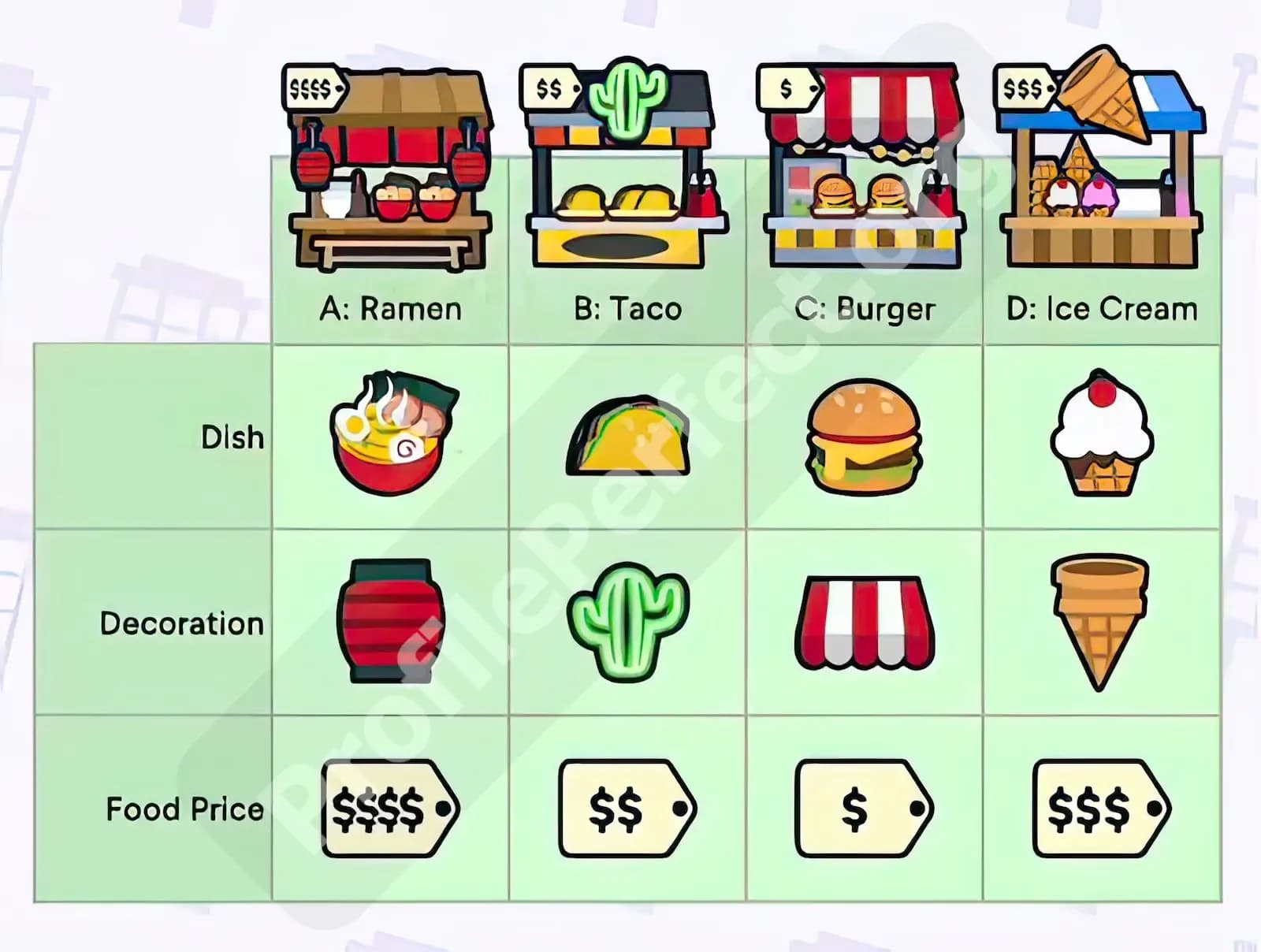
Level 18 is a great early example because it looks like a simple street-food puzzle, but the price row does most of the work. The solved setup includes Ramen, Taco, Burger, and Ice Cream across four stalls. The obvious clues give you anchors: Stall D sells Ice Cream, and Stall A sells Ramen.
Then the crunchy part arrives: “Ramen costs the same as two Tacos.” That clue tells you Ramen is more expensive than Taco. In the solved grid, Ramen lands at $$$$, while Taco lands at $$. The clue isn’t asking you to know anything deep about cuisine. It’s asking you to translate “two tacos” into a price relationship.
The Burger clue also works through position. The Burger stall is beside the Ice Cream stall, and the cheapest stall is next to Ice Cream. Since Ice Cream is already Stall D, Burger becomes Stall C, and Stall C gets the cheapest price. That’s the clean Profile Perfect loop: anchor the obvious food first, then let position and price do the heavy lifting.
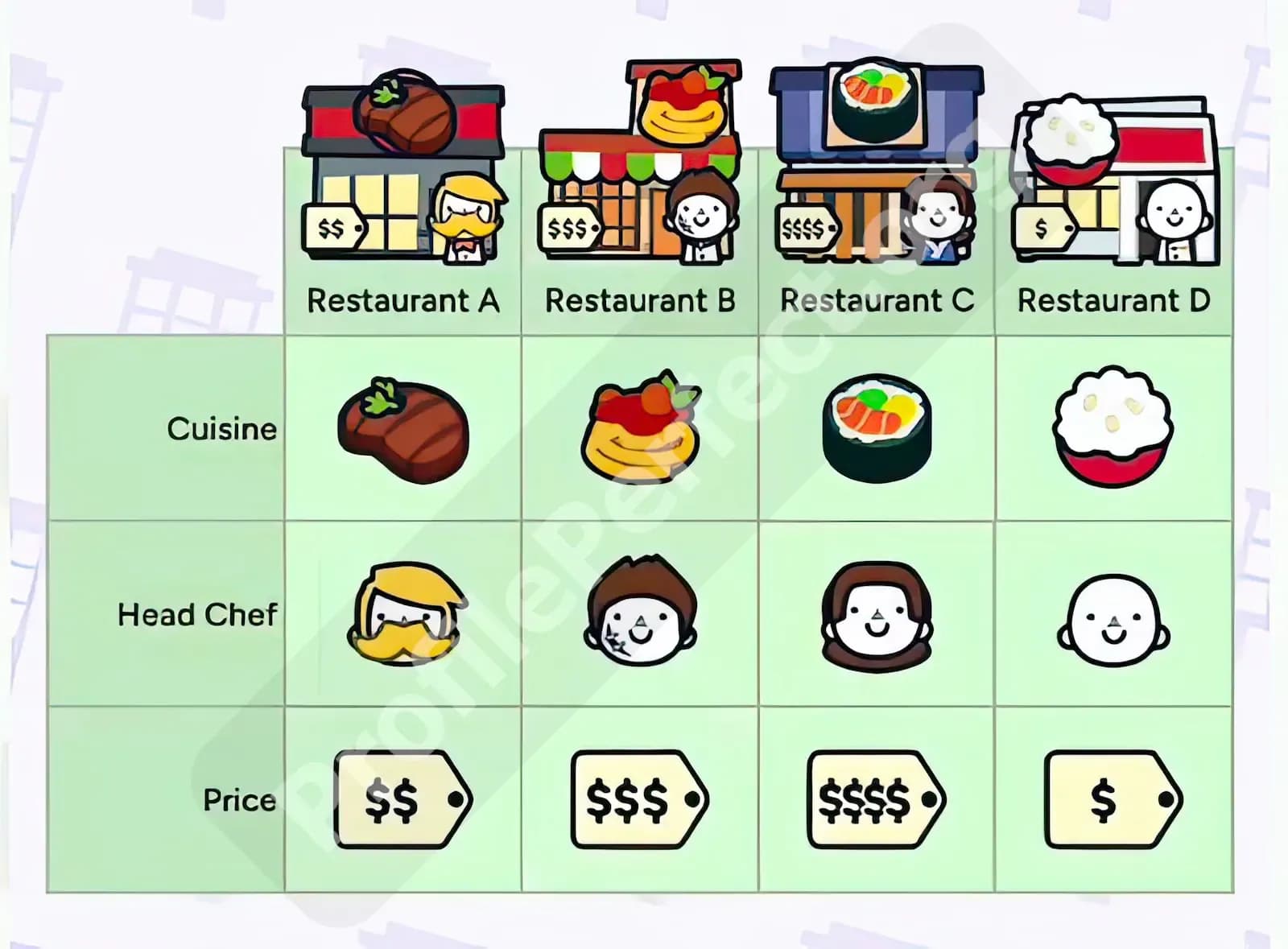
Level 22 expands the food clue into a restaurant puzzle. Now you’re matching Cuisine, Head Chef, and Price. The cuisines are Steak, Pasta, Sushi, and Rice. The key is to avoid solving by taste preference. Don’t think, “Sushi is expensive, so I’ll tap $$$$.” Wait for the clue chain.
The puzzle gives Restaurant D as Rice, then says the restaurant serving Rice is the most affordable. That locks Rice to $. Another clue says the cheapest restaurant is next to the most expensive one, which pushes $$$$ into the neighboring slot. Later, the Sushi chef clue connects Sushi with the long-haired chef, and the grid completes from there.
This is where Profile Perfect is at its best. It uses common food logic — rice as affordable, sushi as premium — but the real proof comes from adjacency and chef traits. The vibe is foodie, but the solve is still a logic grid.
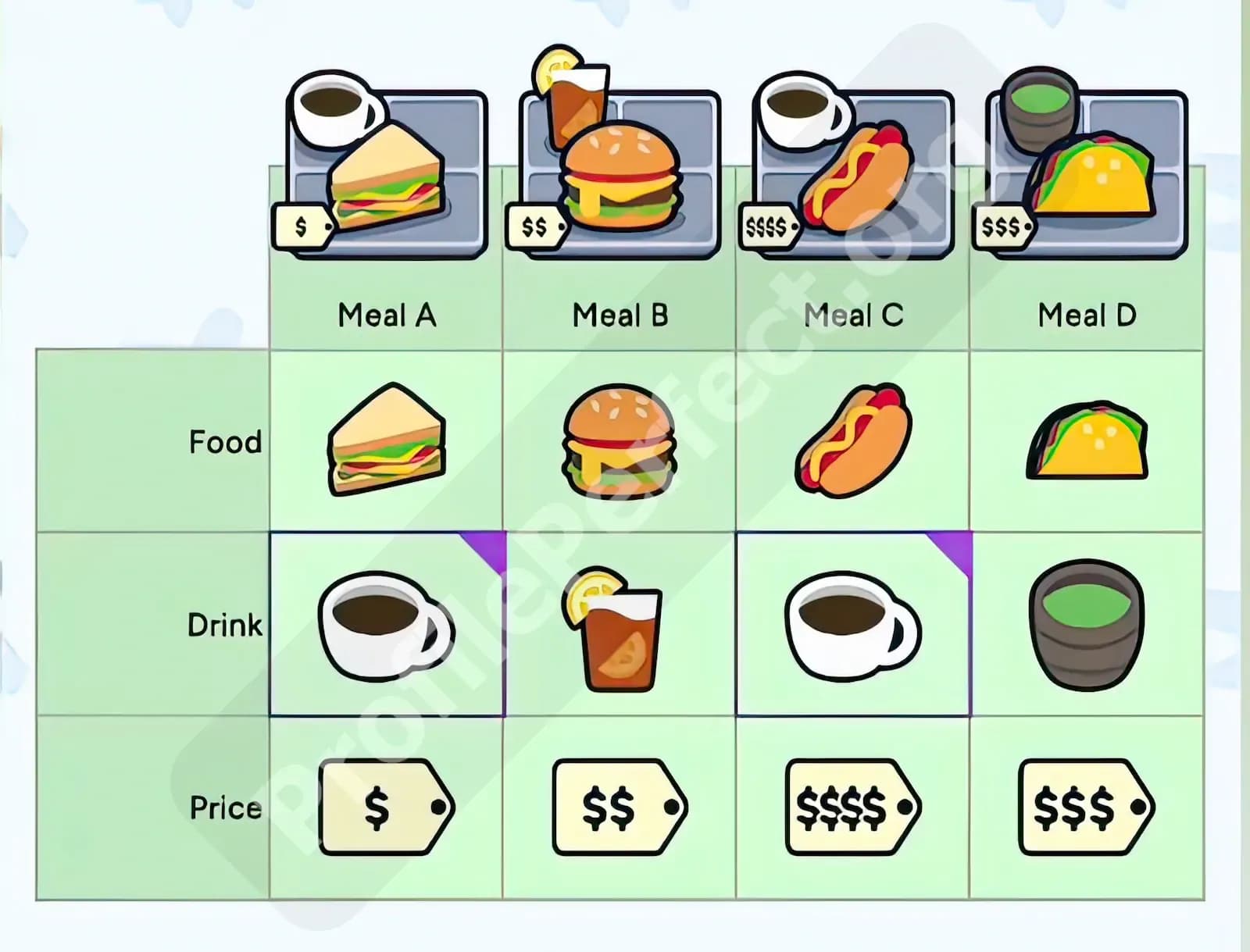
Level 34 teaches a different food pattern: meal bundles. Each subject is a meal, and the rows include Food, Drink, and Price. The food options include Sandwich, Burger, Hot Dog, and Taco. The drinks include Coffee, Lemon Tea, and Tea.
The clue “Only 1 meal has Lemon Tea as its drink” is a direct drink clue. Easy anchor. But the smarter clue is “Cheapest and priciest meals are paired with Coffee.” That means Coffee appears on two different meals, and those meals must sit at the two price extremes.
This is a good reminder: not every row in Profile Perfect is one-to-one in the way you expect. Some values can repeat when the level design allows it. If a clue says two meals share Coffee, don’t fight the clue just because you’re used to every answer being unique. Read the level’s rules, not your habits.
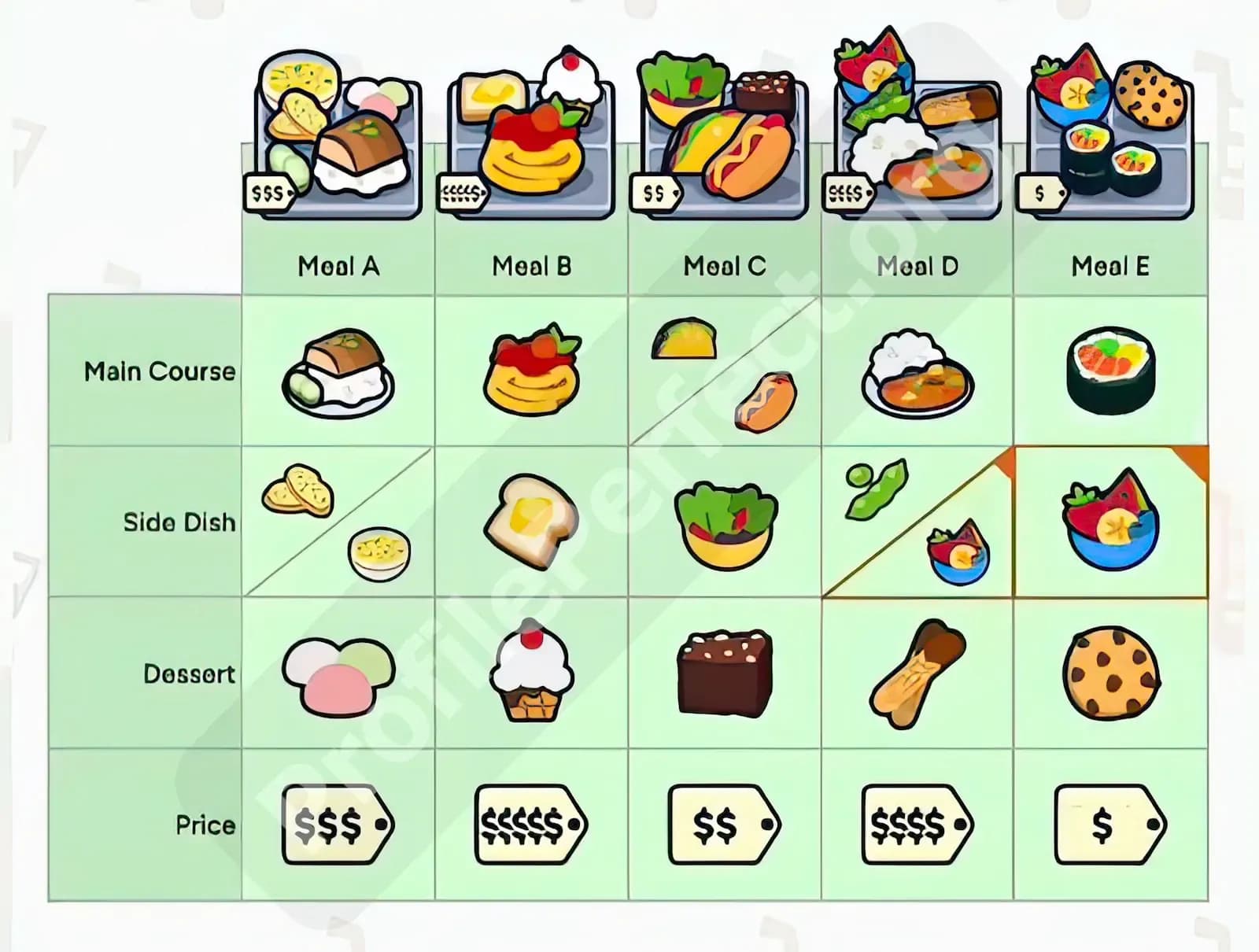
Level 45 is one of the big food examples because it stacks Main Course, Side Dish, Dessert, and Price. This is where food clues can start to feel chaotic. You’re juggling Chicken Rice, Pasta, Taco, Curry, Sushi, sides like Green Salad and Edamame, desserts like Mochi and Churros, and five different price tiers.
The winning move is to split the meal into courses. Don’t read the whole thing as “food.” Read it as four separate systems: main, side, dessert, price.
“Taco is complemented by Green Salad” connects a main course to a side dish. “The most expensive meal is paired with a cold dessert” connects price to dessert, making Ice Cream a strong candidate. “Chicken Rice is worth three sets of Sushi” connects two main courses through price. That last clue is especially useful because it tells you Chicken Rice is more expensive than Sushi, and specifically three times the lowest value if Sushi is sitting at $.
This level also includes clue language where a cell may show two possible or combined labels, such as a side dish or main course appearing in a split-looking form. Don’t panic. Treat the slash-style wording as the game saying that cell contains multiple visible values or a temporary combined clue state. Keep following the relationships until the grid settles.
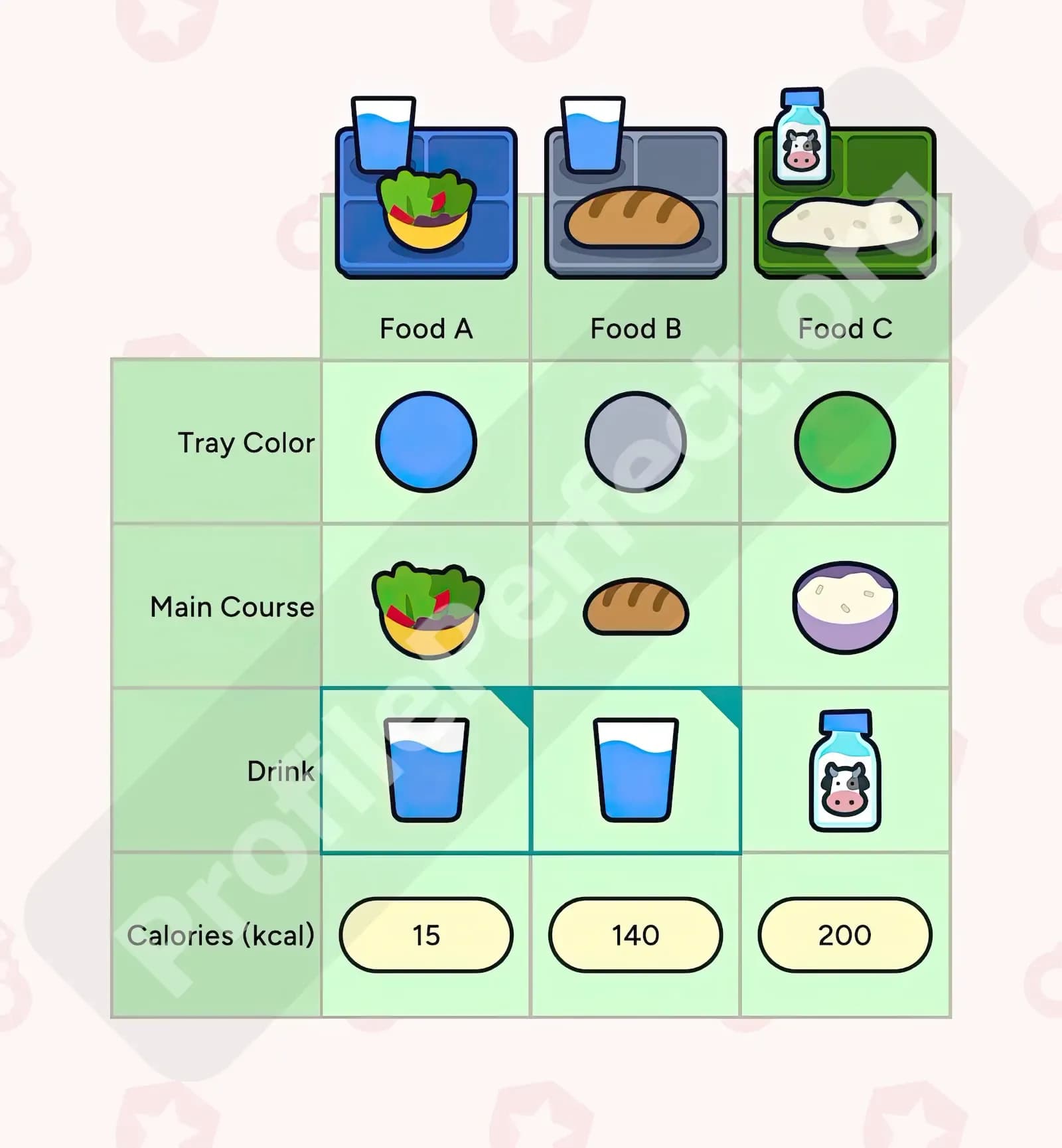
Level 200 moves food into nutrition logic. The subjects are Food A, Food B, and Food C, with Tray Color, Main Course, Drink, and Calories. The foods include Salad, Bread, and Gruel.
This level is clean because the common-knowledge associations are strong. Salad has the lowest calories. Milk pairs with Gruel. Bread has far more calories than Salad. The clue “Bread meal almost has 10x the calories of Salad” is the kind of clue you should treat like a numeric lock. If Salad is 15 kcal, Bread should land near 140 kcal, not 200 kcal.
The important technique here is to solve calories as a ranking system first. Lowest, middle, highest. Once you know the order, tray color and drink clues become easier. Food in the Blue tray has the lowest calorie count, so Blue connects to Salad and 15 kcal. Water is not part of the Green tray, so Green can safely move toward Milk and Gruel.
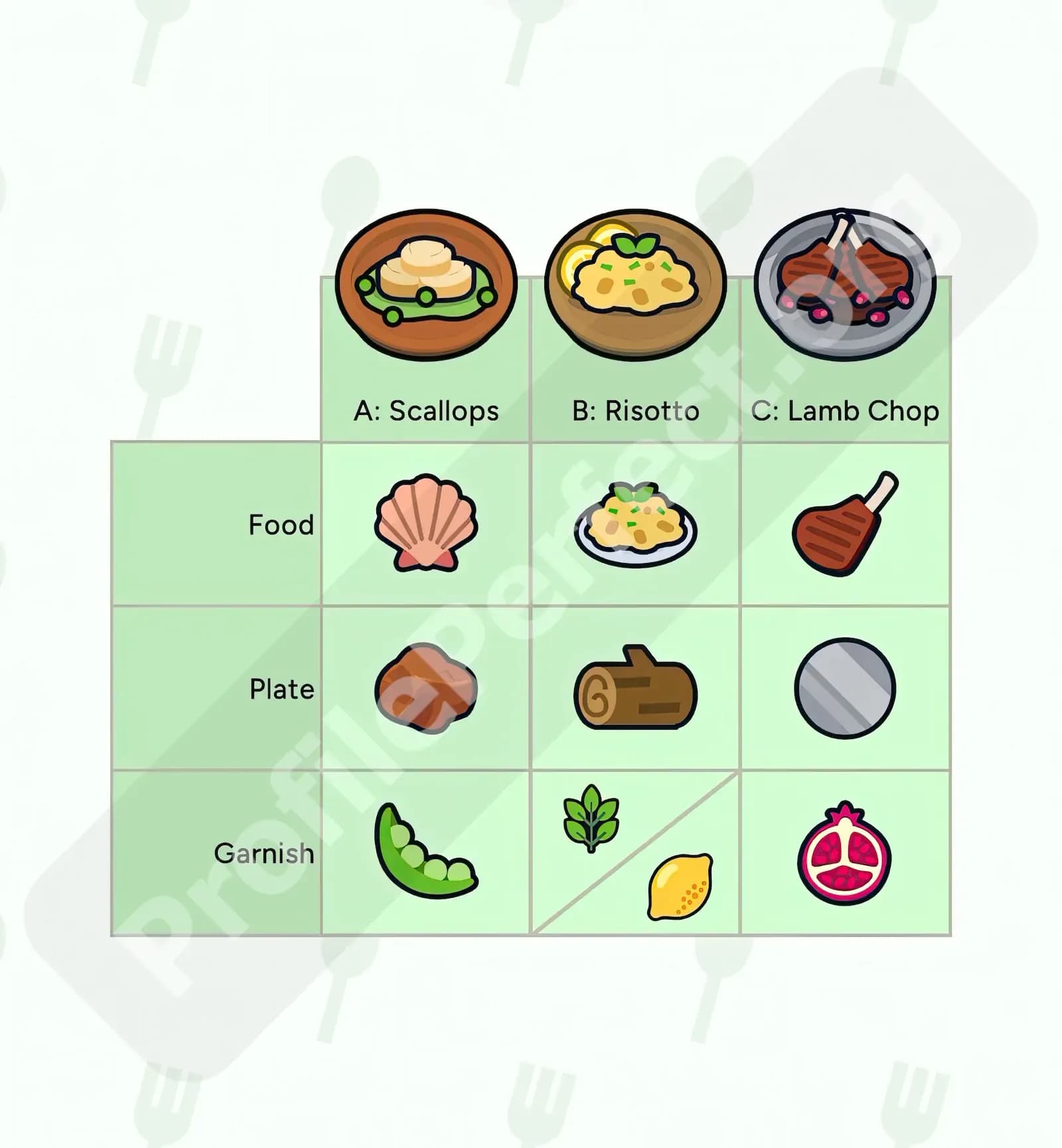
Level 206 is a plated-dish puzzle with Scallops, Risotto, and Lamb Chop. The rows include Plate and Garnish, so the food knowledge shifts from “what dish is this?” to “what goes with it?”
“Peas are the perfect toppings for the Scallops” is a direct pairing clue. “Risotto is presented with multiple garnishes” gives you another anchor. “The Lamb Chop does not go well with the Herbs” is a negative clue, and negative food clues are easy to underestimate.
My rule: in garnish levels, solve the dish-to-garnish pairings before the plate material. The food associations are usually more direct. Once Scallops gets Pea and Lamb Chop avoids Herbs, the remaining garnish options become much easier to place.
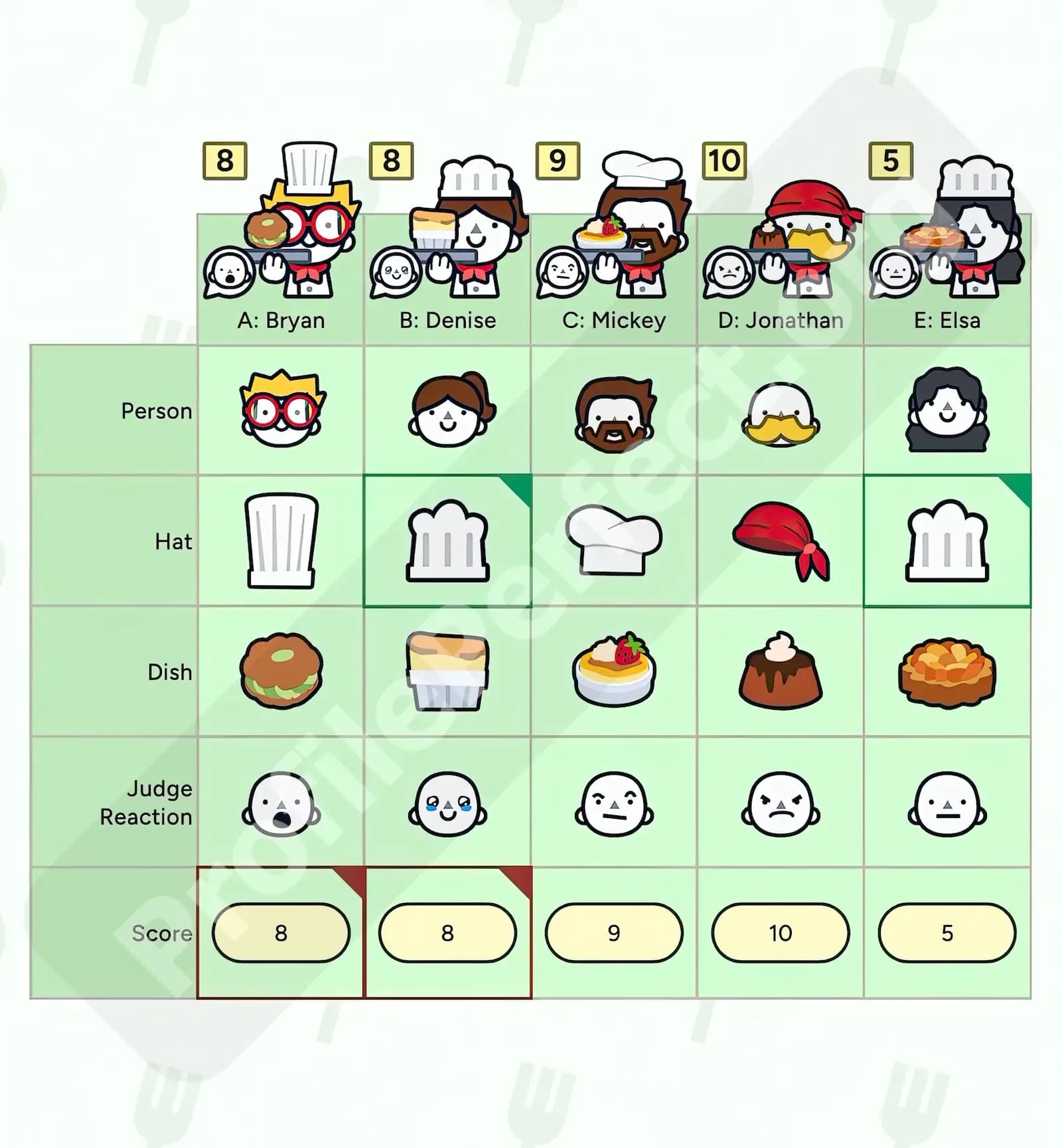
Level 209 throws in a cooking competition theme with dishes like Paris-Brest, Soufflé, Crème Brûlée, Lava Cake, and Tarte Tatin. These names can look intimidating if you don’t know French desserts, but the game isn’t asking you to become a pastry chef.
Most clues connect dish names to chef hats, judge reactions, or scores. Soufflé makes the judge teary-eyed. Tarte Tatin is far from the Tall Hat. Crème Brûlée is made by the chef next to the highest score. Lava Cake did not get an 8.
So the technique is simple: treat fancy food names as tokens. You don’t need to know what Paris-Brest tastes like. You only need to know where it sits in the clue chain. That mindset keeps the puzzle from feeling floaty.
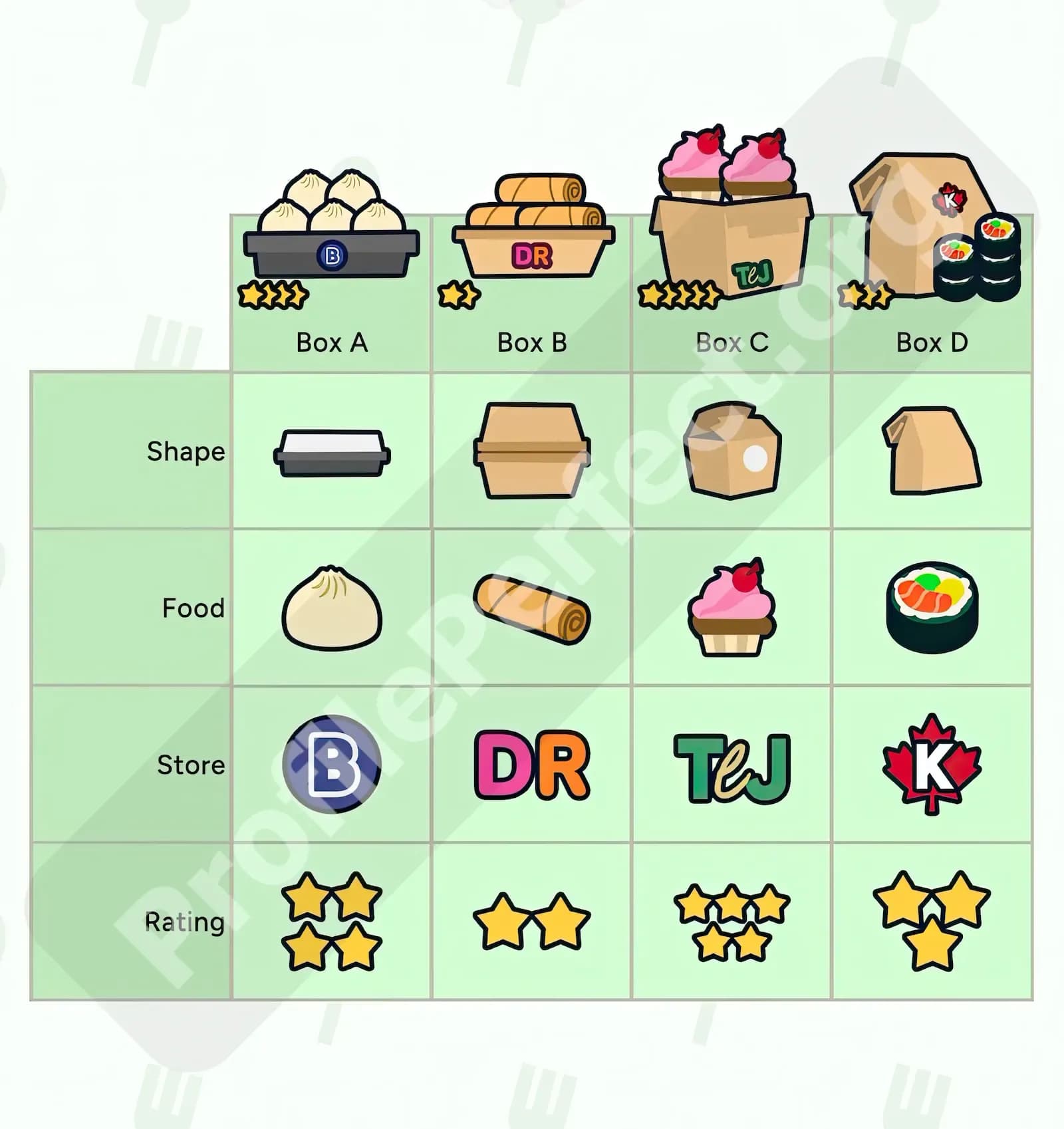
Some food levels aren’t restaurant puzzles at all. Level 211 uses takeaway boxes, foods, stores, and ratings. Cupcake gets the perfect rating. Sushi is served by Kim Hoton. Steamed Bun is not next to Cupcake. Here, the food is tied to packaging and review score.
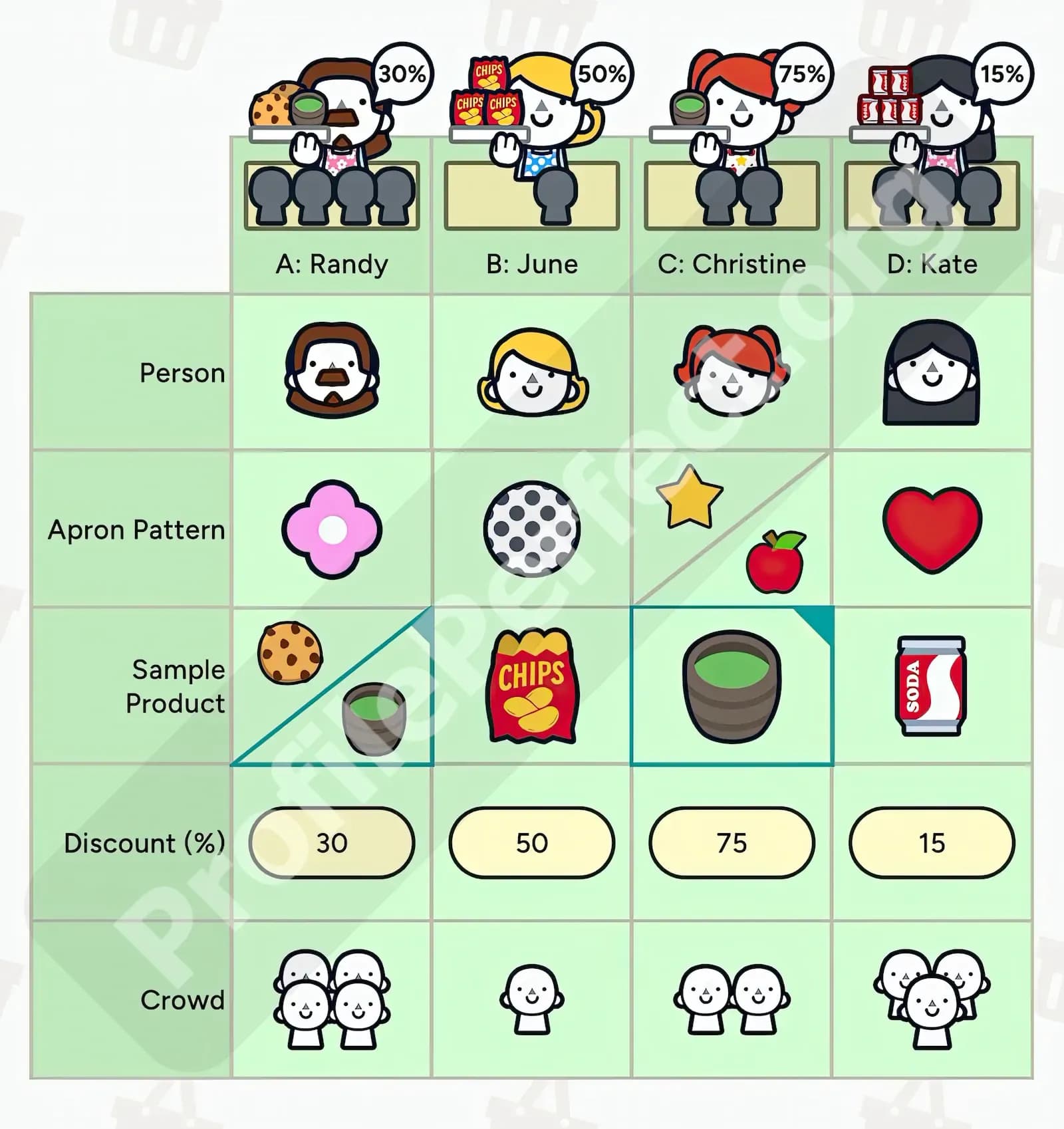
Level 238 uses sample products like Cookie, Tea, Chips, and Soda, then connects them to promoters, apron patterns, discounts, and crowd size. “New fizzy drink” points to Soda. “Dotted apron is between promoters with Tea” turns Tea into a positional clue. The food is just one row in a larger marketing puzzle.
The lesson: when food appears as a product, don’t overthink cuisine. Look for commercial language: rating, discount, crowd, store, sample, package, release sale. Those words tell you which row the clue really targets.
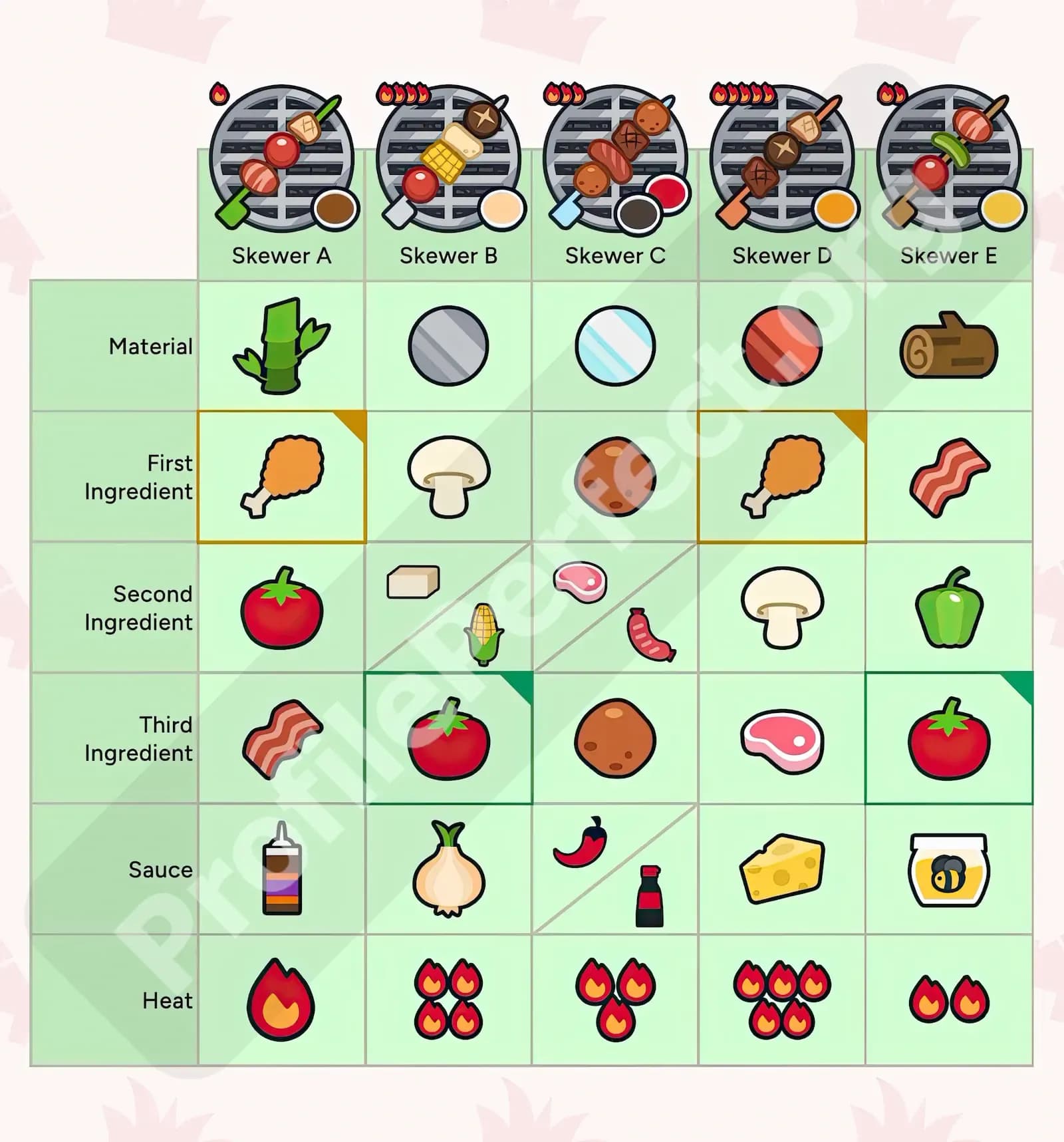
Level 338 is a banger example of late-game food clue design. It has skewers, materials, three ingredient positions, sauce, and heat. The clues include everyday food words, but also coded knowledge: bean curd means Tofu, zein protein points to Corn, a cut of rib-eye points to Beef, and the red vegetable is Tomato.
This level demands two habits. First, track ingredient position. “Mushroom at the tip followed by bean curd” means Mushroom is the first ingredient and Tofu is the second. Don’t just write “Mushroom and Tofu are on Skewer B” in your head; write the order mentally.
Second, separate ingredient clues from heat clues. “Honey sauce’s griller is 2x hotter than 2nd ingredient Tomato’s” gives you a heat relationship. It doesn’t merely say Honey and Tomato are neighbors. In the solved grid, Tomato’s skewer uses x1 heat, and Honey uses x2.
Late-game food puzzles like this reward patient note-taking. They’re not hard because the food is obscure. They’re hard because every ingredient has a row position.
When a Profile Perfect food clue appears, use this loop:
First, identify the row. Is the clue about dish, drink, ingredient, price, calories, rating, or position?
Second, mark direct food anchors. Cold treat means Ice Cream. Fizzy drink means Soda. Bean curd means Tofu. Rolled ground meat means Meatball.
Third, convert comparison clues into rankings. Cheapest, priciest, second-lowest, three times, almost 10x, and highest discount should all become order clues before you tap.
Fourth, respect adjacency. “Beside,” “next to,” “between,” “at the other end,” and “three columns away” are often stronger than the food theme itself.
Finally, use elimination. If the game gives you two safe anchors in a row, let the remaining value fall into place. That’s how you avoid burning lives on a guess that felt right but had no proof.
Food and cuisine clues in Profile Perfect are not about memorizing every dish in the world. They’re about reading the clue’s job. Is the game testing common knowledge, price logic, ingredient vocabulary, or grid position? Once you answer that, the whole level feels less like a messy menu and more like a clean deduction puzzle.
And honestly, that’s why these levels work. They take familiar food — ramen, sushi, coffee, cookies, skewers — and turn it into a compact little logic machine. When the clues click, it’s delicious.