
Solve Profile Perfect fantasy levels faster by decoding genies, dragons, vampires, portals, spells, and other myth clues before touching the grid today.


Guide By Liam Stone
Published on June 15, 2026
Liam Stone has played Profile Perfect since the app first launched on the Apple App Store. He spotted its potential early, and that early bet turned into hundreds of hours spent solving levels, testing clue logic, and documenting answers for other players. Liam runs the YouTube channel Puzzle Game Answer where his puzzle walkthroughs have earned over 935,000 views and a growing community of more than 800 subscribers. He covers a wide range of mobile puzzle games beyond Profile Perfect, giving him firsthand experience with how these games design clues, structure levels, and trip up even experienced players. Every guide on this site reflects that hands on experience. Liam plays each level himself, verifies every answer against the in game grid, and rewrites confusing clues into plain language so you don't need to guess. If you want more of his walkthroughs, subscribe to his channel.
Loading calendar...
Some Profile Perfect levels feel like a cozy detective puzzle. Others suddenly throw you into a full fantasy crossover: genies in lamps, dragons guarding treasure, vampires in coffins, portals with zodiac signs, spells with hand signs, necromancers summoning skeletons, and wizards charging outrageous mentorship fees.
And honestly? I love these levels, but they can absolutely trip players up.
The logic loop in Profile Perfect is still rock-solid: read clues, match subjects, eliminate wrong answers, and fill the grid. The tricky part is that fantasy levels often hide simple logic behind unfamiliar vocabulary. A casual player may understand “next to” or “not beside,” but what about “Cerberus,” “Arcane,” “Hydro,” “Underworld,” or “bowels of the Earth”? That’s where the vibe changes. The level is no longer only asking, “Can you follow the clue?” It’s asking, “Do you understand what this fantasy word is supposed to represent?”
The best technique is simple: decode fantasy nouns before touching the grid.
That means you should first translate the theme into plain puzzle language. Genie usually means lamp. Dragon usually means breath, color, food, and treasure. Vampire usually means blood, coffin, age, and supernatural ability. Portal usually means destination, guardian, sign, and fee. Spell usually means incantation, element, and hand signs. Once you do that translation, the level stops feeling magical and starts feeling crunchy in the best way.
In early Profile Perfect stages, clues tend to be direct. A dog has a name. A room has a floor. A person has a surname. You can usually spot the subject and trait immediately.
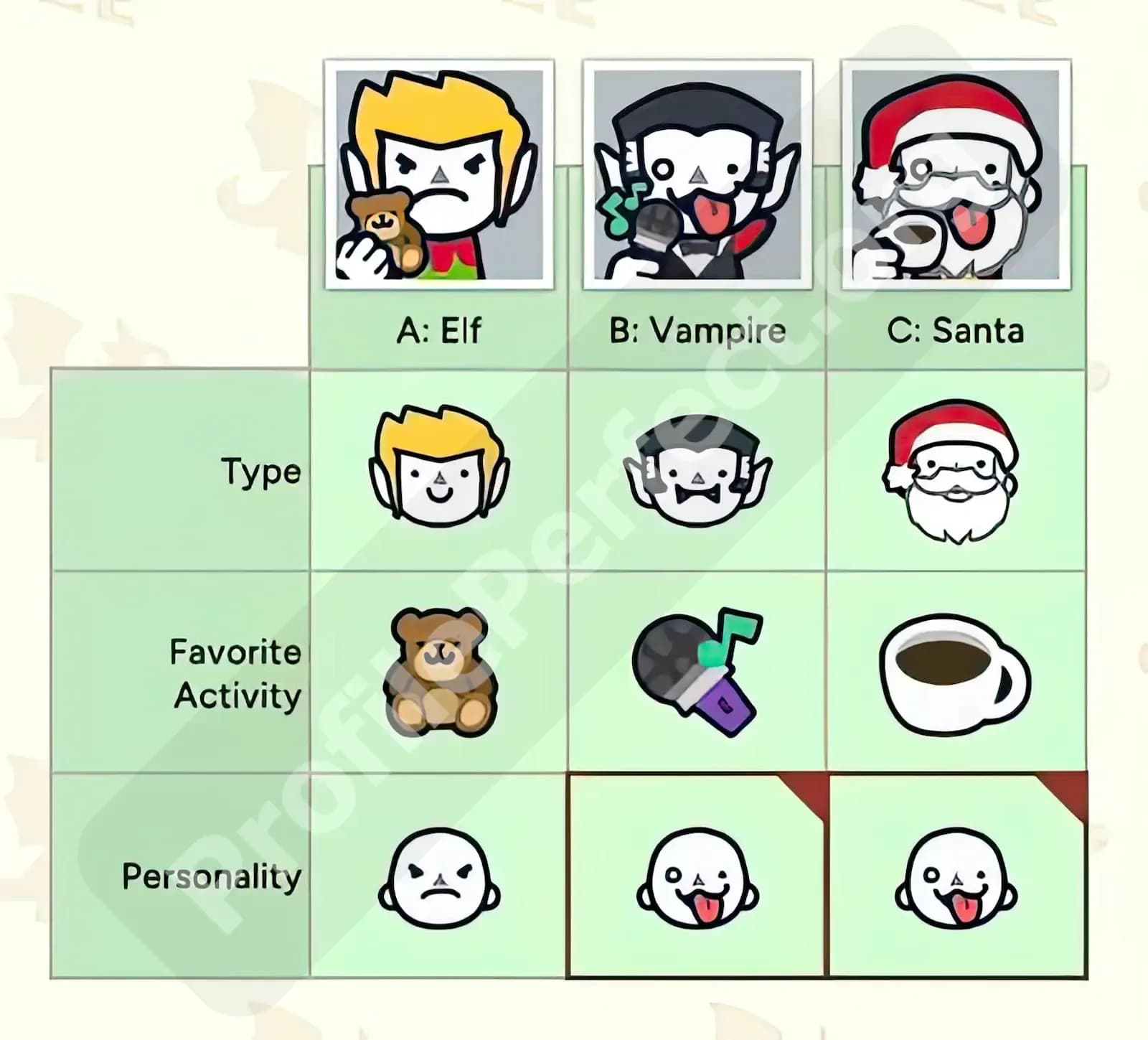
Fantasy levels add a layer of flavor. Level 25, for example, uses Elf, Vampire, and Santa as species types. The puzzle itself is not mechanically wild: you are matching type, favorite activity, and personality. But because “Vampire” and “Santa” carry fantasy associations, your brain may overthink it. The clue says Santa and Vampire are both Goofy. That’s not lore. That’s just a direct match. The banger move is to treat those names as labels first, not stories.
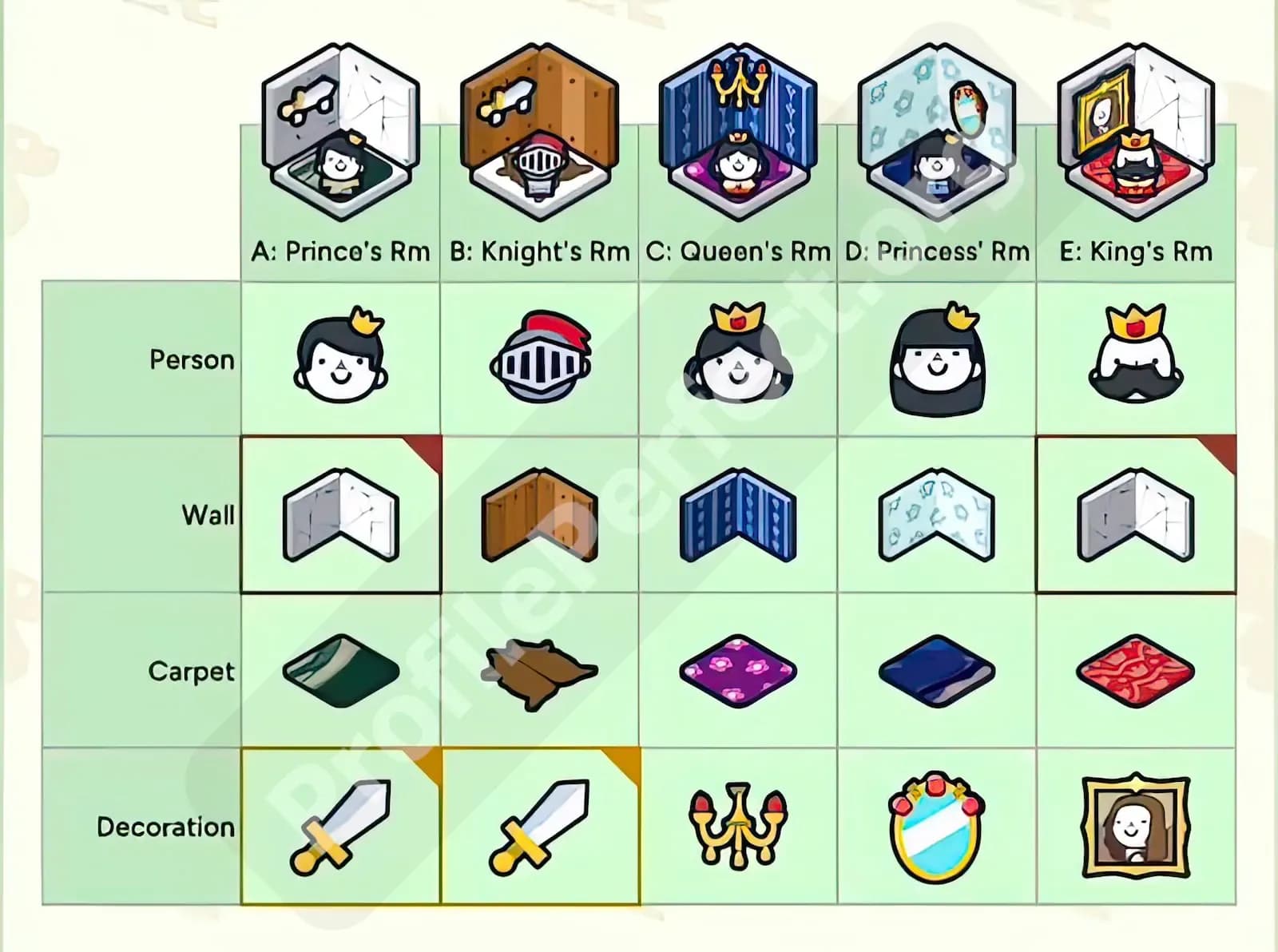
Level 28 shifts into a royal-room setup with Prince, Knight, Queen, Princess, and King. Again, the fantasy dressing can look intimidating, but the grid is really about rooms, walls, carpets, and decorations. “Knight beside the Chandelier” is just a spatial clue. “Prince and King have the same type of Wall” is just a shared-trait clue. Don’t let the castle aesthetic nerf your logic.
The further you go, though, the game starts demanding more vocabulary awareness. That’s where the guide becomes useful.
Before solving, scan every clue and circle the fantasy nouns in your head. Then assign each noun to a trait category.
For example, in a portal level:
Portal = subject Sign = zodiac row Destination = place row Guardian = creature row Entrance Fee = value row
That one mental pass prevents chaos. In Level 31, the words Underworld, Fairy, Wizard, Red portal, Leo, Aries, Capricorn, Gemini, Ghost, Volcano, Sky Palace, Zen Garden, Elf, and Angel all sound like a lore dump. But they map cleanly into five rows: Color, Sign, Destination, Guardian, and Entrance Fee.
The first clue says the portal to Underworld is guarded by Fairy. That is not a scary clue. It is a clean bridge between Destination and Guardian. The rightmost portal has Leo sign? That locks a position. Wizard guarding the Red portal? That links Guardian and Color. Once you strip the fantasy paint away, the loop becomes familiar.
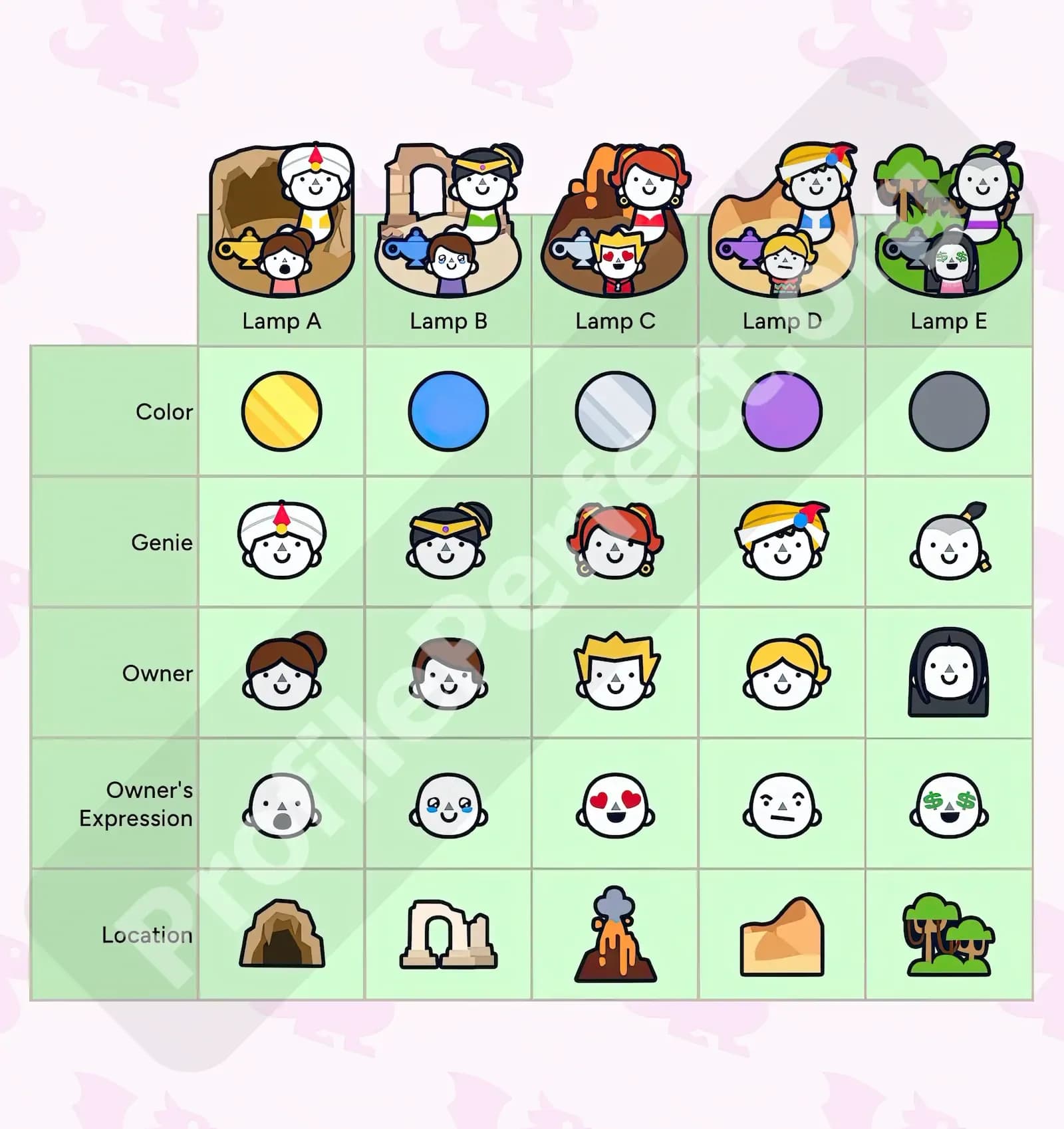
Level 250 is a great genie example. The subjects are Lamp A through Lamp E, and the rows include Color, Genie, Owner, Owner’s Expression, and Location.
The first thing to decode is that genie names are not the subjects. Lamps are the subjects. The genie is one trait attached to each lamp.
That sounds obvious, but it matters. If a clue says “Pari’s lamp was found by Will,” the match is not just Pari = Will. It is Lamp B, or whichever lamp holds Pari, also belongs to Will. Same with “Nazir was sleeping in Purple lamp.” Nazir maps to the Genie row, Purple maps to Color, and eventually the owner and location fall into place.
This is where Profile Perfect can feel floaty if you rush. “Someone planning to buy a Bugatti” points to the Money Face expression. “Zoe was travelling around Gobi” points to Desert. “Zobaa’s last owner hid her lamp in Eisriesenwelt” points to Cave. The fantasy clue is doing double duty: part mythology, part common-knowledge translation.
My rule: solve the lamp’s physical facts first. Color and location are usually more concrete than owner expressions. Once Gold, Blue, Silver, Purple, and Dark Gray are placed, the genie-owner chain becomes much easier.
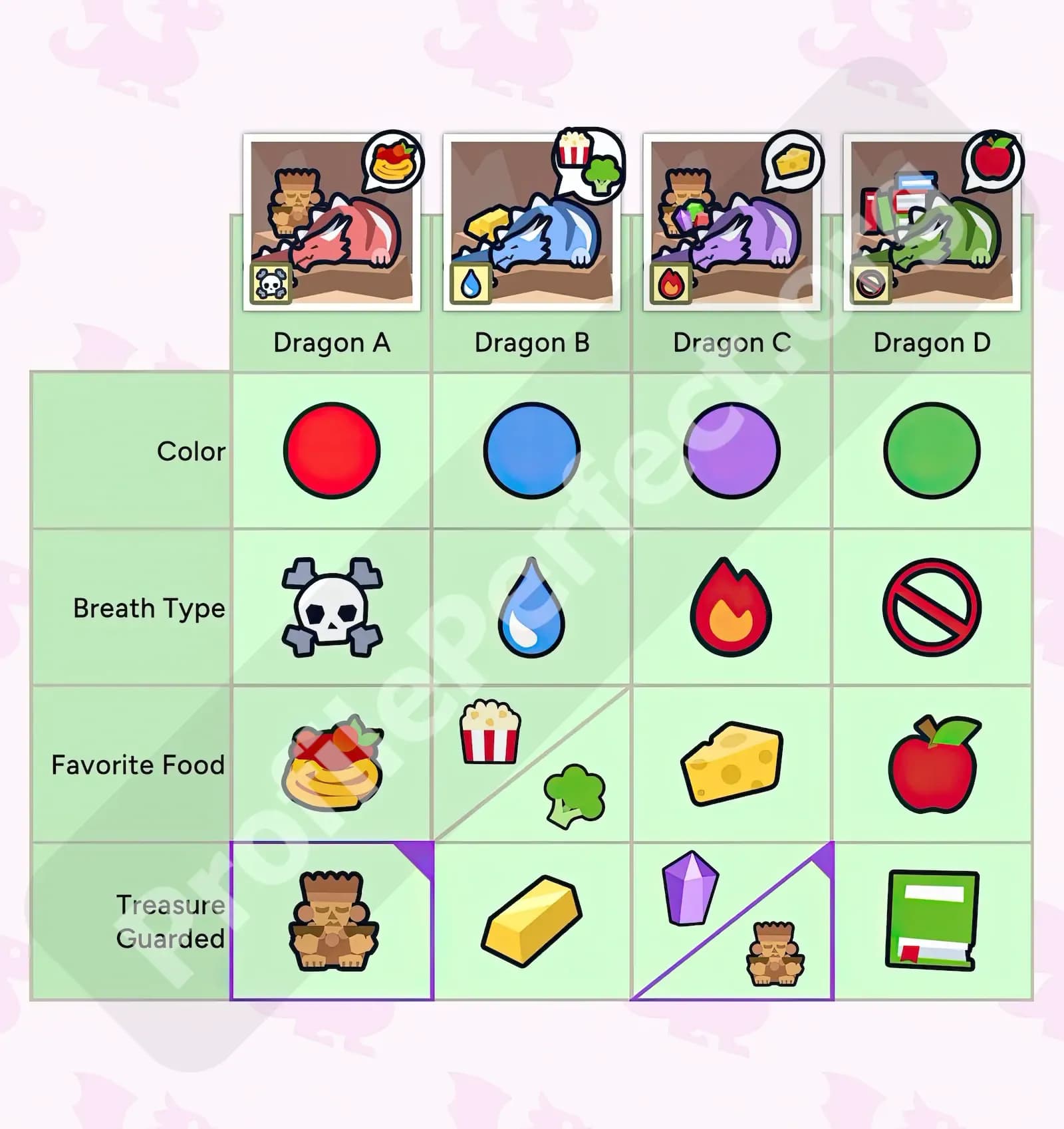
Dragons are one of the cleanest fantasy clue types because the categories are predictable. Level 245 uses Dragon A through Dragon D, then asks you to match Color, Breath Type, Favorite Food, and Treasure Guarded.
Start with breath. In fantasy logic, breath is basically the dragon’s “power type.” Fire, Water, Poison, or None are not flavor words; they are row values. The clue “The dragon that protects the Books has normal breath” means Books = None. “The Fire dragon is neighbor to the normal one” creates a direct spatial relation. “Red Dragon is known as the Toxic Giant” links Red with Poison.
Then move to treasure. Gold, Gems, Books, and Artifact are the fantasy equivalent of possessions. The clue “Dragon with multiple treasures does not have Gold” is a classic elimination clue. Don’t tap randomly. Mark Gold away from the multi-treasure dragon, then use nearby clues to squeeze the row.
Food clues are the funniest because they often disguise simple answers. “Long yellow food topped with red sauce” means Spaghetti. Beautiful stone protectors means Gems. Once you translate the clue, the level loses its teeth.
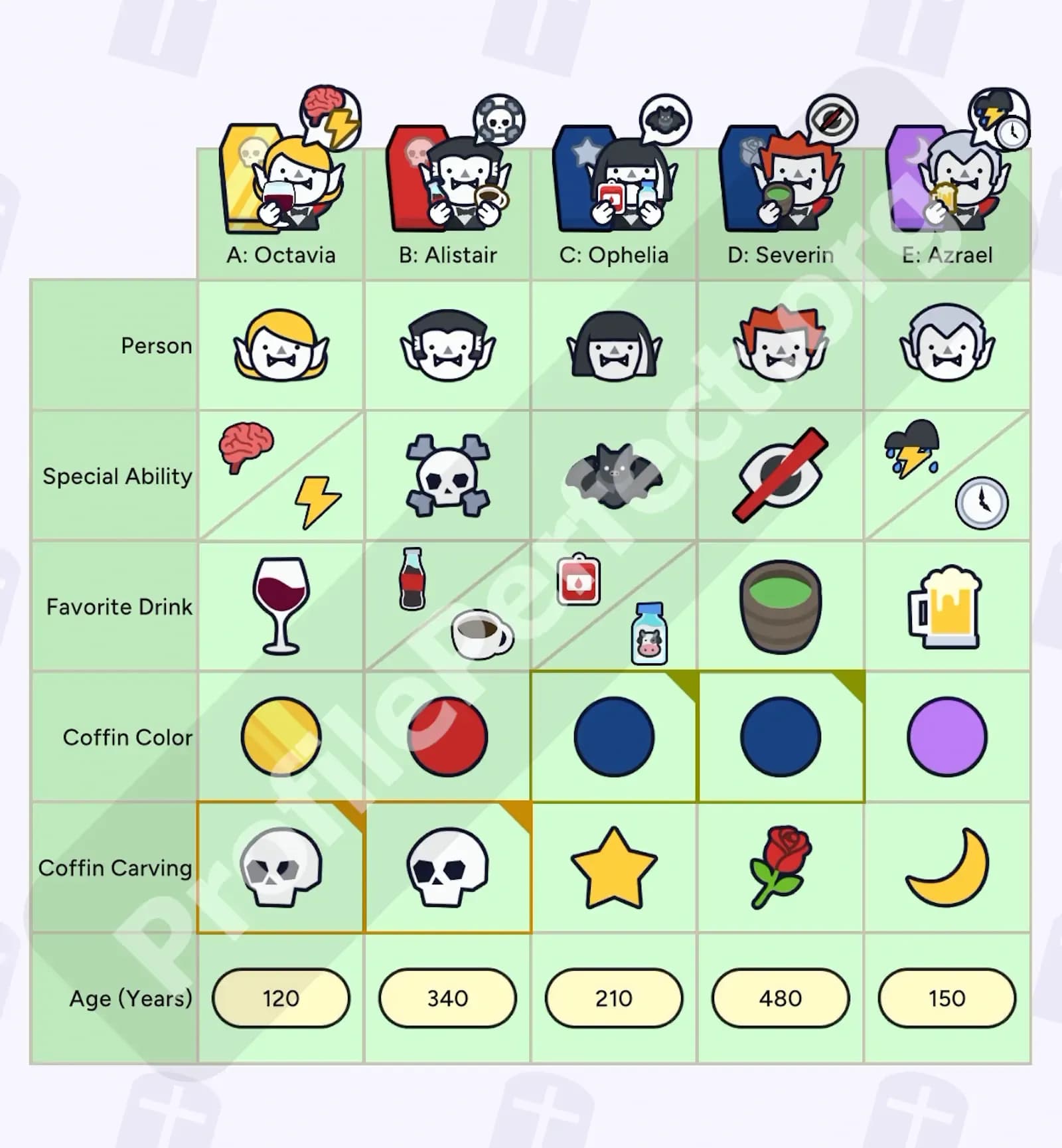
Vampire levels can look like a shambling corpse of too many gothic nouns, but they’re usually structured beautifully. Level 360 has Person, Special Ability, Favorite Drink, Coffin Color, Coffin Carving, and Age.
The key is to separate vampire flavor from hard logic.
“Ophelia reminisces about her life over the past two centuries” means Ophelia is around 210 years old. “The youngest vampire is at the far left” is a position clue. “The unnoticeable Severin has a Navy coffin” points to Severin and Invisibility. “A vampire disguises itself as a bat” points to Transformation. “Vampire that likes Blood does not have a disposable army” means Blood is not paired with Summon Skulls.
Also watch the drink clues. Blood, Milk, Wine, Beer, Tea, Coffee, and Soda can overlap with vampire jokes, but they still behave like grid values. “Adrenaline-rush drinks” points to Coffee or Soda. “Worldwide collection of leaves” points to Tea. It’s cheeky, but fair.
The biggest trap is assuming all vampire clues are about Blood. They aren’t. Profile Perfect loves using vampire theming to distract you from age math, coffin symbols, and ability placement.
For spell-heavy levels, decode elements before incantations.
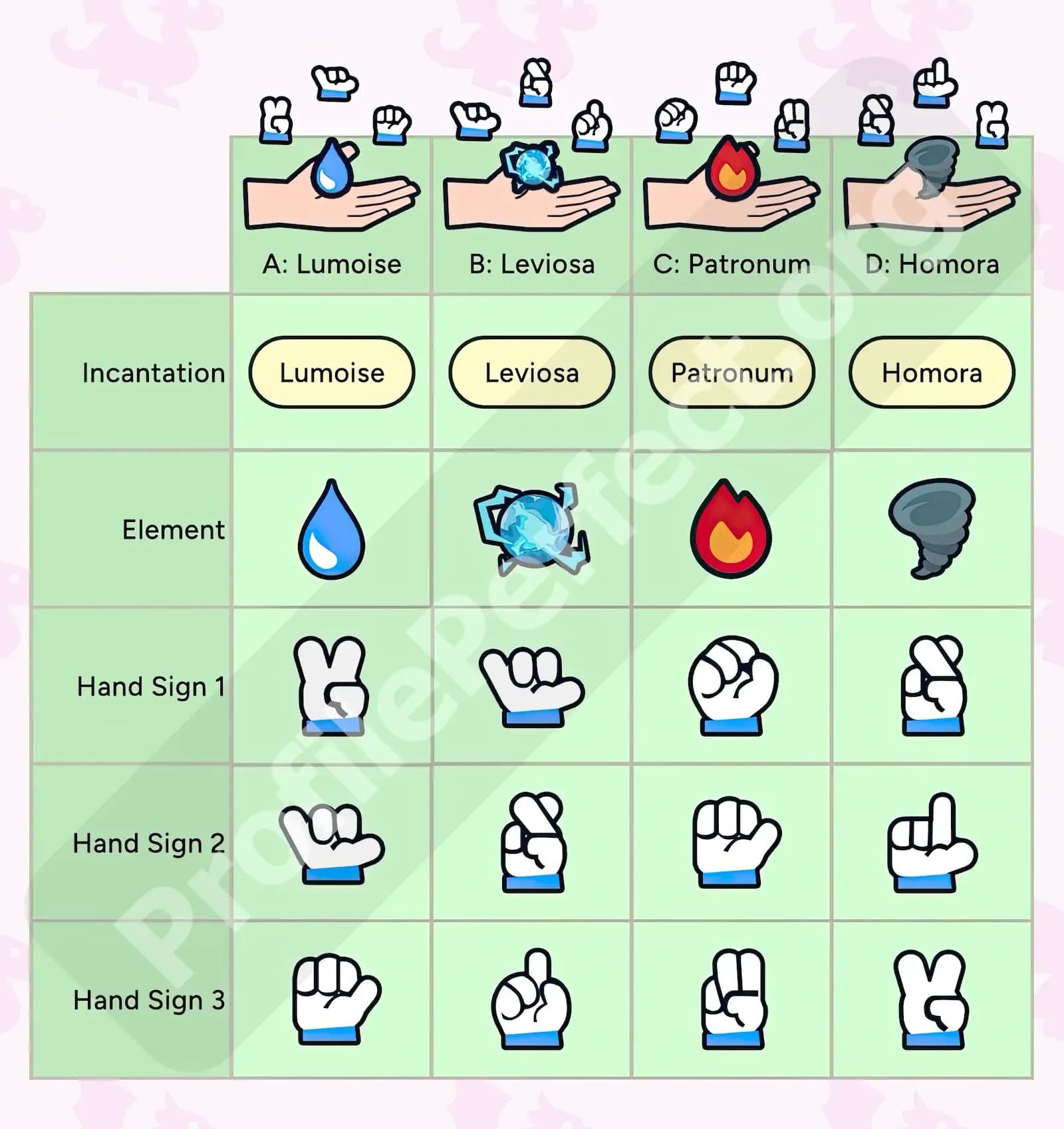
Level 246 uses spells with Incantation, Element, and three Hand Sign rows. Hydro, Pyro, Gust, and Arcane are the anchor words. Hydro means water. Pyro means fire. Gust means wind. Arcane means magic. Once those are clear, the made-up incantations like Lumoise, Leviosa, Patronum, and Homora become labels.
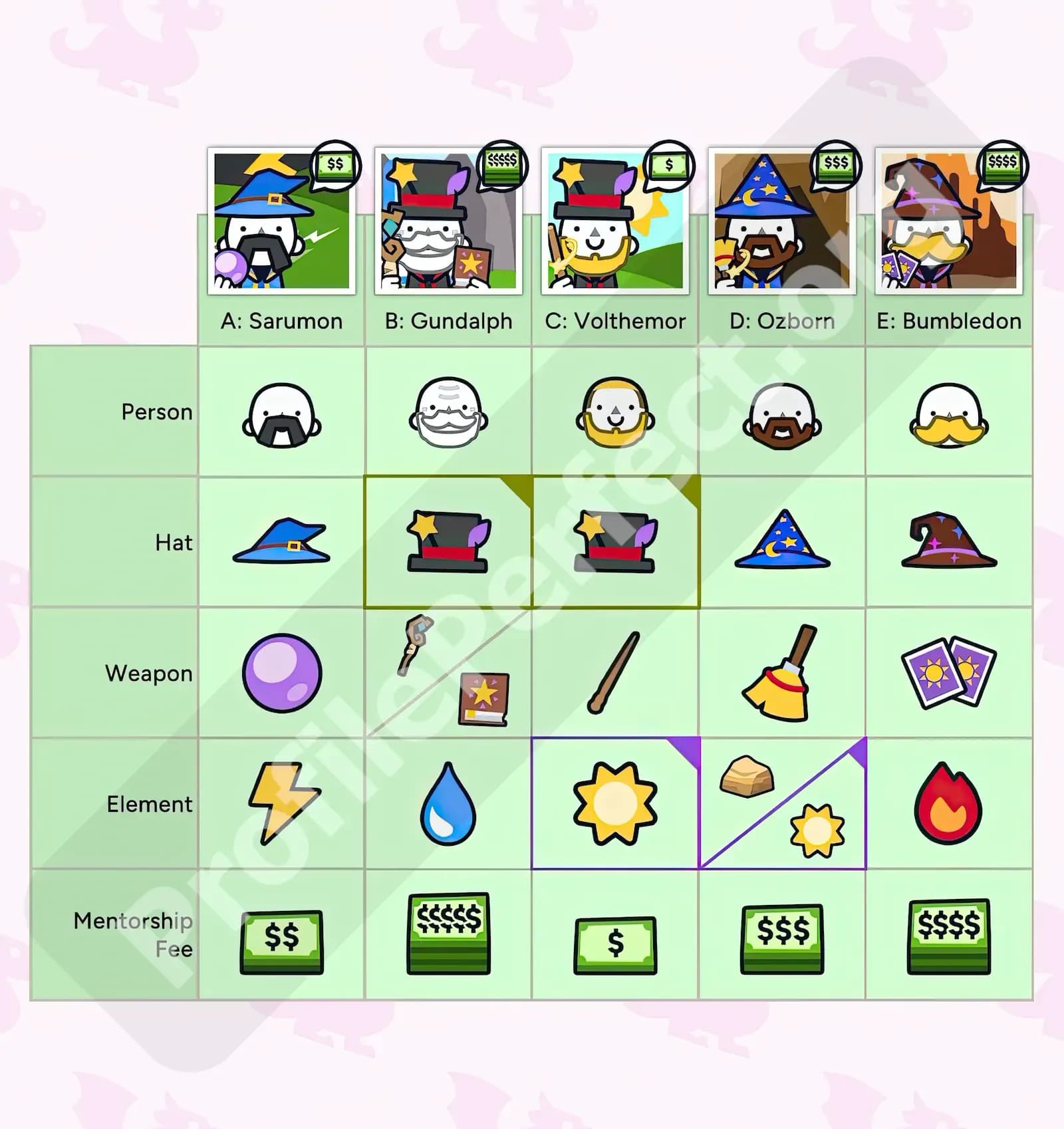
Level 247 does the same thing with wizards. Sarumon, Gundalph, Volthemor, Ozborn, and Bumbledon are parody-style wizard names, but the real solve runs through Hat, Weapon, Element, and Mentorship Fee. “Gundalph the Blue is named after the element he masters” points toward Water. “The pointy hat wizard defeated a witch and stole her vehicle” points to Broom. “There are 2 wizards that can cast the lumière spell” points to Light.
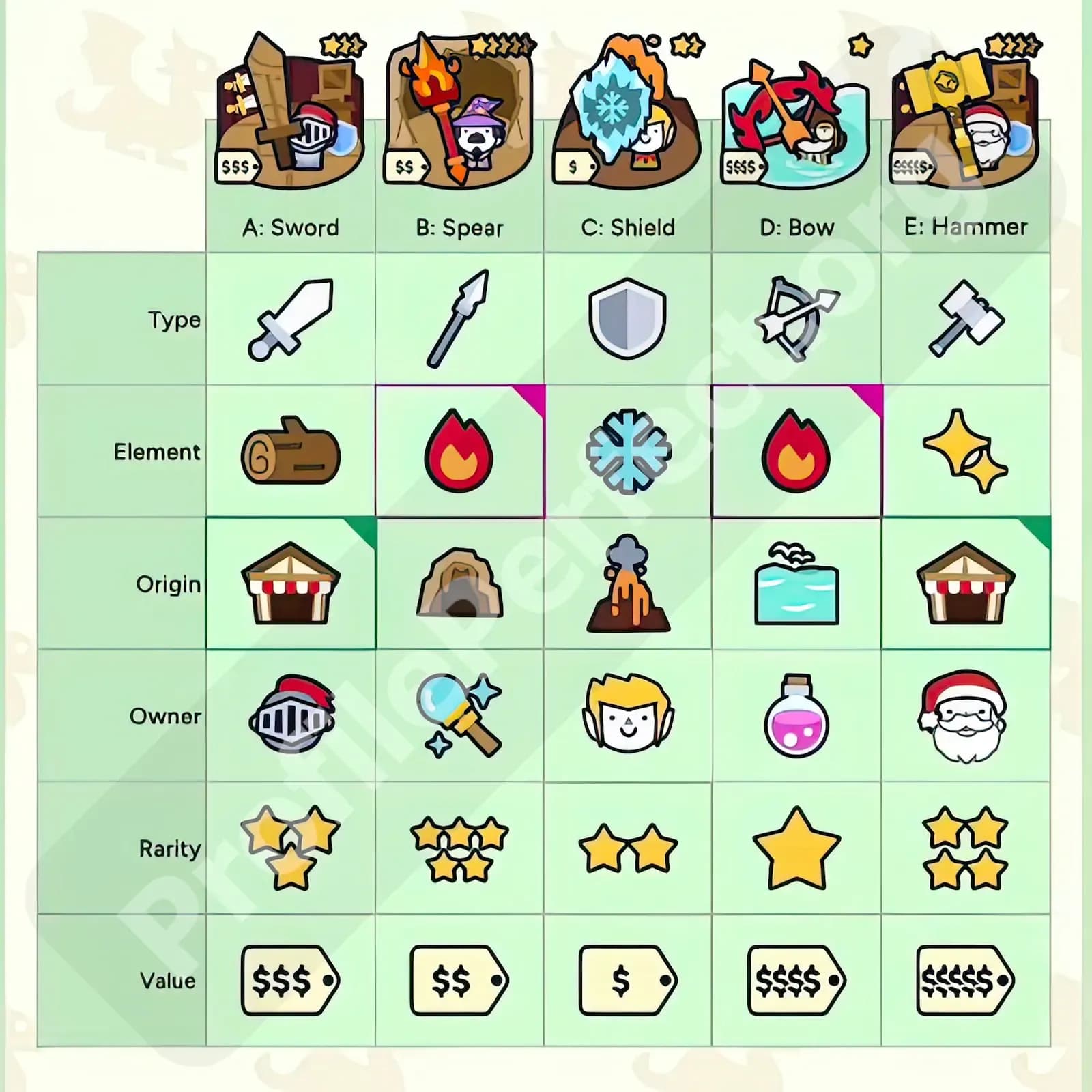
In Level 32, magical weapons add another layer: Sword, Spear, Shield, Bow, Hammer, Fire, Ice, Wood, Light, Cavern, Volcano, Ocean, Wizard, Elf, Alchemist, Santa. The trick is to treat weapon type and element as separate rows. A Fire weapon is not automatically from Volcano. The level may pair Fire with Cavern or Ocean to mess with your assumptions. Don’t let fantasy instinct override clue logic.
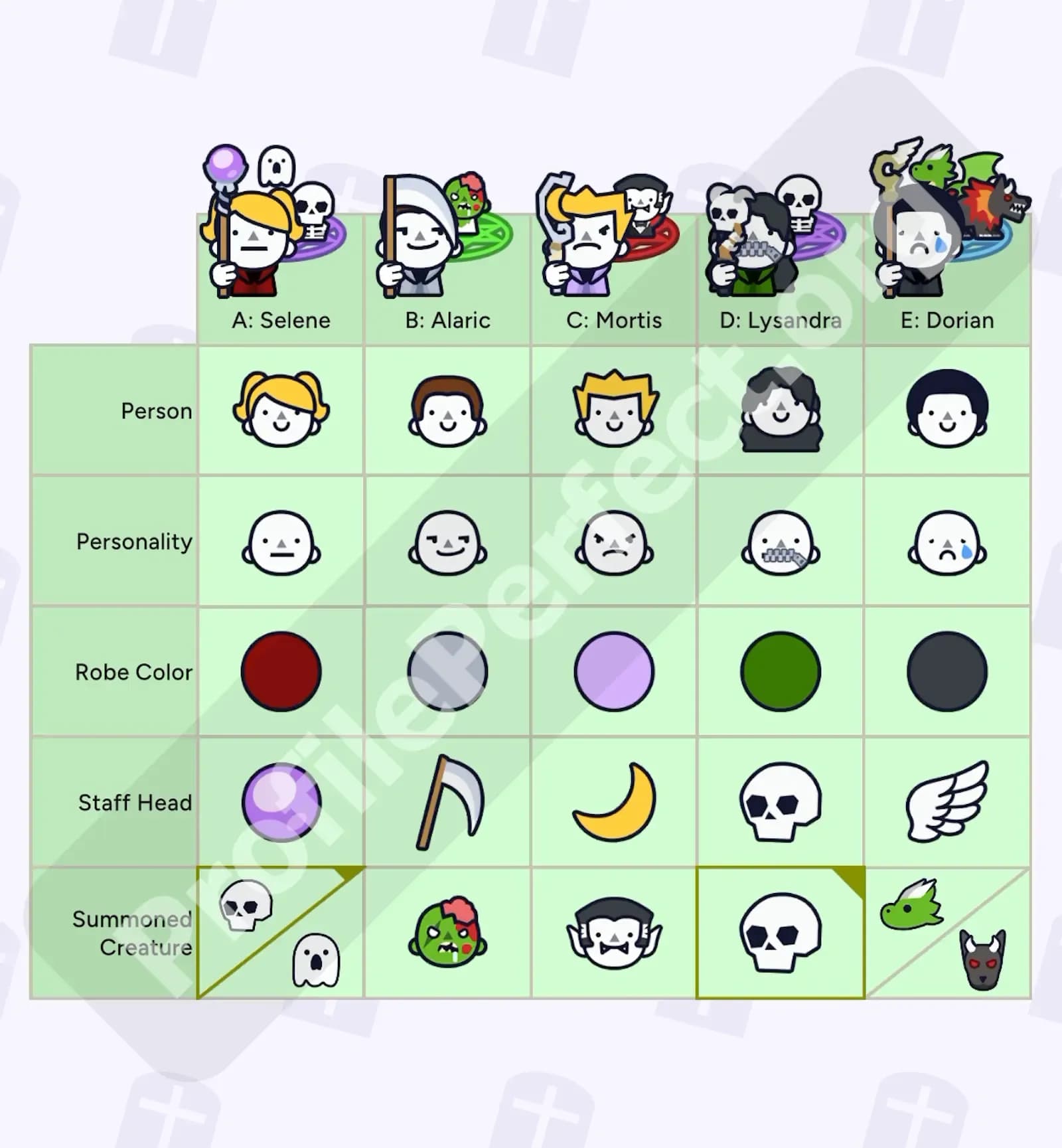
Level 356 is a late-game fantasy gauntlet. Necromancers summon Skeleton, Ghost, Zombie, Vampire, Dragon, and Hound. The clue “Necromancer E can call forth Cerberus” is the big vocabulary check. Cerberus means Hound. If you don’t know that, the whole level feels unfair.
This is the exact kind of Profile Perfect clue where common knowledge matters. “Phoenix slayer” links to Wing staff. “Sharp staff” points to Blade. “No foul, rotten odor” points away from Zombie. The level is still logical, but it expects you to translate creature mythology into grid terms.
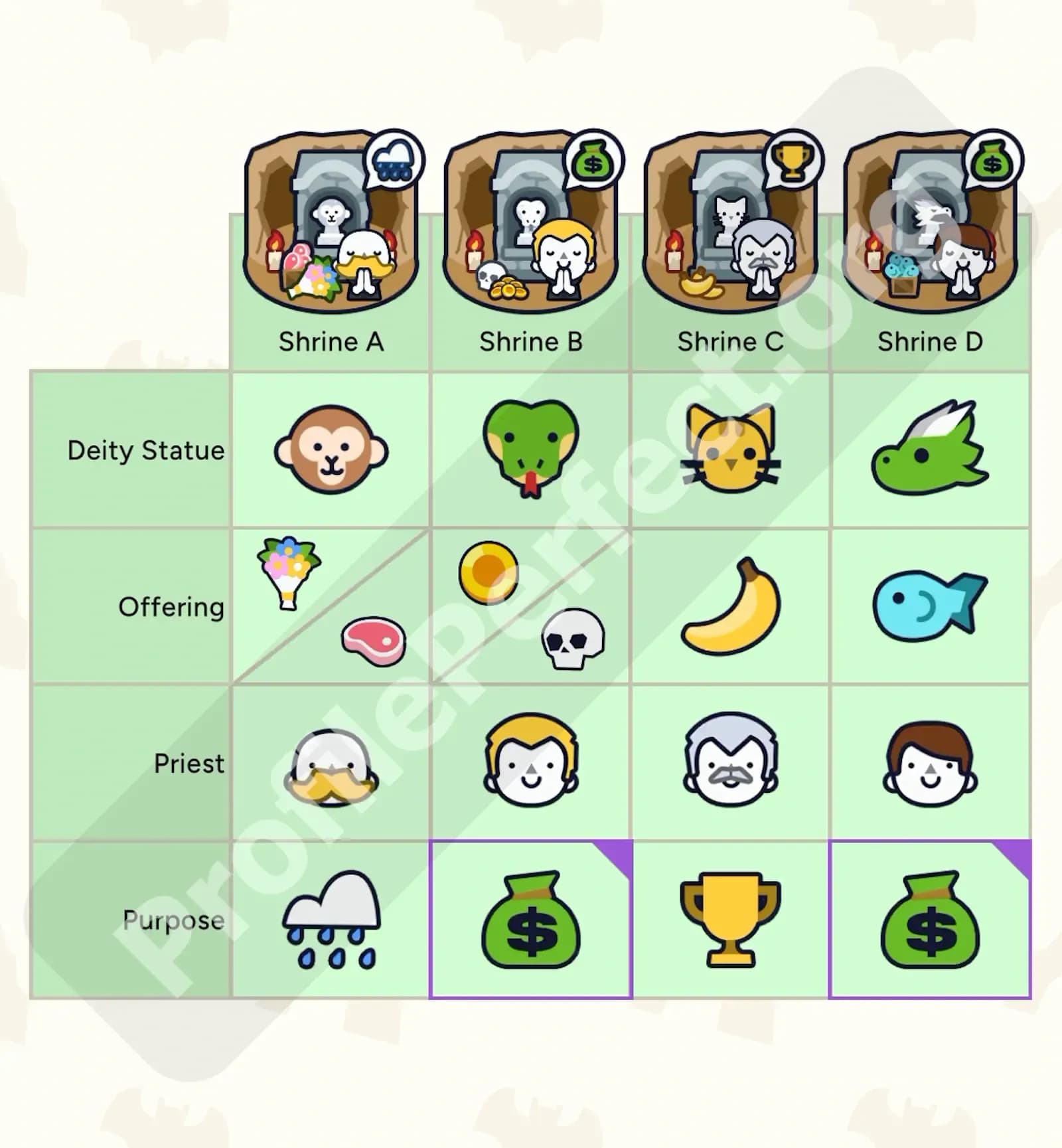
Level 392 uses shrine and deity language. Monkey, Snake, Cat, and Dragon are statue values. Offerings like Coin, Skull, Banana, Fish, Flower, and Meat become the matching items. “Money is required to make more money” points to Coin and Wealth. “Deity to the left of the Dragon does not exist in Chinese Zodiac” points to Cat, because Dragon exists in the Chinese zodiac and Cat does not. That clue is a neat little knowledge check.
Before you tap anything in Profile Perfect fantasy stages, do this:
First, identify the subjects. Are you solving lamps, dragons, portals, spells, weapons, vampires, shrines, or necromancers?
Second, translate the fantasy nouns into row categories. Genie goes under lamp identity. Breath goes under dragon power. Blood goes under drink. Zodiac names go under sign. Hydro and Pyro go under element.
Third, place direct clues first. “Portal C is Underworld,” “Dragon D protects Books,” “Purple coffin has Moon,” and “Silver lamp is in the middle” are free anchors.
Fourth, handle spatial clues only after anchors are placed. “Next to,” “between,” “left of,” “right of,” and “farthest from” become much stronger once you know at least two fixed positions.
Finally, never guess because a word feels right. Fantasy theming is designed to bait assumptions. A Fire weapon might not come from a Volcano. A vampire may prefer Tea. A dragon may eat Spaghetti. That’s the joke, and it’s also the puzzle.
The magic levels in Profile Perfect are not unfair once you learn the language. They’re just asking you to become a translator before you become a detective. Decode the nouns, lock the obvious matches, and let the grid do the rest.