
Learn why color is the best anchor trait in Profile Perfect, with examples from Levels 13, 23, 32, 44, 58, and 66 to connect clues and solve faster today.

Guide By Liam Stone
Published on June 10, 2026
Liam Stone has played Profile Perfect since the app first launched on the Apple App Store. He spotted its potential early, and that early bet turned into hundreds of hours spent solving levels, testing clue logic, and documenting answers for other players. Liam runs the YouTube channel Puzzle Game Answer where his puzzle walkthroughs have earned over 935,000 views and a growing community of more than 800 subscribers. He covers a wide range of mobile puzzle games beyond Profile Perfect, giving him firsthand experience with how these games design clues, structure levels, and trip up even experienced players. Every guide on this site reflects that hands on experience. Liam plays each level himself, verifies every answer against the in game grid, and rewrites confusing clues into plain language so you don't need to guess. If you want more of his walkthroughs, subscribe to his channel.
Loading calendar...
Color clues look simple. That’s exactly why players underrate them.
In Profile Perfect, I’ve learned to treat color as one of the strongest anchor traits in the whole game. When a clue says “the Blue building,” “the Black coffee,” or “the GreenCoin,” it usually isn’t just describing an object. It’s giving you a hook that can connect multiple rows at once: person, object, position, material, size, entry gate, activity, and sometimes even hidden values. That’s the good stuff. That’s the crunchy deduction loop that makes Profile Perfect work.
After checking the Level 1–400 data, Color appears in 76 levels, making it one of the most frequent traits across the game. That matters because frequent traits train repeatable habits. Once you learn how color behaves, you can use the same logic again and again instead of solving every level from zero.
The short rule: don’t treat color as decoration. Treat it as a central identity.
Every Profile Perfect level has subjects and traits. Subjects are the columns: Tent A, Building B, Hat C, Ticket A, Coffee B, and so on. Traits are the rows: Color, Type, Material, Owner, Activity, Size, Time, Entry Gate, etc.
Color is powerful because it often sits in the middle of the logic chain. A clue may start with a color, then point to a type. Another clue may use that type to determine a position. A third clue may use the position to solve a totally different trait.
That means one color clue can become a multi-step bridge.
For example:
“The Black tent is an A-Frame type.”
That single sentence gives you Black = A-Frame. But if another clue says the A-Frame is not beside the Multi-room tent, suddenly Black also affects placement. If Canvas belongs to the one-person tent, and the Black tent is the A-Frame, now color is helping you narrow material and capacity too.
That’s why color clues feel small but hit hard.
When I open a new Profile Perfect level, I scan for direct color clues before I touch anything risky. Direct color clues use simple language like:
“The Blue building has Wooden door.”
“The Green-Beanie is a newly released hat.”
“Coffee on the right has a White color.”
“Brown tent is next to the Red tent.”
These are safer than vague comparison clues because they usually give you either a direct match or a direct position relationship.
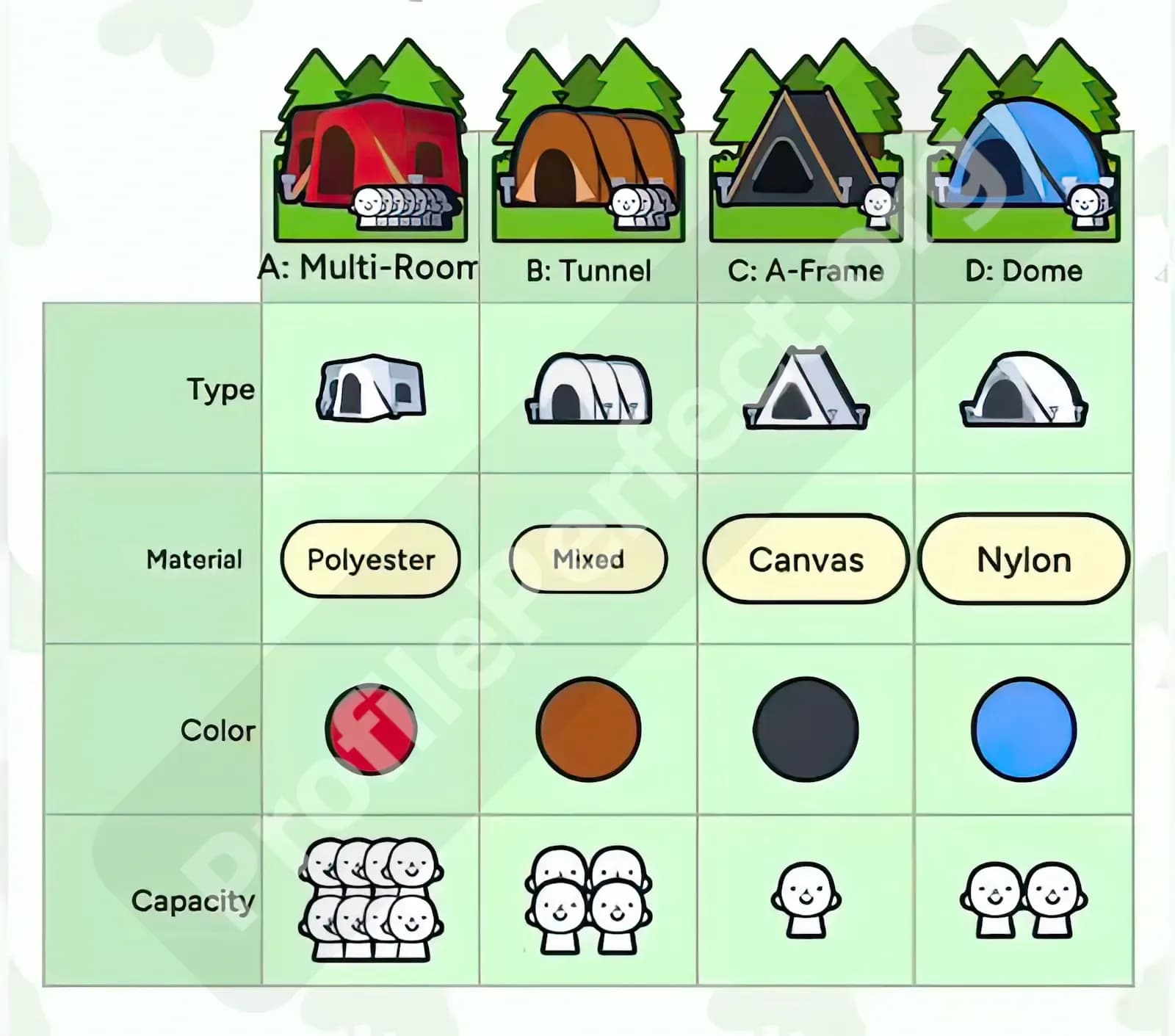
In Level 13, Tent A starts as Red, and the clue says the Brown tent is next to the Red tent. Since Tent A is Red, Tent B becomes Brown. That’s a clean anchor. No guessing, no weird vibe, no wasted life.
From there, the level gets easier. The Black tent is A-Frame, the Blue tent is Nylon, and the Dome tent is not Black. Because Tent D is already Dome, it can safely become Blue and Nylon. The color row starts solving the material and type rows before you even deal with capacity.
That’s the dream loop: color first, identity second, extra traits third.
Position clues are where Profile Perfect can get nasty. “Next to,” “left of,” “right of,” and “farthest from” can turn a harmless-looking level into a shambling corpse if you misread one word.
Color helps because it makes positions easier to visualize.
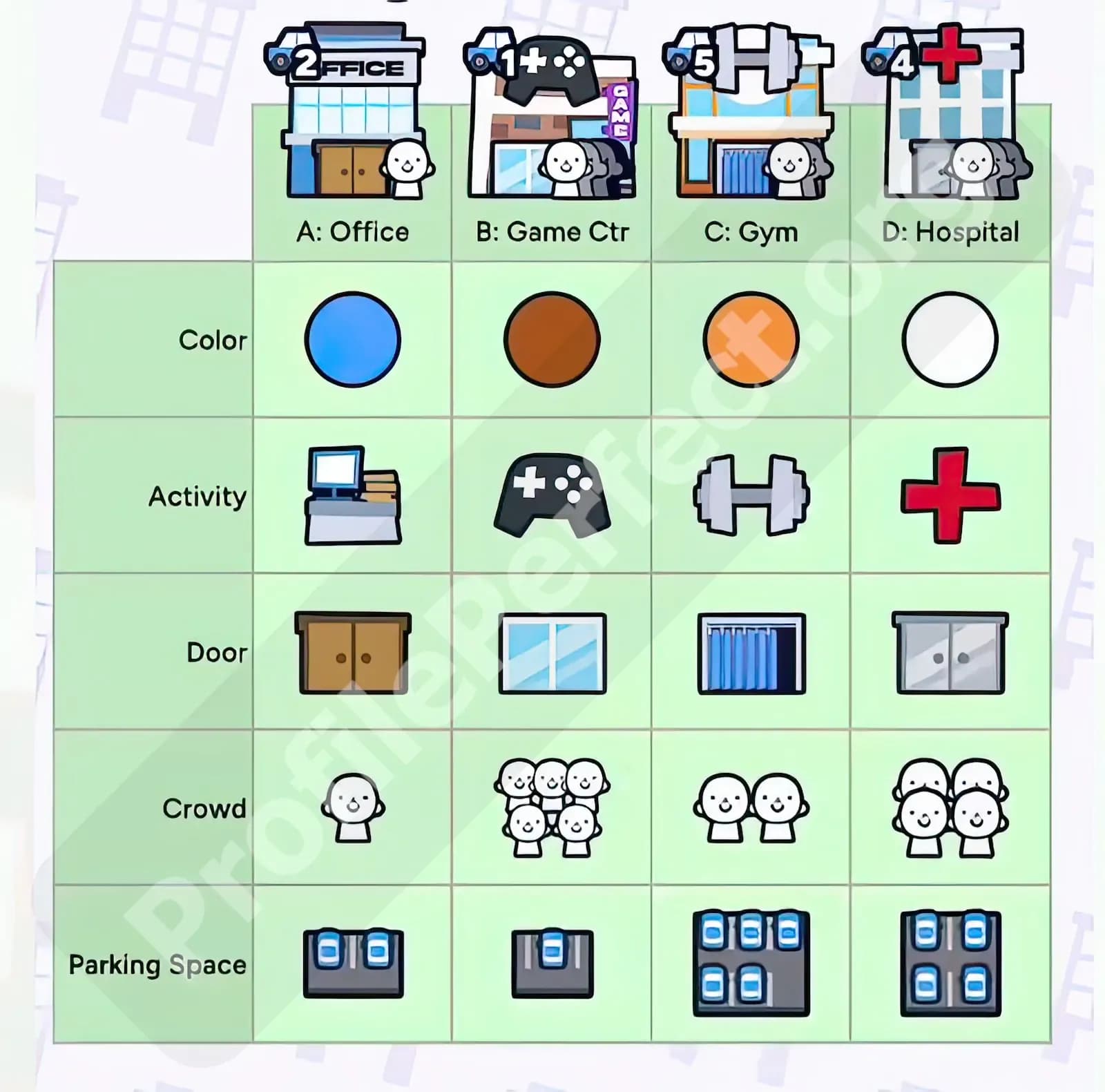
Level 23 is a great example. The Brown building is the neighbor of both the Office and the Gym. Since a subject can only have two direct neighbors if it sits between them, Brown must be Building B, with Office on one side and Gym on the other. That gives you a strong layout: Building A is Office, Building B is Brown, and Building C is Gym.
Then color keeps chaining. The White building is not next to the Glass door one. The Blue building has Wooden door. Since Building B has the Glass door, White can’t be A or C, so White lands on Building D. That leaves Blue for Building A and Orange for Building C.
Notice what happened there: Brown solved position, White solved exclusion, and Blue solved door type. Color didn’t just fill a row. It ran the whole level’s traffic system.
Profile Perfect loves compound clues. These are clues where color is glued to another trait, like “GreenCoin,” “Green-Beanie,” “Wooden-Sword,” or “Black coffee.” Don’t read these as flavor text. Split them.
“GreenCoin” means Green + Coin.
“Green-Beanie” means Green + Beanie.
“Black coffee” means Black + Coffee color, not necessarily a drink style.
This is a huge solving technique.
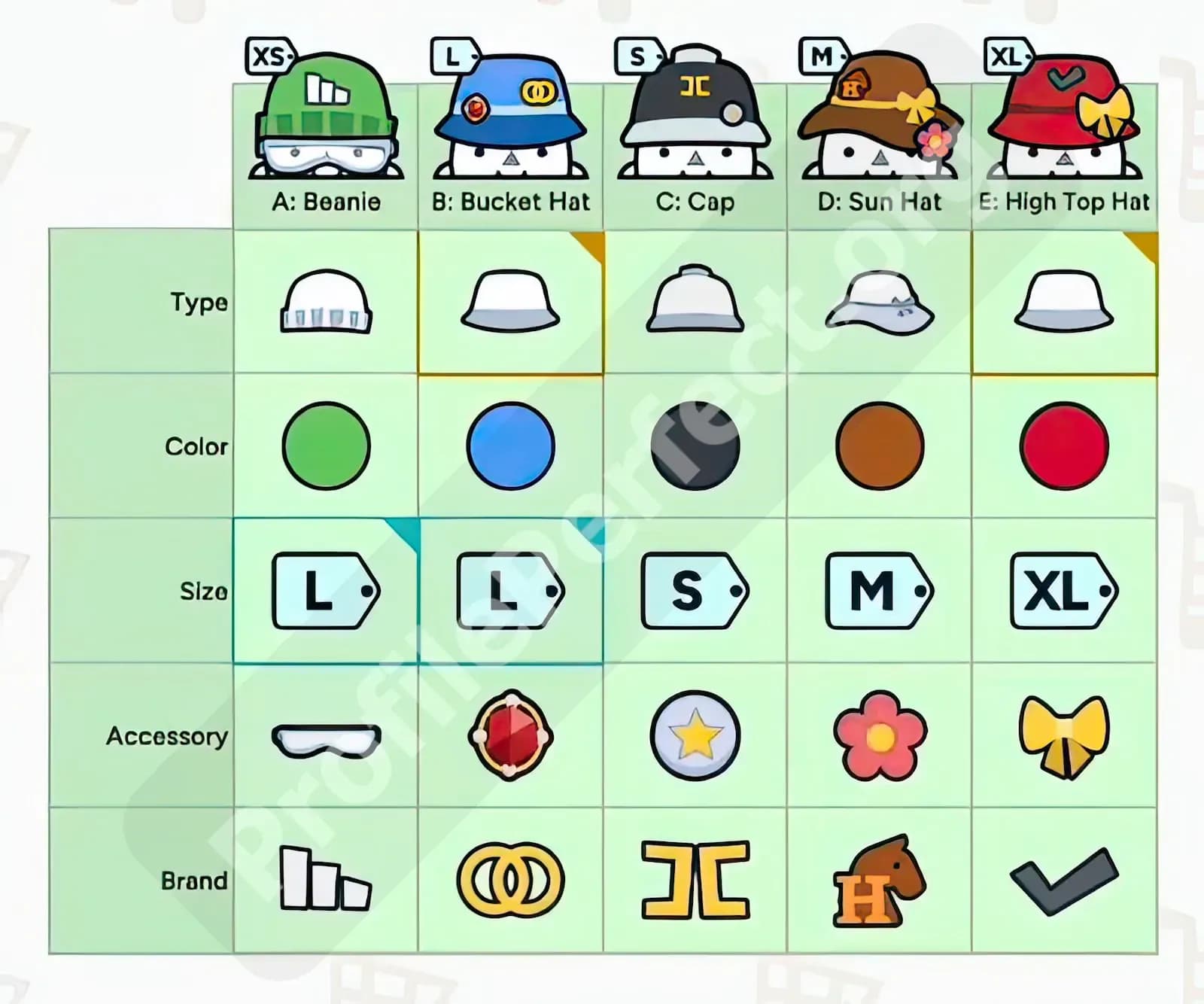
In Level 44, the clue “The Green-Beanie is a newly released hat” instantly links Hat A to both Beanie and Green. That is a banger anchor because Hat A was already Beanie. Once Green is locked to Hat A, another clue says the NyKey hat is farthest from the Green hat, so NyKey goes to Hat E. Then the Black hat is next to the Glowcci hat. Since Hat B is Glowcci, Hat C becomes Black.
Now the color row has created a clean spine: Hat A is Green, Hat C is Black, Hat D is Brown, and Hat E is Red. With Blue left over, Hat B becomes Blue. That leftover solve is not a guess. It’s the row-reduction rule doing its job.
Some Profile Perfect levels hide values from the visible starting grid, but the clues still reveal them. This is where color anchors become even more important.
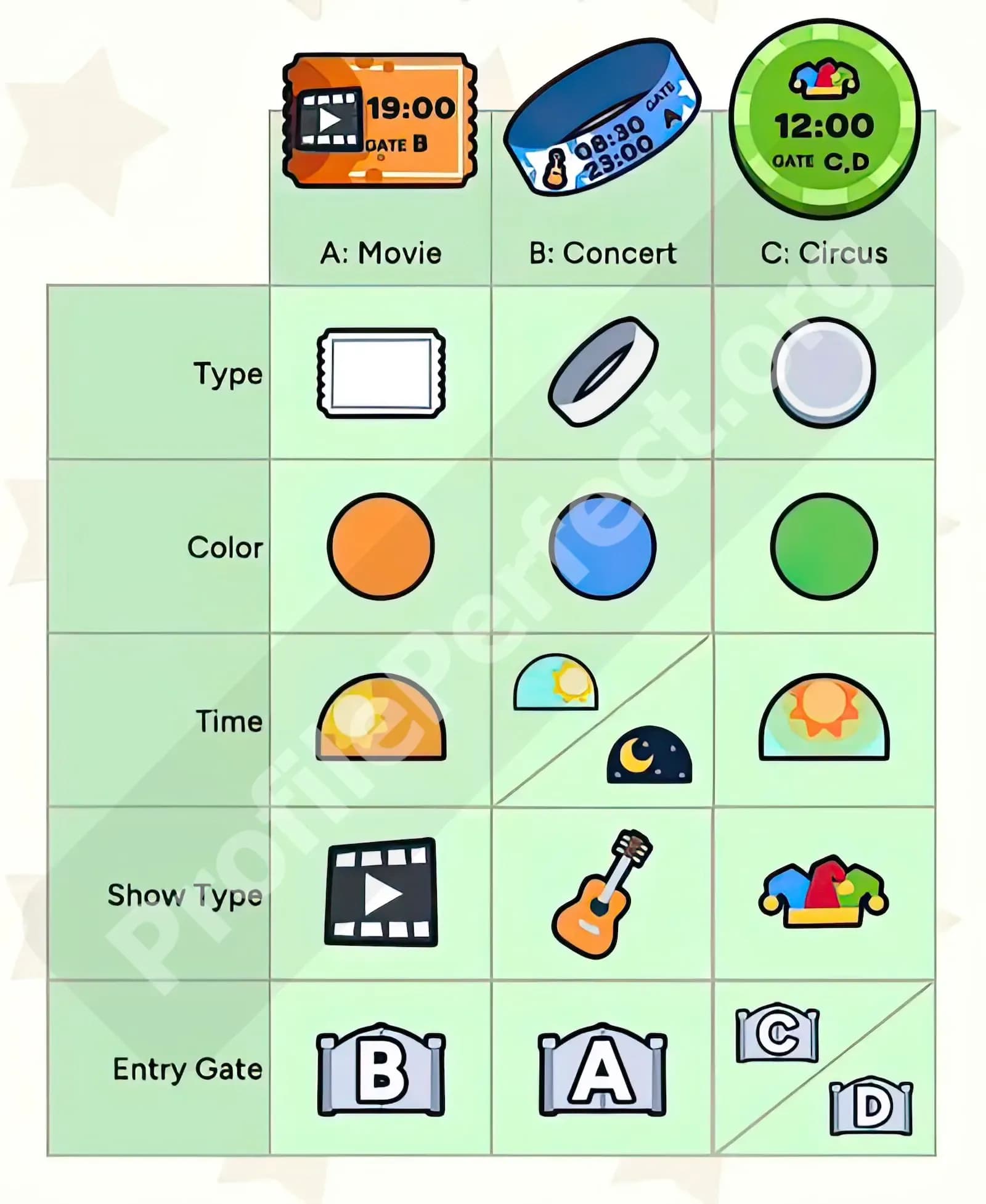
Level 58 is a compact but tricky ticket puzzle. Ticket A starts with Evening, but its Orange color is hidden. The clue “Orange ticket is required to enter gate” reveals Ticket A as Orange and links it to Gate B. Another clue says GreenCoin does not grant access to Night show. Split that into Green + Coin. Since Ticket C is the Coin and Green, it cannot be Night. That helps push Night onto Ticket B, while Ticket C takes Afternoon.
The level also has a split value: Ticket B’s time is Morning / Night, and Ticket C’s gate can be C / D. Split values can feel floaty if you rush. The safe play is to use color as the stable handle. GreenCoin gives you Ticket C. Orange ticket gives you Ticket A. Once those anchors are stable, the split values stop feeling random.
“Only” clues are some of the strongest clues in Profile Perfect. When they include color, respect them immediately.
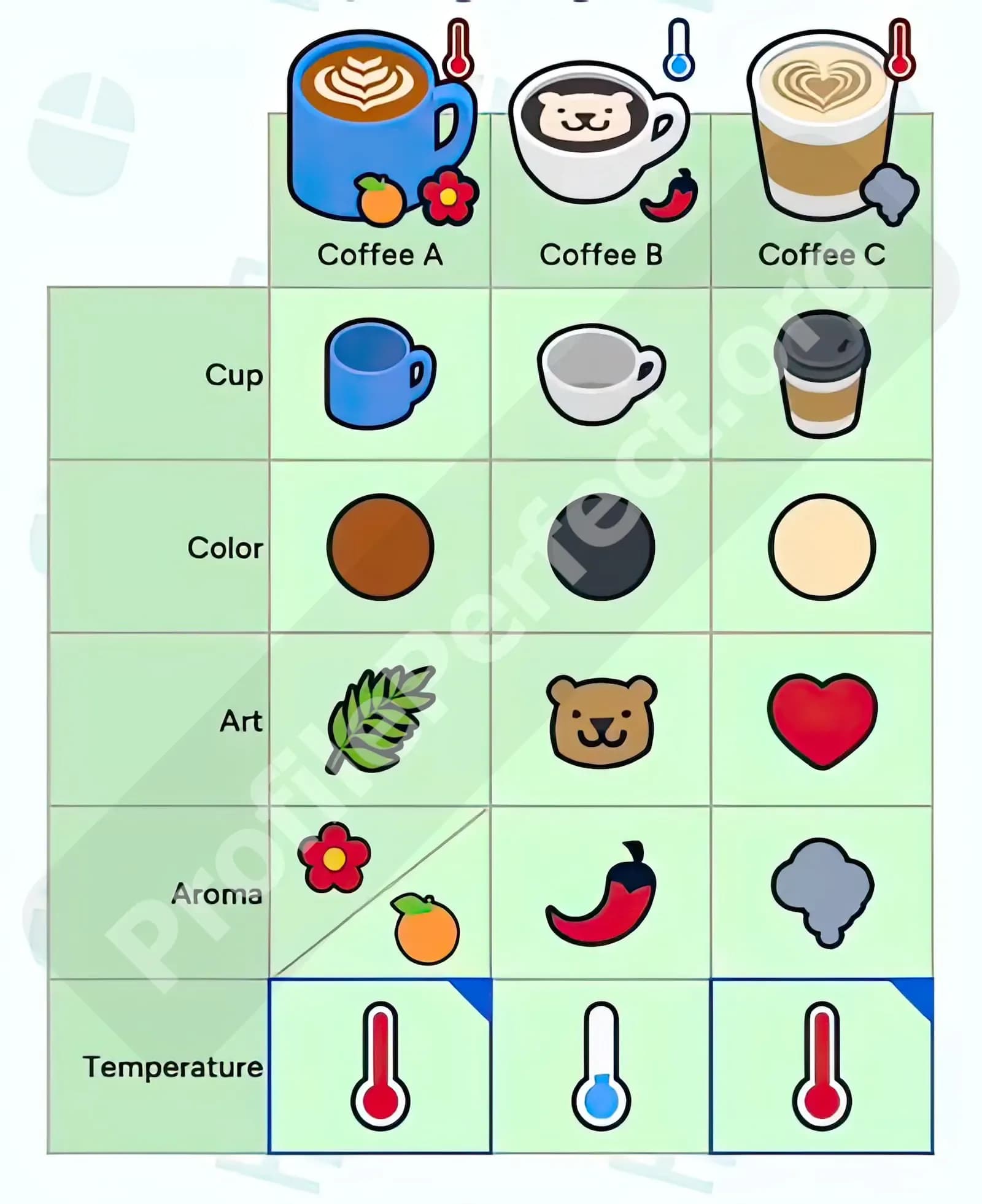
Level 66 says, “The Black coffee is the only Cold one.” That means two things at once: Black = Cold, and every non-Black coffee is not Cold. Since Coffee C is White and Coffee A becomes Brown through the Mug clue, Coffee B must be Black and Cold.
That clue is a tank. It doesn’t just solve Coffee B’s color and temperature; it protects Coffee A and Coffee C from wrong temperature guesses. Then the Mug cup has Brown coffee, Coffee C is White, and Paper Cup belongs to Coffee C. Color becomes the bridge between cup, temperature, art, and aroma.
This is also where players lose lives. They see “only Cold one” and tap too quickly without applying the negative side. The better move is to mark Black = Cold, then mentally mark Brown and White as Hot. In Profile Perfect, the negative space matters just as much as the checkmark.
Here’s the one nerf to this whole strategy: not every color word belongs to the Color trait.
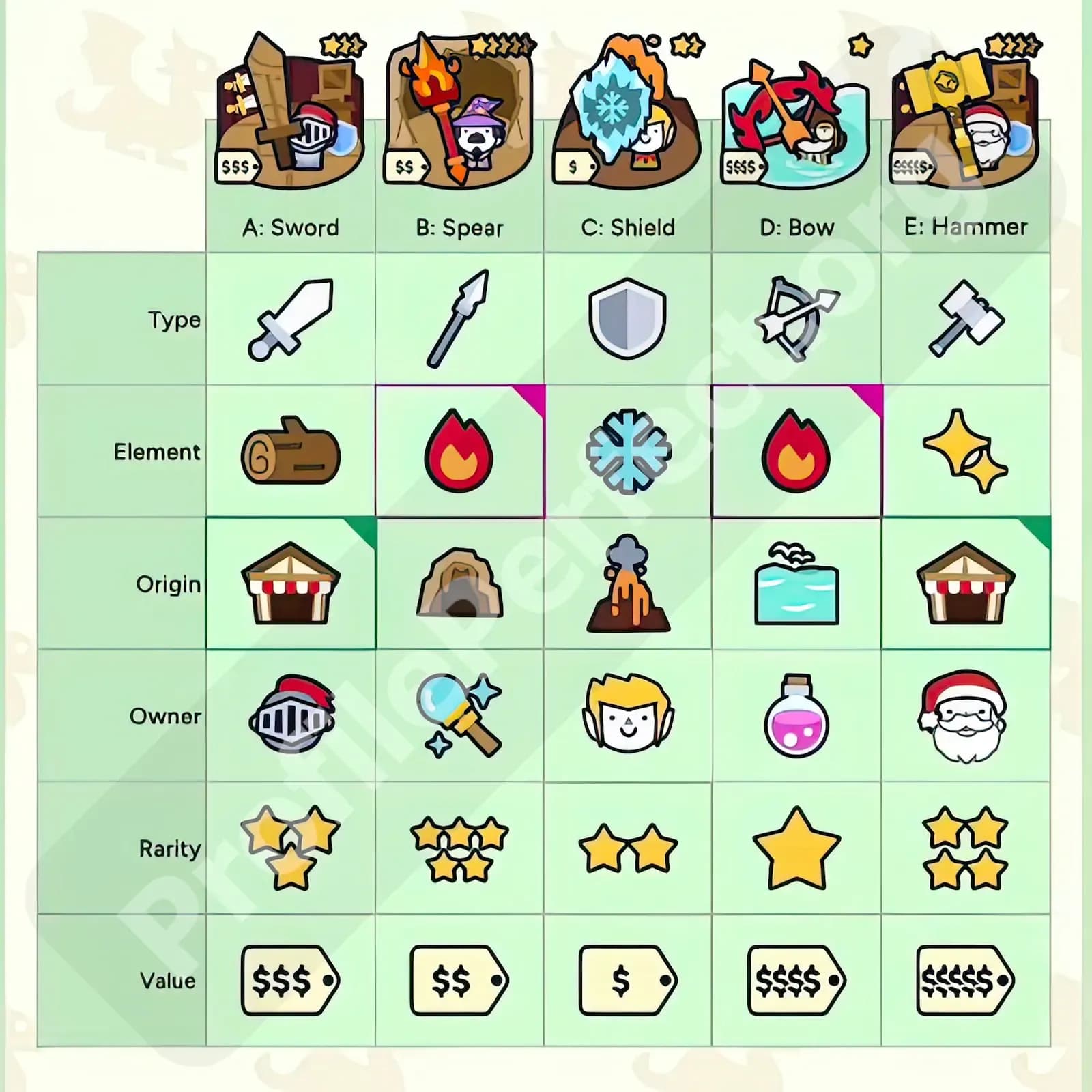
Level 32 is the warning shot. It has “Wood” as an Element, not a Color. The Wooden-Sword clue links Sword + Wood + Star3 + $$$, but Wood is part of the Element row. If you treat it like a color clue, you’ll get your grid logic twisted.
That said, the same anchor method still works. The “Wooden-Sword” is a compound clue, so split it into Type = Sword and Element = Wood. Then connect rarity and value. The technique is the same; the row label changes.
This is why you should always read the trait list before tapping. Is “Black” under Color? Is “Wood” under Material or Element? Is “Brown” a color, or part of a named object? Profile Perfect loves these tiny language traps.
Here’s the routine I recommend:
First, scan all clues for color words before making moves. Red, Blue, Green, Black, White, Brown, Orange, and similar words are usually high-value.
Second, separate direct color matches from position clues. “A is Blue” is immediate. “Blue is next to Glass” needs placement logic.
Third, split compound words. GreenCoin becomes Green + Coin. Green-Beanie becomes Green + Beanie.
Fourth, apply “not” and “only” clues carefully. “Black is the only Cold one” means non-Black subjects are not Cold.
Fifth, use leftovers only after the row is almost solved. If four hats already have Green, Black, Brown, and Red, then the final hat being Blue is deduction, not guessing.
Level 13 teaches color as a neighbor anchor: Red leads to Brown, Black leads to A-Frame, Blue leads to Nylon.
Level 23 teaches color as a layout tool: Brown sits between Office and Gym, White avoids Glass, Blue takes Wood door.
Level 32 teaches you not to misread trait labels: Wood is an Element, but the compound-clue method still applies.
Level 44 teaches color as a brand and size connector: Green points to Beanie, Black points near Glowcci, Red avoids Black.
Level 58 teaches hidden color logic: Orange and Green are not always visible at first, but they still drive the answer.
Level 66 teaches “only” logic: Black is the only Cold coffee, making the other coffees Hot by elimination.
Color is one of the most reliable traits in Profile Perfect because it’s easy to recognize, frequent across levels, and deeply connected to other rows. When you use colors as anchors, the puzzle stops feeling like a messy pile of clues and starts feeling like a clean deduction chain.
The big mistake is treating color like a cosmetic label. Don’t. In Profile Perfect, color is often the fastest route from uncertainty to control. Lock the color anchors, connect them to type or position, let row-reduction clean up the leftovers, and save your lives for the truly weird clues.
That’s how you solve faster without guessing.