
Learn how to chain clues in Profile Perfect with transitive logic, anchor clues, and examples from 15, 19, 28, 40, and 52 to solve faster without guessing.


Guide By Liam Stone
Published on June 10, 2026
Liam Stone has played Profile Perfect since the app first launched on the Apple App Store. He spotted its potential early, and that early bet turned into hundreds of hours spent solving levels, testing clue logic, and documenting answers for other players. Liam runs the YouTube channel Puzzle Game Answer where his puzzle walkthroughs have earned over 935,000 views and a growing community of more than 800 subscribers. He covers a wide range of mobile puzzle games beyond Profile Perfect, giving him firsthand experience with how these games design clues, structure levels, and trip up even experienced players. Every guide on this site reflects that hands on experience. Liam plays each level himself, verifies every answer against the in game grid, and rewrites confusing clues into plain language so you don't need to guess. If you want more of his walkthroughs, subscribe to his channel.
Loading calendar...
There is a point in Profile Perfect where the game stops being a simple tap-the-obvious-answer puzzle and turns into a real logic workout. One clue says “Hiker B brought a Camera,” another says the person with the Camera is not in the Cave, and suddenly you are not solving one clue anymore. You are solving a chain.
That is where many players get stuck. Profile Perfect is not only about reading clues. It is about linking clues together until one fact creates the next fact. If John is the Doctor, and the Doctor owns the red car, then John owns the red car. That is transitive logic, and it is one of the most important skills for solving Profile Perfect fast.
Every level has subjects and traits. Subjects are the columns: hikers, stations, rooms, passengers, or people. Traits are the rows: names, jobs, moods, locations, accessories, salaries, seats, and other details.
A normal clue gives you one match. A chained clue lets one match unlock another. Once you know Hiker B has the Camera in Level 15, every later clue about “the person with Camera” is really a clue about Hiker B. Once you know Station A has the Freight train in Level 19, every clue about the Freight station secretly points back to Station A.
This is the mindset shift. Do not leave trait clues floating in your head. Convert them into subject clues as soon as possible. “The Camera hiker” becomes Hiker B. “The Freight station” becomes Station A. “The Guide” becomes Person A. The board gets much less messy when you rename clues this way.
A chain needs a solid first link. In Profile Perfect, I call these anchor clues. They are direct facts that do not require much interpretation: Room E has the Golden Portrait, Passenger A has Gluten allergy, Person A is the Guide, or Hiker A is at the Waterfall.
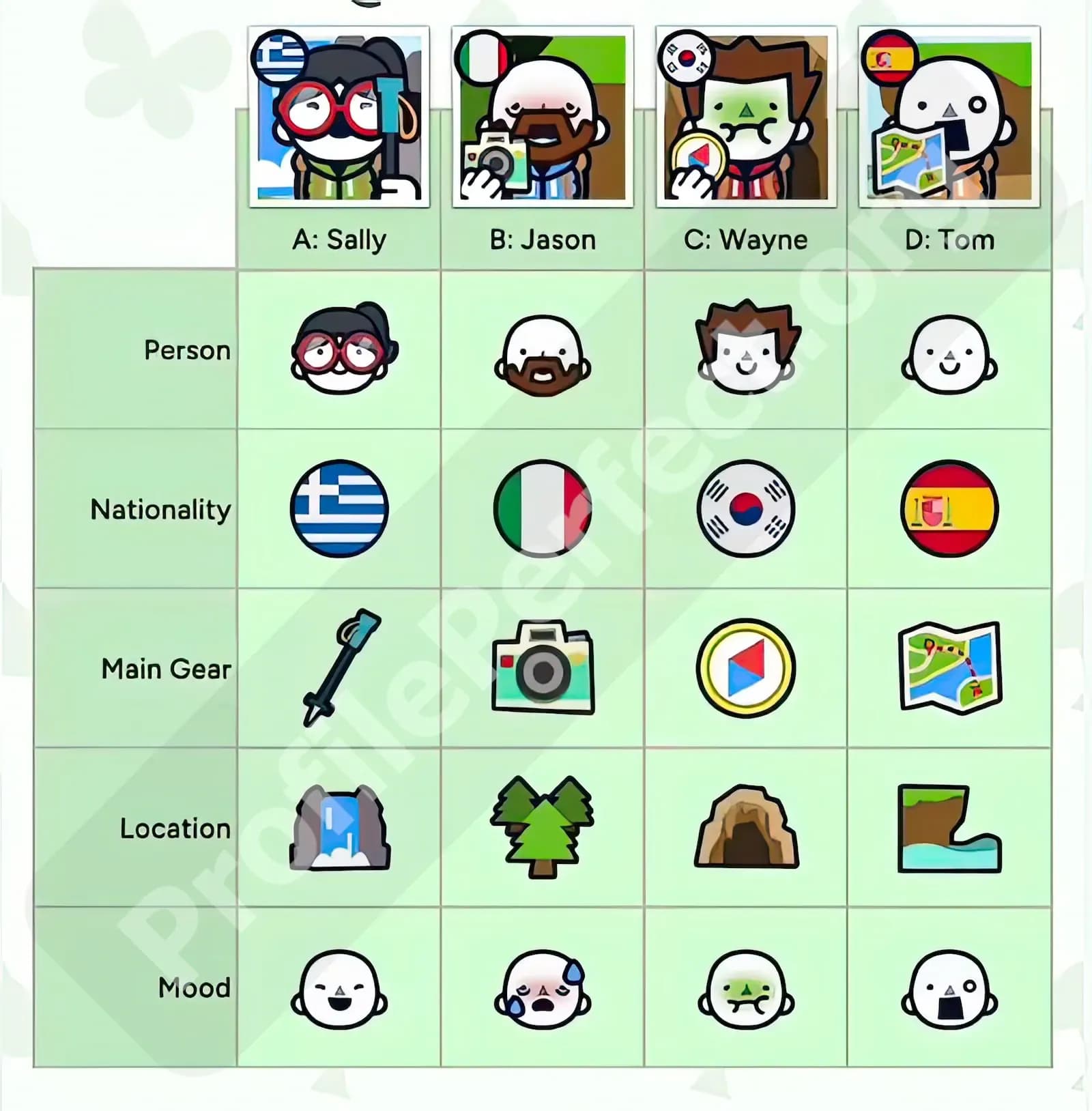
Level 15 is a great example. Hiker A starts at the Waterfall. Another clue says the hiker at the Waterfall is Excited. A later clue says the Excited hiker uses the Walking Stick. That gives you a clean chain:
Hiker A = Waterfall → Excited → Walking Stick.
That one chain solves three traits without guessing. It also eliminates a lot of wrong options. Hiker A cannot have the Camera, Compass, or Map. Hiker A cannot be Tired, Sick, or Shocked. One good chain does not just fill a cell; it nerfs a whole chunk of the grid.
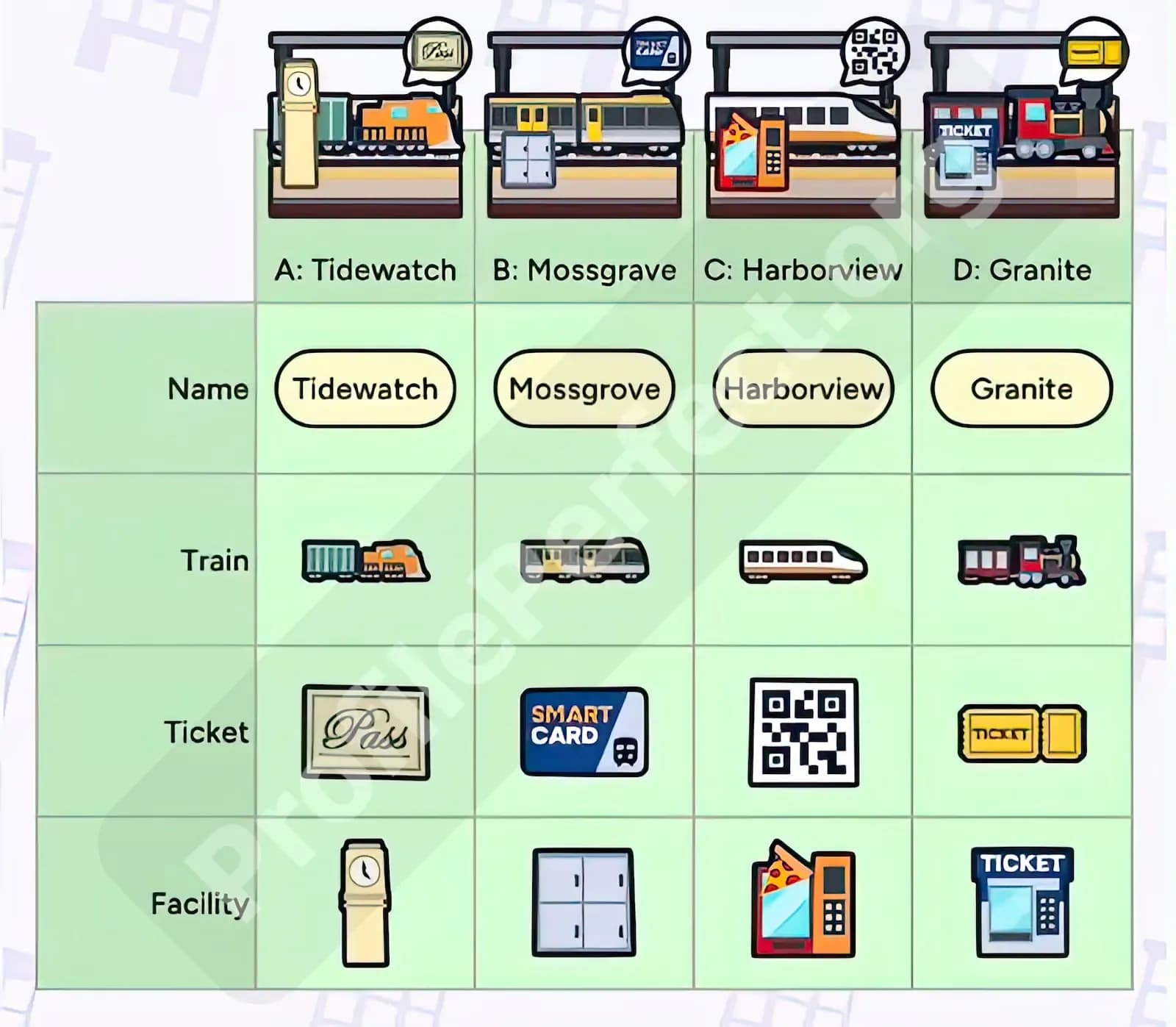
Level 19 uses the same loop with stations. Station A has the Freight train. Tidewatch is the name of the station with a Freight train. Therefore, Station A is Tidewatch. Then the clue saying the Freight station does not accept QR Code tickets becomes a Station A clue too. That helps push QR Code away from Tidewatch and toward the Harborview / Bullet Train / Pizza Machine chain.
The fastest Profile Perfect players do this automatically. When the game says something about a trait, they immediately ask: which subject already owns that trait?
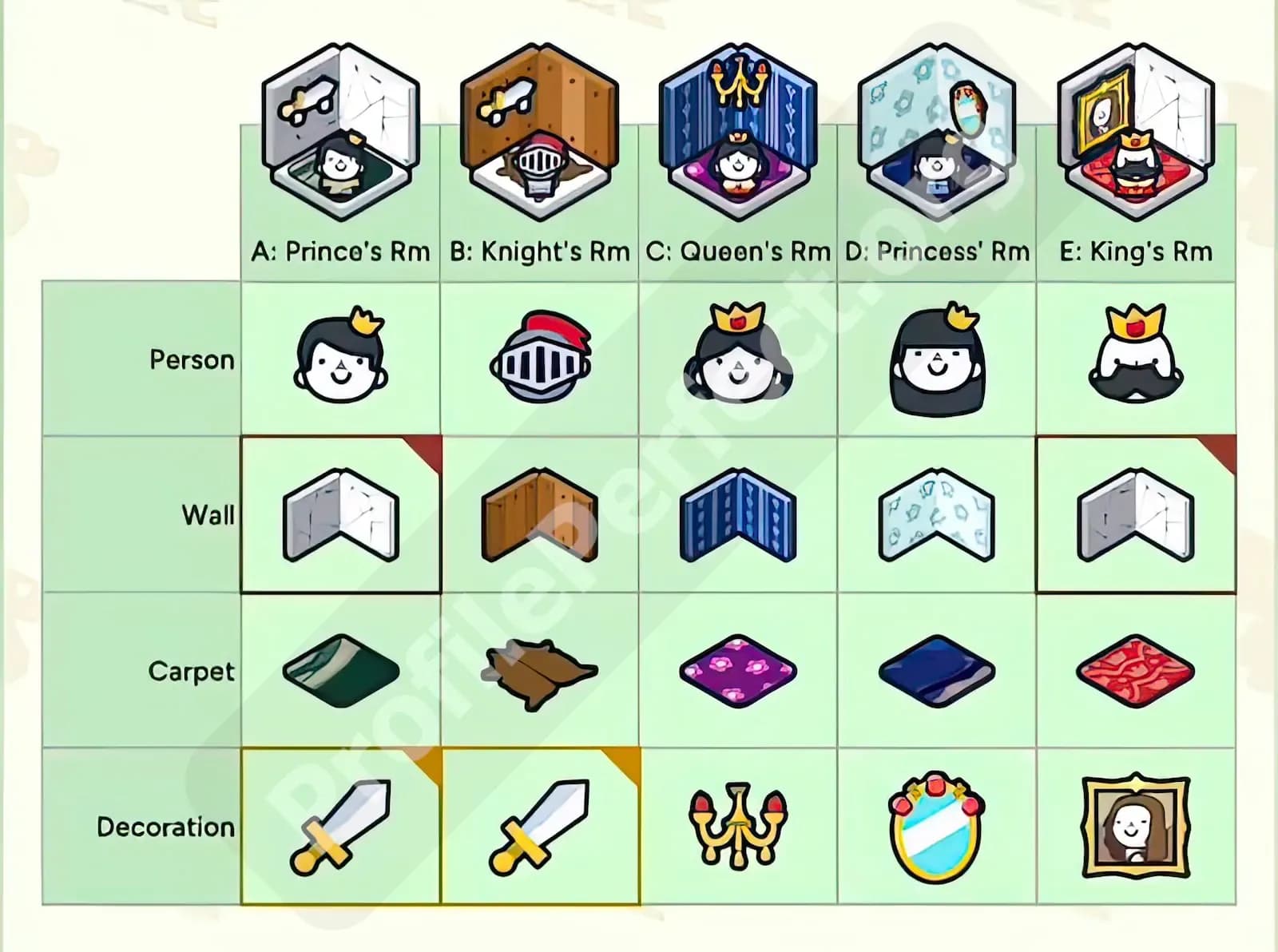
Level 28, the royal room puzzle, is a banger training level for this. Room B has the Leather Carpet. Another clue says the Leather Carpet room has a Wooden wall. So Room B is now Leather and Wooden. The Chandelier is in the middle room, Room C. The Knight is beside the Chandelier, which places the Knight in Room B. Now Room B is not just a room. It is the Leather room, the Wooden room, and the Knight’s room.
That compression is powerful. Any future clue about Leather, Wooden, or Knight now points to the same place.
The Prince and King chain is even cleaner. The Princess is in Room D. The Prince is not next to the Princess, which pushes the Prince away from the neighboring rooms and into Room A. Another clue says the Prince and King have the same wall type. Once the King lands in Room E, Rooms A and E share Marble walls. That is classic Profile Perfect chaining: person to position, position to wall, wall back to another person.
Words like next to, between, furthest, left of, and not beside are where Profile Perfect gets spicy. These clues usually connect more than two cells, so treat them like engines.
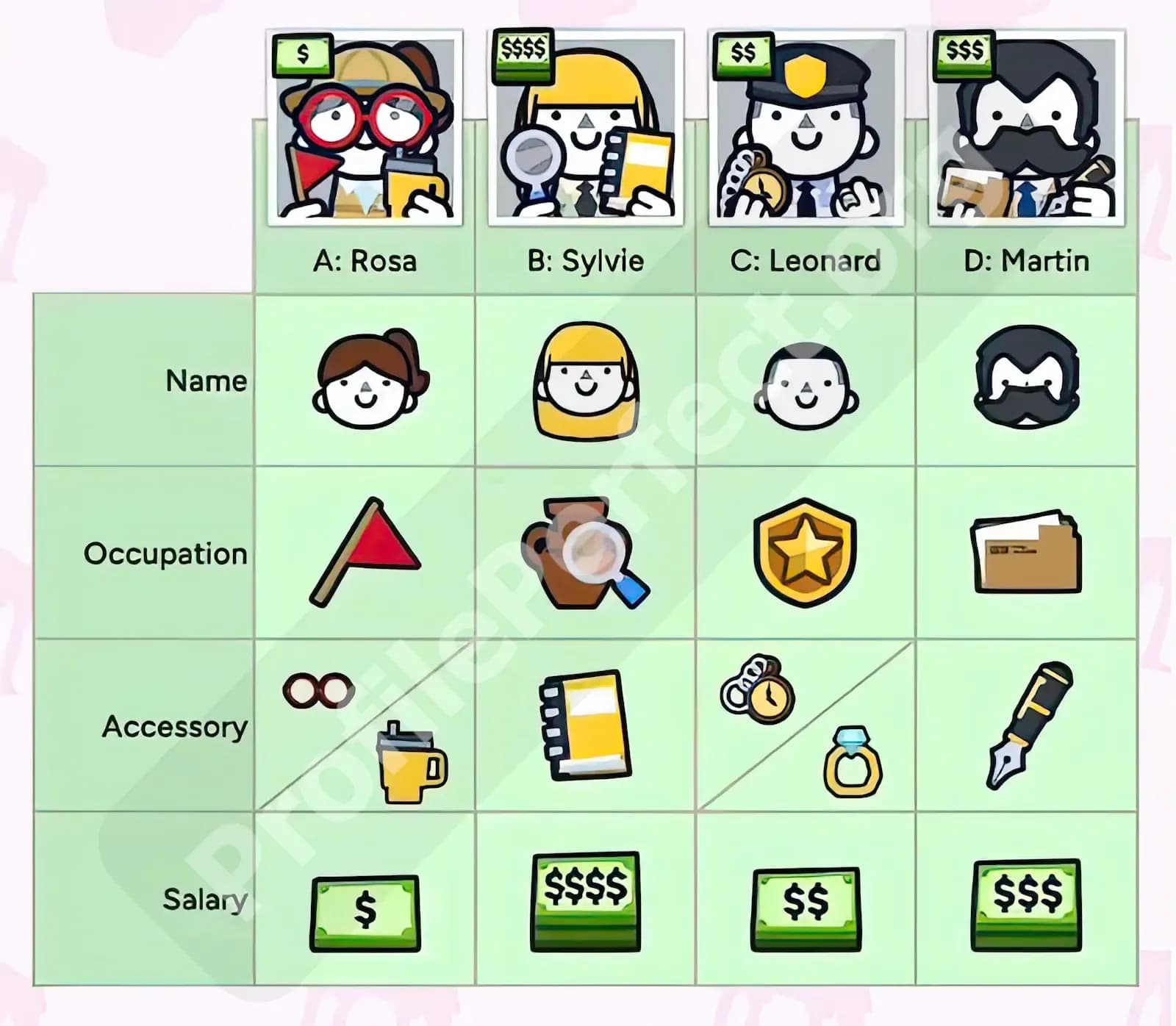
Level 52 is built around this idea. Person A is the Guide. The Archivist is furthest from the Guide, so the Archivist must be Person D. Then the clue “Leonard is between Sylvie and Archivist” becomes much sharper. If the Archivist is Person D, Leonard must sit at Person C, and Sylvie must sit at Person B.
That gives you a chain from occupation to position to names:
Person A = Guide → Person D = Archivist → Person C = Leonard → Person B = Sylvie.
Then the salary and accessory clues lock in around that chain. Person C owns the Pocket Watch and is between the two highest earners, so Person B and Person D become the top salary slots. The Fountain Pen belongs to Martin, and Martin does not have the highest salary, so Martin fits Person D with $$$. Now Person D is Archivist, Martin, Fountain Pen, and the second-highest earner.
That is how you stop drowning in clues. You compress four clues into one identity stack.
Positive clues feel better, but negative clues win levels. “Not next to,” “does not have,” and “is not” clues can close a chain just as hard as direct matches.
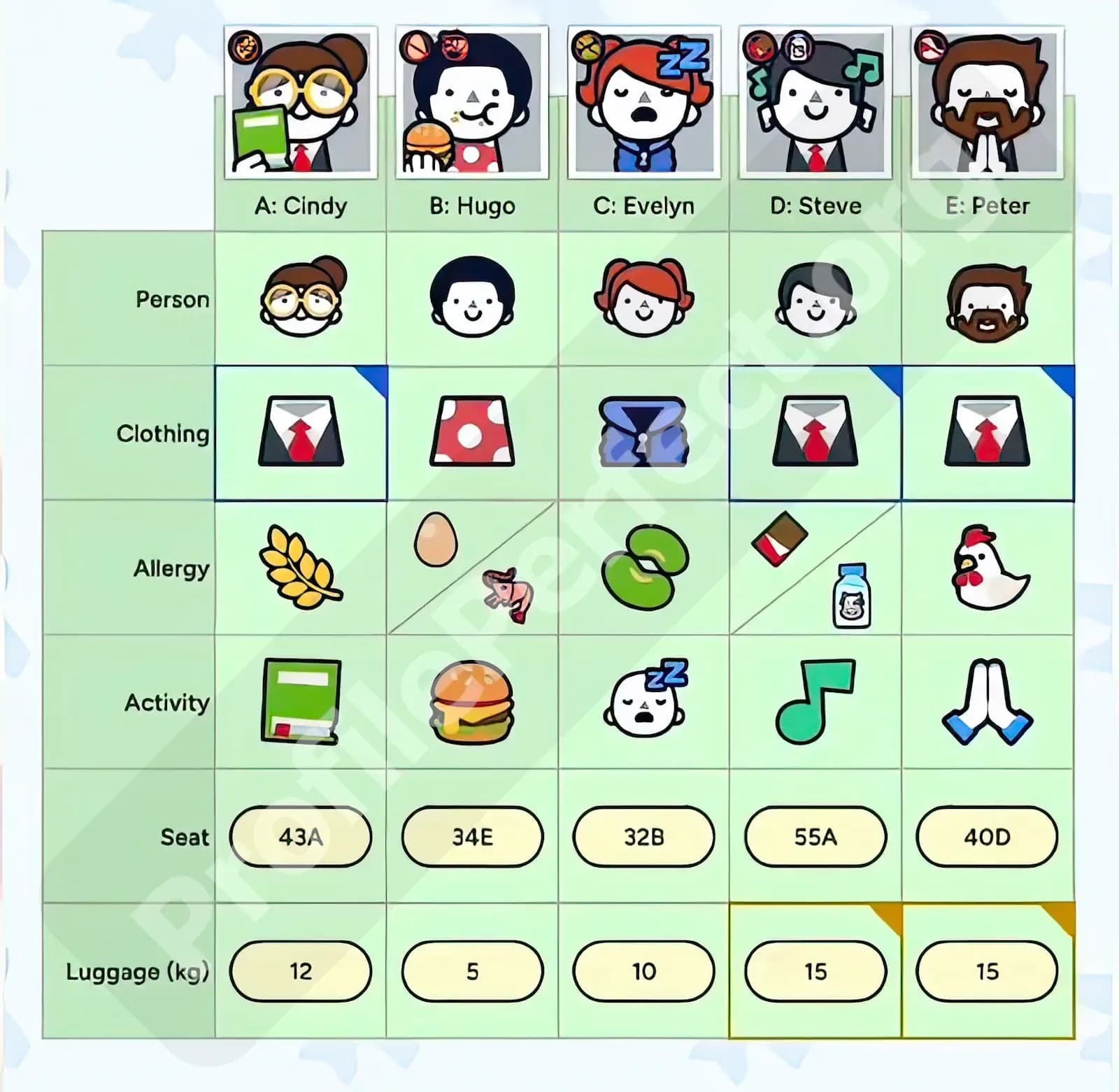
Level 40 looks messy because each passenger has a name, clothing, allergy, activity, seat, and luggage weight. But the logic is still manageable. Passenger A has Gluten. The person next to Gluten is Eating, so Passenger B is Eating. Passenger B has the lightest luggage: 5 kg. The person with 5 kg is not Steve. Later, Hugo is checking food for Egg, so Passenger B becomes Hugo, Eating, Egg, Shrimp, Polkadot, 34E, and 5 kg.
The negative clues keep the chain honest. Polkadot is not next to Dairy. Once Polkadot is Passenger B, Dairy cannot belong to Passenger A or Passenger C. The person in 55A is not allergic to Shrimp or Chicken, which helps place the Chocolate / Dairy allergy set on Passenger D. It feels like a lot, but each “not” clue removes bad branches until only one route survives.
When a Profile Perfect level starts to feel floaty, use this loop.
First, mark the anchors. Look for direct facts like “A is B.” Do not start with the weirdest clue. Start with the safest one.
Second, rename trait clues. If you know Passenger A has Gluten, then “the Gluten passenger” now means Passenger A. If you know Person A is the Guide, “the Guide” now means Person A.
Third, look for consequence clues. These are the clues with next to, between, furthest, same, highest, lowest, and not beside. They are the clues that make chains explode.
After every confirmed match, ask one question: what clue just changed meaning? That tiny habit is the difference between guessing and solving.
Before spending a life, say the logic out loud or write it in one short line.
“Person A is the Guide. The Archivist is furthest from the Guide, so Person D is Archivist. Leonard is between Sylvie and Archivist, so Leonard is Person C and Sylvie is Person B.”
If the sentence sounds clean, the deduction is probably clean. If you hear too many maybes, do not tap yet.
Clue chaining is the core loop of Profile Perfect once the early levels stop holding your hand. The more you connect names, jobs, items, positions, and negative clues, the less the game feels like a guessing trap and the more it becomes what it is at its best: a crunchy, satisfying deduction puzzle where every answer earns its place.