
Master Profile Perfect basics by reading subjects, traits, and clues first. Use Levels 1-10 examples to solve early grids faster without wasting lives.

Guide By Liam Stone
Published on June 10, 2026
Liam Stone has played Profile Perfect since the app first launched on the Apple App Store. He spotted its potential early, and that early bet turned into hundreds of hours spent solving levels, testing clue logic, and documenting answers for other players. Liam runs the YouTube channel Puzzle Game Answer where his puzzle walkthroughs have earned over 935,000 views and a growing community of more than 800 subscribers. He covers a wide range of mobile puzzle games beyond Profile Perfect, giving him firsthand experience with how these games design clues, structure levels, and trip up even experienced players. Every guide on this site reflects that hands on experience. Liam plays each level himself, verifies every answer against the in game grid, and rewrites confusing clues into plain language so you don't need to guess. If you want more of his walkthroughs, subscribe to his channel.
Loading calendar...
The fastest way to get better at Profile Perfect isn’t tapping faster. It’s reading better.
That sounds obvious, right? But this is exactly where new players lose lives. Profile Perfect looks simple in the first few levels: a few people, dogs, rooms, dresses, or objects, plus a small grid of traits. Then you tap the answer, the board fills in, and the loop feels smooth. But the game has a strict logic-grid brain underneath that cozy, detective-themed vibe. If you start guessing before you understand what the columns and rows mean, the whole level can tank in seconds.
So before you tap anything in Profile Perfect, learn this basic rule: subjects are the things you are solving for, traits are the categories you need to assign, and clues are the bridges between them.
Once that clicks, the early levels become much easier. Levels 1–10 are especially useful because they teach the core logic in a clean, readable way. They are not just warm-up levels. They are the tutorial the game is quietly giving you.
Subjects are the main columns or items in a level. Think of them as the “containers” that need complete profiles.
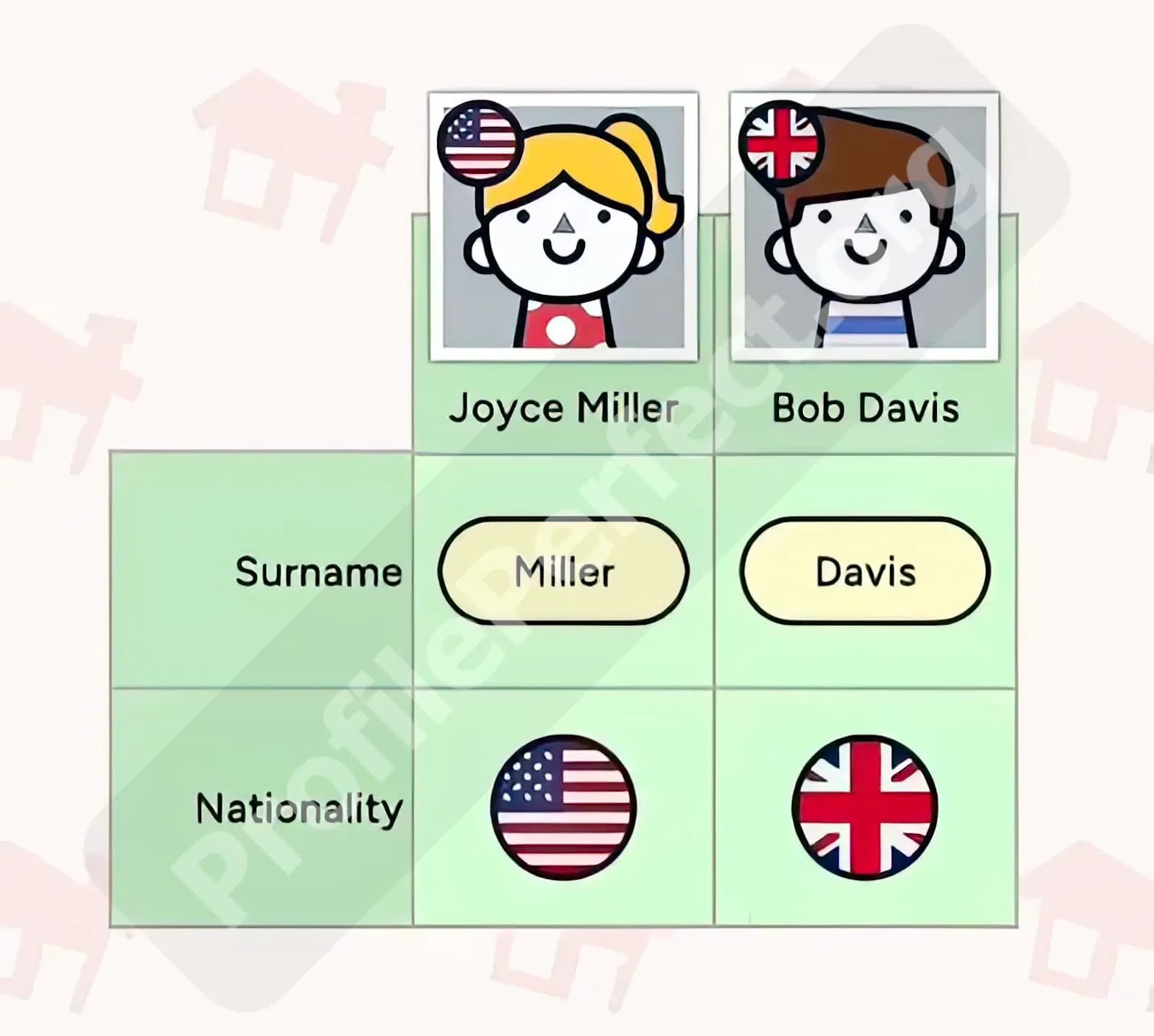
In Level 1, the subjects are Joyce and Bob. Each person needs a surname and a nationality. In Level 2, the subjects are Dog A, Dog B, and Dog C. Each dog needs a name and a breed. In Level 3, the subjects are Room A and Room B, and each room needs a type, wall pattern, and floor type.
That’s the first move in every Profile Perfect level: identify the subjects before reading too deeply into the clues.
A beginner mistake is to jump straight to words like “Miller,” “Domino,” “Kitchen,” or “Handbag” and start matching them randomly. Don’t. First ask: who or what is this level about?
If the level shows three dresses, your subjects are Dress A, Dress B, and Dress C. If it shows four traps, your subjects are Trap A, Trap B, Trap C, and Trap D. If it shows families, bags, dogs, or fish, those are your columns. Every clue is trying to fill those columns with the correct traits.
This sounds basic, but it creates a clean mental map. You are not solving “random clues.” You are completing each subject’s profile.
Traits are the rows or categories attached to each subject. They answer questions like:
What is this person’s surname? What is this dog’s breed? What color is this bag? Who owns this trap? What animal does this trap catch?
In Level 1, the traits are Surname and Nationality. Joyce becomes Miller and American. Bob becomes Davis and British.
In Level 5, the traits are Decoration, Vehicle, and Members. Family A has Swings, a Red Car, and 2 members. Family B has a Pool, a Bicycle, and 5 members. Family C has a Pumpkin, a Purple Minivan, and 6 members.
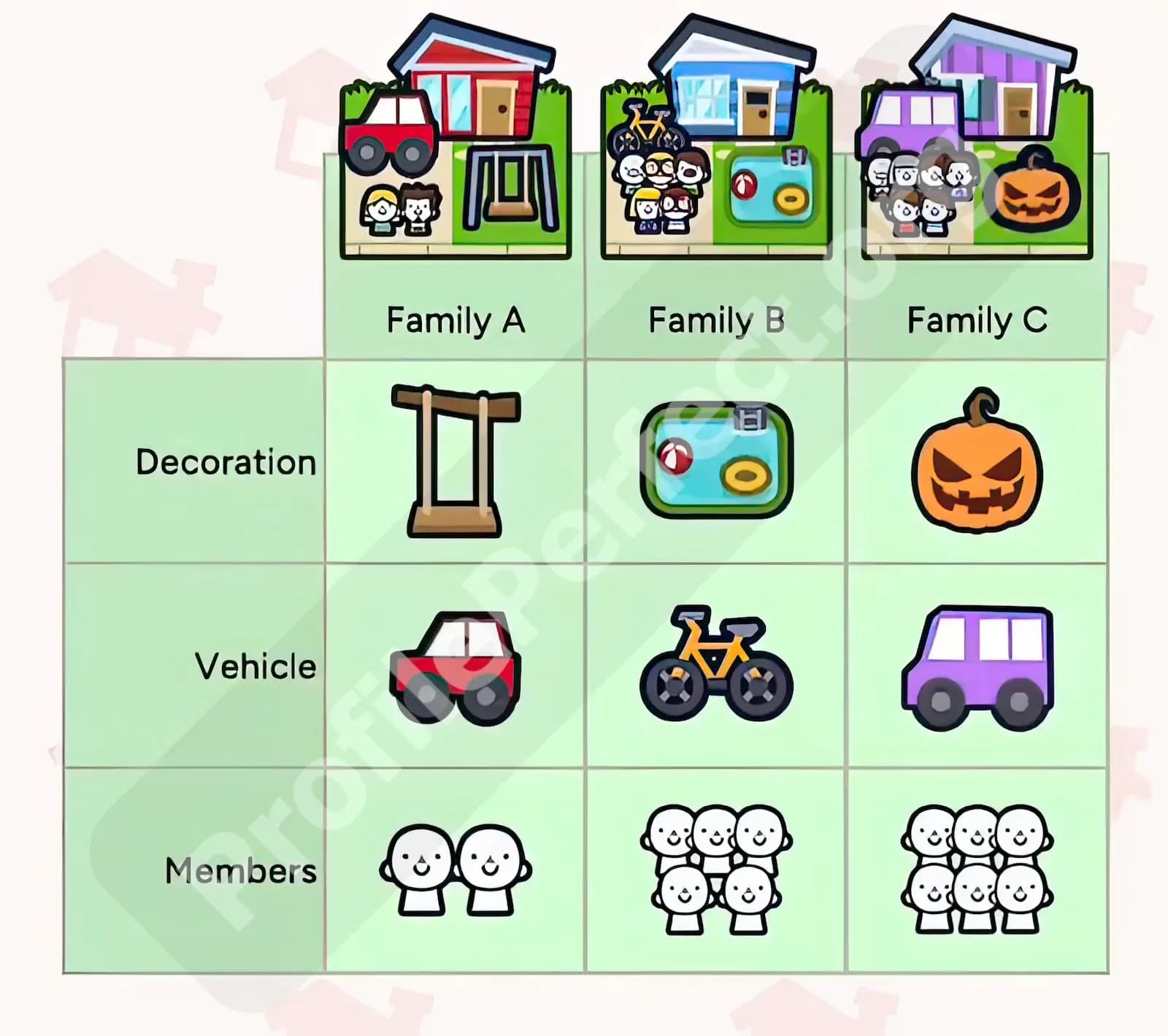
That’s already a more crunchy grid. Instead of two traits, you’re juggling three. But the rule stays the same: each subject gets one value from each trait category.
This is where Profile Perfect starts feeling like a logic-grid game rather than a simple matching game. A clue about a vehicle may also tell you something about family size. A clue about a decoration may depend on position. A clue about price may connect to origin and color. The trick is to treat every trait category as its own mini-row of possibilities.
The easiest clues in Profile Perfect are direct clues. These are the banger beginner clues because they give you a clear match with almost no interpretation.
Level 1 gives you “Joyce’s full name is Joyce Miller.” That immediately tells you Joyce = Miller. Another clue says Bob is part of the Davis family, so Bob = Davis. No drama, no guessing.
Level 2 gives you “Attached to Dog B is a tag that reads Domino.” That means Dog B’s name is Domino. It also says Pomeranian is Dog C’s breed, so Dog C = Pomeranian.
Level 4 gives you “Rightmost dress has a Handbag as accessory” and “Dress A has Polkadot pattern.” Since Dress C is the rightmost dress, Dress C has the Handbag. Dress A has Polkadot. These are anchor clues.
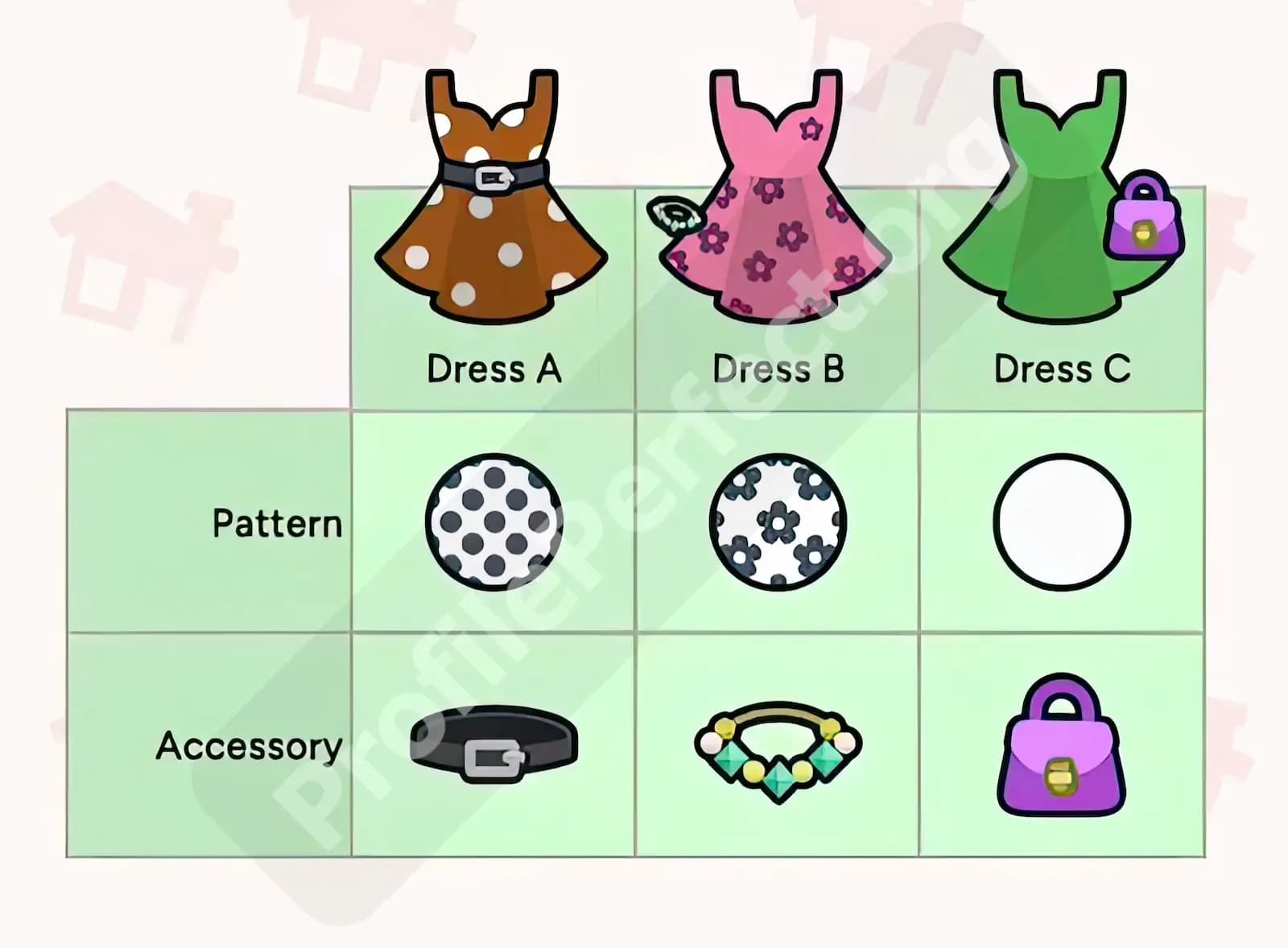
Anchor clues are the first answers you should place. They stabilize the whole grid. In Profile Perfect, one correct match often eliminates multiple wrong options. Once Joyce is Miller, Bob cannot be Miller. Once Dog B is Domino, Dog A and Dog C cannot be Domino. The board starts cleaning itself up.
Not every clue says the exact trait name. Sometimes Profile Perfect describes the answer instead.
Level 3 says “Tools to make food can be found in Room B.” The game does not directly say “Room B is the Kitchen,” but that is what the clue means. Food tools belong in a kitchen. So Room B = Kitchen.
The same level says “the room where people sleep,” which points to Bedroom. So if Room B is Kitchen, Room A becomes Bedroom.
Level 9 does this with fish. “The Insect eaters have whiskers like a cat” points to Catfish. “Clownfish munch on drifting Plankton” connects Clownfish to Plankton. The clue is not just asking you to read; it’s asking you to translate everyday language into grid language.
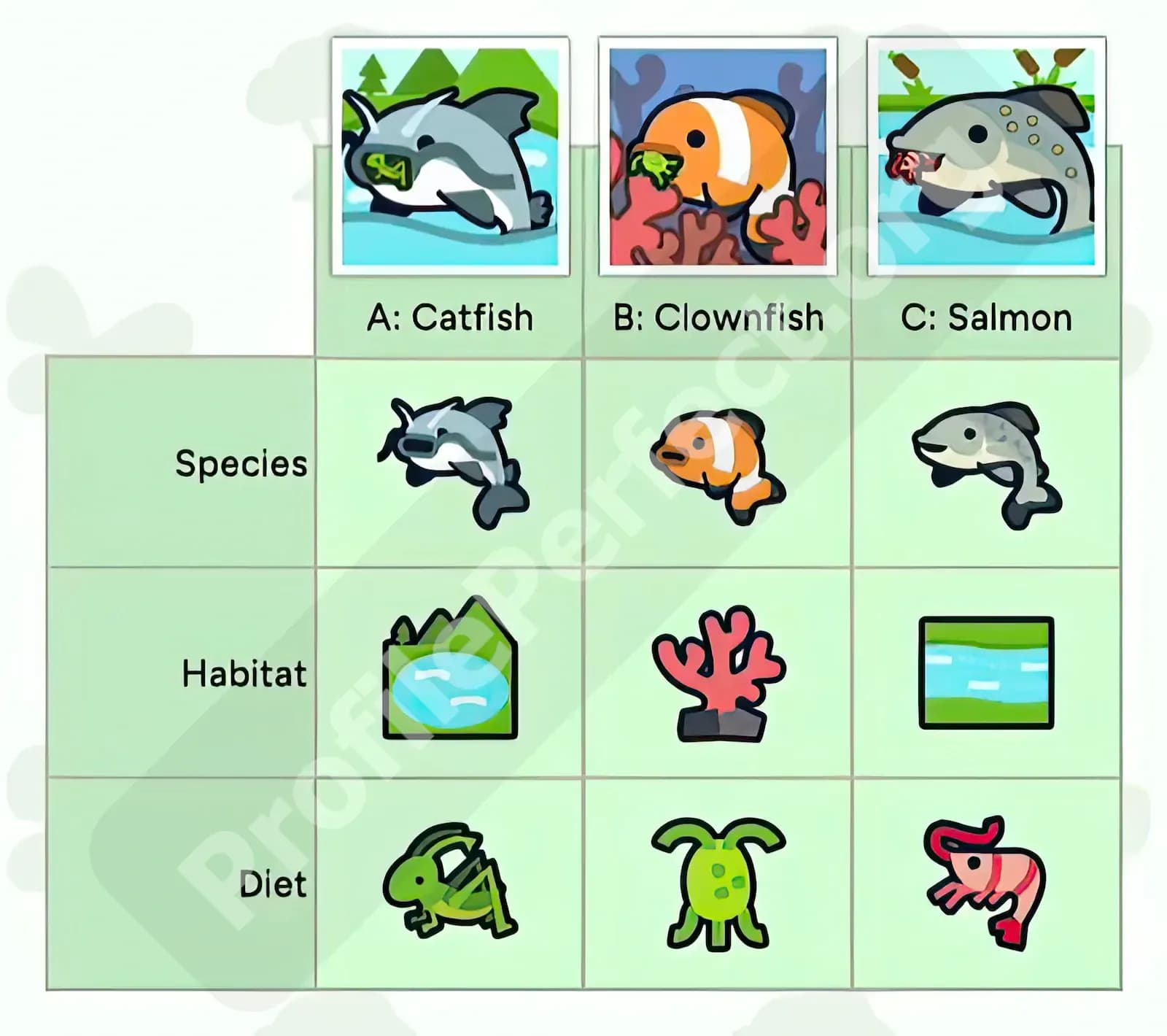
This is one of the most important beginner techniques in Profile Perfect: convert the clue into a clean formula.
“Tools to make food” = Kitchen. “People sleep there” = Bedroom. “Whiskers like a cat” = Catfish. “Lived in England” = British. “Lived in USA” = American.
Once you translate the clue, the puzzle becomes much less floaty.
After the direct matches, Profile Perfect introduces position clues: next to, beside, rightmost, leftmost, not next to, and on the right of.
Level 4 says the Floral dress is next to the Polkadot dress. Since Dress A is Polkadot, Dress B must be Floral. Then another clue says the Solid patterned dress pairs with the Handbag. Since Dress C has the Handbag, Dress C is Solid.
Level 5 says Halloween decoration is on the right of the Pool. Since Family B has the Pool, Family C gets the Pumpkin. This clue only works if you understand the order of the subjects: Family A, Family B, Family C.
Level 10 uses several position clues. The Steel trap is next to the Wood trap. Since Trap A is Wood, Trap B becomes Steel. Plastic is next to the trap catching Dove, and Alice uses the rightmost trap to catch a Dove, so Trap D catches Dove and Trap C is Plastic.
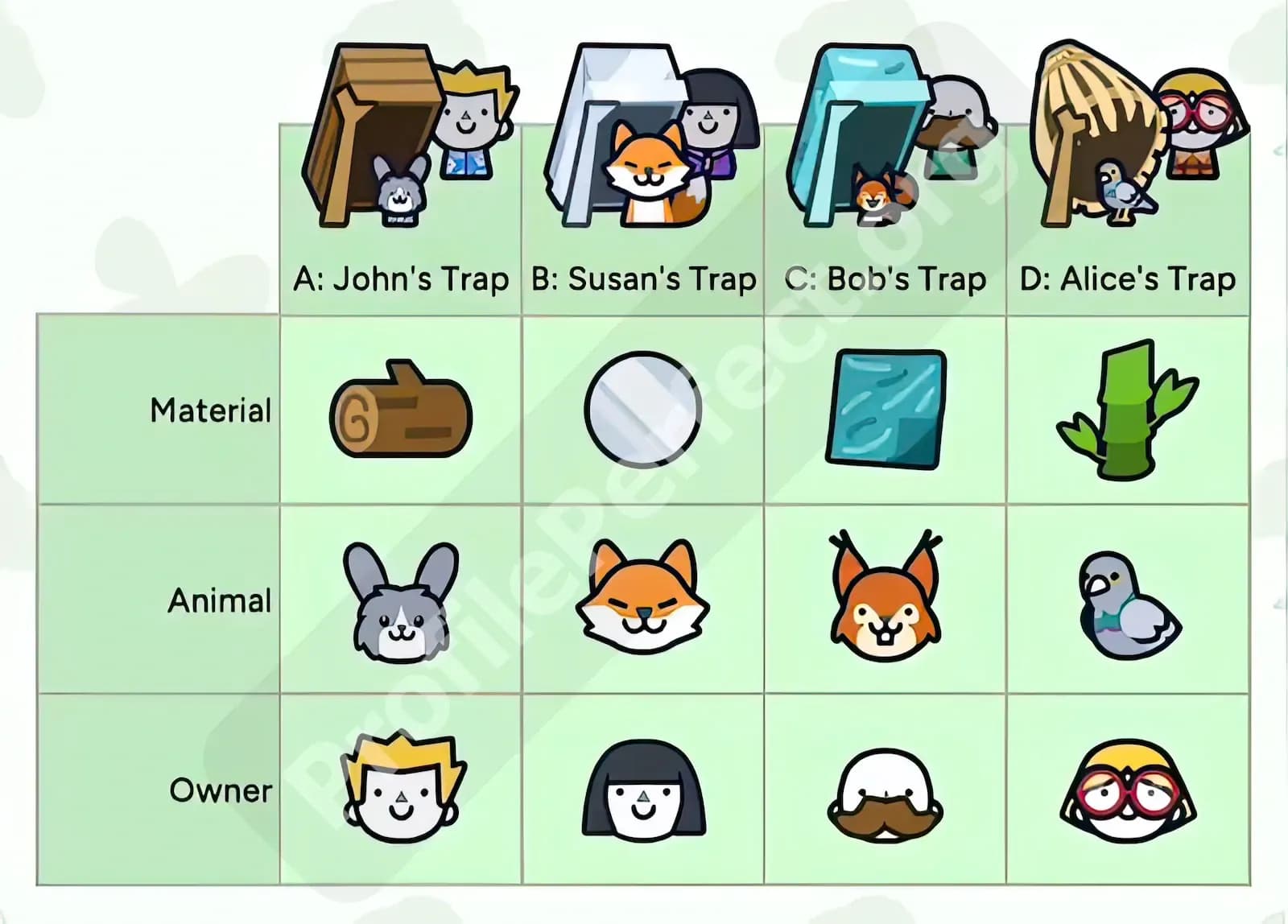
Position clues are where beginners often roll their eyes because they feel vague. But they are rock-solid if you read the board from left to right. The subject letters matter. A, B, C, and D are not just labels. They tell you the order.
Profile Perfect gives you a two-life limit, so random tapping is a bad habit. The better loop is: place direct clues, translate descriptive clues, apply position clues, then use elimination.
Level 6 is a good example. Bag A is from Germany and has a Medium price. Bag C is cheaper than the German bag, so Bag C is Low. The cheapest bag is Green, so Bag C is Green. The French bag is next to the German bag, so Bag B is from France. Since the French bag is not Red, Bag B must be Purple, leaving Bag A as Red.
Nothing there requires a guess. Each answer narrows the grid until the remaining option becomes obvious.
Level 7 does this with four people. Person A is the Maid. Person C is the Chef and is Shopping. The Chef has 6 years of service. The Security is Driving. A person with 3 years of service is next to the Driving person, so Person A gets 3 years. Then the Gardener, Lunch, and 8 years fall into place through position and comparison.
This is the real Profile Perfect skill: don’t ask “what looks right?” Ask “what can no longer be wrong?”
Before tapping, say the relationship out loud in a simple subject-trait format.
Joyce — Surname — Miller. Dog B — Name — Domino. Room B — Type — Kitchen. Dress C — Accessory — Handbag. Family C — Members — 6. Trap D — Owner — Alice.
This tiny habit prevents messy mistakes. It also helps when a clue contains multiple pieces of information. For example, “Alice uses the rightmost trap to catch a Dove” gives two matches: Trap D = Alice and Trap D = Dove. Don’t waste that clue by only filling one cell.
If you’re new to Profile Perfect, treat Levels 1–10 like a training course. Level 1 teaches direct identity clues. Level 2 teaches name-and-breed pairing. Level 3 teaches descriptive translation. Level 4 teaches adjacency. Level 5 teaches order-based clues. Level 6 teaches price and origin chains. Level 7 teaches multi-trait deduction. Level 8 teaches larger dog-profile grids. Level 9 teaches vocabulary clues. Level 10 teaches owner, material, animal, and position logic together.
The core technique never changes: read the subjects first, scan the traits second, then solve the clues from most direct to most conditional.
Once you build that habit, Profile Perfect becomes a much cleaner game. The grid stops feeling like a pile of random boxes and starts feeling like a detective board. And that’s when the game’s logic loop finally clicks.