
Beat Profile Perfect 5-subject and 6-trait stages by splitting big grids into mini-grids, using clear examples from Levels 32, 39, 40, 49, 68, and 83.


Guide By Liam Stone
Published on June 10, 2026
Liam Stone has played Profile Perfect since the app first launched on the Apple App Store. He spotted its potential early, and that early bet turned into hundreds of hours spent solving levels, testing clue logic, and documenting answers for other players. Liam runs the YouTube channel Puzzle Game Answer where his puzzle walkthroughs have earned over 935,000 views and a growing community of more than 800 subscribers. He covers a wide range of mobile puzzle games beyond Profile Perfect, giving him firsthand experience with how these games design clues, structure levels, and trip up even experienced players. Every guide on this site reflects that hands on experience. Liam plays each level himself, verifies every answer against the in game grid, and rewrites confusing clues into plain language so you don't need to guess. If you want more of his walkthroughs, subscribe to his channel.
Loading calendar...
There is a point in Profile Perfect where the game stops feeling like a neat deduction snack and starts acting like a full logic boss fight. Five subjects, six trait rows, and clues that touch three places at once? The loop is still rock-solid, but the grid gets chunky fast.
The mistake is trying to solve the whole monster at once. Don’t. Split every large Profile Perfect stage into mini-grids. Instead of “I need to solve six rows,” think, “I need to solve two traits that keep talking to each other.”
Early levels usually teach one idea at a time: direct matches, neighbors, left-right placement, or simple elimination. Later stages stack those ideas together, so a five-subject, six-trait level creates more cross-category chains.
Level 32 matches Weapon A to E across Type, Element, Origin, Owner, Rarity, and Value. A clue like “The Wooden-Sword’s value is equal to its rarity” links Type, Element, Value, and Rarity. Level 40 does the same with Person, Clothing, Allergy, Activity, Seat, and Luggage. Your job is not to memorize everything. Your job is to create smaller battlefields.
Start with the subject line: A-B-C-D-E. Keep that order fixed because advanced clues often depend on position: next to, left of, right of, farthest from, or between.
Next, collect anchors: facts that do not need interpretation. In Level 32, Weapon B starts with Cavern and $$, Weapon C is the Shield, and Weapon D belongs to the Alchemist. In Level 40, Passenger A has Gluten allergy, Peter is Praying, Evelyn is Sleeping, and Passenger B has the lightest luggage.
Then split traits into pairs or clusters. If clues keep mentioning rarity and value, solve those together. If they keep talking about seats and luggage, keep those together. Only tap when a mini-grid is stable. Profile Perfect does not reward brave guesses.
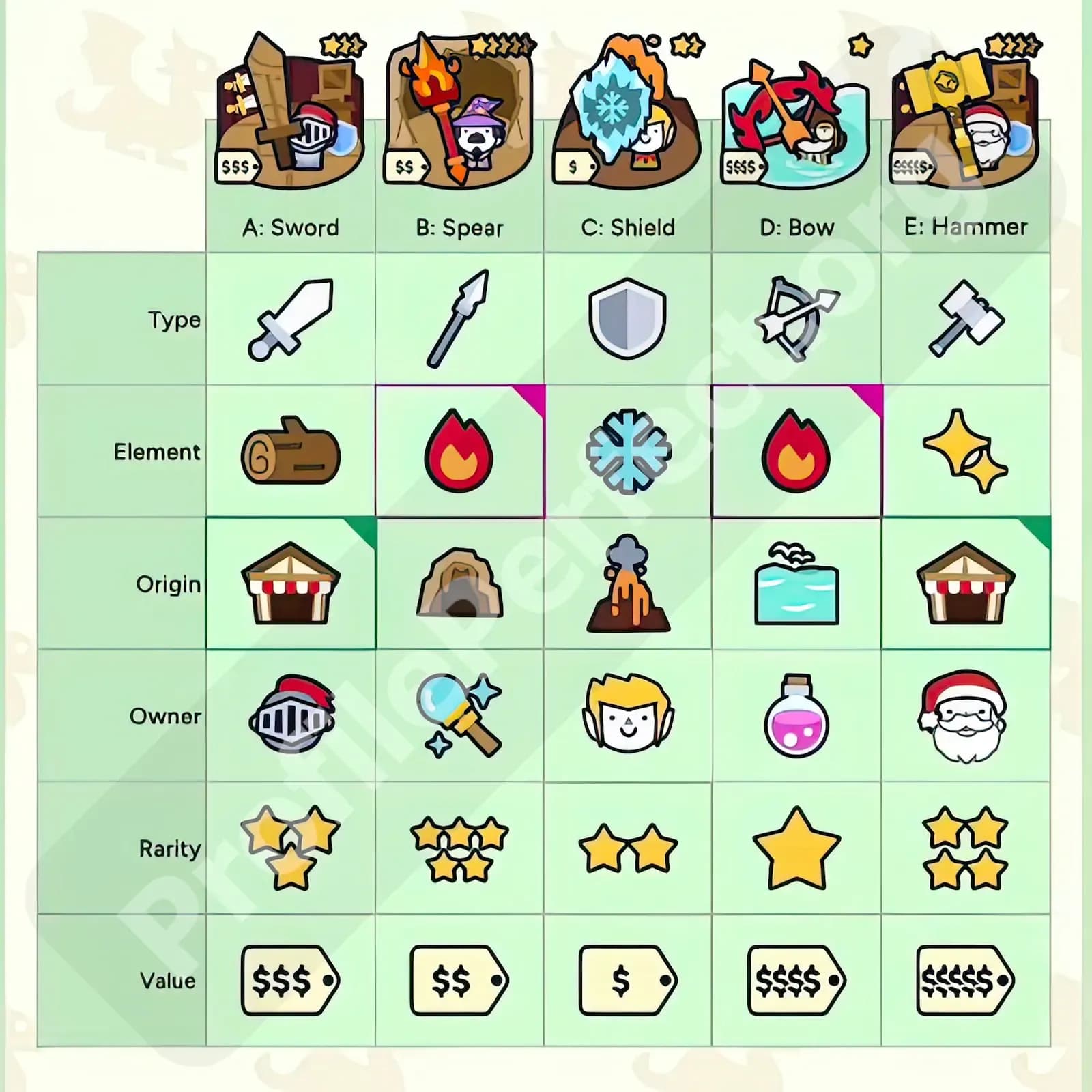
Level 32 has five weapons and six traits, but it breaks down beautifully. Mini-grid one is Type + Owner. Weapon C being the only defensive type points to Shield. Weapon D belongs to the Alchemist. The Wizard found his weapon in the Cavern, and Weapon B is already tied to Cavern, so Weapon B becomes the Wizard’s weapon.
Mini-grid two is Element + Origin. The Shield uses Ice, neither Elf nor Alchemist has a Wooden neighbor, and the Light weapon sits to the right of a Fire weapon. Those are position clues, so solve them on the A-B-C-D-E line before tapping.
Mini-grid three is Rarity + Value. The Wooden Sword’s value matches its rarity, the Wizard’s weapon is two stars rarer than the Knight’s, the Spear is the rarest weapon, and the Bow costs twice as much as the Spear. Treat this like a number puzzle; once it clicks, the remaining cells fall into place.
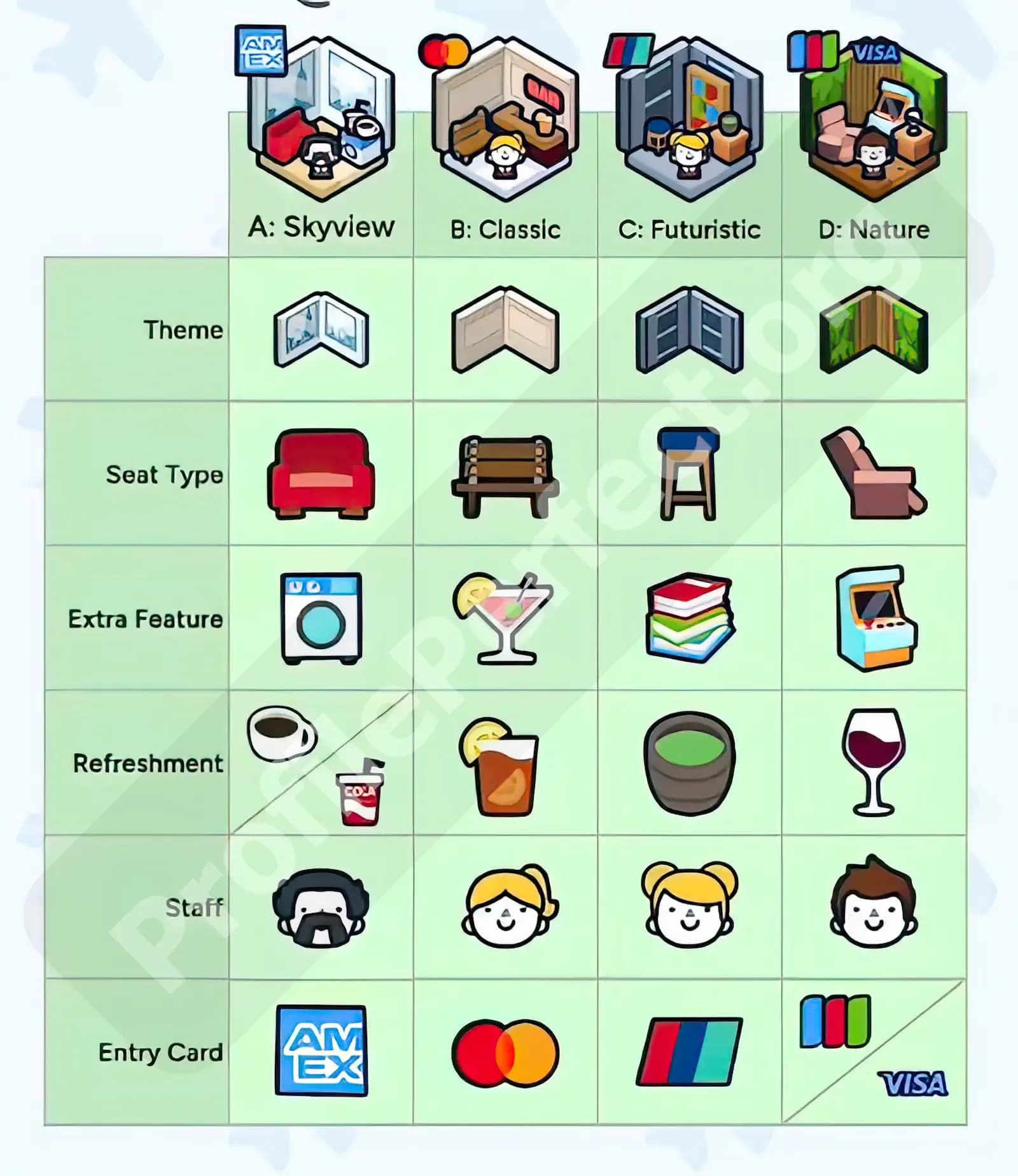
Level 39 has only four lounges, but it still teaches the 6-trait problem because Theme, Seat Type, Extra Feature, Refreshment, Staff, and Entry Card all overlap.
Start with Theme + Seat. Bench connects to Skyview, Tea connects to Futuristic, Gary is not near Futuristic, and Gary does not use Stool or Recliner. That cluster leads you toward Gary’s Skyview Sofa lounge.
Then solve Extra Feature + Refreshment. Sofa is three columns away from Arcade, Nature links to games, Laundry and Library are not neighbors, and Lounge A customers drink Coffee while washing clothes. Keep that separate from the card clues.
Finally, handle Staff + Entry Card. Classic uses Mastercard, Visa cannot sit next to Mastercard, JCB leads to Wine, and the two-card lounge sits beside Eliza. Solve it all at once and it feels messy. Split it, and it becomes fair.
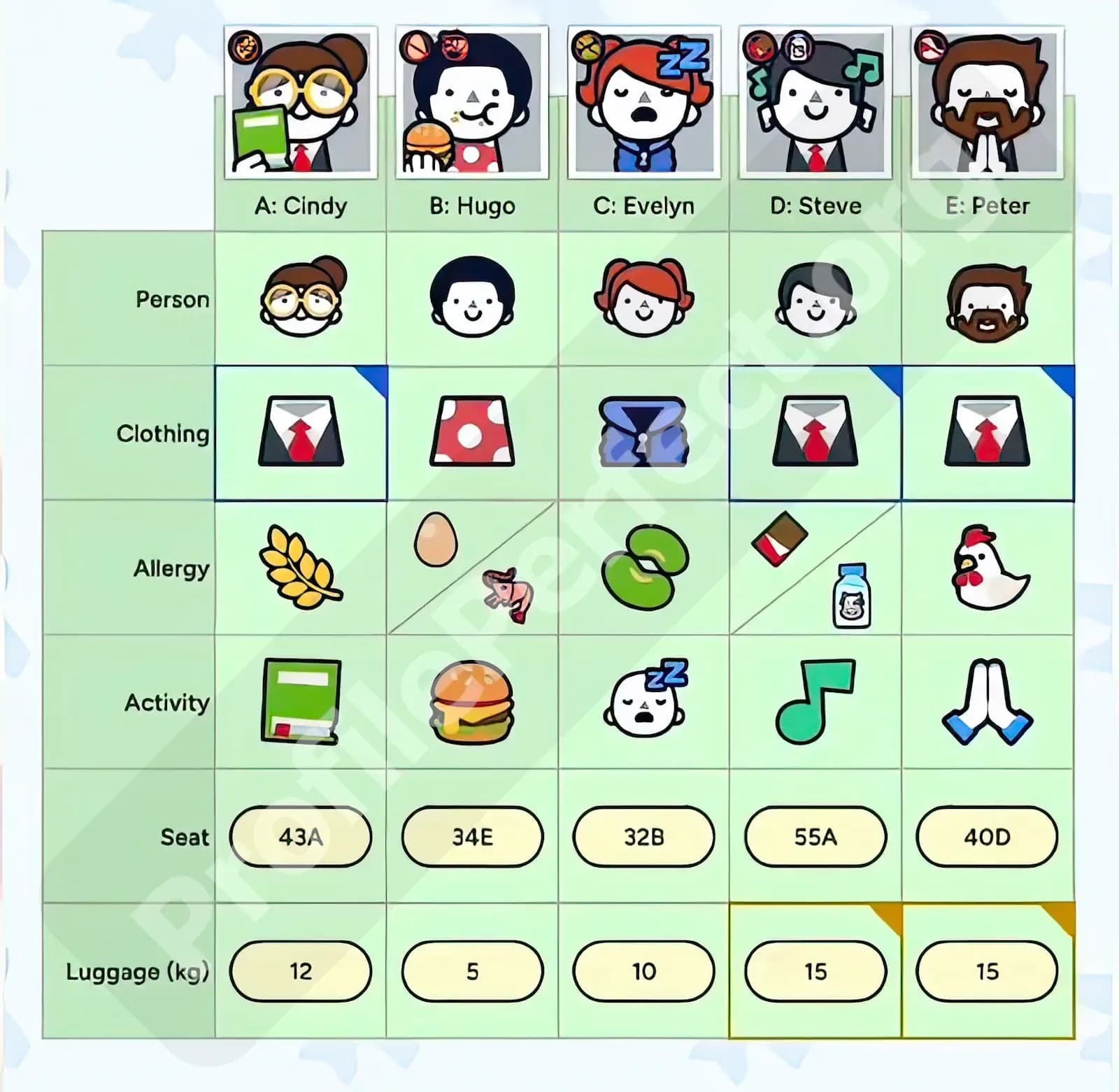
Level 40 is a classic “too much information” stage. Open with Person + Activity: Peter is Praying, Evelyn is Sleeping, the person next to Gluten is Eating, and Cindy is not Evelyn’s neighbor. That gives you identity placement before clothing gets involved.
Next, shift to Allergy + Seat. Hugo and Evelyn sit below row 35, the 5 kg passenger is not Steve, the 55A passenger shares luggage with Peter, and multiple-allergy passengers are not Beans. This is where the level becomes a logic chain rather than a simple matching row.
Save Clothing + Luggage for late-game cleanup. Polkadot cannot sit next to Dairy, Chicken cannot neighbor Polkadot or Jacket, Reading is not beside Jacket, and Suit wearers carry the heaviest luggage. Clothing feels vague early, but it becomes powerful once people and seats are locked.
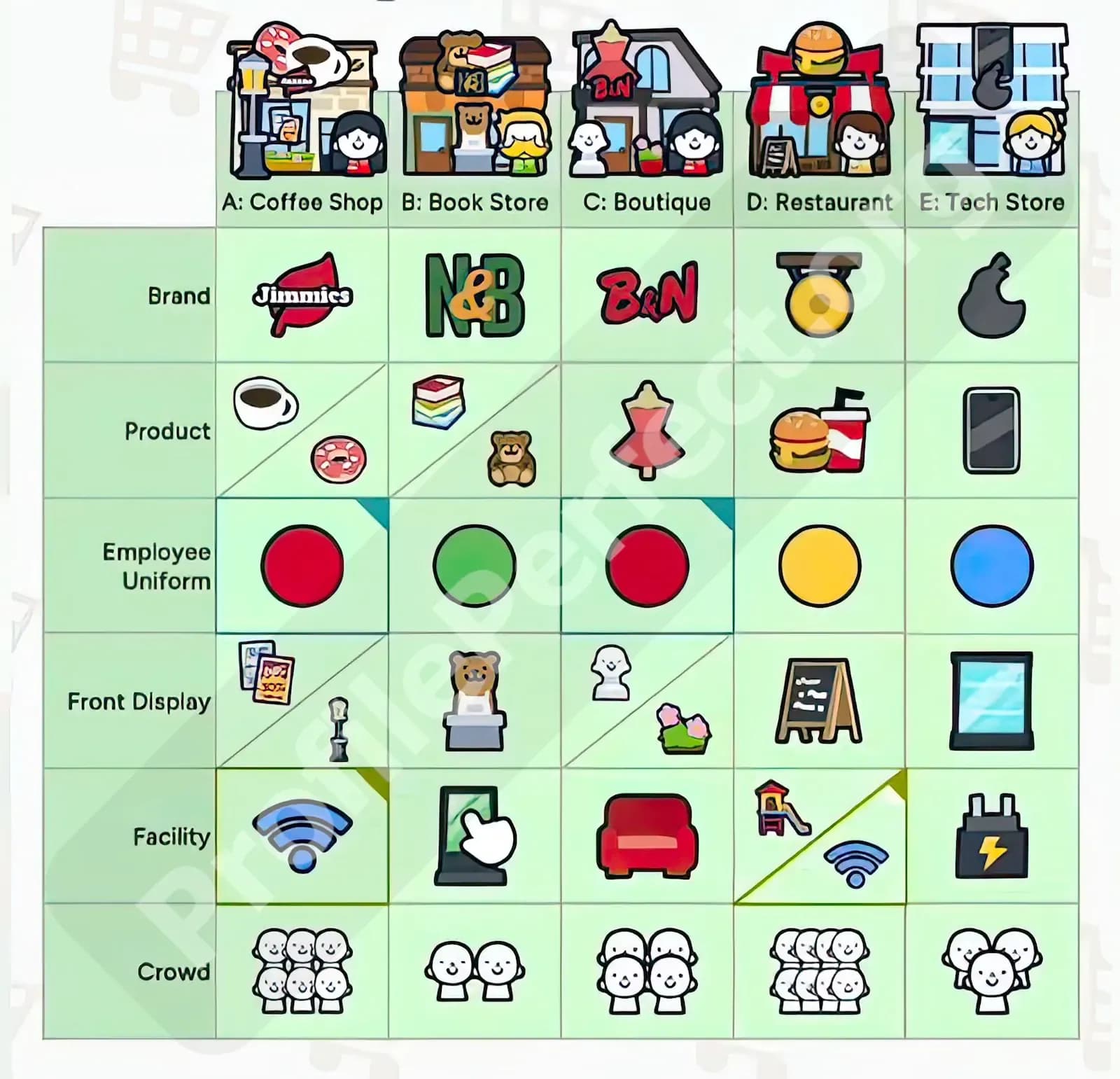
Level 49 is a banger because it adds multi-value cells. Coffee / Donut or Books / Plushies does not mean either-or; it means the store has both values.
Split the stage into Store Identity, Storefront, and Crowd Economy. Store Identity covers Brand + Product + Uniform: Yellow Gong wears Yellow, the middle shop sells Clothing, the book store wears Green, and Fast Food sits between Red and Blue uniforms.
Storefront covers Front Display + Facility. Store B has the Bear Statue, Bear Statue neighbors Wi-Fi and Rest Area, Pear has the Glass Case, and Posters and Chalkboard have two stores between them.
Crowd Economy handles numbers. Store C has twice as many customers as Store B, Nelson & Baker has slightly fewer crowd than Pear, and the robusta aroma from Store B’s left neighbor helps lock Coffee into Store A. The level only looks chaotic until each clue gets its own bucket.
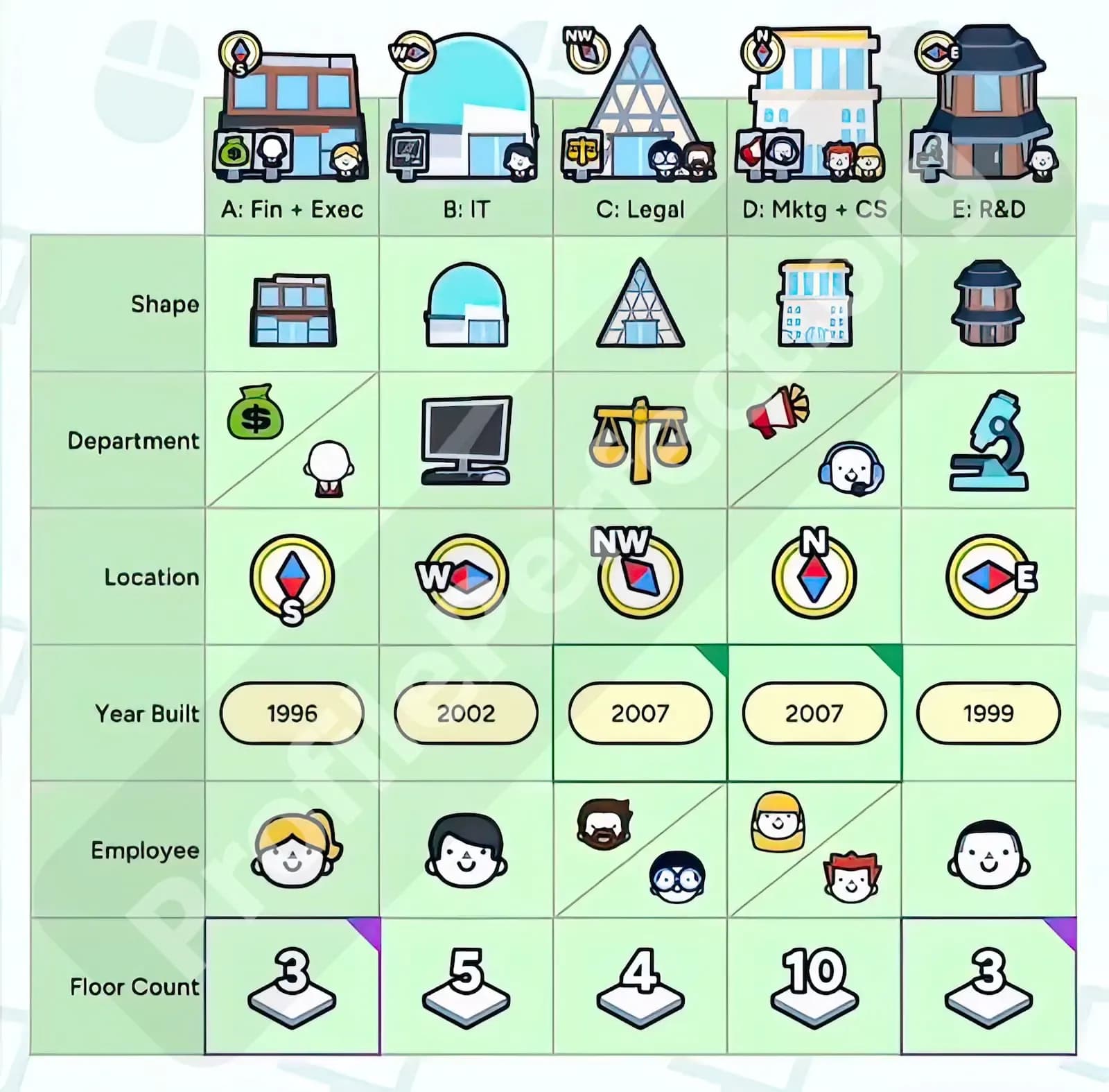
Level 68 combines five subjects, six traits, and hidden starting values. Building E already hides East, Building A hides 1996, and Building D hides Eric. Treat those as invisible anchors, not bonus trivia.
Start with Department + Location + Year Built. IT is in Building B, IT is next to the oldest building, B and E are opposite each other, and Legal is in the Northwest building. That solves the campus layout.
Then solve Shape + Floor Count. Tall is North, Hexagonal links to Research, 2007 buildings are not round, and Eric’s office has twice the floors of Daxter’s. Finally, close Employee + Department with Adam, Pauline, Rachel, Ethan, Ivan, and Daxter. This level rewards order more than speed.
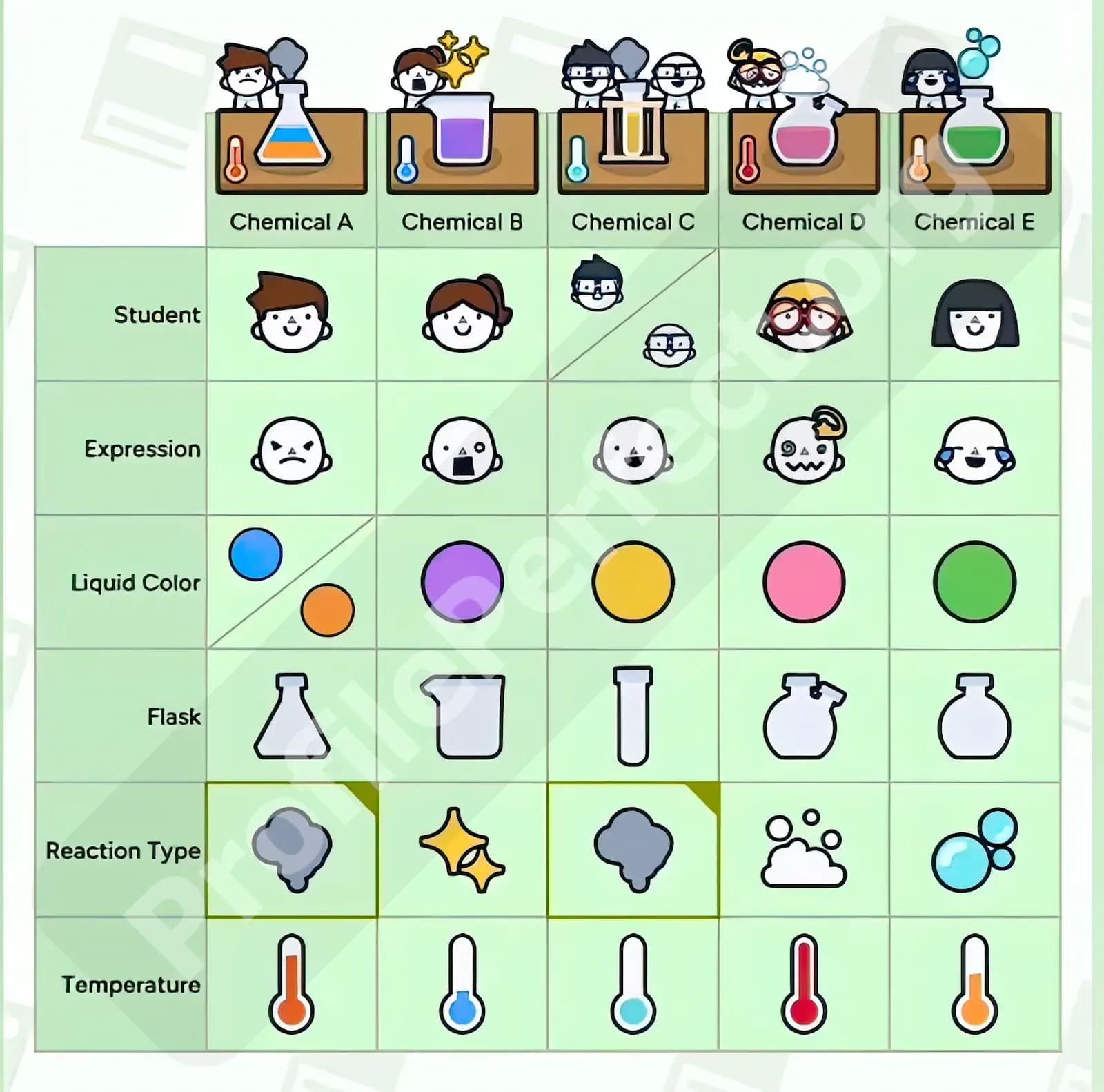
Level 83 looks scary because the theme is scientific, but the logic is clean. Chemical A and C are Smoke reactions. Chemical D has the Two Neck flask and Foam reaction, while Chemical C is Very Cold. Those anchors shrink the board immediately.
First solve Flask + Reaction. Erlenmeyer has no flask on its left, Megan uses the Round flask, and Foam neighbors Bubble. Then solve Temperature + Color: Purple and Green are three students apart, the hottest and coldest chemicals are neighbors, Billy is between Cold and Very Hot, and Orange is second hottest.
Only then finish Student + Expression. Ronald is Angry, Megan is Laughing, someone laughs at a Confused neighbor, John is Happy with Yellow, and the Beaker user is Shocked. Once the physical setup is locked, the people stop feeling random.
Beginner players solve rows. Advanced players solve relationships. In Profile Perfect, Wood travels with Sword, rarity, and value. Hugo travels with food, Egg, and low luggage. Bear Statue travels with neighboring facilities. IT travels with the oldest building and the Hexagonal building’s position.
That is the real loop. Spot the clusters, build mini-grids, and only tap when the relationship is proven. Do that, and even the biggest 5-subject, 6-trait levels become what Profile Perfect does best: tight deduction puzzles where every small lock opens a bigger door.