
Learn a safer Profile Perfect solving method: read subjects first, mark only confirmed matches, and avoid risky taps that waste lives in early levels.

Guide By Liam Stone
Published on June 10, 2026
Liam Stone has played Profile Perfect since the app first launched on the Apple App Store. He spotted its potential early, and that early bet turned into hundreds of hours spent solving levels, testing clue logic, and documenting answers for other players. Liam runs the YouTube channel Puzzle Game Answer where his puzzle walkthroughs have earned over 935,000 views and a growing community of more than 800 subscribers. He covers a wide range of mobile puzzle games beyond Profile Perfect, giving him firsthand experience with how these games design clues, structure levels, and trip up even experienced players. Every guide on this site reflects that hands on experience. Liam plays each level himself, verifies every answer against the in game grid, and rewrites confusing clues into plain language so you don't need to guess. If you want more of his walkthroughs, subscribe to his channel.
Loading calendar...
The fastest way to lose a Profile Perfect level isn’t by being slow. It’s by getting impatient.
That sounds obvious, but Profile Perfect has a sneaky little loop: the game looks simple, the early puzzles feel friendly, and then one “probably right” tap burns a life. Do that twice and the level tanks. No dramatic boss fight, no timer panic, just one wrong checkmark and suddenly the puzzle has teeth.
The good news? You don’t need to guess. The early levels, especially Levels 1, 2, 3, and 5, teach the core mindset that carries through the rest of Profile Perfect: mark only confirmed matches, use every clue as proof, and let elimination do the boring work for you.
This guide is all about that anti-frustration method.
In Profile Perfect, every level gives you subjects and traits. Subjects are the columns or main items: Joyce and Bob in Level 1, Dog A through Dog C in Level 2, Room A and Room B in Level 3, and Family A through Family C in Level 5.
Traits are the rows or categories you need to match: surname, nationality, breed, room type, decoration, vehicle, family size, and so on.
Before tapping anything, I like to mentally ask: “Do I know this, or do I only suspect it?”
That question matters because a confirmed negative is safer than a risky positive. In logic-grid terms, an “X” means something cannot be true. A checkmark means this is definitely true. In Profile Perfect, wrong checkmarks are the real danger. They cost lives. So the cleanest solving style is simple: never place a checkmark unless a clue directly proves it or elimination leaves no other option.
That sounds slow, but it’s actually the faster loop. You avoid restarts, keep the board clean, and stop fighting the puzzle’s own rules.
A lot of new players jump straight into the clue list. I get it. Clues feel like the meat of the puzzle. But in Profile Perfect, the grid layout is the map. If you don’t understand the map first, the clues become floaty.
Start each level by identifying the subjects.
In Level 1, the subjects are Joyce and Bob. That means every trait must belong to one of those two people. The traits are Surname and Nationality.
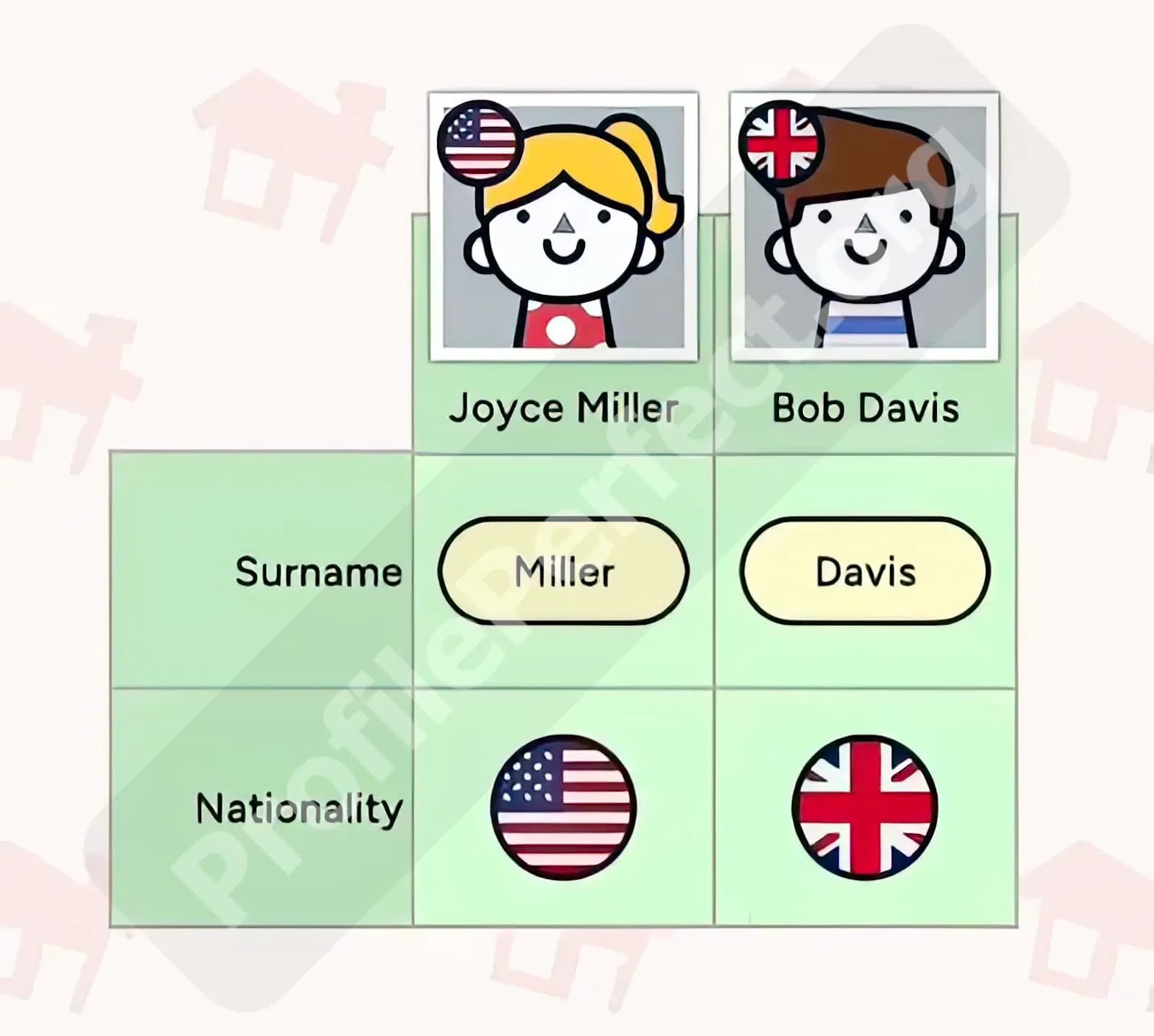
Once you know that, the clues become much easier to process:
Joyce’s full name is Joyce Miller.
Bob is from the Davis family.
The Davis family has lived in England.
The Miller family has lived in the USA.
This is a rock-solid beginner puzzle because every clue is either direct or linked. Joyce is Miller. Miller means American. Bob is Davis. Davis means British. No guesswork. No risky checkmarks. Just clean chain logic.
The big lesson from Level 1 is this: when a clue names a subject and a trait directly, mark it first. These are anchor clues. They lock the board down and make everything else safer.
Not all clues work the same way. Some clues say “A is B.” Others say “A is next to B,” “the thing with X also has Y,” or “the item on the right belongs to Z.”
Direct clues are your safest checkmarks.
Relationship clues need more care.
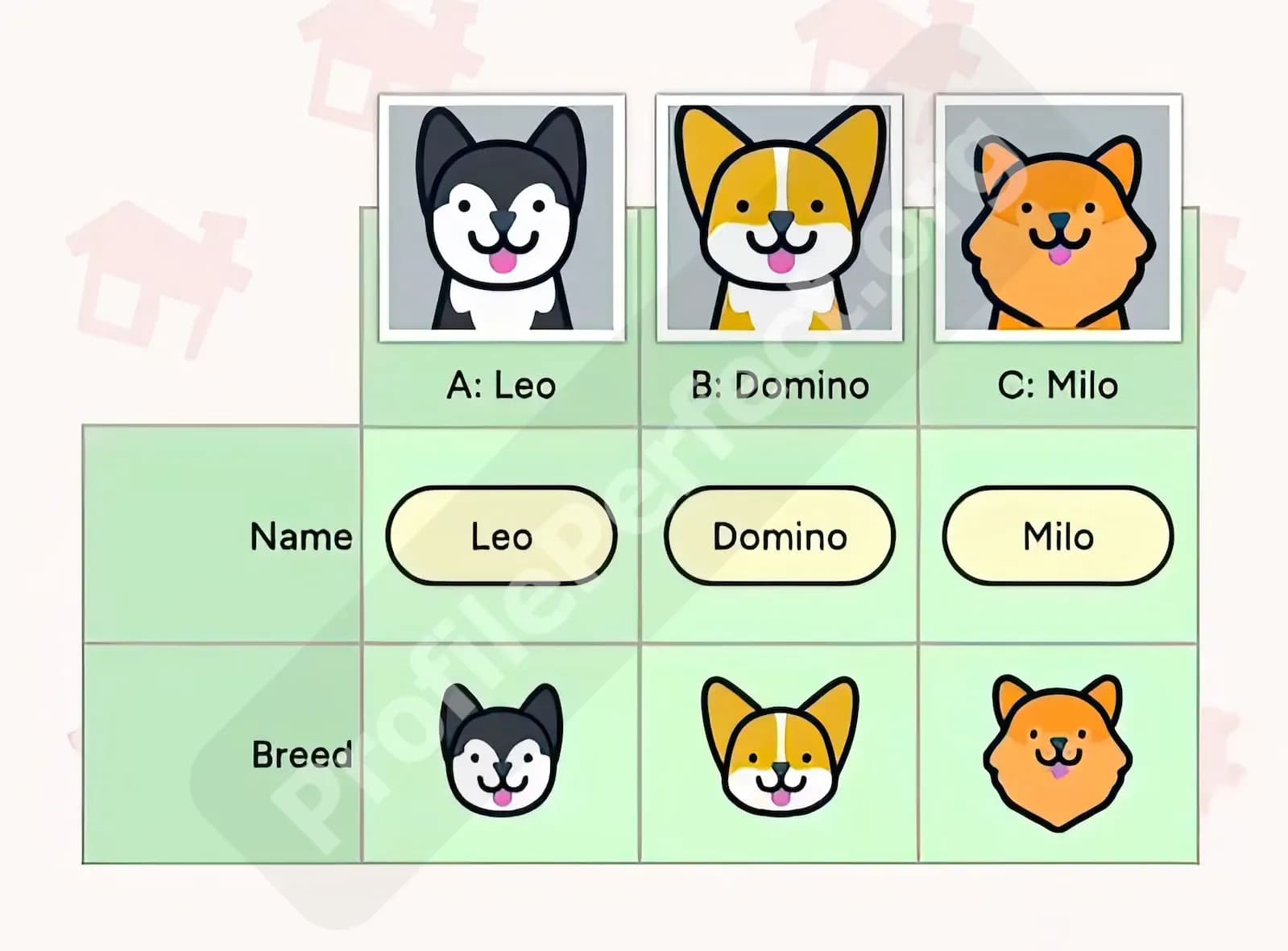
Level 2 is the first great example. The subjects are Dog A, Dog B, and Dog C. The traits are Name and Breed. You get direct clues like:
Dog B has the tag “Domino.”
Dog C is a Pomeranian.
Dog A is the black and white dog, which points to the Siberian Husky.
Those are safe. You can mark Dog B as Domino, Dog C as Pomeranian, and Dog A as Siberian Husky.
But then Profile Perfect throws in a relationship clue: Milo is next to Domino.
This is where guessing can wreck the run. Since Domino is Dog B, “next to Domino” could mean Dog A or Dog C at first glance. Don’t tap Milo yet unless another clue proves which side is right.
The proof comes from the Husky clue. The Husky is called Leo. Since Dog A is the Husky, Dog A must be Leo. That leaves Milo for Dog C.
This is the core anti-guessing technique: when a clue gives multiple possible positions, do not choose immediately. Park it in your head, solve another clue, then come back when the board has fewer options.
Profile Perfect loves soft wording. It doesn’t always say “Room B is Kitchen.” Sometimes it says “tools to make food can be found in Room B.”
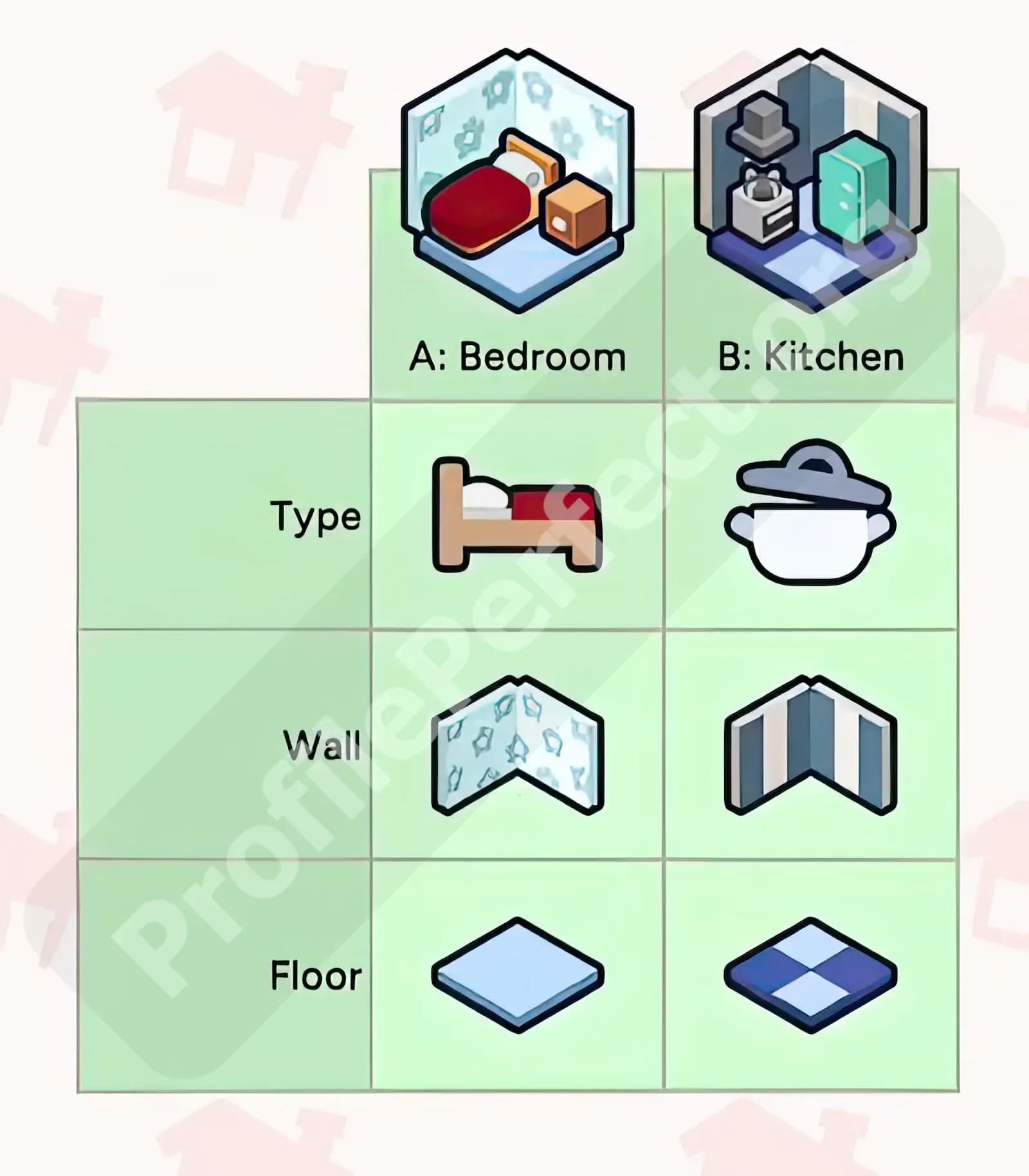
That’s Level 3, and it’s a perfect example of translation logic.
The subjects are Room A and Room B. The traits are Type, Wall, and Floor. The clue “tools to make food” means Kitchen. So Room B is Kitchen. Since there are only two rooms and one is Kitchen, Room A becomes Bedroom.
Then another clue says the Bedroom has a Floral wall. Since Room A is Bedroom, Room A gets Floral. Room B gets Striped by elimination.
Finally, the clue about the room beside the Tiled floor having a Solid floor gives the floor pairing: Room B is Tiled, Room A is Solid.
The trick here is not just reading the words. It’s converting the vibe of the clue into the exact trait on the board. “Tools to make food” is not flavor text. It’s a disguised category match.
This comes up constantly in Profile Perfect. “Lived in England” maps to British. “Halloween decoration” maps to Pumpkin. “Same color as the house” can map to Red Car if the visual or puzzle context supports it.
Good Profile Perfect players aren’t just tapping answers. They’re translating.
Profile Perfect levels are built around mutual exclusivity. If Dog A is Leo, then Dog B and Dog C are not Leo. If Family C has the Purple Minivan, the other families don’t.
That means you don’t always need a clue for the final blank. Sometimes the final blank is the answer because everything else has been ruled out.
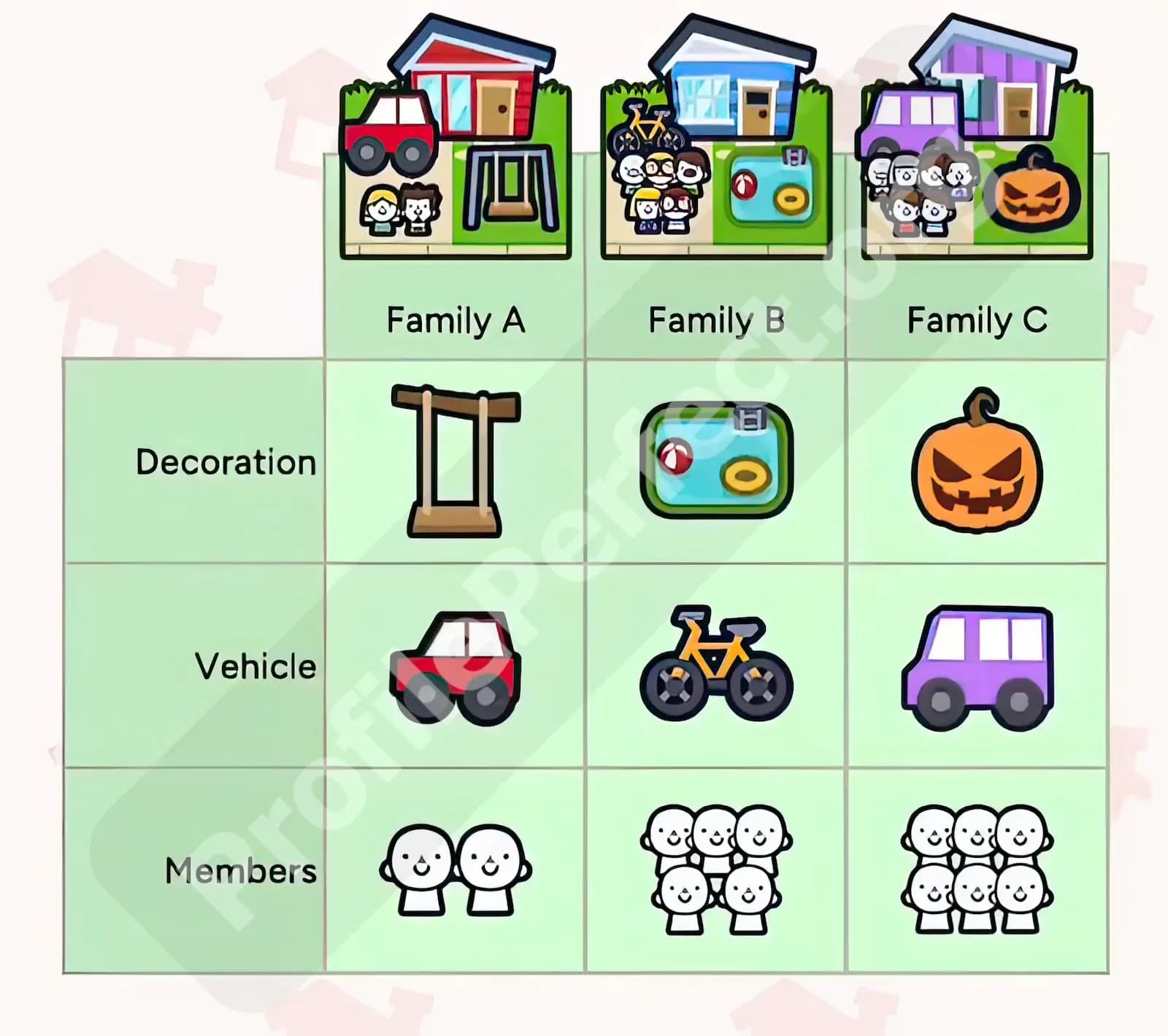
Level 5 shows this well. The subjects are Family A, Family B, and Family C. The traits are Decoration, Vehicle, and Members.
You get several sturdy anchors:
Family C has the Purple Minivan.
Family C has 6 members.
Family A has the Red Car.
The Red Car belongs to a family of 2.
The family with the Bicycle has a Pool.
Halloween decoration is on the right of the Pool.
The family with 2 members built the Swings.
Here’s the safe solving order. First, mark Family C as Purple Minivan and 6 members. Then mark Family A as Red Car. Since the Red Car belongs to the family of 2, Family A has 2 members. Since the family with 2 members built the Swings, Family A has Swings.
Now look at what remains. Family C is on the right side and Halloween decoration means Pumpkin, so Family C gets Pumpkin. The Pool must belong to Family B, and the Bicycle clue confirms Family B has Bicycle. The remaining member count for Family B is 5.
Notice what didn’t happen: we didn’t guess that Family B had 5 members early. We waited until the board forced it. That’s the crunchy deduction loop Profile Perfect wants from you.
Before placing a checkmark, run this tiny checklist:
Can I point to the exact clue that proves this?
If not, does another confirmed match create a chain that proves it?
If not, has elimination removed every other option?
If the answer is still no, don’t tap the checkmark.
This habit saves lives. More importantly, it keeps your thinking clean. A bad guess doesn’t just cost a life; it can poison the whole board. You start building logic on top of a shaky assumption, and suddenly the puzzle feels unfair when the real issue was one risky tap three moves ago.
When I get stuck, I don’t ask, “What should I try?” I ask, “What do I know for sure?”
That mindset changes everything.
Levels 1, 2, 3, and 5 make a great mini-training route.
Level 1 teaches direct clue chaining: Joyce to Miller, Miller to American.
Level 2 teaches patience with adjacency clues: Milo is next to Domino, but you need Leo and the Husky clue to confirm the final placement.
Level 3 teaches clue translation: “tools to make food” means Kitchen.
Level 5 teaches multi-trait chaining: Red Car leads to 2 members, which leads to Swings.
Together, these levels show the full beginner loop. Read the subjects. Identify traits. Mark direct clues first. Hold uncertain relationship clues. Translate descriptive wording. Use elimination only when the board truly forces it.
Profile Perfect isn’t a speed-clicking game. It’s a proof game.
The players who clear levels smoothly aren’t lucky. They’re disciplined. They don’t tap because an answer feels right. They tap because the clue, the grid, or elimination gives them permission.
That’s the whole anti-frustration secret: treat every checkmark like a final answer. If it’s confirmed, place it. If it’s only likely, wait. The board will usually give you a safer path within the next clue or two.
Once that habit clicks, Profile Perfect becomes much less stressful. The game stops feeling like a trap and starts feeling like a satisfying logic loop: read, confirm, eliminate, solve.
And honestly? That’s when the game is at its best.